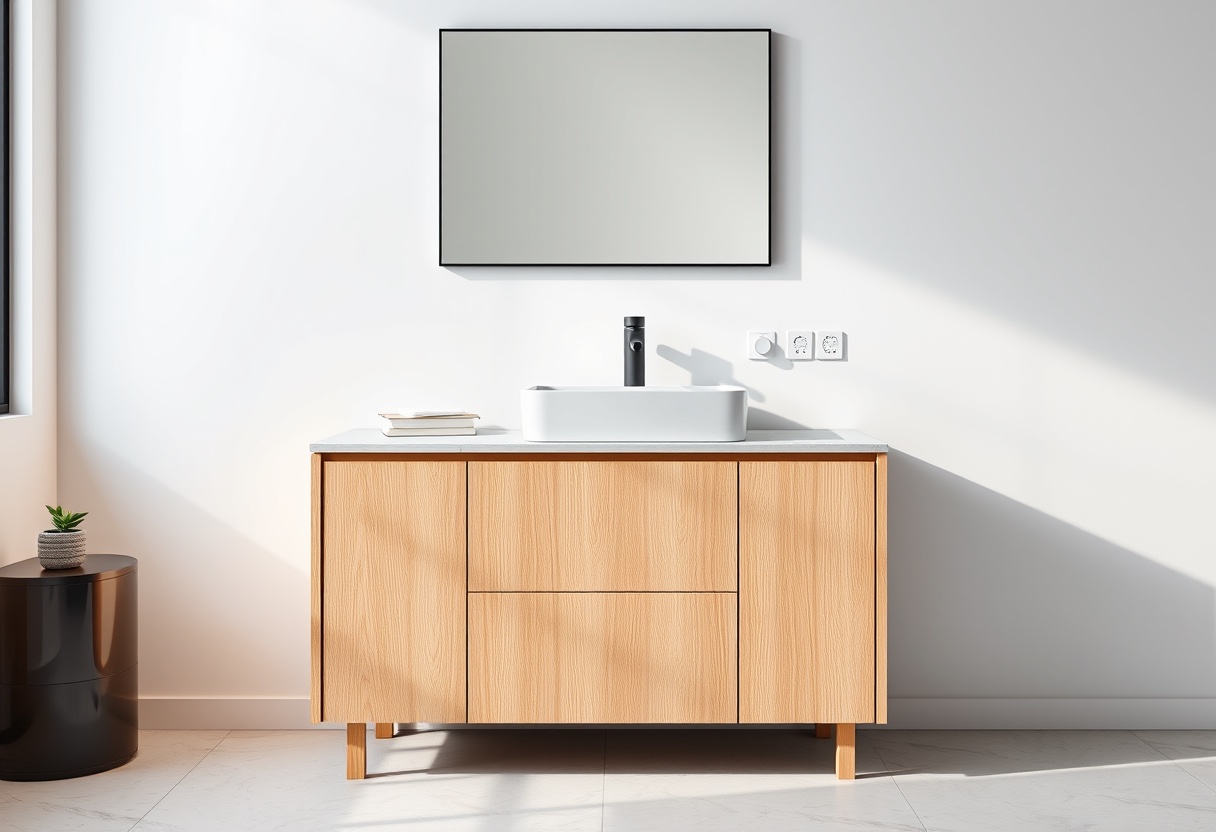
Getting bathroom cabinet and basin matching right is less about taste and more about geometry, plumbing and moisture. When the basin type, cabinet width, countertop cutout, faucet holes and trap all agree before fabrication, installation is fast and returns are rare. When they don't, you get colliding bowls, drilled-in-the-wrong-place tops and swollen cabinet edges. This guide walks importers, retailers and project buyers through the decisions in the order they actually matter.
Key takeaways
- Basin type first — it decides whether the top is flat, cut, or one piece.
- Size the cabinet to the basin — not the reverse; leave 50-100mm of top margin per side.
- Match holes, drain and trap — the most common field failures all live here.
01 Start here
Match the basin type to the countertop first
Every matching decision flows from one question: how does the basin meet the top? Get this wrong and nothing else lines up.
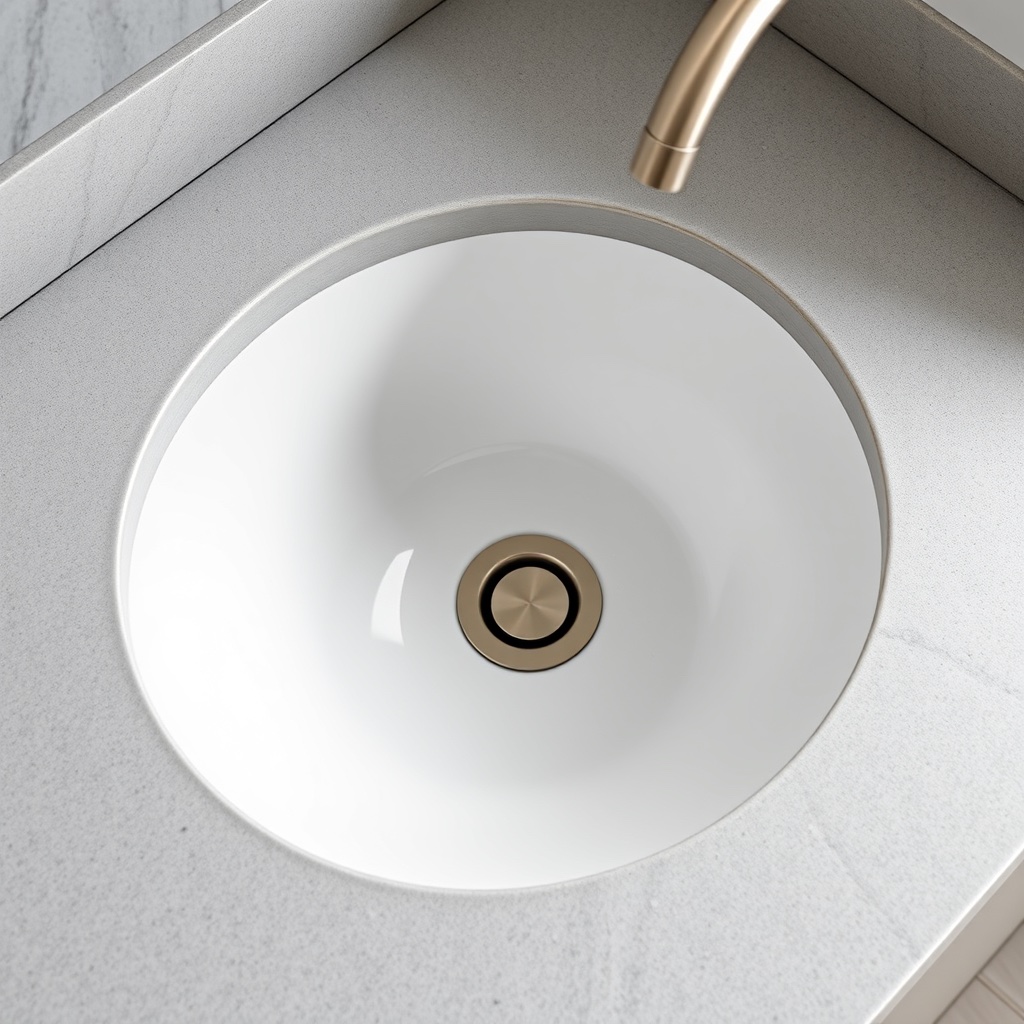
An above-counter (vessel) basin needs a flat, solid top with only a small drain hole. An undermount basin needs a top pre-cut with a finished, polished cutout and is bonded underneath. A drop-in / self-rimming basin sits in a cutout with its rim resting on the top. A semi-recessed basin needs a top with a front-edge cutout so the bowl projects forward over the cabinet face. An integrated (one-piece) ceramic top molds bowl and counter together, removing the silicone seam where mold and leaks usually start.
The cheapest way to avoid a warranty claim is to confirm the basin model and its cutout template before the cabinet top is fabricated.
02 Dimensions
Size the cabinet to the basin, not the reverse
Specify the basin footprint first, then choose a cabinet that physically clears the bowl plus its drain and trap. A frequent mismatch is a deep vessel basin colliding with the back panel or the drawer boxes. Leave at least 50-100mm of countertop margin on each side of the bowl for usability and to support the cutout.
Height matters too. A vessel basin sits roughly 100-150mm above the top, so the cabinet body should be specified shorter to keep the finished rim near the ergonomic 800-870mm range. Traditional vanity height is about 800-820mm, while "comfort height" of 850-915mm is now a common default for adults.
Standard vanity dimensions (guide)
| Dimension | Single | Double |
|---|---|---|
| Width | 600 / 700 / 750 / 800 / 900 / 1000 / 1200mm | 1200-1500mm+ (1500mm practical min) |
| Depth | 460-530mm (slim 300-450mm) | 460-550mm |
| Height (floor) | 800-850mm standard / 850-915mm comfort | 800-915mm |
03 Holes & water
Match faucet holes, drain and trap
Faucet drilling must agree across basin, top and faucet. The common standards are single-hole, 4-inch (100mm) centerset 3-hole, 8-inch (200mm) widespread 3-hole, or no deck holes for a wall-mounted faucet. A vessel basin with no tap ledge needs either a tall vessel faucet drilled in the countertop or a wall spout — verify the spout reach and height clear the bowl rim before ordering.
Drain and trap alignment is the most common on-site failure. The basin drain centerline must line up with the wall or floor rough-in. Wall-hung cabinets and undermount basins often need a bottle trap or offset trap to fit the shallow depth and reach the wall connection; vessel basins commonly use an exposed pop-up plus bottle trap. Always hand the plumber the drain center dimensions.
Put the rough-in on the drawing
For projects, send the basin model's cutout template and drain center dimensions with the PO. The cabinet top is fabricated to that template — changing it after cutting is scrap, not a revision.
04 Mounting
Wall-hung versus floor-standing
Wall-hung (floating) cabinets free up floor space, ease cleaning and read as modern — but they transfer the full loaded weight (cabinet, stone top, basin, water and stored items) to the wall. They need solid masonry backing or added timber/steel blocking on stud or drywall walls. Floor-standing units are simpler to install, carry heavier stone tops, and suit uneven or hollow walls.
Wall-hung if
- The wall is concrete/block or you can add blocking or a rated rail.
- The market wants a modern, easy-to-clean look.
- Floor space and a sense of openness are priorities.
Floor-standing if
- Walls are drywall-only or uneven and you can't add backing.
- You are pairing a heavy stone or large double top.
- You want the simplest install for non-specialist fitters.
05 Materials
Choose the carcass for moisture, not just looks
Board grade is the single biggest durability and complaint driver in wet rooms. Plywood (multi-layer/marine) is the most water-stable wood-based core and holds screws well. MDF is smooth and paint-friendly but swells badly once an edge seal fails; particleboard/MFC is cheapest but least water-tolerant. Solid wood looks premium but moves with humidity. PVC/WPC, aluminum and 304 stainless steel are inherently waterproof and best for humid, tropical or coastal markets.
Cabinet carcass materials at a glance
| Material | Moisture behavior | Best for |
|---|---|---|
| Marine / multi-layer plywood | Most stable wood core; good screw hold | Premium wood-look, mixed climates |
| MDF (HMR / green) | Smooth, paintable; swells if edge unsealed | Lacquer fronts, dry-to-moderate use |
| Particleboard / MFC | Lowest water tolerance | Budget, dry rooms only |
| PVC / WPC | Fully waterproof | Humid, tropical, coastal |
| 304 stainless / aluminum | Fully waterproof, rust-resistant | Wet, high-traffic, contract |
Edges beat species
Sealing matters more than the core. Insist on PVC or ABS edge banding on all exposed edges (PUR hot-melt resists water and heat better than EVA), a sealed sink cutout and back panel, soft-close stainless or zinc-alloy hardware, and adjustable feet or a water-resistant toe kick.
06 Finish & storage
Coordinate the finish, storage and the full suite
Match the cabinet finish to the basin glaze and the top. Glossy white or black basins pair with high-gloss lacquer or matched stone; matte basins suit matte melamine, wood-grain or fluted PVC fronts. Keep metal finishes consistent across faucet, drain, handles and any exposed trap — chrome, brushed nickel, matte black or brushed gold.
Plan storage around the plumbing. A center bowl forces shallow notched drawers or a door around the trap; offsetting the basin left or right yields full-depth drawers on the other side. U-shaped drawers wrap around the P-trap to recover storage — but the drawer boxes must be engineered for that early, so fix the basin position before production. Leave a gap for shut-off valves, and avoid sealing the cabinet airtight; trapped humidity accelerates swelling and mold. A 10-30mm counter overhang beyond the cabinet face sheds drips away from the doors.
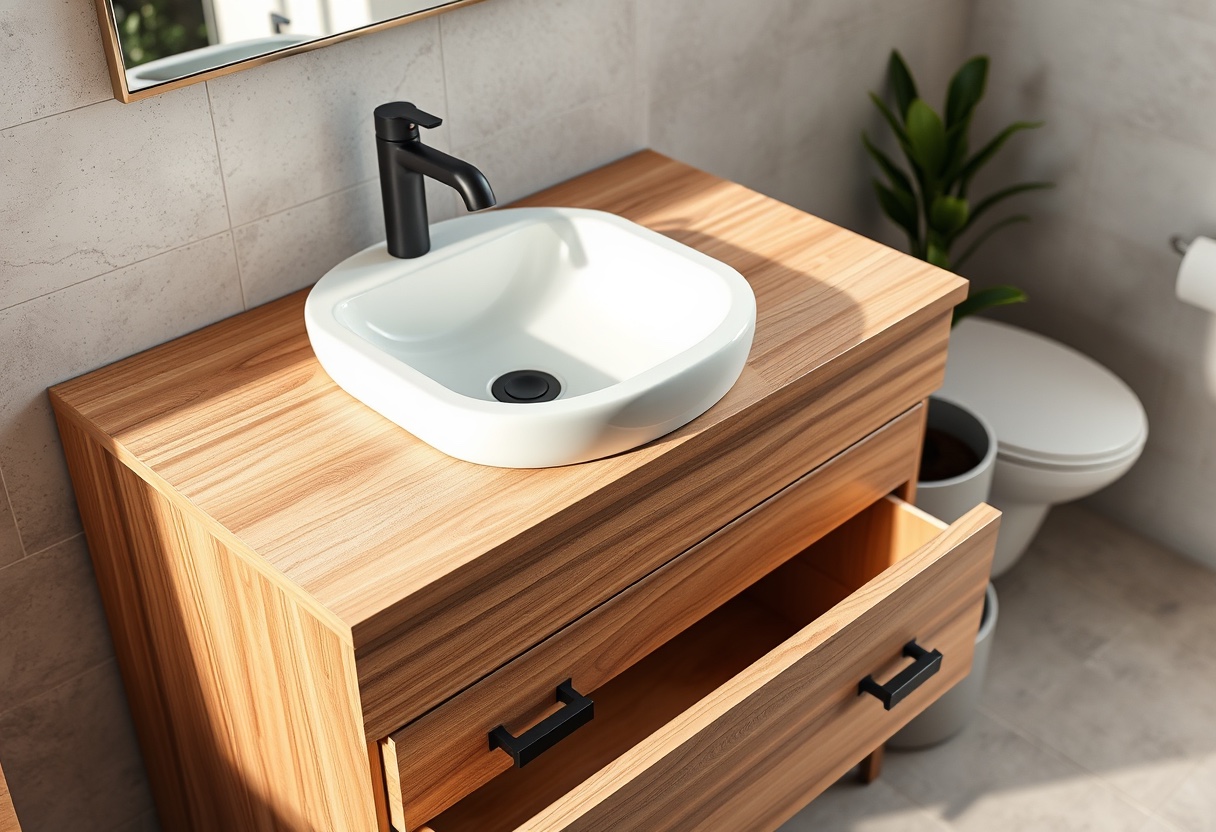
Sell the suite, not the parts. A coordinated set is basin + cabinet + mirror or mirror-cabinet (plus an optional side or tall unit), unified on width, finish, mounting type and handle style. The mirror-cabinet width usually equals or sits just under the vanity width.
07 Sourcing
Ordering, packing and OEM/ODM
For ocean freight, flat-pack (knock-down/RTA) maximizes container fill, lowers per-unit freight and reduces transit damage, but shifts assembly to the buyer and needs clear fittings and instructions. Assembled units present better at retail but ship more air and risk corner damage. Treat ceramic basins as a separate breakage class: EPE foam corners, molded pulp or foam end caps, honeycomb/5-ply cartons, and a wood frame or crate for vessel and large pieces. Agree the packaging spec and breakage allowance up front.
As a ceramic sanitary ware manufacturer in Guangdong, China, Chengda supports matched basin-and-cabinet sets with OEM/ODM scope across cabinet size, finish (melamine, PVC film, lacquer, veneer), handle style, basin shape and color, plus logo and branded packaging. MOQ is normally set per model and per color/finish; mixed-SKU containers and custom sizes raise the minimum and lead time and may add tooling or sample fees. Certification support varies by product and market — request available test reports before ordering.
Send us the brief
Share your basin sizes, target widths, mounting type and market, and we will propose matched vanity-and-basin sets with a cutout template, packing plan and OEM/ODM options. Ask for the catalog to start.
FAQ Common questions
Bathroom cabinet and basin matching FAQ
Which basin type works with a flat top, and which needs a cut top?
Above-counter (vessel) and integrated one-piece tops use a flat surface (the vessel just needs a small drain hole). Undermount, drop-in and semi-recessed basins all need a cut top — undermount and semi-recessed require a finished, polished cutout in a non-porous top such as stone, sintered stone or solid surface, not raw MDF.
What cabinet height should I order for a vessel basin?
Because a vessel sits roughly 100-150mm above the top, specify a shorter cabinet so the finished rim lands near 800-870mm. Confirm the bowl height with the basin model before fixing the cabinet body height.
How much countertop margin should I leave around the bowl?
At least 50-100mm on each side, for both usability and structural support of the cutout. Also check the cabinet's internal width and depth clear the bowl footprint plus the drain and trap.
Do I need a bottle trap or an offset trap for a wall-hung vanity?
Often yes. Wall-hung cabinets and undermount or vessel basins have shallow depth and a wall rough-in to reach, so a bottle trap or offset trap is common. Provide the drain center dimensions so the plumber can align it.
Which cabinet material is best for humid or coastal markets?
Fully waterproof bodies — PVC/WPC, aluminum or 304 stainless steel — perform best in wet, tropical or coastal conditions. Among wood cores, marine/multi-layer plywood is the most dimensionally stable; sealed edges matter more than the species.
Can you supply custom matched sets and what about MOQ?
Yes — OEM/ODM covers size, finish, handles, basin shape/color, logo and packaging, with a matching mirror or mirror-cabinet to complete the suite. MOQ is set per model and per color/finish; custom sizes and mixed-SKU containers raise the minimum and lead time. Request available test reports for your market before ordering.
Done well, bathroom cabinet and basin matching turns a box of parts into a clean, watertight suite that installs in minutes and lasts for years — and that starts with confirming the basin and its template before the first cut.