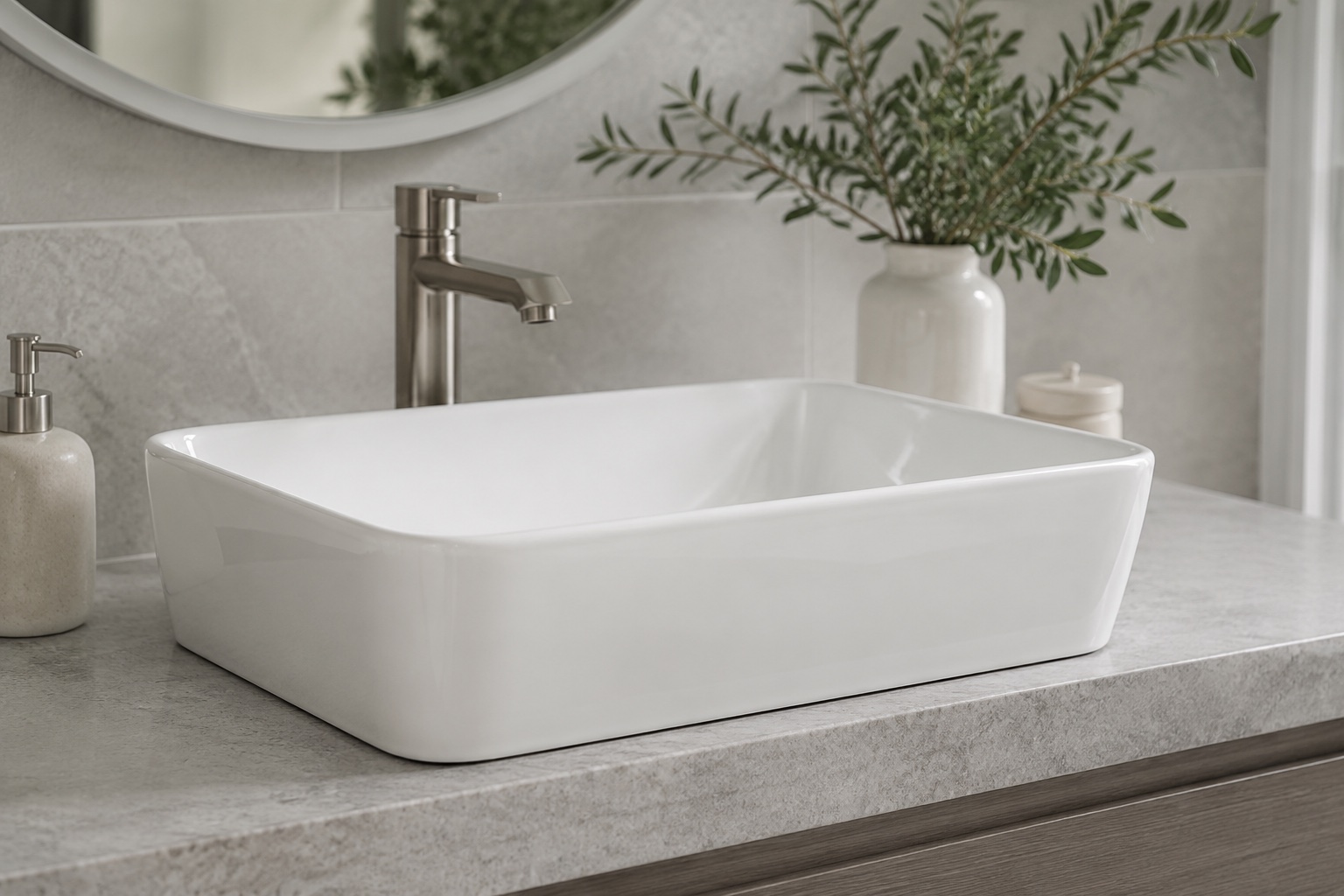
Knowing how to choose a ceramic wash basin is a sourcing decision, not just a styling one. For importers, contractors and hotel buyers, the wrong call shows up later as on-site rework, replacement units, or stock that won't sell. This guide is written from a factory and export point of view, so you can spec it right the first time.
Key takeaways
- Type and drilling come first — pick the basin type by your plumbing and vanity, and lock faucet holes before production, because holes are drilled into the ceramic and can't be changed later.
- Judge the body, not the look — true vitreous china absorbs ≤0.5% water; ask for the body type and an absorption report in writing.
- Match the paperwork and packing — confirm certification for your market (cUPC / CE / WRAS), then agree MOQ, lead time and export packing up front.
01 Start here
Start with basin type, not looks
The installation context decides the type; appearance comes second. Match the type to the rough-in plumbing and the pre-built vanity first — specification misalignment, not raw material, is the number one cause of costly site rework.
Five basin types at a glance
| Type | Best for | Watch out |
|---|---|---|
| Above-counter / vessel | Hospitality, feature bathrooms — cheapest to install, no cutout | Sits higher, splashes more |
| Undermount | High-end vanities, retailers — seamless, easy-to-wipe counter | Needs a precise cutout and clip mounting |
| Wall-hung | Small or accessible layouts — frees the floor, flexible height | Needs a sound wall or reinforcement |
| Pedestal | Walls that can't be reinforced — fully hides trap and supply lines | No cabinet storage |
| Semi-recessed | Shallow vanities — projects forward over a narrow counter | A compromise on bowl position |
Spec the system, not just the bowl
Buy the basin, waste and faucet as one coordinated set. Tap-hole count must match the faucet, and the waste type must match the overflow — mismatches across hundreds of rooms are expensive to fix on site.
02 Drilling
Confirm faucet holes before production
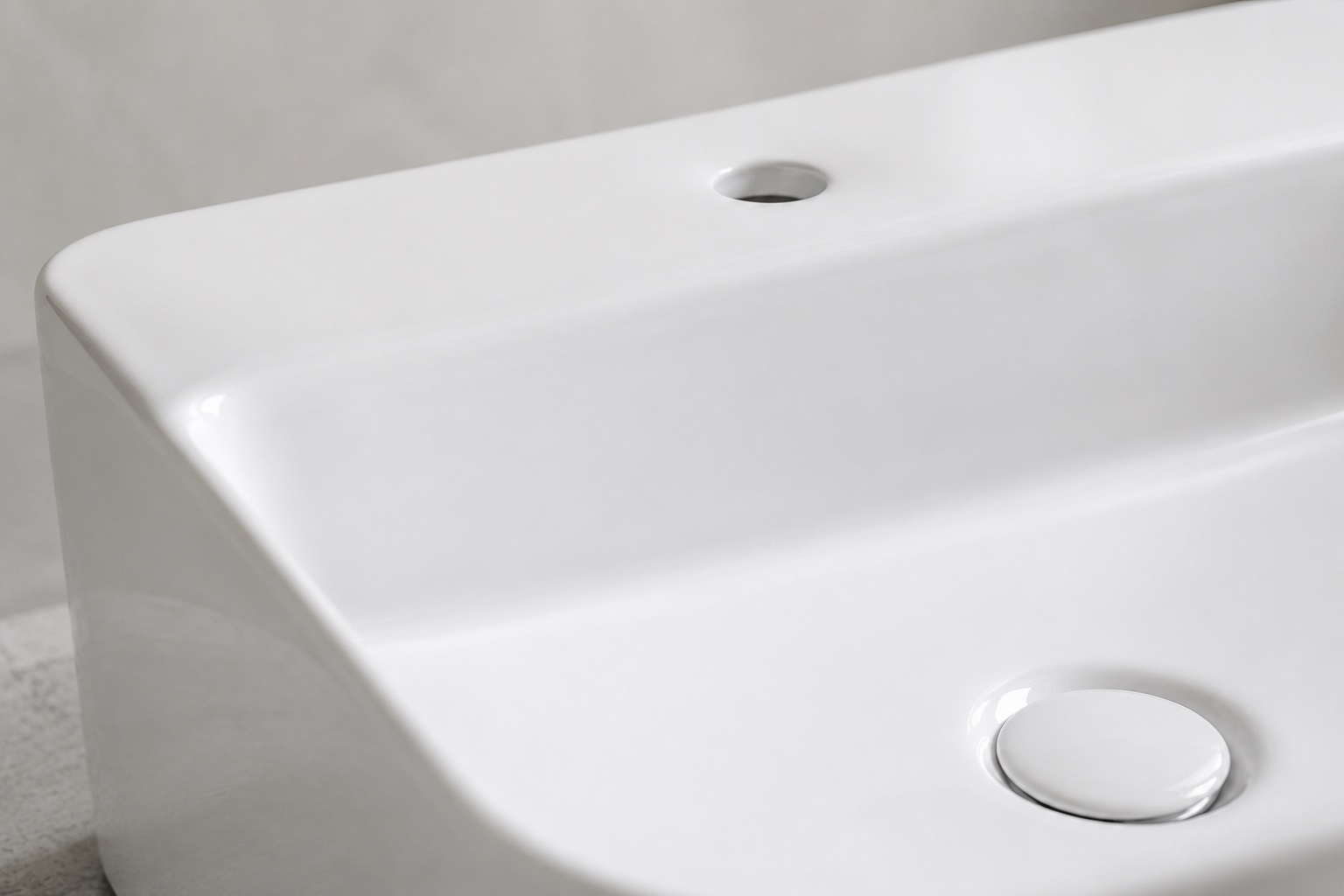
Tap holes are drilled into the ceramic and cannot be changed later. Get this wrong and the whole batch is unusable — a deck drilled for a widespread set will not accept a single-hole faucet.
Faucet-hole configurations
| Drilling | What it takes |
|---|---|
| Single hole | Modern monobloc tap |
| 4-inch centerset | Three holes grouped close together |
| 8-inch widespread | Two separate handles plus spout, spaced 8–16 in |
| No tap hole | Deck-mount or wall-mount taps on designer and vessel basins |
03 Drainage
Overflow and waste: a paired decision
The overflow choice dictates the waste type. Mismatched waste causes leaks or a non-functioning overflow, so specify both together.
Overflow drives the waste
| Basin | Waste needed | Where it fits |
|---|---|---|
| With overflow | Slotted pop-up (lets the overflow drain) | Hotel, family and commercial use |
| No overflow | Unslotted (sealing) waste | Cleaner look on vessel basins; risks overfilling |
04 Finish
Glossy vs matte glaze
This is a real cost and maintenance trade-off, not just taste.
Glossy vs matte
| Finish | Upside | Trade-off |
|---|---|---|
| Glossy | Lower cost, repels water and dirt, cleans fast, resists acidic cleaners and UV | Shows fewer character marks — the safe pick for high-turnover commercial use |
| Matte | Hides daily marks, carries retail trend value | ~15–30% more (harder firing); light colors can show metal marking and may dull over 12–18 months |
05 Quality
Judge the ceramic body by water absorption
Body quality is graded by how much water it absorbs — the single most diagnostic quality number. Ask for the body type and absorption value in writing. The test method is ASTM C373 (5h boil + 24h cold soak), with GB 6952-2015 used in China.
Body types compared
| Body | Water absorption | Notes |
|---|---|---|
| Vitreous china (Grade-A) | ≤0.5%, fired ~1200–1260 °C | Resists staining, crazing and bacterial growth — the correct body for wash basins |
| Earthenware / fine fireclay | Higher (fireclay ~6–11%) | More prone to staining and crazing |
06 Compliance
Match certification to your market
Certifications gate which markets a SKU can enter. A basin documented for both CE and cUPC lets you cover two regions with one SKU, cutting supplier and SKU count. Hotel and government projects often require certified, lead-free, hygienic-design fixtures.
Certification by market
| Market | Certification |
|---|---|
| US & Canada | cUPC / IAPMO (refs ASME A112.19.2 / CSA B45) |
| UK | WRAS |
| EU | CE; EN 14688 functional standard for wash basins |
Certification support may vary by product and market — request available test reports or certification documents before ordering.
07 Sizing
Get the dimensions right
For project buyers, size is the hard constraint. The basin must match vanity width, depth and the existing rough-in — powder rooms take small 15–20 in units; master baths and commercial projects take 30–50 in.
Typical dimensions
| Format | Typical size |
|---|---|
| Round / oval | ~16–20 in (30–45 cm) diameter |
| Rectangular | ~40–70 cm wide × 30–50 cm front-to-back |
| Bowl depth | 5–8 in (12–20 cm) — deeper reduces splash |
| Install height | Rim usually 32–34 in from the floor |
08 From the floor
The factory view: what quality control looks like
As a ceramic sanitary ware manufacturer in Guangdong, China, Chengda treats a basin order as a production and export problem, not just a catalog pick. A suspiciously light basin can signal a thin or under-fired body — quality vitreous-china basins commonly run 10–18 kg depending on size.
What we check before it ships
| Check | What we look for |
|---|---|
| Glaze under strong light | Pinholes, bubbles, crawling, crazing, color variation |
| Warpage tolerance | Straightedge check so the basin seats flat and drain/faucet align |
| Thermal-shock / crazing | A mismatched glaze crazes, then chips in service |
| Load test | Wall-hung basins expected to take ~1.1 kN (~110 kg) |
| AQL pre-shipment | Random checks on finished, packed units |
09 Getting it there
Logistics, MOQ and packing
Breakage is a cost line, not an afterthought. Always validate glaze color, dimensions and drilling on a production-grade sample before committing — sample fees are usually nominal and credited against the bulk order.
Order and shipping basics
| Item | Detail |
|---|---|
| Breakage | ~10% in sea freight if poorly packed; engineered EPE/EPS foam, corner protectors, 5-ply carton |
| MOQ | A 20ft container load or ~5–10 units per SKU; flexible low MOQ for trial orders |
| Lead time | ~25–35 days standard, ~45 days for bespoke items |
| Customs | HS code 6910; confirm EXW/FOB terms and full-container loading quantity |
Buyer's quick-decision checklist
- Pick type by plumbing and vanity, then style.
- Lock faucet holes and match overflow to slotted/unslotted waste.
- Choose glaze by use case, and require vitreous china ≤0.5% absorption in writing.
- Confirm certification for your market and send exact dimensions.
- Agree MOQ, lead time, packing and Incoterms — and buy basin + waste + faucet as one system.
How to choose a ceramic wash basin comes down to specifying correctly — right type, right drilling, right body, right paperwork — and packing it to survive the container.
Get those decisions aligned, and the rest is straightforward.
If you're sizing a project, building a retail range, or developing a private-label line, we're happy to help you spec it. Send us your basin dimensions and drilling, request our catalog, or ask about OEM / ODM and project supply.
FAQ Common questions
Frequently asked questions
What water absorption rate indicates a good-quality ceramic basin?
True vitreous china (Grade-A) absorbs ≤0.5% by weight, fired around 1200–1260 °C. Lower-fired bodies absorb more and are prone to staining and crazing. Ask the supplier for the body type and an absorption test report before ordering.
What is the difference between single-hole, centerset and widespread faucet holes?
Single-hole takes a monobloc tap; 4-inch centerset has three close holes; 8-inch widespread uses two separate handles plus a spout. Holes are drilled at manufacture and cannot be changed, so match the basin and faucet as a system before production.
Do I need a slotted or unslotted pop-up waste?
A basin with an overflow needs a slotted waste so the overflow can drain. A basin with no overflow needs an unslotted (sealing) waste. Getting this wrong causes leaks or a non-functioning overflow.
Is a glossy or matte ceramic basin better?
Glossy costs less, cleans fast and resists acidic cleaners — ideal for high-turnover commercial use. Matte costs about 15–30% more, hides daily marks and adds retail trend value, but light colors can show metal marking and may dull over time.
Which certifications do I need to import ceramic basins?
cUPC/IAPMO (ASME A112.19.2 / CSA B45) for the US and Canada, WRAS for the UK, and CE for the EU. A basin documented for both CE and cUPC can cover two markets with one SKU. Certification support varies by product and market.
What is the typical MOQ and lead time for wholesale ceramic basins?
Usually a 20ft container load or about 5–10 units per SKU, with flexible low MOQ for trial orders. Standard production runs ~25–35 days, extending to ~45 days for highly customized items.