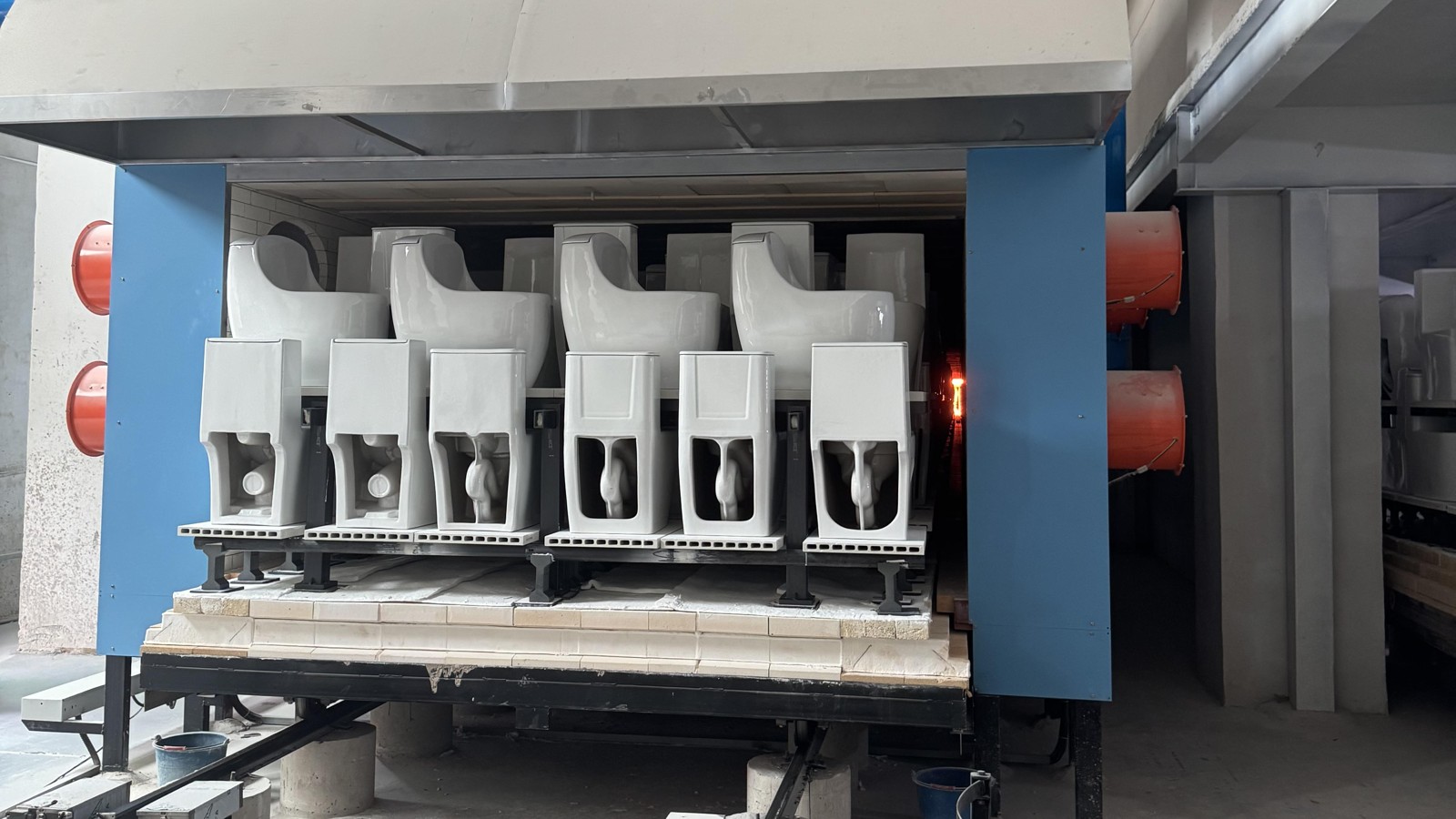
The ceramic firing temperature inside our kiln looks like a small detail. It is not. Fifty degrees decides whether the basin you ship cracks in winter, stains in a year, or lasts a decade.
Every importer, wholesaler and project buyer eventually asks the same question about vitreous china: how do you know it will last? The honest answer lives in the kiln. Firing temperature is the single process variable that turns a soft, porous clay body into a dense, waterproof ceramic — and it is the one number most catalogues never print. This guide explains why we fire ceramic sanitaryware at 1,250 °C, what vitrification actually does, how water absorption changes at 1,200 °C, and how high-fired ceramic differs from low-fired ware you may be quoted elsewhere.
Key takeaways
- The vitrification window — vitreous china only becomes truly waterproof between 1,220 °C and 1,260 °C. Too cool and micro-pores remain; too hot and the body warps.
- We fire at 1,250 °C — the upper-middle of that window, backed by kiln-cycle data that keeps the geometry stable.
- 1,200 °C is not enough — water absorption climbs from under 0.5% toward roughly 2%, the gap between a 25-year basin and a 5-year one.
- High-fired beats low-fired — sanitaryware needs a fully vitrified body, not a glaze doing all the waterproofing.
01 The material
What is vitreous china — and why firing temperature decides everything
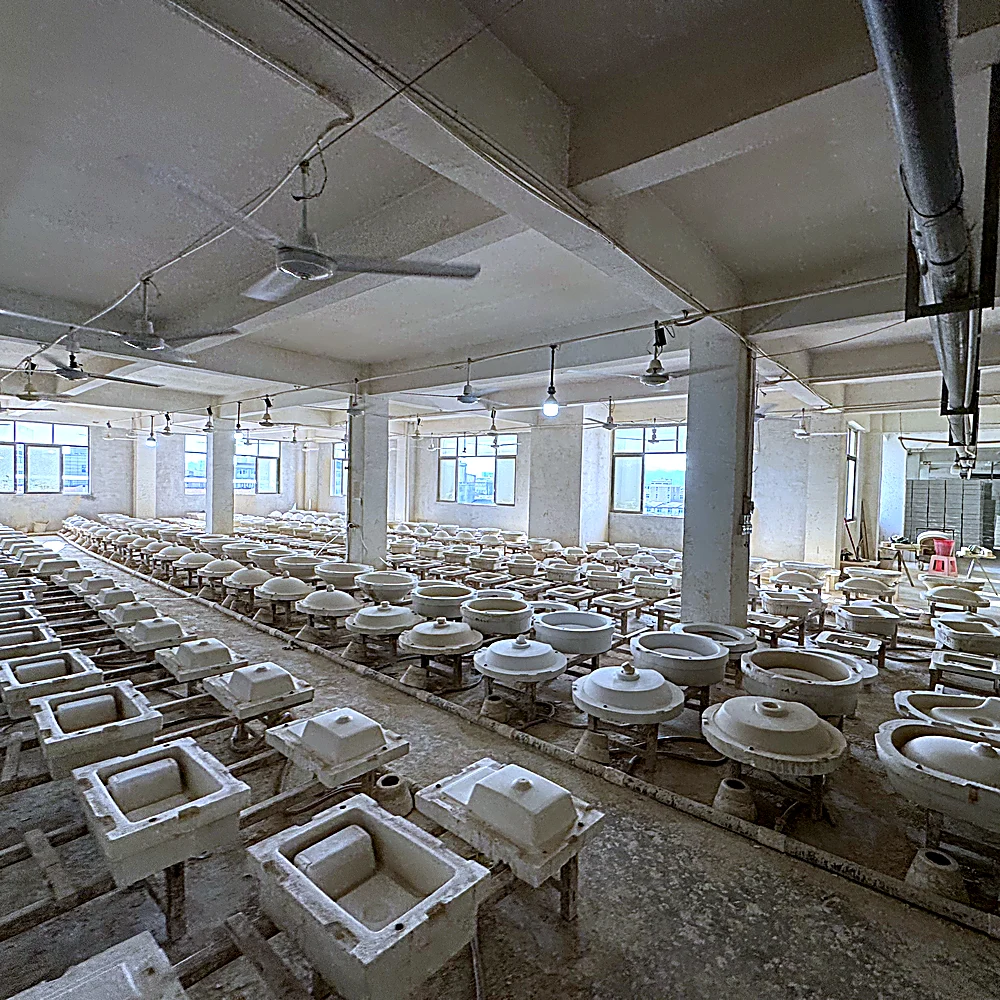
Vitreous china is the ceramic body used for most quality basins and toilets. It starts as a slip — a liquid blend of kaolin, ball clay, quartz and feldspar — cast into a mould, dried, glazed, then fired. "Vitreous" means glass-like, and that word is the whole point: during firing the feldspar melts and flows into the spaces between clay particles, forming a glassy phase that fills the pores and locks the structure together.
Get the ceramic firing temperature right and that glassy phase seals the body from the inside. Fall short and the pores stay open. A basin can look finished, glazed and glossy, yet still drink water through micro-pores you cannot see. That is why firing temperature — not glaze colour, not wall thickness alone — is the true measure of a sanitaryware body.
02 The window
The vitrification window: why 1,250 °C
Vitreous china becomes truly waterproof somewhere between 1,220 °C and 1,260 °C — the vitrification window. Below that range, micro-pores remain, invisible until water finds them. Above it, the body slumps, the glaze runs, and flat surfaces lose their line.
We fire at 1,250 °C — the upper-middle of that window. Slightly hotter than the industry-standard 1,220 °C, but with a firing curve and kiln-cycle data that keep the geometry stable. Firing near the top of the window pushes vitrification as far as it will safely go, so water absorption lands well under the limit rather than just scraping past it.
Why not simply fire hotter and be done with it? Because past roughly 1,260 °C the gains reverse. The glassy phase becomes too fluid, rims deform, drain holes shift out of tolerance and a basin that leaves the mould perfectly flat leaves the kiln with a rock. Firing high is not about chasing heat — it is about buying certainty without giving up the shape.
The point of firing high is not the heat. It is the certainty.
03 Fifty degrees
What changes at 1,200 °C — water absorption and strength
At 1,200 °C the body is fired but not vitrified. The clay has hardened, yet the glassy phase never fully develops, so the pore network stays open. Water absorption — the standard laboratory measure of how much water a fired body soaks up by weight — climbs from under 0.5% toward roughly 2%. In practice, that is the difference between a 25-year basin and a 5-year one.
Absorption is not an abstract number. An open-pored body is weaker under load and thermal shock, more likely to develop crazing (fine cracks in the glaze) as it expands and contracts, and far more vulnerable in cold climates, where trapped moisture freezes, expands and splits the ceramic from within. The same fifty degrees also lowers mechanical strength, so a lightly fired basin chips at the rim and cracks around the drain long before a vitrified one would.
Fired at 1,250 °C vs 1,200 °C
| Property | 1,250 °C (vitrified) | 1,200 °C (under-fired) |
|---|---|---|
| Vitrification | Full — glassy phase seals pores | Partial — pore network open |
| Water absorption | Under 0.5% | Around 2% |
| Mechanical strength | High | Reduced |
| Crazing & staining | Resistant | Prone over time |
| Freeze–thaw risk | Low | High |
| Realistic service life | Decades | A few years |
04 Grades
High-fired vs low-fired ceramic — what buyers should know
Not all bathroom ceramic is the same body. Low-fired earthenware, fired roughly between 1,000 °C and 1,150 °C, stays porous by nature; it relies almost entirely on its glaze to hold water, so a single chip in that glaze exposes a thirsty body underneath. It is cheaper to make and lighter to ship, which is why it appears in some budget catalogues — but it belongs to décor, not to a fixture used with water every day.
High-fired ceramic — stoneware and vitreous china fired at 1,200 °C and above — vitrifies through the whole cross-section, so the body itself is waterproof and the glaze is protection rather than the only defence. For basins, toilets and any sanitaryware that meets water for years, high-fired vitreous china is the only sensible choice. A quick field test buyers use: a vitrified body rings when tapped and feels dense for its size, while an under-fired one sounds dull. The firing temperature you cannot see is exactly what separates the two.
05 The stakes
Why firing temperature matters to importers and project buyers
For a brand owner or contractor, firing temperature is not a technical footnote — it is your return rate. Under-fired basins pass a showroom glance and fail in the field: hairline cracks after a cold shipping season, cloudy stains where water has crept into the body, glaze crazing that turns a white basin grey. Each one becomes a claim, a replacement and a dent in the reputation you are trying to build.
So when you compare quotations, look past price per piece and ask three questions of any supplier: what temperature the body is fired at, what water absorption the finished ware records, and whether a test report is available for the specific product. Certification and available documentation vary by product and destination market, so ask for what applies to your range rather than assuming a blanket claim. A factory that fires with intent can answer all three without hesitation.
06 In production
How we hold 1,250 °C in production
A peak temperature on a datasheet means little without control. What matters is the whole firing curve: how fast the kiln climbs, how long the ware soaks at peak so heat reaches the core, and how evenly the temperature holds from the front of the load to the back. Body placement, wall thickness and glaze are all tuned around that curve, because the same 1,250 °C treats a thin rim and a thick base differently.
After firing, water absorption is the check that keeps everyone honest — a straightforward laboratory measure that tells us whether the body truly vitrified or merely hardened. It is a mindset as much as a setpoint: fire to the number, then verify the number. Across over 25 years of production in Chaozhou and exports to more than 50 countries, that discipline is what lets us stand behind the ware long after it leaves the kiln.
07 FAQ
Ceramic firing temperature: frequently asked questions
What temperature is ceramic sanitaryware fired at?
Quality vitreous china sanitaryware is fired between about 1,200 °C and 1,260 °C, the vitrification window. We fire at 1,250 °C so the body fully vitrifies and water absorption stays well under the limit.
Why fire ceramic at 1,250 °C and not higher?
1,250 °C sits in the upper-middle of the vitrification window — hot enough to seal the pores, but below the point where the body slumps and rims, drain holes and flat surfaces distort. Higher is not automatically better once geometry starts to move.
What is a good water absorption for vitreous china?
Under 0.5% by weight is the mark of a properly vitrified body. Values climbing toward 2% indicate under-firing and a much shorter service life, especially in cold climates.
Is a higher firing temperature always better?
No. Below the window the body stays porous; above it the glassy phase runs and shapes warp. The goal is the right temperature held evenly, not simply the highest number a kiln can reach.
High-fired vs low-fired ceramic — which is right for bathroom basins?
High-fired vitreous china. Low-fired earthenware stays porous and leans on its glaze to hold water, which makes it unsuitable for fixtures used with water daily. For basins and toilets, choose a fully vitrified, high-fired body.
Cheaper. Faster. Not what we make.