This is part one of our series on how ceramic sanitaryware is made — a step-by-step walk from raw clay to a finished basin. We go deep here, and we won't skip the stages most factories keep behind closed doors.
If you want to understand what ceramic basins and toilets are actually made of — or you're sourcing a reliable factory-direct supplier — this is where the whole process begins: with four natural minerals and the casting slip they become. Get this stage right and everything downstream gets easier; get it wrong and no amount of glazing or firing can fully rescue the piece.
Key takeaways
- Four minerals, not one material — ceramic sanitaryware is vitreous china, a blend of ball clay, kaolin, feldspar and quartz, each doing a specific job.
- Clay becomes a liquid — the dry minerals are milled with water into a smooth, pourable casting slip that is poured into plaster moulds.
- Consistency is everything — stable raw materials and a controlled slip recipe decide the strength, whiteness and water absorption of the finished basin.
- This is part one — a step-by-step series taking you onto the real factory floor, from slip through forming, glazing, firing and packing.
01 The raw materials
What is ceramic sanitaryware made of?
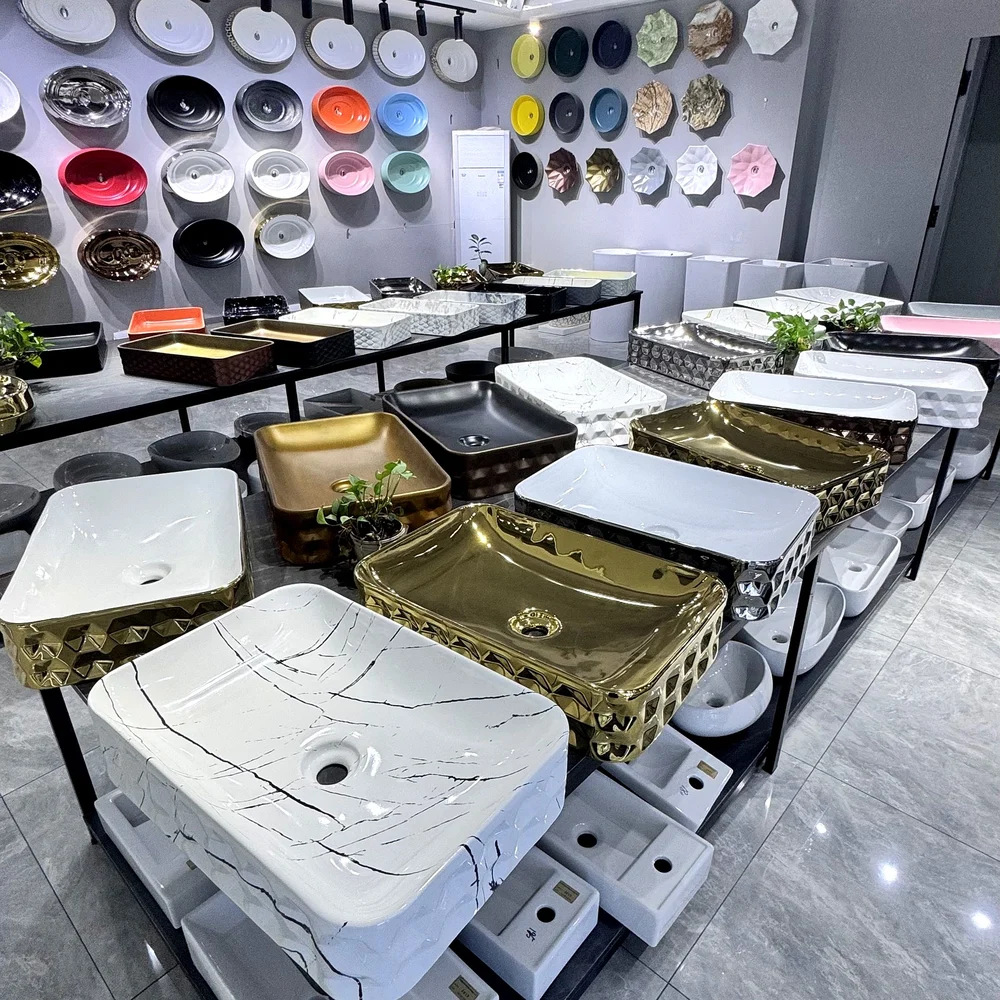
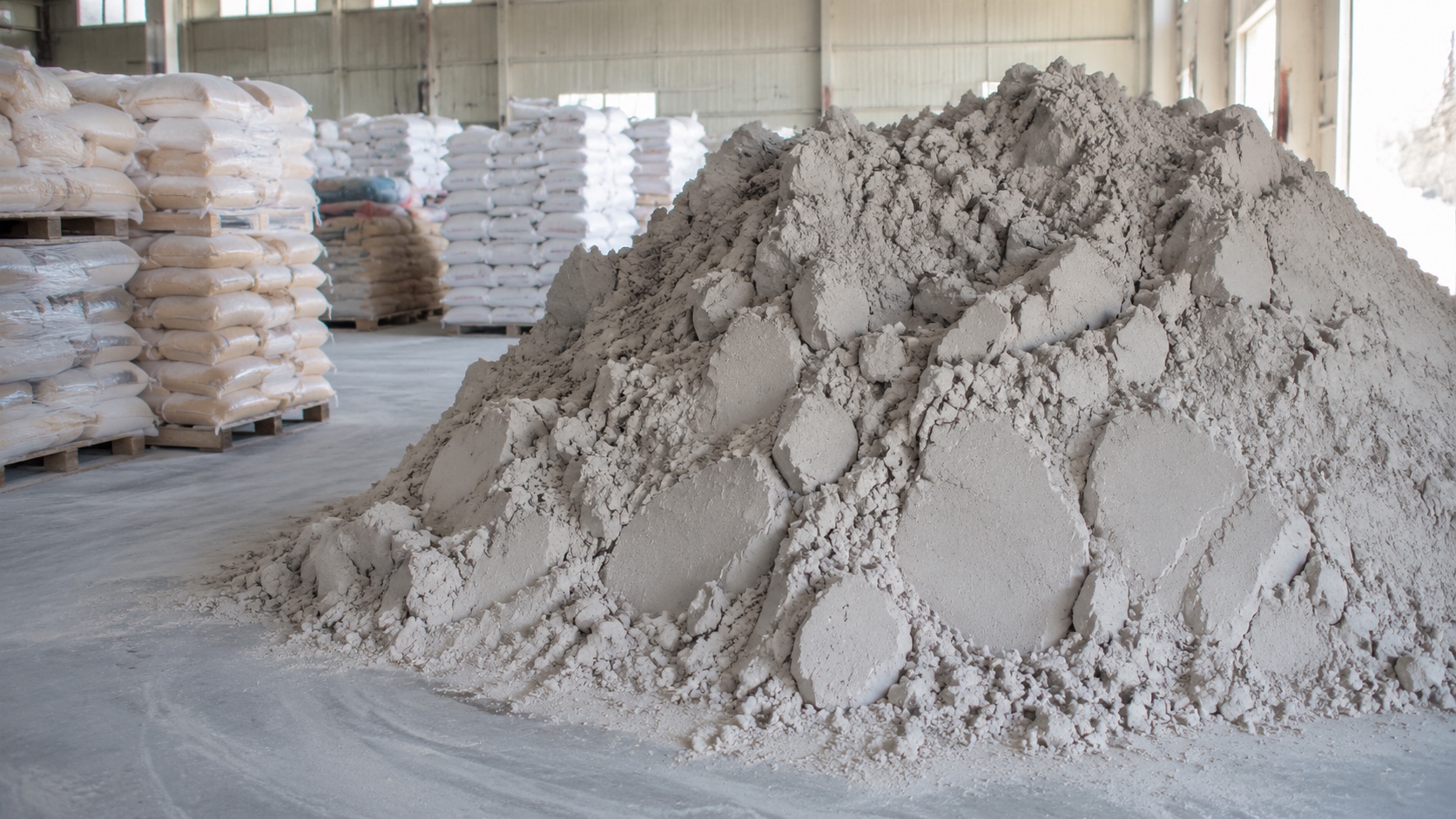
You've seen the finished piece — a white, smooth, hard ceramic washbasin, toilet or urinal. But at the very start it is none of those things. It isn't stone and it isn't metal. It's a heap of grey-white clay.
Guangdong Chengda Intelligent Technology Co., Ltd. is a ceramic sanitaryware factory in Chaozhou, Guangdong — one of the largest ceramics clusters in China. Over 25 years we've hosted many buyers on factory tours, and when they first walk into the raw-material workshop nearly all of them say the same thing: "So it all starts with this pile of mud?"
Yes — but it's no ordinary mud. Quality sanitaryware is made from vitreous china, a precise blend of four natural minerals. Each one does a specific job, and the ratio between them is what separates a durable, low-absorption basin from a weak, warping one. In simple terms, two of the minerals give the wet clay its workability, one melts into glass during firing, and one holds the shape steady.
The four raw materials of vitreous china — and what each one does
| Mineral | Role in the body | What it controls |
|---|---|---|
| Ball clay | Plasticity & green strength | Lets the wet body hold shape and gives the dried "greenware" enough strength to handle. |
| Kaolin (china clay) | Whiteness & purity | The clean white body colour and refractory backbone; low iron content keeps the fired piece bright. |
| Feldspar | Flux | Melts during firing and forms the glassy phase that vitrifies the body and lowers water absorption. |
| Quartz (silica) | Structural skeleton | Acts as the filler that controls shrinkage and warping and keeps the piece dimensionally stable. |
Balance matters. Too much clay and the body cracks as it dries and shrinks; too much feldspar and it slumps and over-vitrifies in the kiln; too much quartz and it becomes brittle. The recipe our workshop follows is the product of years of adjustment for our specific kilns, moulds and climate — which is exactly why raw materials are the one link in the chain we've refused to cut corners on.
Consistent raw materials decide the consistency of every process that follows. It isn't a romantic beginning — it's the one link in the chain we've refused to cut corners on for over 25 years.
02 Making the slip
How raw clay becomes casting slip
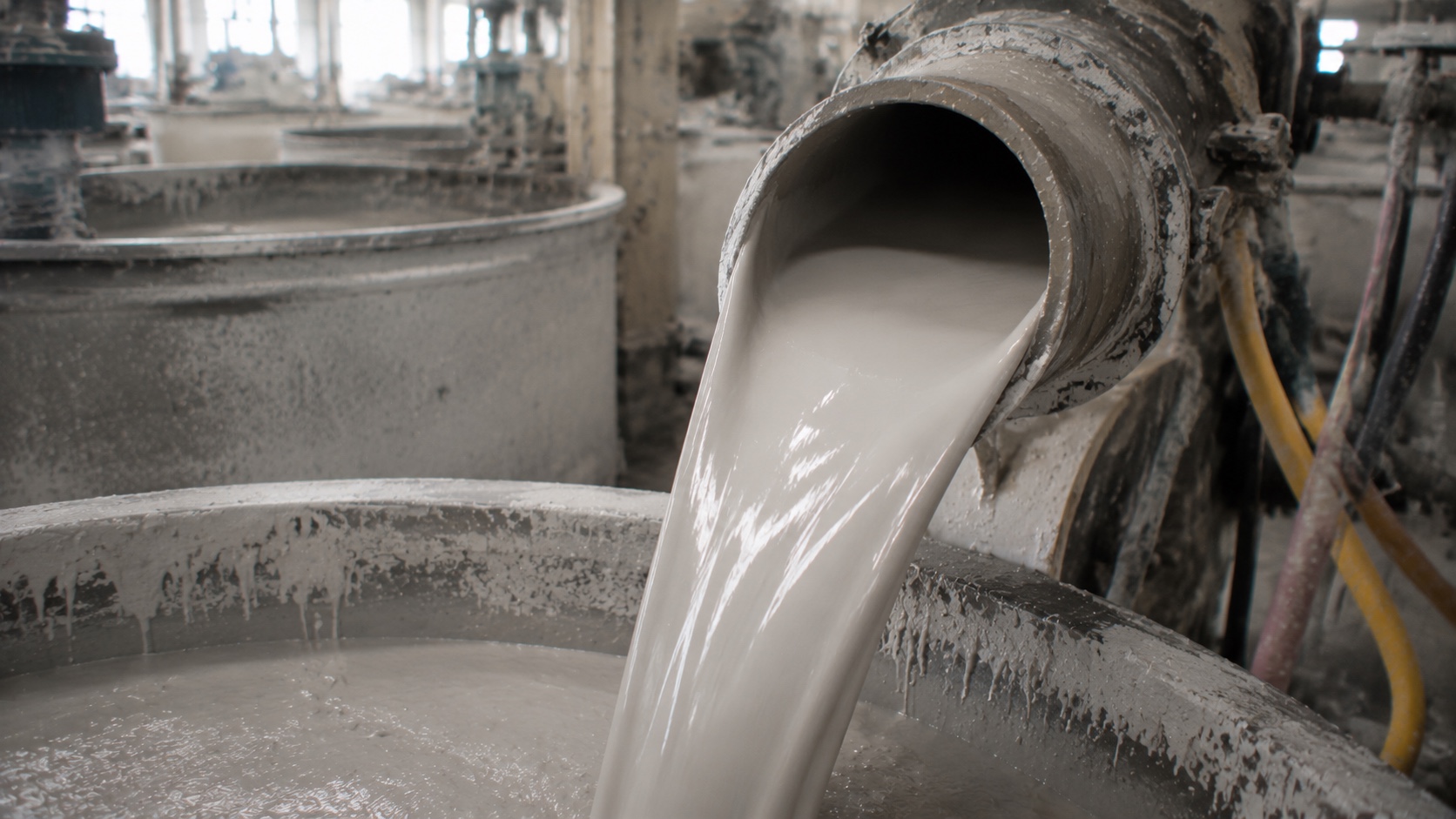
A basin can't be moulded from dry powder or from a stiff lump of clay. It has to be poured. So the first real job of the factory is to turn those four minerals into casting slip — a smooth, cream-like liquid with the consistency of thin paint. Here is how that happens on our floor, step by step.
1. Weighing and blending. The clays and minerals are batched to a fixed recipe. Getting the proportions right at this stage is what makes every later batch behave the same way — the same drainage speed in the mould, the same shrinkage in the kiln.
2. Ball milling. The blend is loaded into a ball mill with water and ground for hours. This breaks the minerals down to a fine, even particle size. Roughly a third of the mixture is water — enough to make the clay flow, but not so much that it takes forever to firm up in the mould.
3. Deflocculants. A small, carefully measured dose of deflocculant (an electrolyte such as sodium silicate) is added. This is the quiet piece of chemistry that makes slip casting possible: it lets the slip stay fluid and pourable with far less water, which means faster casting and less shrinkage later. Get the dose wrong and the slip either gels in the tank or drains too slowly into the mould.
4. Sieving and magnetic separation. The slip passes through fine sieves to remove coarse particles, then across magnets that pull out stray iron. Iron specks are a common cause of dark spots on a finished white basin, so this step protects the surface quality customers actually see.
5. Ageing and checking. The slip rests in stirred tanks so it matures and stays homogeneous. Before it is released to the casting line, we check its specific gravity (density) and viscosity (flow) — the two numbers that tell us whether a batch will cast cleanly. Only slip that hits the target window is poured into the moulds.
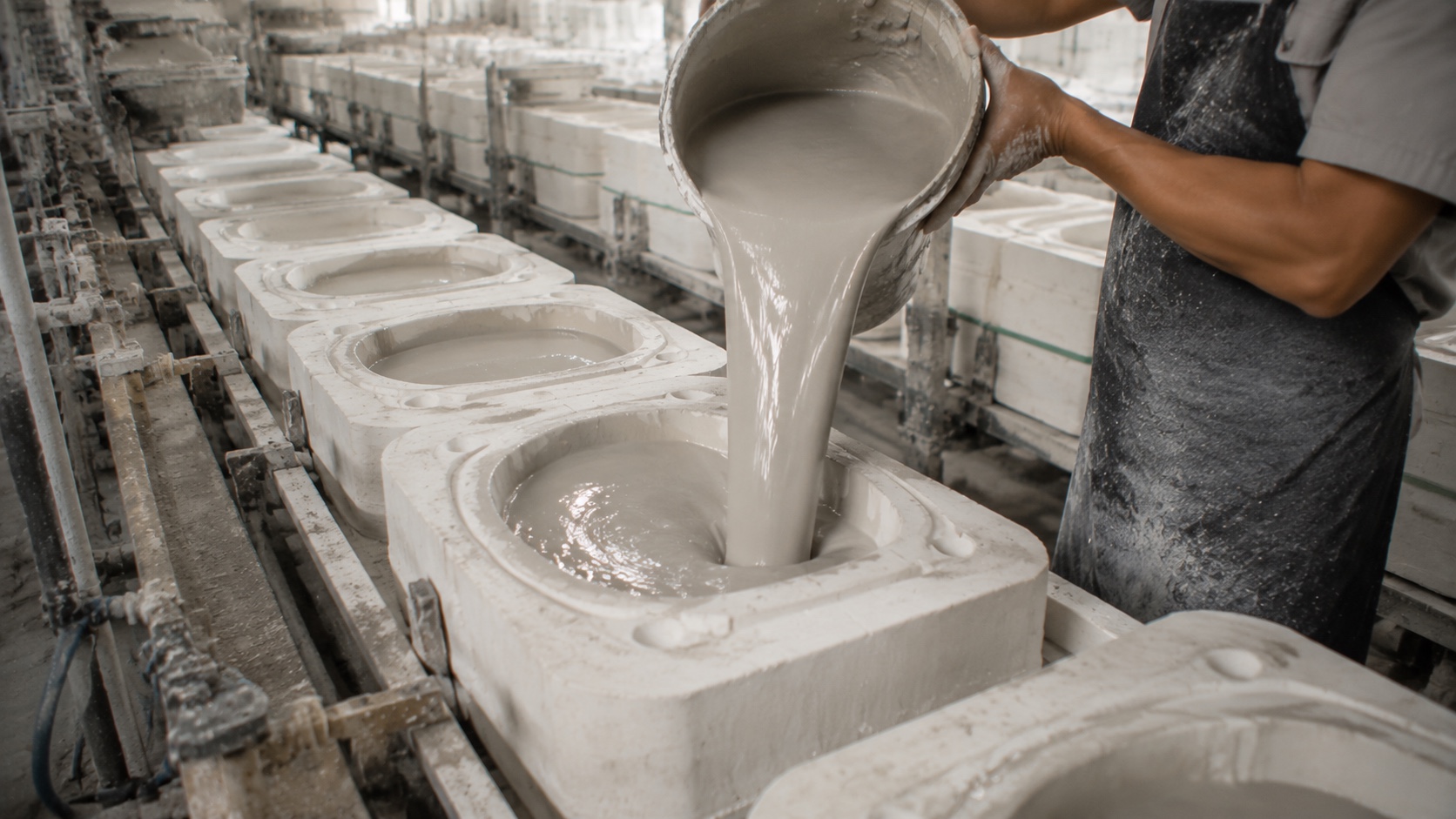
From here the slip is ready for the casting workshop, where it is poured into plaster moulds that draw out the water and leave a solid clay wall behind. That forming stage is where the liquid finally takes the shape of a basin — and it's the subject of the next article in this series.
03 Why it matters to buyers
Why raw-material quality matters when you're sourcing
For an importer, wholesaler or project buyer, this workshop you never see is where a lot of your risk is decided. Two suppliers can quote you the same product and the same photos, yet ship very different quality — and the difference often traces straight back to the slip.
A few things to keep in mind when you evaluate a ceramic sanitaryware factory:
Water absorption. A well-vitrified vitreous-china body has low water absorption, which resists staining, odour and cracking over time. Weak recipes or under-firing leave the body porous. It's a reasonable spec to ask any supplier about.
Batch-to-batch consistency. If you reorder, you want piece two thousand to match piece one. Fixed recipes and slip testing are what make that possible. Factories that "eyeball" the mix tend to drift.
Surface cleanliness. Iron spots, pinholes and a wavy surface frequently begin in the raw materials and slip, not in the glaze. Sieving and magnetic separation are cheap insurance a serious factory won't skip.
Dimensional stability. Warping and out-of-round rims are usually a shrinkage problem set in motion at the slip and drying stage — worth checking on your samples before you commit to volume.
None of this is exotic. It's ordinary discipline, done the same way every day. When you visit a factory, the raw-material and slip room is a good place to judge whether that discipline is real.
04 FAQ
Raw materials & casting slip: common questions
What are ceramic basins and toilets made of?
Most quality ceramic sanitaryware is made of vitreous china — a fired blend of ball clay, kaolin (china clay), feldspar and quartz. The clays give workability and whiteness, feldspar melts to form a glassy, low-absorption body, and quartz keeps the shape stable during firing.
What is casting slip?
Casting slip is the liquid form of the clay body. The dry minerals are ball-milled with water and a small amount of deflocculant into a smooth, pourable fluid — about the thickness of thin paint — that can be poured into plaster moulds to form basins and toilets.
What is the difference between ceramic, vitreous china and porcelain sanitaryware?
They overlap. "Ceramic" is the broad category; vitreous china is the high-fired, low-porosity body used for most modern basins and toilets, sealed with a vitreous glaze. Porcelain refers to a similar dense, vitrified fired body. In practice, buyers should focus on water absorption and finish rather than the label alone.
Why does raw-material quality affect the finished basin?
Because everything downstream inherits it. Inconsistent minerals or an untested slip lead to warping, pinholes, iron spots and higher water absorption that glazing and firing can't fully fix. Stable raw materials are the foundation of a consistent product.
Can a factory customise the ceramic body or slip for OEM/ODM orders?
Yes. Recipes are tuned to a factory's own moulds, kilns and target specs, and can be adjusted for whiteness, wall thickness and product type. If you have specific requirements, share them early — it's easier to plan at the slip stage than to correct after firing.
05 The series
What's next in the series
Now that the slip is ready, the next parts follow it through the rest of the factory: forming and fettling, glazing, high-temperature firing, inspection and packing. Each article takes you onto the real production floor — and into the details you only learn after over 25 years of making this for a living. If you're sourcing basins, toilets or urinals, reading the series is the fastest way to understand what separates a good supplier from an average one.