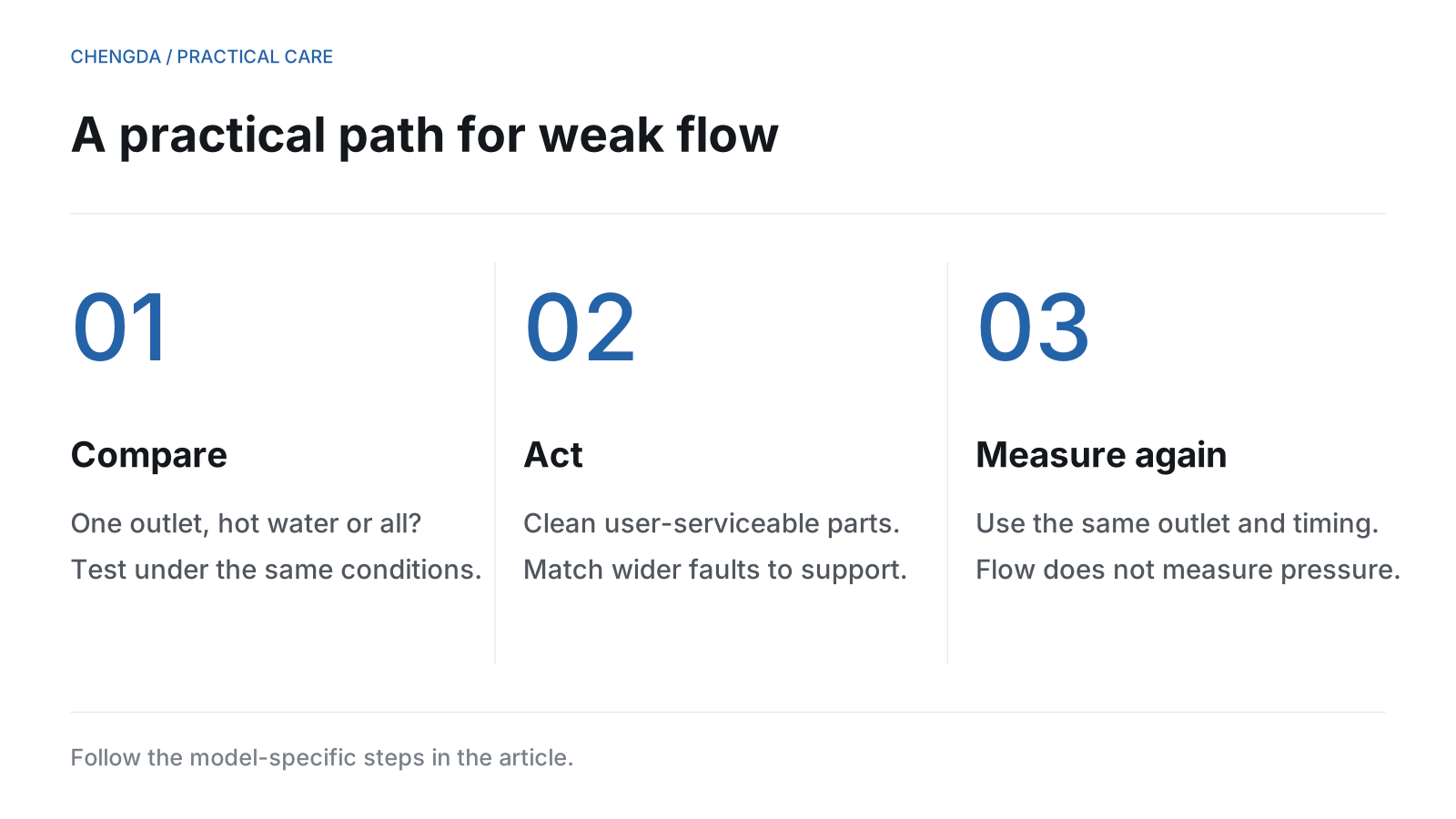
Start by finding the pattern: one tap, one shower, hot water only, or several outlets together. A dirty outlet may improve after cleaning; a shared supply problem needs a different response. Replacing the fixture or adding a pump before making that distinction can leave the real restriction untouched.
Use the table to choose a first action, then follow the relevant steps. If you need the underlying explanation, read water pressure versus flow rate. This guide focuses on what to do and how to check whether it helped.
01 WHAT TO DO
Choose the first action from the affected outlets
Compare normal use before taking anything apart. These patterns guide the next check; they do not prove a specific fault.
| What you notice | First action | If it persists |
|---|---|---|
| One basin tap is weak on hot and cold | Identify and clean its user-serviceable aerator | Have its supply path, filters and cartridge checked |
| Only the shower is weak or uneven | Clean permitted nozzles and accessible filter as its manual describes | Ask for a shower valve, hose and supply check |
| Several cold outlets or neighbours are affected | Check supply notices and compare nearby properties | Contact the water supplier or building manager |
| Only hot water is weak | Compare another hot outlet and note the heater model | Use a plumber or qualified water-heater service provider |
| Flow drops when another outlet opens | Record the combination that causes the drop | Request running-pressure and simultaneous-demand checks |
02 WHAT TO DO
One weak basin tap: clean the correct aerator
Moen's identification guide distinguishes exposed, concealed and non-accessible designs. Find your model's instructions first. A recessed aerator may need its supplied key; a smooth outlet does not automatically unscrew.
Moen recommends cleaning, reinstalling and testing the aerator. Delta's guide also stresses keeping its small parts and gasket correctly assembled.
- Turn the tap off. Protect the basin and cover the waste opening while handling small parts. Photograph the assembled outlet and keep a dish ready for the gasket and insert.
- Remove only the user-serviceable aerator, using the specified tool and direction. Stop if it is seized or the instructions require dismantling the faucet body.
- Rinse loose debris from the screen. For deposits that remain, use only the cleaner, contact time and method approved for that model and finish. Keep the parts in their original order.
- Restore the gasket, screen and complete aerator assembly; tighten as instructed. Reopen the waste, run cold water, check the joint for leaks and repeat the original flow observation.
| Result | Next step |
|---|---|
| Flow returns and the joint stays dry | Keep the assembly complete and use the maker's ongoing care instructions |
| Insert is damaged or flow remains poor | Ask the manufacturer for the correct replacement; request a plumber's check if the fault remains |
03 WHAT TO DO
One weak shower: clean what its manual permits
First check that the handshower hose is not visibly kinked and that the normal spray selector is fully in its intended position. For models with rub-clean silicone nozzles, gently rub them as instructed. Do not poke metal tools into the openings.
If the manual allows head removal, turn the shower off, remove it as directed and keep its seal and filter. Rinse accessible debris, use approved descaling care, then reinstall every component. Check for leaks and run each spray mode. hansgrohe's care guide illustrates this sequence and explains why cleaning chemistry must suit the product.
Persistent low delivery needs investigation of the hose, shower valve and supply. Leave fixed concealed fittings and electrical covers to the appropriate service professional. Cleaning a head does not establish that the valve behind it is sound.
04 WHAT TO DO
Several outlets are weak: check the supply before buying parts
Try the cold kitchen tap as well as the bathroom tap, then ask whether neighbours have noticed the same change. Check your water supplier's current works or outage notices. If several properties are affected and no notice explains it, report the location, start time and affected cold outlets to the supplier.
If only your home or flat is affected, contact the landlord, building manager or qualified plumber to check the internal or shared building supply. Thames Water uses these comparisons to direct investigations. Do not alter communal valves, pressure controls or building pumps to experiment.
05 WHAT TO DO
Only hot water is weak: separate a tap fault from a heater issue
Compare another hot outlet using its normal controls, without collecting scalding water. If just one tap is affected, ask a plumber to check that tap's hot supply, model-specific inlet filter and cartridge. Moen's bathroom troubleshooting distinguishes temperature-specific restriction from an aerator affecting both sides.
If several hot outlets are affected while cold delivery remains usual, book the water heater's qualified service provider. Give them its model, any displayed code and when the change began. Ask for checks of the heater's inlet screen, hot-water path and scale-related servicing where applicable. Rinnai's maintenance guidance identifies filter cleaning and professional flushing; the correct work depends on the appliance.
06 WHAT TO DO
It happens only during simultaneous use: test that condition
Write down the exact combination: for example, the basin tap weakens while the toilet refills. Ask the installer to record running pressure and flow at relevant points with that combination operating, then compare the findings with each fixture's requirements. A reading with all outlets closed cannot answer this question.
The repair should follow the finding: clear or replace a confirmed restricted component; assess pipe size and layout if the supply route cannot meet demand; or choose a fixture compatible with the measured conditions. Salamander's measurement guidance shows why outlet conditions matter. These are professional decisions, not a reason to install a booster blindly or discard flow regulators. Staggering use can reduce the immediate conflict while the cause is investigated.
07 WHAT TO DO
Check the result under the same conditions
After cleaning or repair, compare the same outlet, handle setting and spray mode, with the same other outlets operating. Keep all filters, seals and regulators installed. For an accessible cold tap, a measured container and timer can compare delivered volume over the same interval. That measures flow, not pressure.
Look for a steadier stream, restored delivery and dry joints. There is no universal target for every fixture. If improvement is absent or quickly disappears, send the before-and-after observations, model and cleaning details to the service provider. Have any remaining pressure question measured with suitable instruments, rather than inferring it from the stream's appearance.
Technical references
FAQ COMMON QUESTIONS
Frequently asked questions
Can I remove the flow restrictor to make the tap stronger?
Keep the complete approved assembly. Clean accessible debris or replace damaged parts with the correct item; removing a regulator changes the fitting's intended behaviour and does not locate the cause of a new reduction.
Can I soak every aerator or shower head in vinegar?
No. Use the exact manufacturer's care instructions. Some finishes, seals and components are incompatible with particular acids. Do not assume one brand's cleaning recipe applies to another, and never mix cleaners.
Cleaning did not help. Should I replace the whole faucet?
Ask for a model-specific check first. The restriction may be in a filter, cartridge or supply path. A confirmed damaged aerator may only need its matching replacement; an upstream problem will not be fixed by a new faucet alone.
Should I buy a pump if several fixtures cannot run together?
Have running pressure, available flow and demand assessed first. Repairs, pipework changes or equipment matching may be appropriate. Any booster proposal must suit the actual system and local supply requirements.
RELATED · UNDERSTAND THE CAUSE
Water Pressure vs Flow Rate →
Want to understand why it happens? Read the companion explanation.