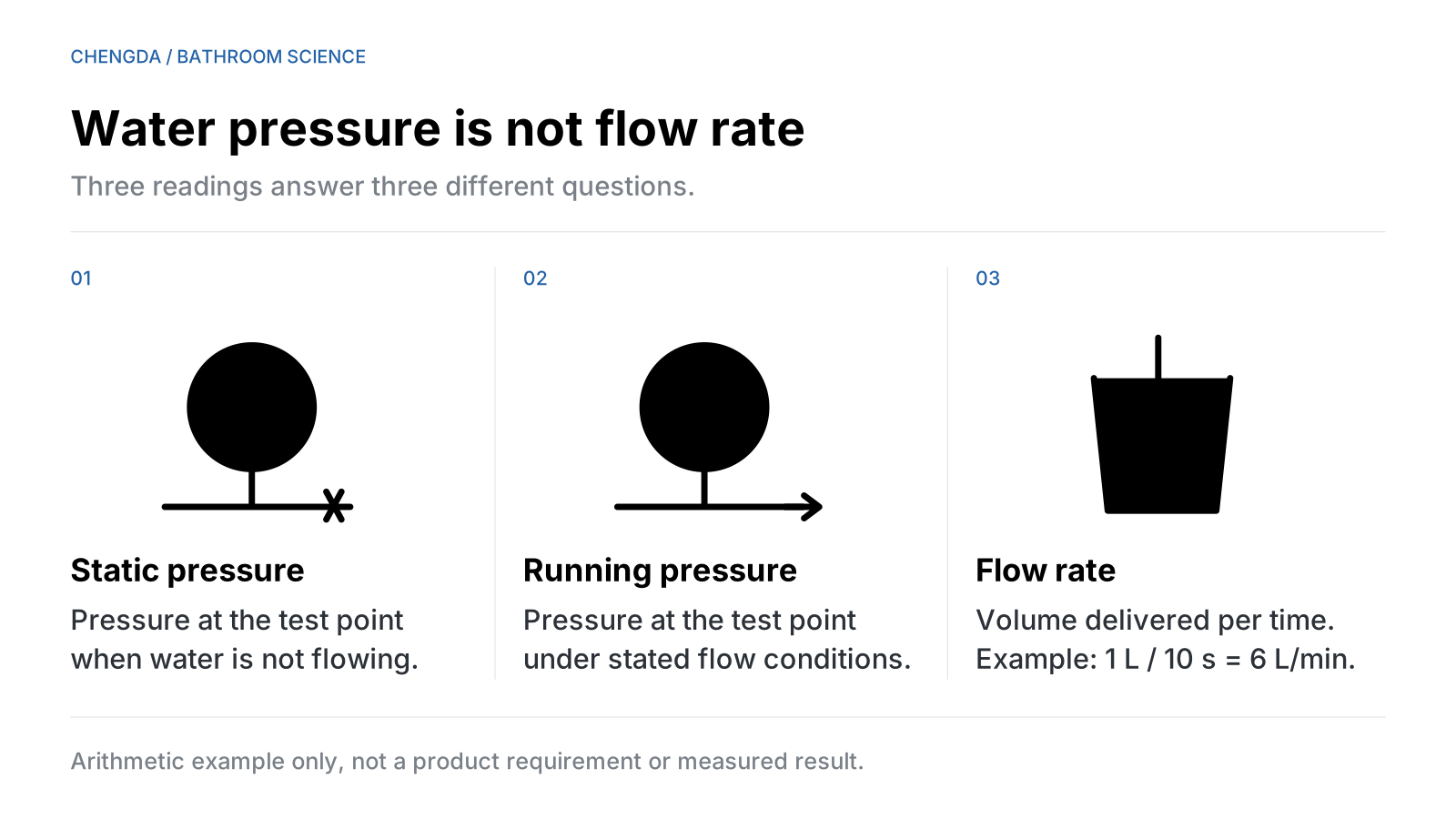
Water pressure describes the force per unit area in the supply. Flow rate describes how much water passes a point in a given time. They are related, but a pressure reading alone cannot tell you how quickly a basin tap will fill a jug or whether a fixture will work properly.
The missing question is often when the pressure was measured. A reading with every outlet closed describes a different condition from a reading while water is running. Understanding that difference helps explain a weak tap, slow tank refill or change when another outlet opens.
01 HOW IT WORKS
Three measurements that answer different questions
In domestic plumbing, static pressure usually means a reading with no water being drawn from the system being checked. Running or flowing pressure is measured while water is moving under stated conditions. Some installation manuals call this dynamic pressure. Flow rate is a separate measurement of delivered volume over time.
The distinction is visible in Salamander's AquaScan guidance, which separates static and flowing tests. Always keep the measurement location and open outlets with the result; a bare number loses much of its meaning.
| Measurement | What it describes | Typical units |
|---|---|---|
| Static pressure | Supply pressure at the test point without water draw | bar, kPa, MPa or psi |
| Running pressure | Pressure at the test point during specified water use | bar, kPa, MPa or psi |
| Flow rate | Volume delivered through an outlet per unit of time | L/min or gallons/min; identify the gallon convention |
02 HOW IT WORKS
Why can the pressure look adequate but the tap still feel weak?
A closed-outlet reading does not challenge the plumbing to deliver water. Once an outlet opens, the available supply must move water through pipes, fittings and the fixture itself. Restrictions that matter during flow may not be obvious from the earlier standing reading. South Staffs Water explicitly distinguishes pressure from delivered flow.
This is why two apparently conflicting observations can both be true: the pressure seemed satisfactory with the outlets closed, yet the running tap delivered little water. The useful next question is what happens at the relevant point during actual use, including normal simultaneous demand.
These observations narrow an investigation; they do not identify a failed component. A restricted outlet, a supply limitation and the intended behaviour of a water-saving fitting can produce superficially similar complaints. Ask the installer to separate those possibilities before choosing a remedy.
03 HOW IT WORKS
A forceful stream is not a flow meter
How water feels on your hand also depends on how the outlet shapes it. A concentrated spray and a broad stream distribute water differently. hansgrohe's explanation of shower flow describes the role of nozzle design and velocity, so perceived strength is not a reliable measure of total volume.
Some fittings also regulate their flow. Neoperl explains how pressure-compensating regulators adapt as pressure changes, keeping flow approximately constant within specified limits. Raising supply pressure therefore does not necessarily produce a matching increase in delivery. A moderate stream may be intentional, while a new reduction from the same fitting deserves investigation.
04 HOW IT WORKS
A toilet tank and a direct supply fixture use water differently
A conventional gravity toilet stores water before flushing. Opening its flush valve releases stored water towards the bowl; the supply then replaces the water used. Kohler's operating explanation separates this tank discharge from refill. Slow refill and weak flushing should therefore be described as different symptoms.
A direct supply flushometer takes its flushing water from the line during operation. Its supply must provide the required conditions during that event. Sloan's flushometer information illustrates why both pressure and flow matter. A satisfactory static reading does not establish that the installation can meet the operating demand.
Do not classify every toilet by appearance. A concealed tank still stores water, and a visible tank may contain an assisted system. Integrated smart toilets can use different arrangements. Identify the actual flushing system and its manual before interpreting a supply measurement.
05 HOW IT WORKS
Read the conditions beside the specification
A flow figure normally needs a pressure and operating condition to be useful. For example, the hansgrohe Croma 100 specification lists delivery for particular spray modes at a stated pressure and gives minimum flow pressure separately. Those are different fields, not interchangeable promises.
When comparing a manual with an installation report, read the label before the number. Maximum static pressure describes an upper limit under its stated condition; it does not say that the product needs that pressure. Likewise, a minimum running requirement cannot be verified by a no-flow reading alone.
Location matters too. A water supplier may describe conditions at the property boundary, whereas an appliance manual refers to the connection serving the appliance. Those readings answer different questions. Ask the installer to identify the relevant point instead of treating a building-entry result as proof of performance at every bathroom outlet.
- Match the exact model, market version and operating mode.
- Keep pressure units separate from volume-per-time units.
- Check where the manufacturer says the measurement applies.
- Include other outlets operating during the relevant check.
06 HOW IT WORKS
A jug and timer estimate flow, not pressure
For an ordinary accessible cold tap, collecting a known volume over a measured time can estimate the flow delivered there. Use a stable container, avoid splashing, and leave fittings assembled. This observation describes the outlet in that condition; it is not a substitute for an installer checking inlet pressure.
Teaching example only: if 1 litre takes 10 seconds to collect, the average flow is 1 ÷ 10 × 60 = 6 L/min. This is invented arithmetic, not a Chengda test result, a recommended flow rate or a pass/fail threshold.
Record the tap setting and whether other outlets were in use. Comparing unlike settings can create an apparent change that tells you nothing about the supply. Do not convert a jug result into bar or psi.
07 HOW IT WORKS
Describe the pattern before asking for a fix
A useful report says which outlet changed, when it happens and what else is running. Separate hot and cold observations where ordinary controls allow it. Note whether only one fixture is affected, several fixtures change together, or neighbours have noticed a similar problem.
Thames Water's supply guidance uses those comparisons to help distinguish a wider supply problem from internal plumbing. They are clues, not a diagnosis. Check current utility notices if several properties are affected; ask a qualified plumber or building manager to investigate persistent internal problems.
Give the professional the model reference, the symptom and any clearly labelled measurements. That is more useful than saying simply that the water is weak, and avoids choosing a pressure change before knowing whether pressure is the relevant limitation.
If a reading has already been taken, keep its units, location, time and water-use conditions together. A photograph of the number without that context is incomplete. If those details are missing, label the result as incomplete rather than guessing what was measured.
Technical references
- South Staffs Water — Pressure FAQs
- Salamander Pumps — AquaScan support
- Neoperl — Flow regulators
- hansgrohe — Understanding Shower Flow Rates
- Kohler Assist — How a Toilet Flushes
- hansgrohe — Croma 100 Hand shower Vario 28535000
- Thames Water — No water or low pressure
- Sloan — Dolphin Type I Class A Flushometer
FAQ COMMON QUESTIONS
Frequently asked questions
Can water pressure be satisfactory while flow is low?
Yes. A standing reading can look satisfactory while restrictions or outlet design limit delivery during use. Running pressure and flow measured under stated conditions help distinguish those situations; the standing number alone cannot.
Does a bucket or jug test measure water pressure?
No. Collected volume divided by elapsed time estimates flow at that outlet. Pressure requires a suitable instrument and a defined test condition. A flow result cannot be directly converted into bar, kPa or psi.
Does a slow-filling toilet tank mean the flush is weak?
Not necessarily. Refill replenishes a conventional gravity tank, while flushing releases stored water. Report refill time and the flush symptom separately, and have the actual system checked rather than assuming they share one cause.
What minimum pressure should every bathroom fixture have?
There is no single value suitable for every fixture. Use the exact model's requirements, including whether they refer to static or running pressure, the measurement point, and any associated flow condition. A water utility's service target is a different specification.
NEXT · PRACTICAL SOLUTIONS
How to Fix Weak Water Flow in the Bathroom →
Ready to deal with it? Follow the matching steps and check the result.