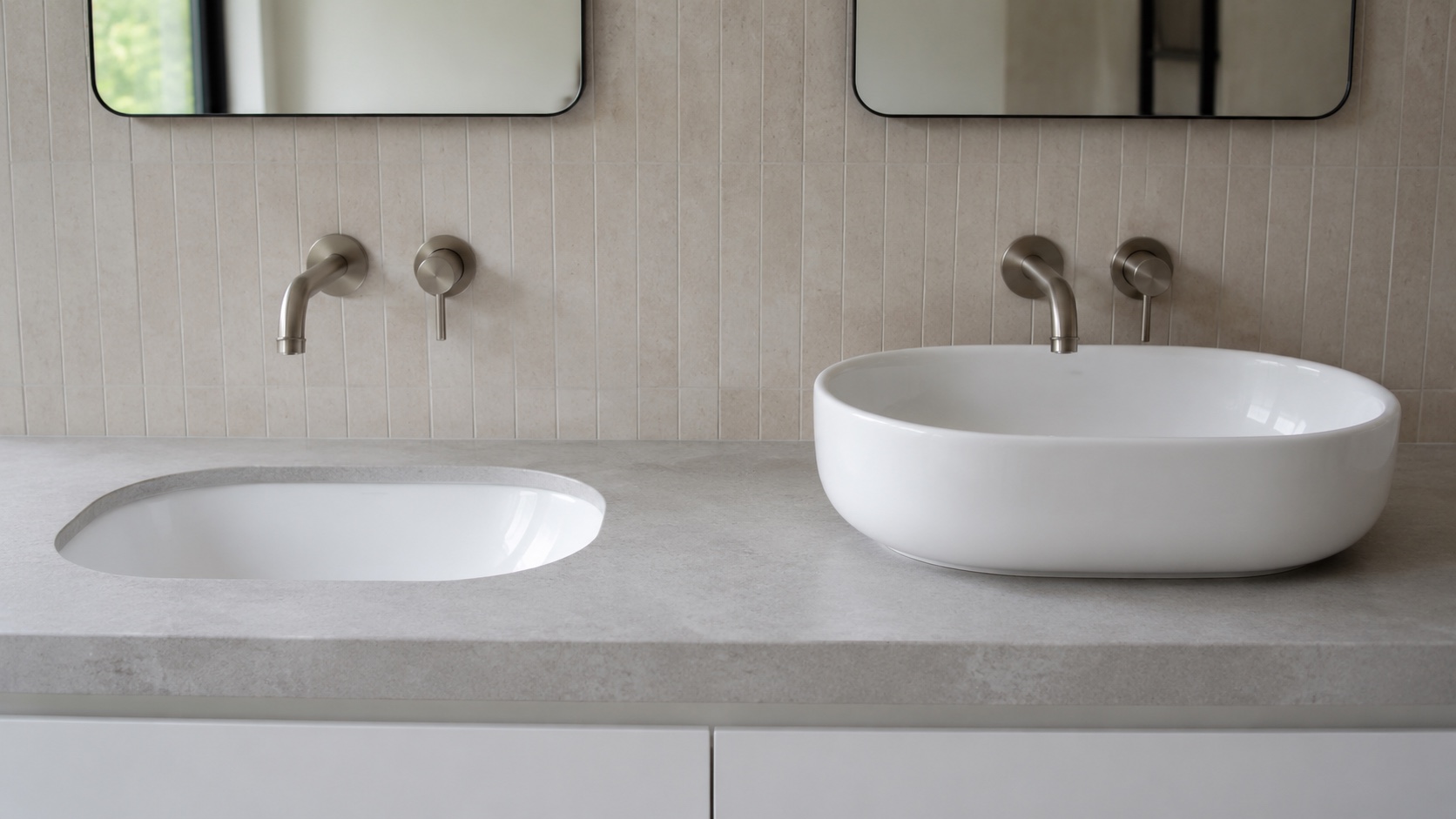
Choosing between an undermount basin vs countertop basin looks like an aesthetic call, but for importers, contractors, and hotel buyers it quietly decides your countertop material, your labour cost, your cleaning routine, and even which waste and faucet you must order. This guide breaks down the real trade-offs so you can spec the right basin for each project the first time.
Key takeaways
- Mounting position drives everything — undermount fixes below the counter (rim hidden), countertop sits on top (bowl fully visible).
- Undermount needs a solid, sealed top — stone, quartz, or solid surface; not laminate or particleboard.
- Countertop is faster and cheaper to fit, works on almost any surface, and makes a bold design feature; undermount wins on seamless easy-clean counters.
01 THE BASICS
What actually differs between the two
An undermount (under-counter) basin is bonded beneath the countertop, so the counter edge overhangs the bowl rim and the sink itself disappears under a cutout. A countertop basin — also called above-counter, sit-on, or vessel — rests fully on top of the finished surface with the whole bowl on show.
Importantly, the ceramic body is usually identical. Both types are typically produced in high-fired vitreous china with the same glaze, water absorption, and durability. The choice is about mounting method and look, not material quality. That single difference in position, though, cascades into cleaning, cost, countertop choice, faucet, and waste — which is where buyers get caught out.
02 COUNTERTOP FIT
The biggest hard constraint: your worktop
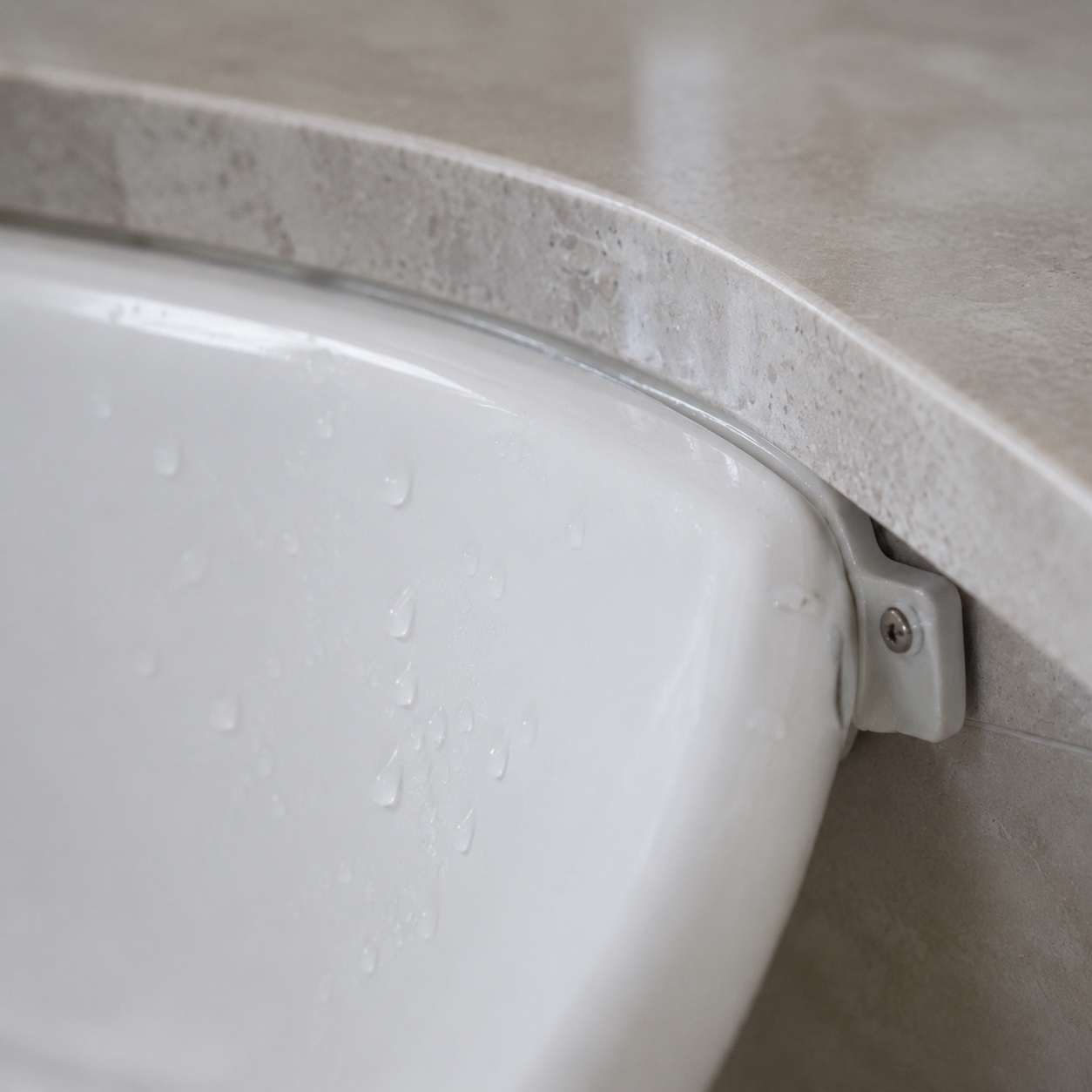
This is the deciding factor on most projects. An undermount basin hangs from the underside of the top and its cut edge is permanently exposed to water, so it demands a solid, water-resistant surface: natural stone, quartz/engineered stone, solid surface such as Corian, concrete, or well-sealed hardwood. On these, the fabricator can polish the exposed cutout edge smooth and anchor the basin with clips and adhesive.
Undermount is not suitable over laminate or tile-over-particleboard. A laminate cutout exposes an unsealed core that swells, warps, and delaminates once wet, and the substrate cannot carry the basin's hanging weight. A countertop basin has no such limit — it sits on top, so it works on almost any surface, including laminate and tile, which makes it the natural pick for renovations and budget fit-outs.
Confirm the top before you order
If the project uses laminate, tile, or thin tops, quote a countertop/vessel basin. Reserve undermount for jobs with quartz, granite, or solid-surface vanities in the spec.
03 HYGIENE & CLEANING
Wipe-down speed and usable counter space
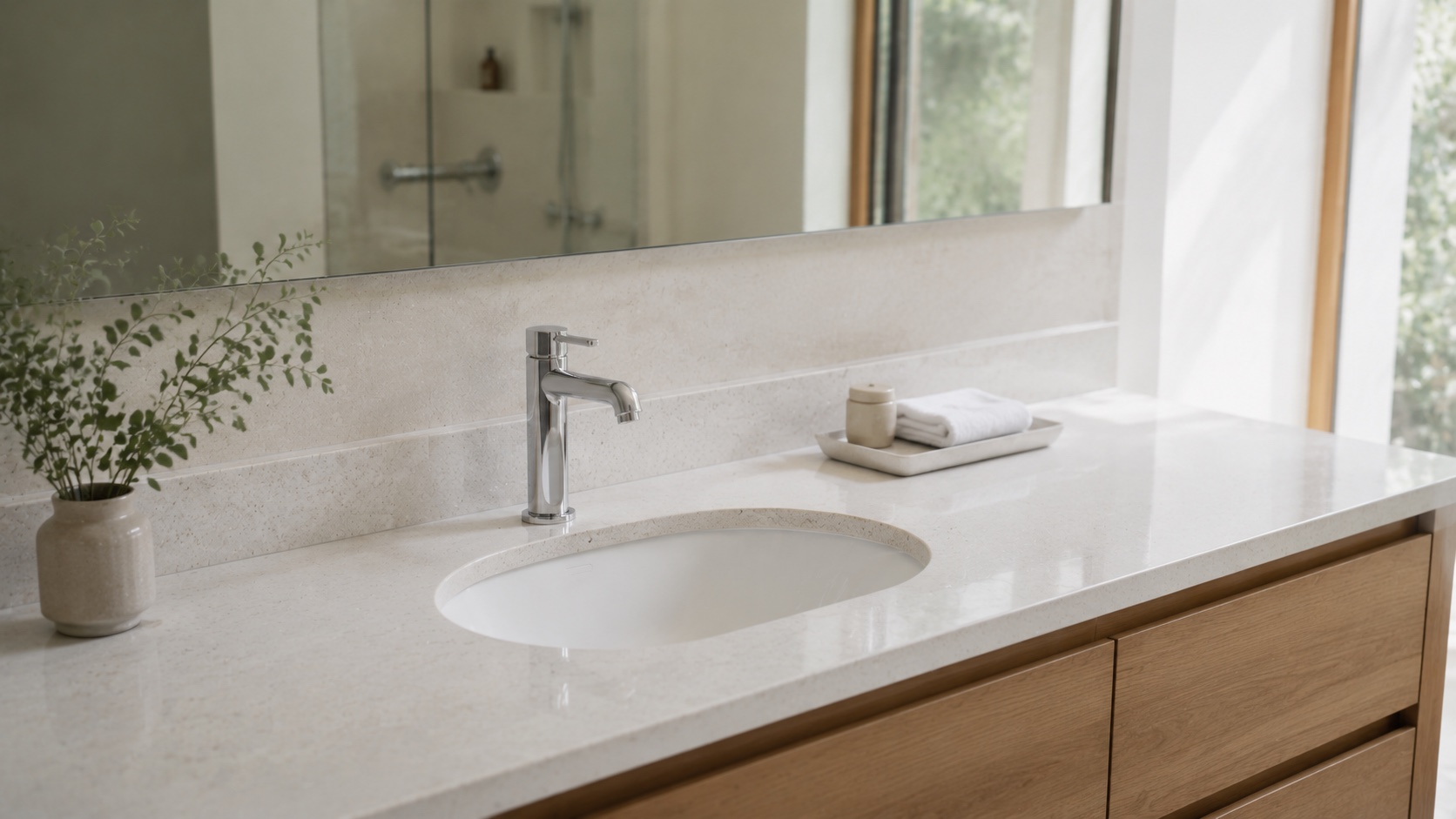
For high-traffic bathrooms, undermount is the easy-clean winner. With no raised rim, water, soap, and debris wipe straight off the counter into the bowl, leaving more clutter-free, usable surface. That is why hotels and busy commercial washrooms lean undermount where stone tops allow.
A countertop basin creates a seam where the bowl meets the surface. That silicone contact line collects dust, soap scum, and water spots, so housekeeping has to wipe around the base of every bowl. It is manageable, but it is a recurring cleaning task worth flagging to a project buyer costing labour over hundreds of rooms.
04 HEIGHT & SPLASH
Ergonomics and faucet matching
Height is the catch with vessel basins. The bowl stacks its full height (roughly 10–15 cm) on top of the counter, so on a standard vanity the rim can reach a tiring level. Buyers often specify a lower vanity (around 80–82 cm) so the finished rim lands at a comfortable ~85–90 cm — but note that at the upper end this is already at the limit of easy reach for young children. Undermount lowers the effective basin, giving a lower, deeper wash position that suits family and children's bathrooms.
Splash follows from height. A tall vessel bowl needs a correctly matched tall vessel faucet or a wall-mounted spout; a standard deck tap over a raised bowl splashes. Undermount pairs neatly with a normal deck-mounted faucet drilled into the counter and tends to splash less. Always confirm faucet type and hole count against the basin before ordering.
05 COST & INSTALL
Labour, skill, and lead time
Countertop basins are faster and cheaper to fit. The top needs only a drain hole (typically 40–55 mm) and a tap hole, then the basin drops onto the surface and is sealed with a thin silicone bead. Easy to fit, easy to swap — a real plus for retailers and quick renovations.
Undermount costs more and is skill-dependent. The fabricator must template the cutout to the basin's exact dimensions (generally within about ±1–2 mm), polish the exposed edge, and secure the basin from below with heavy-duty clips plus adhesive — usually work for a stone shop or a pro, not a general fitter. Because a ceramic basin weighs roughly 12–22 kg, larger bowls should rely on mechanical clips or brackets, not silicone alone.
Undermount vs countertop at a glance
| Factor | Undermount basin | Countertop / vessel basin |
|---|---|---|
| Mounting | Below the top, hidden rim | On top, full bowl visible |
| Countertop needed | Stone, quartz, solid surface only | Almost any surface, incl. laminate |
| Cleaning | Wipe straight into bowl, no rim | Wipe around a base seam |
| Faucet | Standard deck-mounted | Tall vessel or wall-mounted |
| Install cost/skill | Higher, precise, pro/stone shop | Lower, faster, easy to swap |
| Best for | Seamless hotel & upscale residential | Design features, retail, renovations |
06 OVERFLOW & WASTE
The ordering error to avoid
This detail causes more wrong shipments than any other. Many vessel/countertop basins have no overflow hole, so they need a matching non-overflow (unslotted) pop-up or click-clack waste. Undermount basins commonly include an overflow and use a slotted waste. Pairing a slotted waste with a no-overflow basin — or the reverse — is a classic mistake that leaves water pooling or the overflow non-functional.
Match them deliberately: overflow basin to slotted waste, no-overflow basin to unslotted waste. Chengda can supply basins drilled with 0, 1, or 3 tap holes and with or without overflow to your spec, so tell us the counter type, faucet, and waste at enquiry and we send the correct template and hole layout.
State these five things
Counter material, faucet type (deck/tall/wall), tap-hole count, overflow yes/no, and target quantity — that is all we need to quote the right basin and MOQ.
07 STYLE & DURABILITY
Design impact and long-term wear
A countertop/vessel basin is a visible centrepiece. It comes in many shapes — round, oval, rectangular, thin-rim — and finishes, giving strong display appeal for boutique hotels, feature powder rooms, and retail ranges. Undermount delivers the opposite: a minimalist, seamless, built-in look prized in modern homes and clean hotel-room schemes.
On durability, quality glazed ceramic/porcelain is non-porous and resists stains, discolouration, and surface dulling under constant daily use, which is why it is the preferred hotel basin material for both mounting types. The practical cautions: a raised vessel bowl (especially glass or thin edges) is more exposed to knocks and chips, while an undermount's underside seam can trap moisture and develop mould if it is not fully sealed during installation. Ceramic remains the more forgiving choice than glass for heavy commercial use.
08 WHICH TO CHOOSE
Matching the basin to the project
There is no universal winner — the right answer depends on the counter, the traffic, and the look you are selling. Use this quick split as a starting point.
Choose undermount when
- The spec includes stone, quartz, or solid-surface tops
- Easy-clean, seamless counters matter (hotels, serviced apartments)
- You want maximum usable counter space and a minimalist look
- A lower, deeper wash position suits the users
Choose countertop/vessel when
- The counter is laminate, tile, or a thin/existing top
- The basin is a design feature or retail showroom piece
- Fast, low-cost fitting and easy future swaps are priorities
- Budget or renovation projects need flexibility
Decide the countertop and the cleaning standard first; the basin type usually follows on its own.
As an OEM/ODM ceramic basin manufacturer in Guangdong, Chengda produces both styles from the same vitreous china body, with customisable size, shape, glaze colour, drain and tap-hole configuration, and branded export packaging. On certification, support varies by product and market — request test reports before ordering. Whichever way the undermount basin vs countertop basin decision goes, tell us the counter, faucet, and quantity and we will match the correct basin, waste, and drilling to your project.
FAQ COMMON QUESTIONS
Frequently asked questions
Can I install an undermount basin on a laminate countertop?
Generally no. Undermount exposes the cut edge to water and hangs weight from the top, so it needs a solid, sealed surface such as quartz, granite, or solid surface. Laminate/particleboard cores swell and delaminate when the cutout gets wet. Use a countertop/vessel basin over laminate.
Which basin is easier to clean and more hygienic?
Undermount. With no raised rim, water and debris wipe straight into the bowl and there is no base seam to scrub, leaving more usable counter — a key reason hotels favour it on stone tops. Countertop basins have a silicone seam around the base that needs regular wiping.
Does a countertop vessel basin need a special faucet?
Usually yes. Because the bowl sits high, it pairs best with a tall vessel faucet or a wall-mounted spout to clear the rim and avoid splashing. A standard deck faucet suits undermount basins. Confirm faucet type and hole count before ordering.
Do vessel basins come with an overflow, and which waste do I need?
Many vessel/countertop basins have no overflow, so they need a non-overflow (unslotted) pop-up waste. Undermount basins usually have an overflow and use a slotted waste. Match them correctly — mismatching is a common ordering error.
Which basin type is more expensive to install?
Undermount. It requires precise cutout templating, edge polishing, and clip-and-adhesive fitting, typically by a stone shop or pro. Countertop basins only need a drain and tap hole and drop onto the surface, so they install faster and cheaper.
Can Chengda supply custom tap-hole drilling and overflow options?
Yes. We supply basins drilled with 0, 1, or 3 tap holes and with or without overflow, in customisable sizes, shapes, and glaze colours, with branded packaging. Share your counter type, faucet, waste, and target quantity for accurate MOQ and pricing.