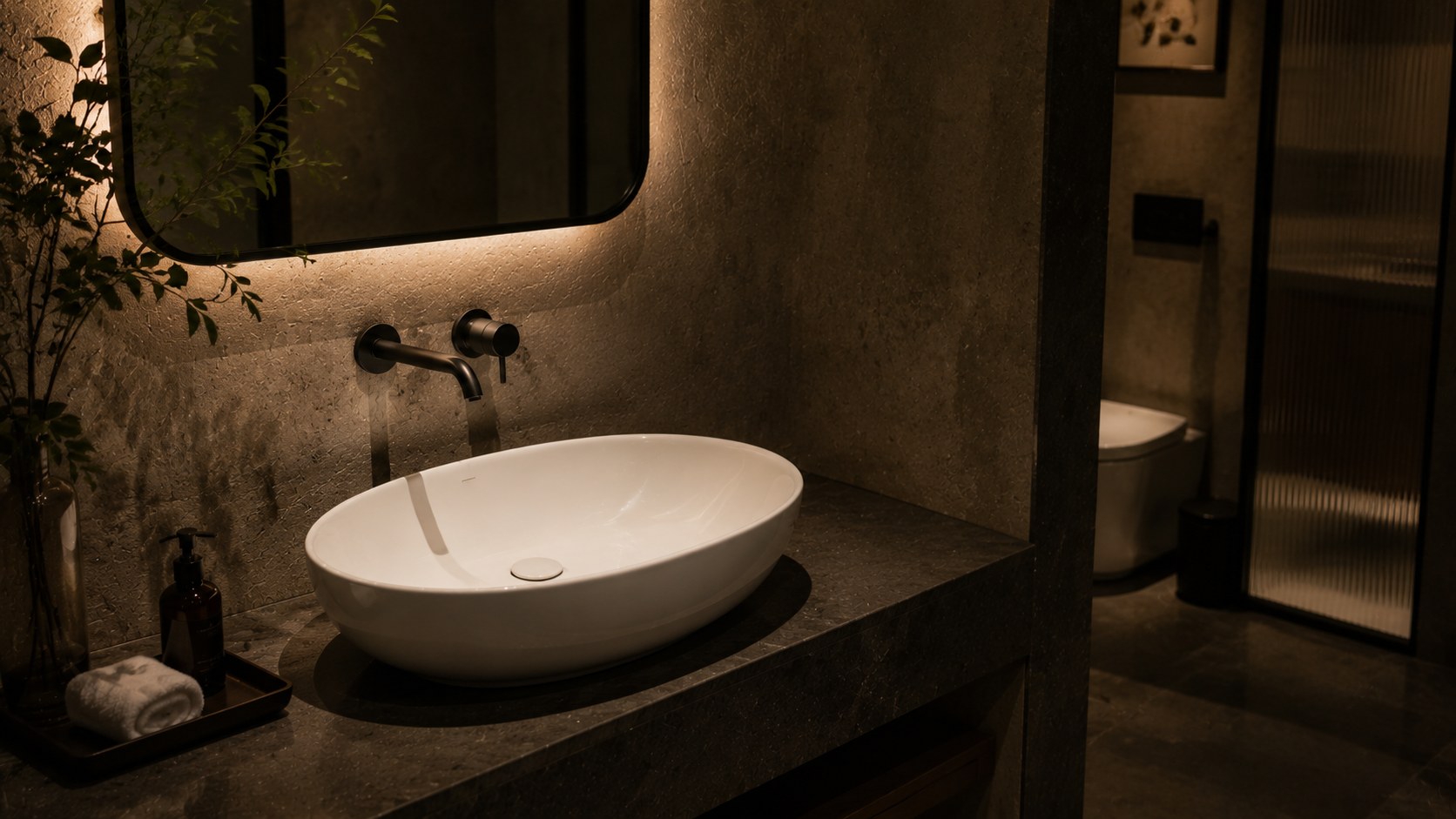
If you are speccing a bathroom and keep meeting the term, the short answer to what is a countertop basin is simple: it is a wash basin that sits fully on top of the vanity, like a bowl placed on the surface, instead of being set into or under it. Because the whole bowl is on show, it is the opposite of an undermount basin — and it is usually the visual centrepiece of the vanity.
Key takeaways
- Sits on top of the counter — also called an above-counter, vessel or art basin; the full bowl stands proud of the surface.
- Only a drain hole is cut — no basin-shaped cut-out, so it works on almost any counter, including laminate, tile and wood.
- A design statement — a wide range of shapes, finishes and colours makes it popular in feature bathrooms, powder rooms and hotels.
01 THE BASICS
What a countertop basin actually is
A countertop basin — also called an above-counter basin, a vessel basin, or an art basin when the shape is decorative — is a bowl that rests on the finished surface of the vanity. When you look at a finished installation, the whole basin body stands above the counter and the tap rises up and over the rim. The counter underneath stays a flat surface; only a drain hole is cut through it.
That is the key contrast with the two built-in styles. A drop-in basin drops into a shaped cut-out with its rim resting on the counter, and an undermount basin is bonded below the counter so nothing shows on top. A countertop basin needs neither a shaped cut-out nor under-counter support — it simply sits on the surface. Because the bowl is fully visible, it is chosen first for its looks, which is why it anchors so many design-led bathrooms.
The bowls are usually high-fired vitreous china (glazed ceramic), the same dense, hard-wearing material used across quality sanitary ware. Ceramic is the standard, but you will also see stone, glass and resin versions — countertop is a mounting style, not a single material.
02 INSTALLATION
How a countertop basin mounts
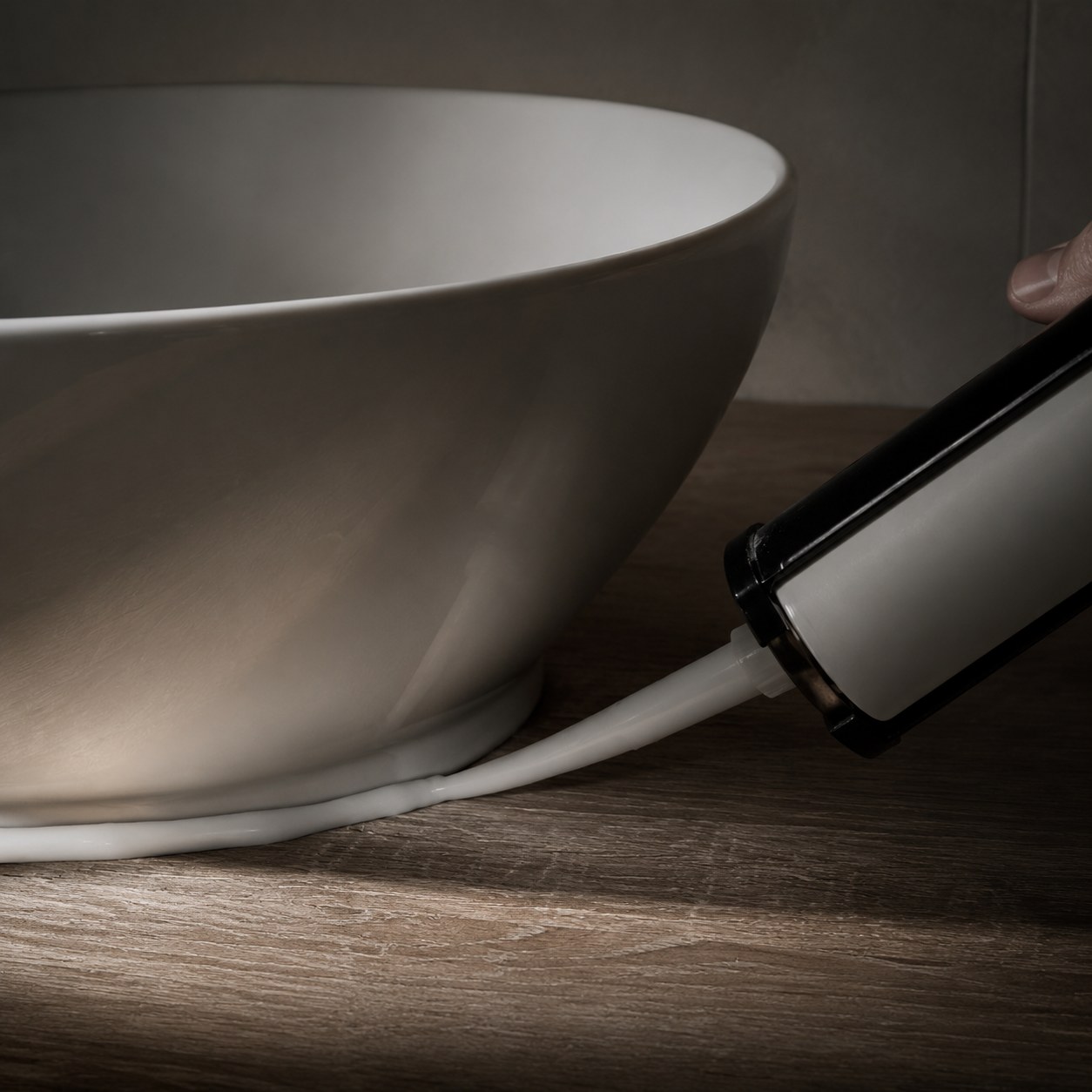
Fitting a countertop basin is the simplest of the three styles, which is a large part of its appeal. The bowl is set on the surface and sealed with a bead of silicone around its base; some models add a mounting ring or bracket for extra grip. The only cut needed in the counter is a single drain hole, typically around 40–45 mm, for the pop-up waste — there is no precise basin-shaped opening to template and cut.
Because only a drain hole is cut, a countertop basin is far more forgiving about the worktop beneath it. It sits happily on solid stone or quartz, but also on laminate, tiled or timber surfaces that would rule out a standard undermount. That flexibility, plus the easy fabrication, makes it a favourite for renovations and budget-sensitive projects as well as high-end ones.
Confirm tap hole and overflow per model
Countertop basins vary: some have a pre-drilled single tap hole, while many art basins have no tap hole and rely on a deck- or wall-mounted tap. Many vessel basins also have no overflow, so they must be paired with an un-slotted (non-overflow) waste; models with a limited overflow take a slotted waste. Confirm the tap-hole and overflow configuration for the exact SKU before you order taps and wastes.
03 SHAPES & SIZES
Shapes and sizes to know
Because the whole bowl is visible, shape is where a countertop basin does its work. The common families are round (the classic bowl look), oval (soft and popular in homes), and rectangular or square (modern, and best for maximising usable basin area on a narrow vanity). Thin-rim art basins add slim walls, sculptural forms and finishes beyond plain white — matte, coloured or textured glazes — for a real statement piece.

On size, typical footprints are round basins around Ø 330–420 mm, rectangular bowls roughly 460–600 mm long, and heights of about 100–150 mm. A semi-recessed variant sits partly over the counter edge and is useful on shallow vanities. Because the numbers drive both the vanity and the tap you choose, confirm the exact external dimensions, tap-hole layout and overflow of each SKU before ordering.
04 TRADE-OFFS
The pros and cons in plain terms
Countertop basins are chosen for looks and easy fabrication, but the same on-top design brings a few trade-offs around height and cleaning. Here is the honest picture.
Countertop basin: pros vs cons
| Factor | Pro | Con |
|---|---|---|
| Appearance | A statement centrepiece; huge range of shapes and finishes | Very much on show — a plain bowl has nowhere to hide |
| Fabrication | Only a drain hole to cut; works on most counters | Taller tap or wall tap adds a little coordination |
| Height | Ergonomic if the vanity is planned around it | Adds its full height on top; can feel high on a standard cabinet |
| Cleaning | Non-porous glaze wipes clean easily | The silicone joint at the base needs occasional care |
In short, if you want the basin to be a feature and you can plan the vanity height and tap around it, a countertop basin delivers. If you want a calm, wipe-straight-in surface with nothing standing proud, an undermount is the better fit.
05 COMPARISON
Countertop vs undermount vs drop-in
Three mounting styles cover almost every bathroom basin. Seeing them side by side makes the countertop decision much clearer.
Three basin mounting styles compared
| Factor | Countertop | Undermount | Drop-in |
|---|---|---|---|
| Where it sits | On top of the counter | Below the counter | In a cut-out, rim on top |
| Cut in counter | Drain hole only | Full basin cut-out | Full basin cut-out |
| Counter needed | Almost any, incl. laminate | Solid, waterproof only | Almost any, incl. laminate |
| Rim height | Highest — bowl stands proud | Lowest — flush surface | At counter level |
| Cleaning the counter | Base join collects dirt | Easiest — wipe straight in | Rim can trap grime |
| Feel | Decorative, statement | Built-in, understated | Practical, everyday |
If you want the basin to make the statement, the countertop bowl wins; if you want the calmest, most seamless surface, the undermount does; if you want the simplest, most budget-friendly fit, a drop-in is hard to beat. For a fuller side-by-side, see our guide on undermount vs countertop basins.
06 IN USE
Tap, height and waste
The one thing to plan carefully is height. A countertop basin adds its full height — roughly 100–150 mm — on top of the vanity, so the effective rim ends up higher than a built-in basin on the same cabinet. A useful rule of thumb: aim for a finished rim height of about 800–850 mm for comfortable hand-washing, which usually means specifying a lower cabinet than standard. In short, counter height ≈ desired rim height − basin height.
Height also drives the tap. Because the water has to reach up and over the rim, a countertop basin needs a tall vessel mixer on the counter or a wall-mounted tap set above the rim — a standard low basin tap will not clear the bowl. Pair that with the right waste: an un-slotted waste for a basin with no overflow, a slotted waste for one with an overflow, and either a pop-up or click-clack to suit.
Before you order a countertop basin
Confirm five things: the bowl external size and shape suit your vanity; the cabinet height is planned so the finished rim lands near 800–850 mm; the tap is a tall vessel mixer or wall-mounted; the tap-hole layout matches (pre-drilled hole vs no hole); and the overflow choice (with or without) matches your chosen waste.
07 WHERE IT FITS
Where countertop basins fit best — and how we help
Countertop basins suit projects that want a design highlight and can plan the vanity around it: feature master baths, powder rooms and en-suites, boutique and business hotels, restaurant and lobby washrooms, and showrooms where a striking bowl earns its place. They pair naturally with tall or wall-mounted taps and with a wide palette of shapes and glazes.
A countertop basin is less about disappearing into the counter and more about becoming the piece everyone notices.
As a ceramic sanitary ware factory in Chaozhou, Guangdong, we produce countertop, art, undermount, drop-in and pedestal basins in high-fired vitreous china, with water absorption of 0.5% or lower and firing around 1250°C for a dense, chip-resistant body — the spec that keeps an exposed vessel bowl looking new. Basins can be supplied with or without overflow and tap hole, in round, oval, rectangular and thin-rim art shapes, with OEM/ODM support for custom sizes, glaze colours and branding, AQL-inspected and export-packed for project and wholesale orders. Certification support varies by product and market — buyers are welcome to request current test reports. If you are weighing decorative options, our note on buying art basins is a useful next read.
Get the height and tap right, and a countertop basin turns an ordinary vanity into the moment of the room.
FAQ COMMON QUESTIONS
Frequently asked questions
Is a countertop basin the same as a vessel sink?
Yes — they describe the same thing. Countertop basin (used in the UK, Australia, India and the Middle East) and vessel sink (the common US term) both mean a bowl that sits on top of the vanity rather than set into or under it. Above-counter basin is another name for it, and art basin usually refers to a decorative, thin-rim countertop version.
Are countertop basins hard to clean or impractical?
The bowl itself is easy — a glazed vitreous china surface is non-porous and wipes clean with mild detergent and a soft cloth. The point to watch is the silicone joint where the base meets the counter, which collects grime and benefits from occasional cleaning and re-sealing. They are practical as long as the vanity height is planned so the rim is not uncomfortably high.
Do you need a special tap for a countertop basin?
Usually yes. Because the bowl raises the water height, you need a tall vessel mixer mounted on the counter or a wall-mounted tap set above the rim; a standard low basin tap will not clear the bowl. Check whether the basin has a pre-drilled tap hole or none — many art basins have no hole and are designed for a deck- or wall-mounted tap.
What height should the vanity be for a countertop basin?
Plan for a finished rim height of about 800–850 mm for comfortable hand-washing. Since the basin adds its own height (roughly 100–150 mm) on top of the cabinet, you usually need a lower-than-standard vanity. A simple guide: counter height ≈ desired rim height − basin height. Coordinate the cabinet, basin and tap reach together.
Do countertop basins chip easily?
The exposed body is more knock-prone than a built-in basin, and very thin-rim art basins are the most delicate, but material quality matters more than the style. A high-fired vitreous china bowl with a dense, low-porosity body (water absorption around 0.5% or lower) and an even glaze resists chipping and staining far better than a poorly fired one. Ask for the firing and water-absorption spec when sourcing.
Do countertop basins need an overflow?
Not necessarily. Many vessel and art basins have no overflow hole and must be paired with an un-slotted (non-overflow) waste; models with a limited overflow take a slotted waste. The important thing is to match the waste to the basin — mismatching them can cause the basin to overflow or the waste to leak. Confirm overflow yes/no per SKU before ordering wastes.