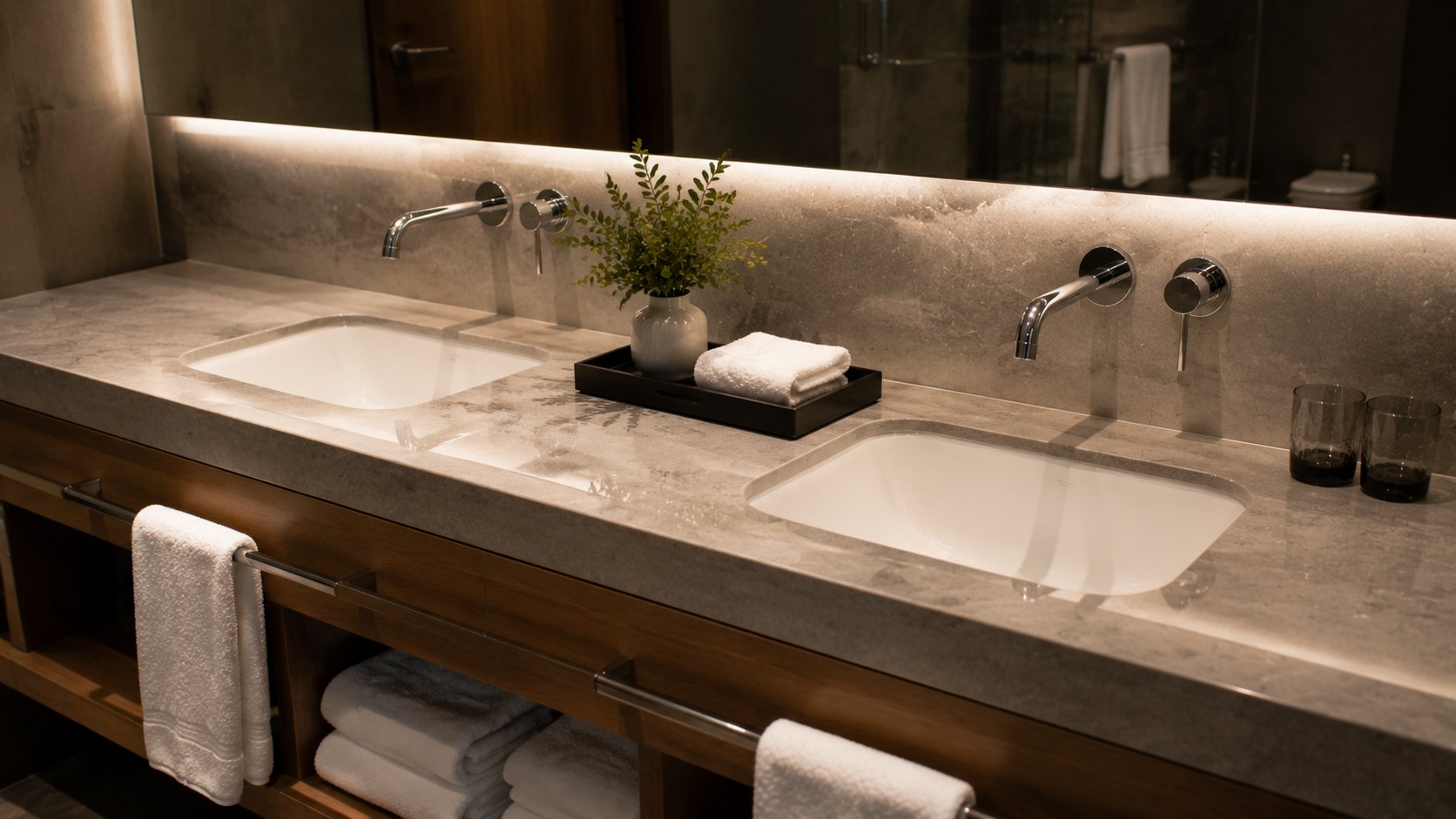
If you are planning a bathroom and keep meeting the term, the short answer to what is an undermount basin is simple: it is a wash basin mounted beneath the countertop, so the rim of the bowl sits hidden under the stone rather than resting on top of it. The result is a clean, uninterrupted surface with no lip to catch water or dust.
Key takeaways
- Mounted below the counter — the basin is bonded under the worktop with clips and adhesive, so no rim shows on top.
- Needs a solid countertop — stone, quartz or solid surface, never plain laminate, because the cut edge is exposed to water.
- Clean and understated — you can wipe water straight off the counter into the bowl, which is why hotels and upscale homes favour it.
01 THE BASICS
What an undermount basin actually is
An undermount basin — also called an under-counter or under-mounted basin — is fixed to the underside of the countertop. When you look down at a finished undermount installation, you see the countertop surface flow over its cut edge and drop straight into the ceramic bowl. There is no raised rim sitting on the counter.
Compare that with the more common drop-in (top-mount) basin, where a lip rests on top of the counter and holds the bowl in place. That lip is the visible difference: a drop-in has one, an undermount does not. Because the mounting hardware is out of sight underneath, an undermount reads as calmer and more built-in, which is a large part of its appeal.
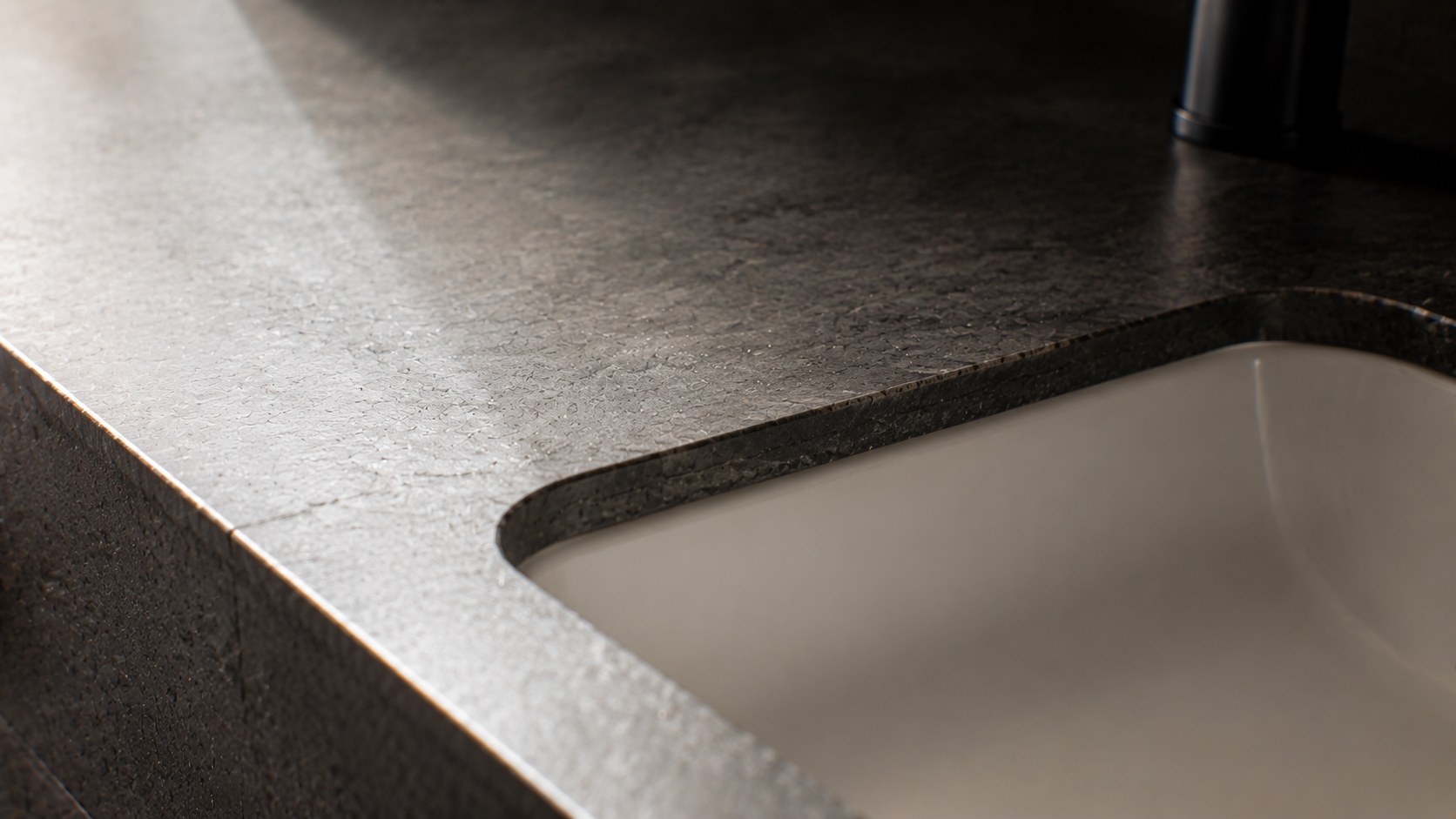
The bowls themselves are usually high-fired vitreous china (glazed ceramic), the same durable material used across most quality sanitary ware. Undermount is a mounting style, not a separate material — you will find ceramic, stone and solid-surface versions, but ceramic remains the most common for bathrooms.
02 INSTALLATION
How an undermount basin is installed
Because there is no rim to carry the weight from above, an undermount basin is held from below by a combination of mechanical clips (or brackets on threaded studs) and a bead of silicone or epoxy adhesive between the bowl and the underside of the counter. The countertop is cut with the sink opening first, the basin is positioned exactly under that opening, and it is then clamped up tight while the adhesive cures.
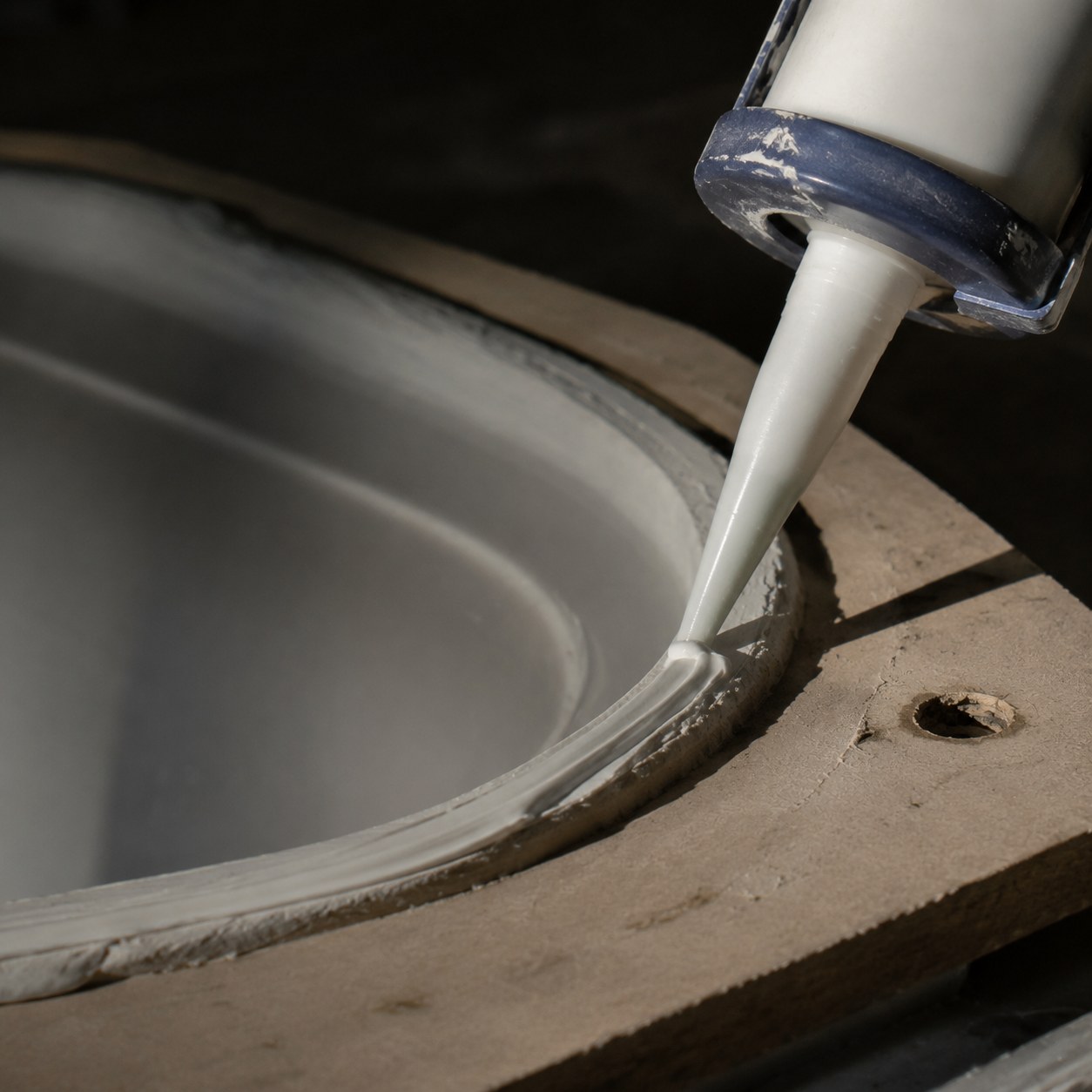
A few practical points follow from this. The whole job is done from underneath, so alignment matters — the bowl must line up neatly with the cut edge before the adhesive sets. Lighter ceramic basins can rely mainly on the adhesive and a few clips; heavier bowls need proper brackets. Installation is a little more involved than a drop-in, and most people have it fitted by a stone fabricator or plumber rather than doing it themselves.
Confirm the cut-out and tap-hole plan early
Undermount basins are usually supplied with no tap hole on the bowl, because the tap is mounted on the counter or wall behind. Decide the tap position, the overflow, and whether you want a 0-, 1- or 3-hole layout before the countertop is cut — changes are hard once the stone is drilled.
03 COUNTERTOP
What countertops does an undermount basin need?
This is the single most important thing to get right. Because the counter is cut and the exposed edge sits right at the water line, an undermount basin needs a solid, waterproof countertop: natural stone (granite, marble), engineered quartz, or a solid-surface material. These can be cut, sealed and polished at the sink opening without swelling or peeling.
Plain laminate (chipboard with a thin surface layer) is not suitable for a standard undermount. Its cut edge is not waterproof, so water creeping under the rim will eventually reach the core and cause the counter to swell and delaminate. If your worktop is laminate, a drop-in basin — whose rim covers and protects the cut edge — is the safer choice. For a fuller side-by-side, see our guide on the difference between undermount and countertop basins.
04 TRADE-OFFS
The pros and cons in plain terms
Undermount basins are popular for good reasons, but they are not the answer for every project. The advantages cluster around looks and cleaning; the drawbacks around cost and countertop dependence.
Undermount basin: pros vs cons
| Factor | Pro | Con |
|---|---|---|
| Appearance | Clean rimless look, feels built-in and premium | Only shows if the counter itself is a quality material |
| Cleaning | Wipe water straight into the bowl; no rim to trap grime | The under-rim silicone seam needs occasional attention |
| Countertop | Showcases stone or quartz beautifully | Requires solid, waterproof worktop — rules out laminate |
| Installation | Frees the whole counter surface | More involved; usually a pro fit, higher labour cost |
In short, if you are already investing in a stone or quartz vanity top, an undermount basin is a natural, understated match. If budget or a laminate top is a constraint, a drop-in gives most of the function for less.
05 COMPARISON
Undermount vs drop-in vs vessel
Three mounting styles cover almost every bathroom basin. Knowing how they differ makes the undermount decision much clearer.
Three basin mounting styles compared
| Factor | Undermount | Drop-in | Vessel |
|---|---|---|---|
| Where it sits | Below the counter | In a cut-out, rim on top | On top of the counter, like a bowl |
| Rim on counter | None | Visible rim | None (bowl stands proud) |
| Counter needed | Solid, waterproof only | Almost any, incl. laminate | Any; only a drain hole |
| Cleaning the counter | Easiest — wipe straight in | Rim can trap grime | Base-to-counter join collects dirt |
| Install effort | Moderate, from below | Easiest, DIY-friendly | Easy; taller tap needed |
| Feel | Built-in, understated | Practical, everyday | Decorative, statement |
If you want a decorative bowl on show, a vessel basin makes the statement; if you want simple and budget-friendly, a drop-in does the job; if you want the calmest, most seamless surface and you have the countertop for it, the undermount wins. Our overview of the main bathroom sink types walks through each family in more detail.
06 IN USE
Cleaning, overflow and waste
The everyday benefit people notice first is cleaning. With no rim standing on the counter, you can sweep water and dust straight off the surface into the bowl, and there is no seam sitting in the splash zone to grow grime. That is why undermount basins are common in hotels and busy family bathrooms where quick wipe-downs matter.
On the plumbing side, most ceramic undermount basins are offered with or without an overflow — the small slot near the top that stops an unattended tap from flooding the counter. Choose a waste (pop-up or click-clack) that matches: a slotted waste for basins with an overflow, an unslotted waste for those without. It is a small detail, but getting the overflow-and-waste pairing right avoids a common install headache.
Before you order an undermount basin
Confirm five things: the countertop is stone, quartz or solid surface (not laminate); the bowl external size fits your vanity; the cut-out and mounting method are agreed with your fabricator; the tap is counter- or wall-mounted (bowl usually has no tap hole); and the overflow choice matches your chosen waste.
07 WHERE IT FITS
Where undermount basins fit best — and how we help
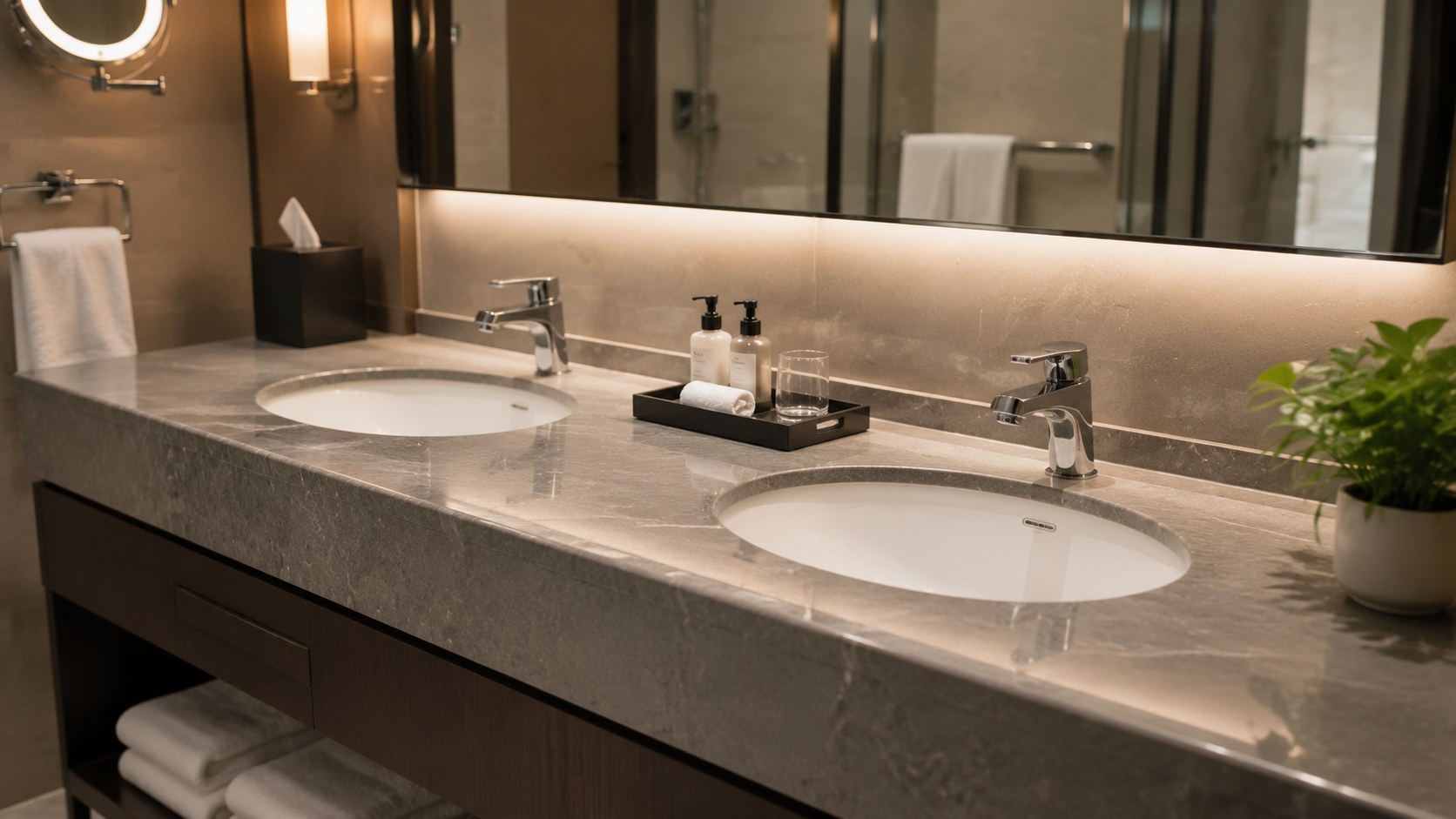
Undermount basins suit projects where the countertop is already a quality material and a calm, seamless look is wanted: upscale homes, boutique and business hotels, serviced apartments and clinics. They pair especially well with stone or quartz vanities and with wall-mounted taps for a fully rimless surface.
An undermount basin is less about standing out and more about disappearing cleanly into the countertop.
As a ceramic sanitary ware factory in Chaozhou, Guangdong, we produce undermount, drop-in, countertop, art and pedestal basins in high-fired vitreous china, with water absorption of 0.5% or lower and firing around 1250°C for a dense, hard-wearing body. Bowls can be supplied with or without overflow, in 0-, 1- or 3-tap-hole layouts, and are AQL-inspected and export-packed for project and wholesale orders. Certification support varies by product and market — buyers are welcome to request current test reports. If you are choosing sizes, our note on how to choose a ceramic basin is a useful next read.
Sometimes the best fixture is the one you barely notice — it simply lets the counter do the talking.
FAQ COMMON QUESTIONS
Frequently asked questions
What is an undermount basin in simple terms?
It is a wash basin mounted underneath the countertop instead of sitting on top of it. The rim of the bowl is hidden below the stone, so the counter surface flows straight into the basin with no visible lip. It is a mounting style, not a material — most bathroom versions are glazed ceramic.
Can I fit an undermount basin on a laminate countertop?
It is not recommended. A standard undermount exposes the cut edge of the counter right at the water line, and laminate's core is not waterproof, so it can swell and delaminate over time. Undermount basins need a solid, waterproof top such as natural stone, engineered quartz or solid surface. On laminate, choose a drop-in basin, whose rim covers the cut edge.
What is the difference between an undermount and a drop-in basin?
A drop-in (top-mount) basin has a rim that rests on the counter and holds it in place, so the lip is visible. An undermount is fixed from below with clips and adhesive, leaving no rim on top for a seamless look. Drop-ins are easier to install and work on almost any counter; undermounts look cleaner but need a solid, waterproof worktop.
Do undermount basins come with a tap hole?
Usually not. Because the basin sits below the counter, the tap is normally mounted on the countertop or the wall behind, so the bowl itself is supplied with no tap hole. Decide the tap position and the 0-, 1- or 3-hole layout before the countertop is cut. Overflow options (with or without) are also chosen at order time and should match your waste.
Are undermount basins hard to clean?
The counter is actually easier to clean — with no rim on top, you can wipe water and dust straight into the bowl. The one point to watch is the silicone seam under the rim where the bowl meets the counter; it benefits from occasional cleaning to keep it fresh, but it is not exposed on the counter surface.