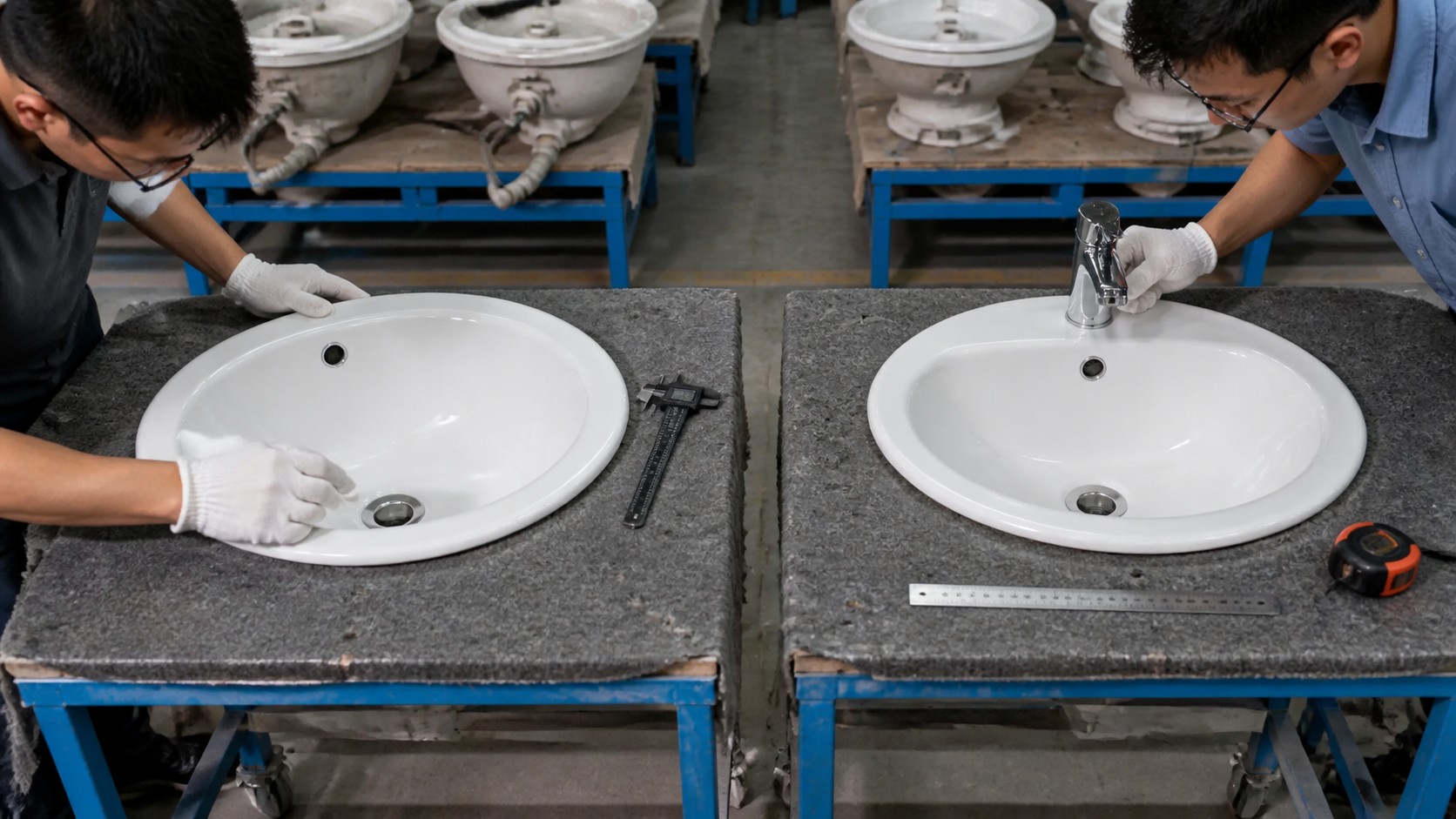
Bathroom basin tap hole size and spacing must be matched to the exact basin, faucet and installation space. “35 mm,” “4-inch centerset” and “8-inch widespread” are useful labels, but none is a complete drilling specification. This guide separates common industry values from confirmed model data and shows importers how to control samples, drawings and production.
Key takeaways
- Treat 35 mm as common, not universal: approve the faucet manufacturer’s allowed hole range against the ceramic.
- Dimension every centre: 4-inch and 8-inch describe spacing, not hole diameters or underside access.
- Trial-install the real set: verify base coverage, wall and bowl clearance, locknuts, hoses, overflow and cabinet before release.
01 READ THE LAYOUT
What do 1-hole, 4-inch and 8-inch basin layouts mean?
A single-hole basin provides one mounting opening for a compatible monobloc faucet. A 4-inch centerset layout usually places the two outer mounting centres 4 inches (102 mm) apart, while an 8-inch widespread layout places the outer centres 8 inches (203 mm) apart. The spout normally occupies the middle position on a three-hole layout, but the signed faucet and basin drawings—not the retail name—must define the actual holes.
These are separate ceramic and faucet configurations. Kohler publishes one Serif drop-in basin family as distinct single-hole, 4-inch-centres and 8-inch-centres models; American Standard likewise lists single-hole, 4-inch centerset and 8-inch widespread variants in one sink family. A three-hole basin is not created by simply adding a deck plate to a one-hole ceramic, and a one-hole basin should not be drilled on site unless its manufacturer expressly approves a method.
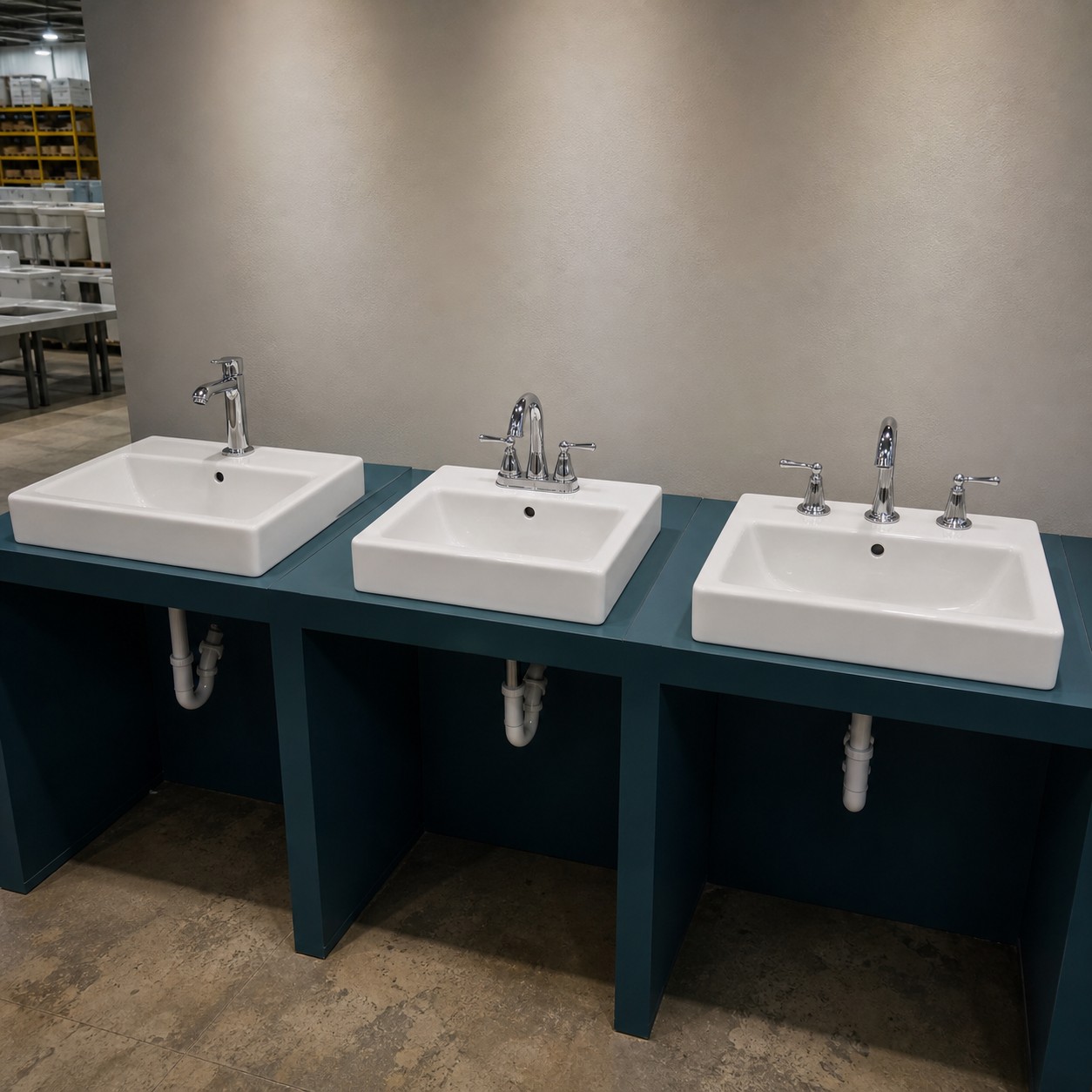
Measure spacing centre to centre. For a three-hole approval drawing, show every hole diameter, the centreline between the outer holes, the spout centre, and the location of that group from fixed ceramic datums.
02 HOLE DIAMETER
Is every bathroom basin tap hole 35 mm?
No. Kingston Brass describes 1-3/8 inch, or 34.925 mm, as an industry-standard faucet-hole diameter and immediately advises checking the product specification for differences. That makes roughly 35 mm a useful early coordination value, not a release dimension. The faucet manufacturer’s minimum and maximum opening, the ceramic supplier’s confirmed hole, and the approved sample must overlap.
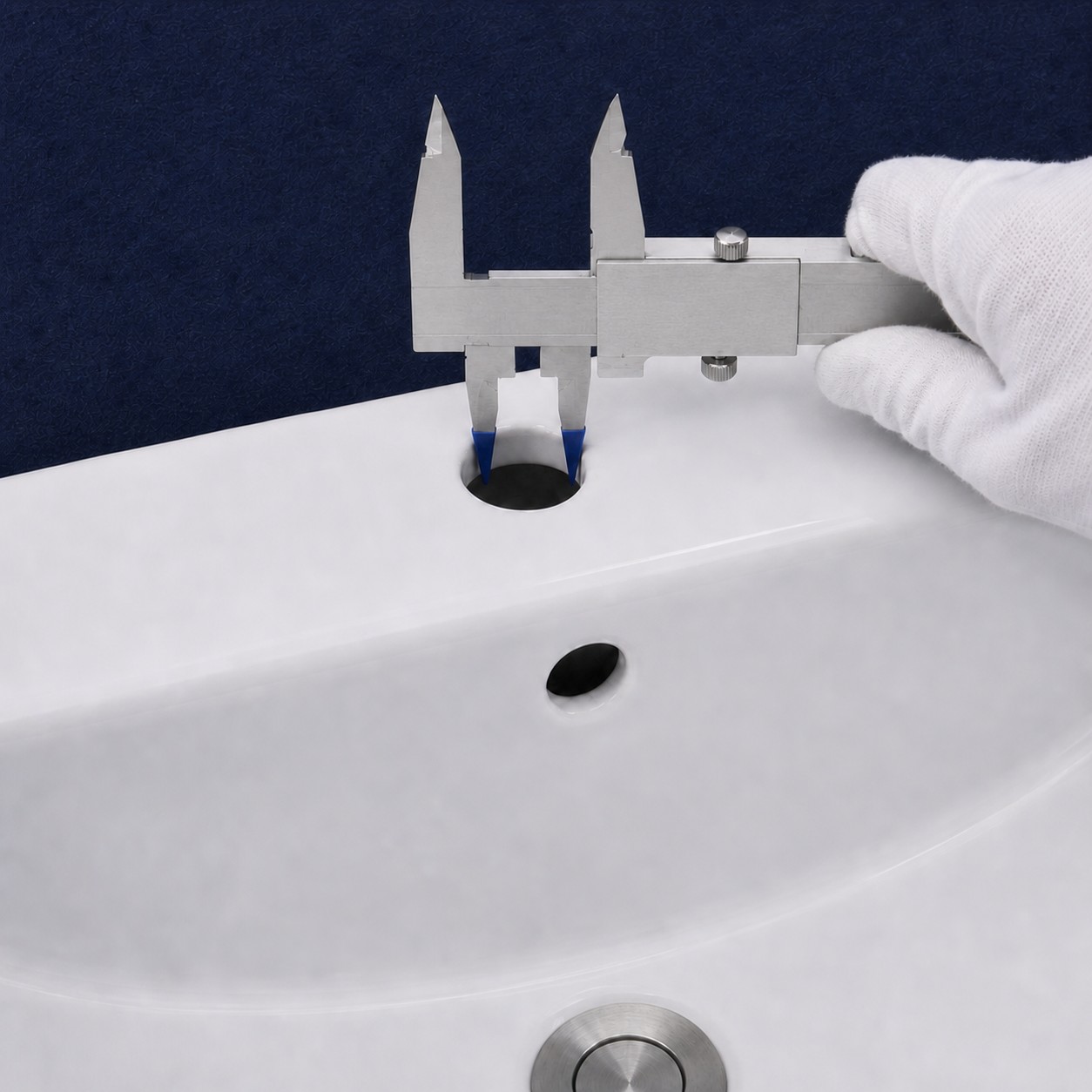
Official model sheets show why. A Kohler electronic single-hole model requires 1-1/4 to 1-1/2 inches (32-38 mm). One Delta centerset example accepts two 29-38 mm holes, while another three-hole Delta model accepts 25-38 mm holes. None of those ranges should be copied to an unrelated faucet.
The Kohler Serif basin family is even more instructive: its single-hole version lists a 35 mm spout hole, while the 4-inch and 8-inch versions show 30 mm spout holes and other faucet holes that vary by layout. Specify each opening by function. Do not turn “tap hole: yes” into “35 mm confirmed” unless the current drawing or measured signed sample actually confirms it.
03 SINGLE-HOLE
What must match on a single-hole basin and faucet?
Check more than the nominal hole. The faucet shank, water tails, studs or mounting bracket must pass through the opening, while the base gasket or escutcheon must fully cover it on the glazed surface. Confirm maximum deck thickness and usable thread length from the exact faucet sheet. A larger cover does not make an undersized hole pass the hardware, and a suitable hole does not guarantee enough thread below a thick ceramic deck.
Place the faucet so its base sits flat and its handle can travel without striking the backsplash, wall or raised ceramic edge. Spout reach and height must land the stream in a useful part of the bowl rather than on the waste cap or near wall. Kohler’s instructions for one specific electronic faucet, for example, require 44 mm behind the spout for screw access and limit the bowl-edge-to-spout-base distance to 29 mm; these are model-specific checks, not universal basin rules.
Some single-handle faucets offer an optional plate for a compatible three-hole 4-inch deck. Moen’s Kyvos sheet is one example. Use that option only when the manufacturer identifies the plate and layout; it is not evidence that any one-hole faucet can adapt to any three-hole basin.
04 4-INCH CENTERSET
How should a 4-inch centerset basin be specified?
Write 4 inches (102 mm) centre to centre between the two outer positions, then add the individual hole diameters and the middle-hole relationship shown by the selected faucet. Many compact two-handle centerset faucets combine the body or handles on a common base, but official sheets also show two-hole and three-hole mounting arrangements. Approve the exact drilling diagram rather than assuming three identical holes.
Check the footprint on top. The common base or escutcheon needs a sufficiently flat glazed landing area and must not bridge a moulded ridge, overflow feature or curved rear ledge. Confirm that the spout is centred over the bowl and that both handles clear the wall through their full travel. Delta’s 25899LF sheet, as a product-specific example, calls for 64 mm minimum clearance to the backsplash and a maximum 43 mm deck thickness.
Below the ceramic, reserve room for threaded shanks, washers, nuts, supply connections and a tightening tool. The centre group can sit close to the bowl wall or overflow channel even when it looks generous from above.
05 8-INCH WIDESPREAD
What changes with an 8-inch widespread faucet?
An 8-inch (203 mm) widespread layout normally separates the hot valve, spout and cold valve into three components, with the outer valve centres 203 mm apart and the spout centred between them. Some widespread faucets allow an adjustable range rather than one fixed spacing, so the faucet drawing controls. On the basin order, record all three centres and diameters instead of writing only “8-inch faucet”.
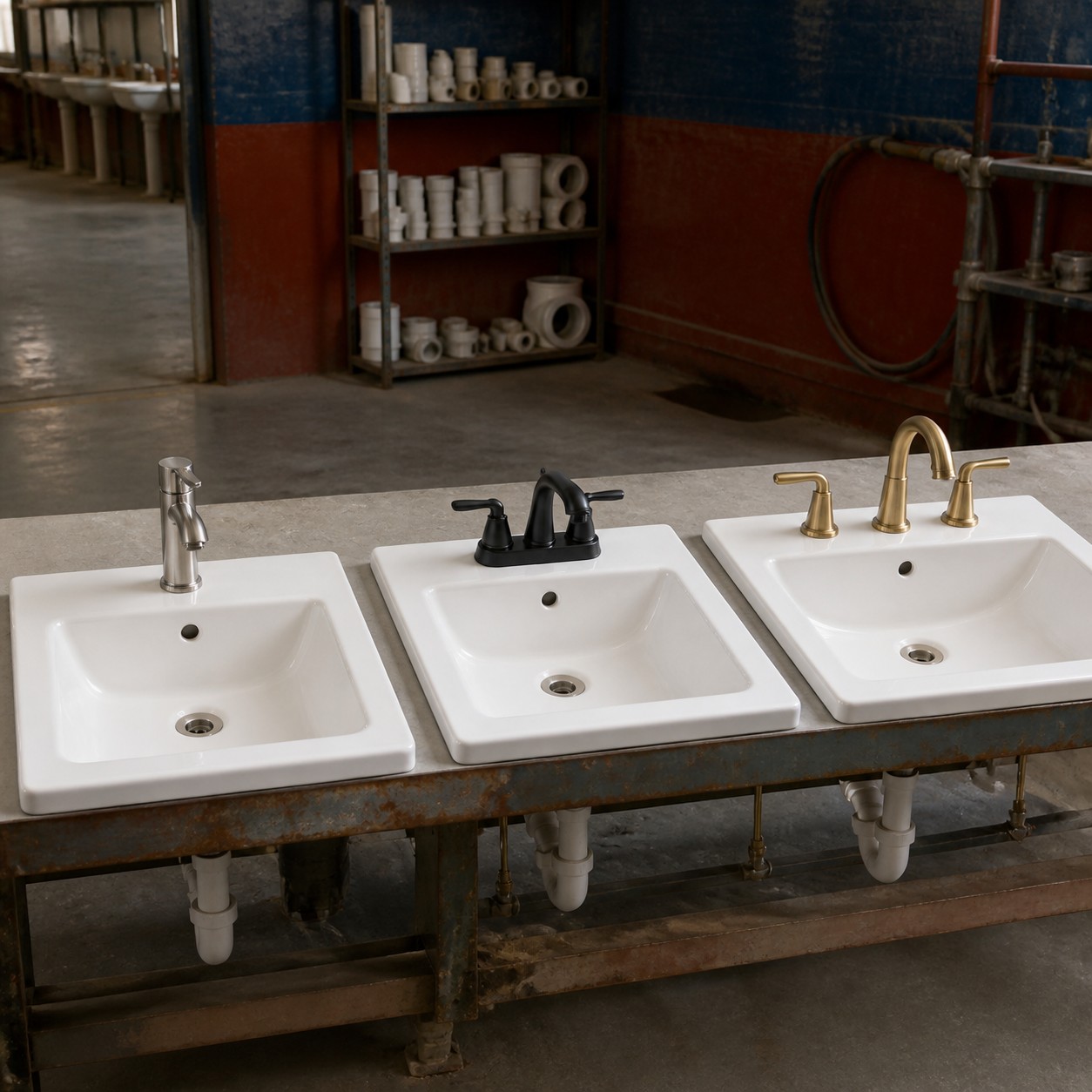
The wider layout needs a longer, flatter rear deck. Verify that each valve base sits entirely on glaze, that both handles clear the wall and basin rim, and that the spout reaches the bowl correctly. Underneath, the valve bodies and connecting hoses need independent access. Hoses must curve without kinking, rubbing a sharp ceramic edge or crossing the overflow body and drain hardware.
Do not assume that a basin family’s external size identifies its drilling. American Standard sells an 8-inch widespread Town Square S drop-in sink as a distinct predrilled variant, alongside single-hole and 4-inch variants. The product code, hole pattern and faucet kit must travel together through sample approval, purchase order, production inspection and site delivery.
06 TOP & UNDERSIDE CLEARANCE
Which clearances cause basin faucet installation failures?
Topside failures include a faucet base that does not cover the hole, an escutcheon rocking on a curved deck, a handle hitting the wall, and a spout landing too close to the bowl wall. Check base dimensions, gasket contact, handle envelope, spout reach and the distance to the finished backsplash.
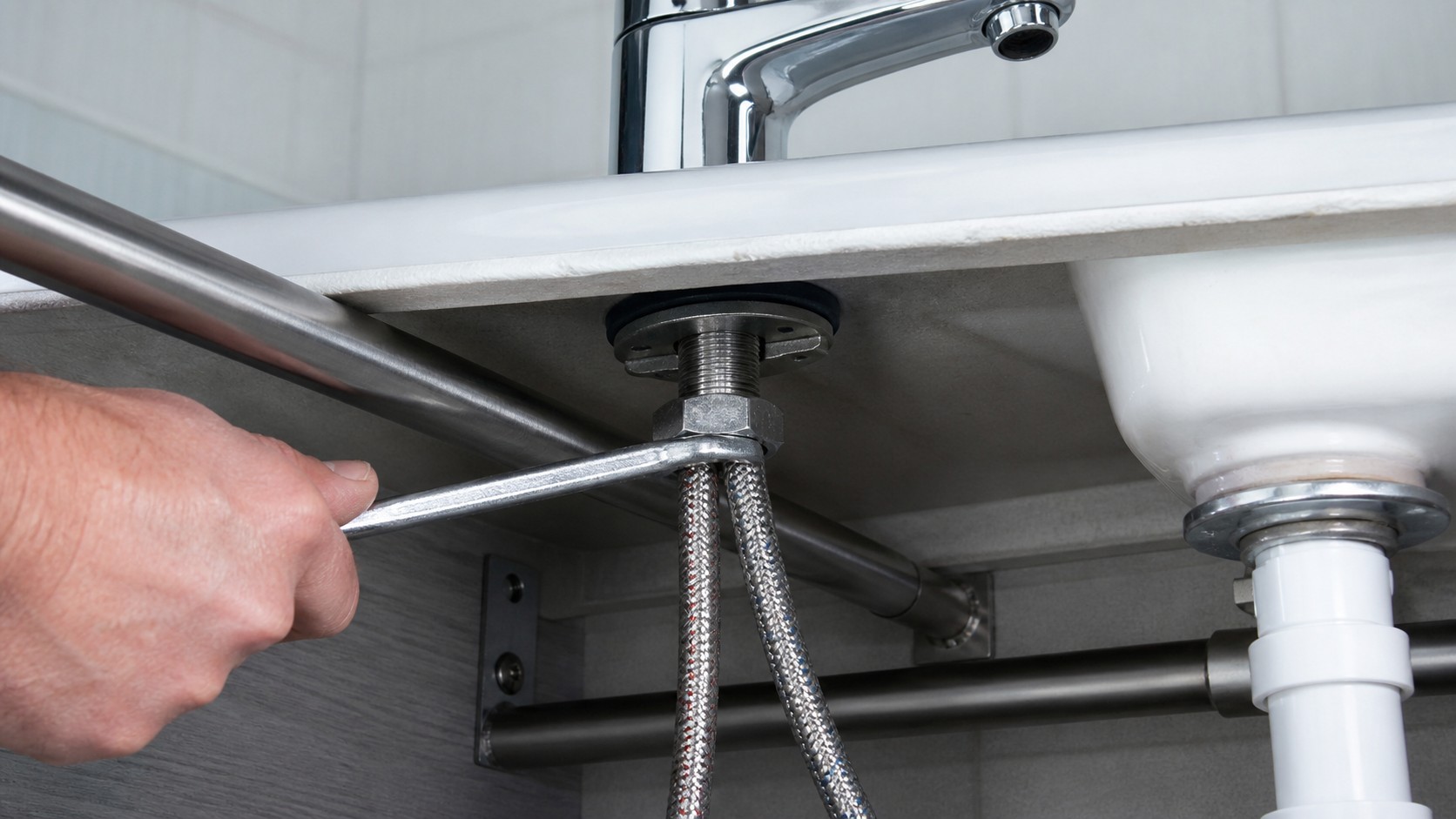
Underside failures are less visible but equally decisive. Moen’s installation sequence places a bracket over the threaded shank and then tightens a mounting nut from below; Kohler shows rubber and metal washers, nuts and an inlet hose beneath its single-hole faucet. Leave a tool path and enough hand space to assemble, tighten, inspect and later remove those parts without cutting the cabinet.
Map the hidden ceramic before approval. The bowl wall, overflow channel, drain body, fixing clips and variable ceramic thickness may reduce the apparent deck space. Add cabinet rails, drawer boxes, supply valves and worktop structure to the same section.
07 CHENGDA SAMPLE & QC
How should Chengda basin tap holes be approved?
Chengda CB0116, CB0118 and CB0120 are current no-faucet-hole drop-in basins. Their published overall sizes are 420 × 310 × 180 mm, 465 × 400 × 190 mm and 510 × 420 × 200 mm. They suit a separately coordinated countertop- or wall-mounted faucet; they are not blank versions that a site team should automatically drill. This article extends our tap-hole versus no-hole selection guide by concentrating on engineering dimensions and installation access.
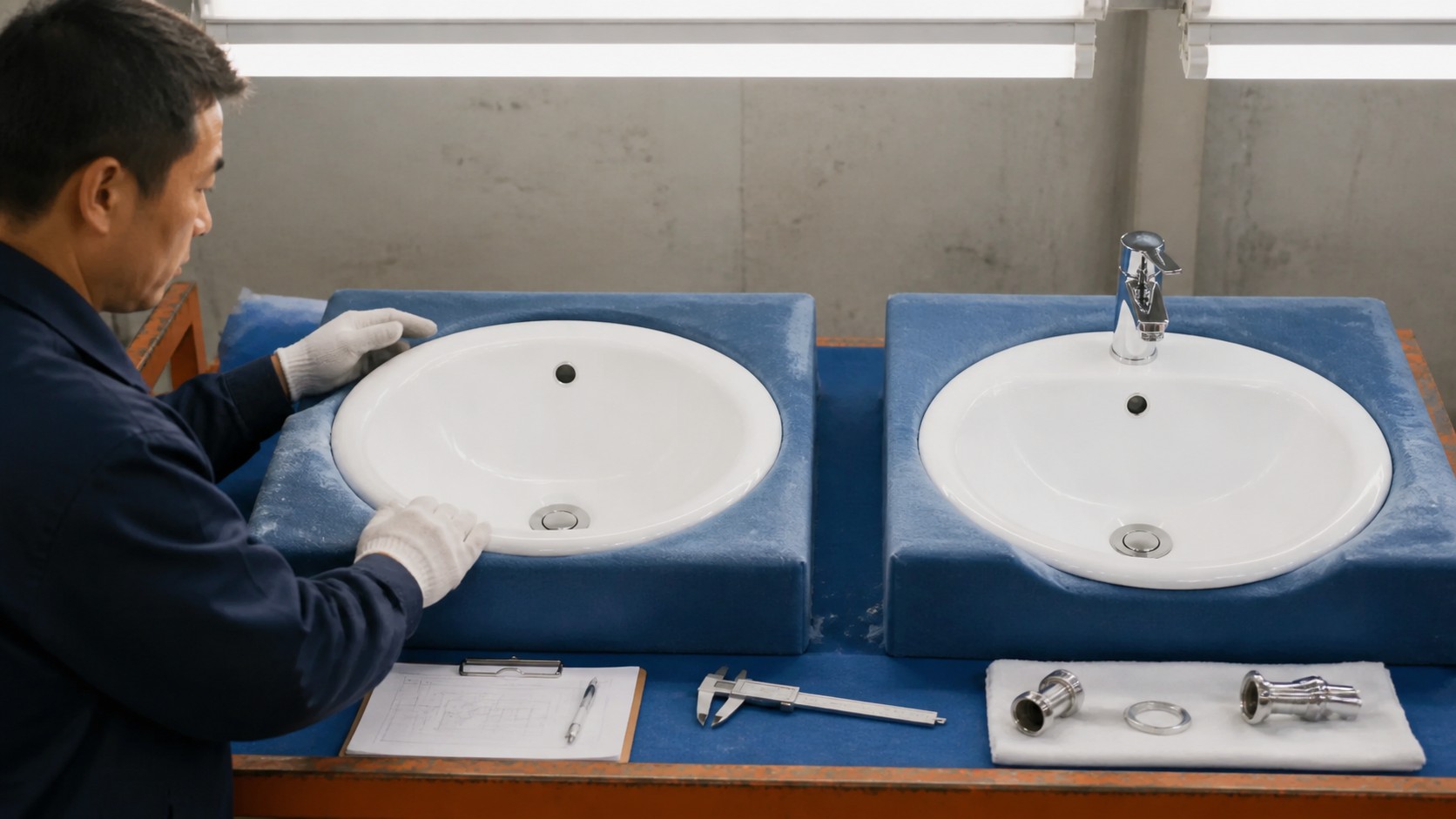
CB0218, CB0220 and CB0222 are current drop-in basins published with one faucet hole, overflow and 45 mm drain. Their overall sizes are 470 × 410 × 175 mm, 510 × 460 × 200 mm and 560 × 480 × 200 mm. The public pages do not state a tap-hole diameter, so this guide does not invent one. Request the current drawing, match the intended single-hole faucet, and confirm the production requirement on the signed sample.
For QC, define the measurement method and ceramic datums before production. Record hole diameter, centre location, deck thickness where the hardware bears, glaze coverage and edge condition. Ceramic firing can create variation, but there is no universal tolerance in this guide: the purchase drawing must state the project limit. Use protected calibrated gauges and test representative production pieces with the actual faucet, bracket, nut and hoses. The broader sanitaryware pre-shipment inspection guide covers sampling, appearance and packing control.
08 ORDER & INSTALLATION FILE
What belongs in a basin tap-hole order drawing?
State basin model and revision, faucet model and revision, hole count, diameter and tolerance for every opening, centre-to-centre spacing, hole-group location from fixed datums, local deck thickness, base or escutcheon footprint, handle movement, spout reach and water landing point. Add the overflow route, drain, fixing clips, cabinet, wall clearance, supply hoses, locknuts and service-tool envelope.
Before volume production, place the actual faucet on a signed basin sample. Pass every shank, hose and bracket through the opening; seat the gasket; tighten from below; connect supplies and waste; run water; check splash, drainage and leaks; then remove the faucet without damage. For a drop-in basin, keep the faucet exercise separate from the countertop cutout and support approval.
Freeze the approved model codes and drawing revision on the purchase order, carton mark and inspection sheet. Do not substitute a visually similar one-hole, centerset or widespread basin during packing.
A spacing name is not a complete drilling specification
Basin SKU; faucet SKU; hole count; every diameter and tolerance; 1-hole, 4-inch or 8-inch centres; datum location; deck thickness; base coverage; wall and bowl clearance; underside bracket, nut and hose envelope; overflow and drain; sample; signed drawing; production gauge; packing identity.
FAQ COMMON QUESTIONS
Frequently asked questions
What is the standard bathroom basin tap hole size?
About 1-3/8 inches or 35 mm is a common industry value, but it is not universal. Approve the exact faucet manufacturer’s permitted opening against the basin drawing and signed sample.
What does a 4-inch centerset bathroom faucet mean?
It normally means the two outer mounting centres are 4 inches (102 mm) apart. Hole count, each diameter, deck thickness and underside access still come from the exact faucet and basin drawings.
What does an 8-inch widespread basin mean?
It normally uses separate hot valve, spout and cold valve components with the outer valve centres 8 inches (203 mm) apart. Some faucets allow an adjustable range, so use the model drawing.
Can a single-hole faucet cover three basin holes?
Only when the faucet manufacturer provides a compatible deck plate for that specific three-hole layout. The plate must sit flat, seal and cover every intended opening.
How much space is needed below a basin faucet hole?
There is no universal value. Reserve the exact bracket, washer, locknut, hose and tool envelope, clear of the bowl wall, overflow, drain, clips and cabinet.
Do Chengda CB02 single-hole basins have a confirmed 35 mm tap hole?
Their public pages confirm one faucet hole but do not publish its diameter. Match the intended faucet to the current drawing and confirm the requirement on a signed sample before production.