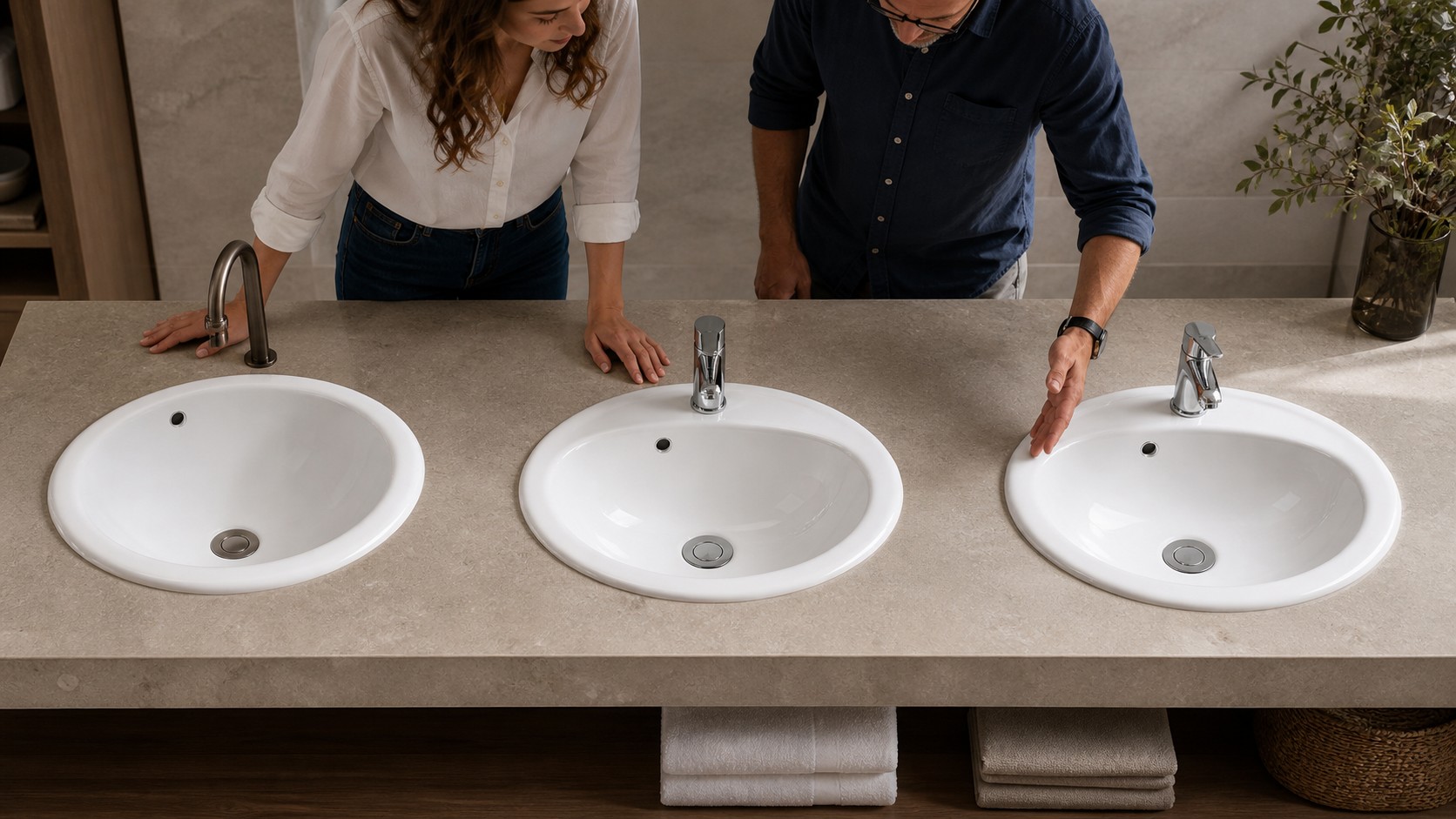
A drop-in bathroom basin remains one of the most practical ceramic formats for importers, furniture companies and renovation projects. Its visible rim sits on the countertop, covers the cut edge and creates a straightforward installation relationship. Yet buyers still need to control the opening, rim overlap, faucet-hole configuration, overflow, cabinet clearance and packing. This guide explains how to specify an inset or self-rimming ceramic basin without relying on outside size alone.
Key takeaways
- The rim is structural and visible: it must seat evenly and safely cover the opening.
- Faucet configuration matters: with-hole and no-hole models need different countertop planning.
- Replacement requires two checks: the bowl must enter the old opening and the rim must cover it.
01 PRODUCT DEFINITION
What is a drop-in bathroom basin?
A drop-in bathroom basin is inserted from above through a countertop opening. Its ceramic rim remains visible and rests on the top, helping carry the basin while the joint is sealed against water. The format is also called an inset, self-rimming or overcounter basin in different markets. For buyers, the key definition is structural: the rim sits above the counter, unlike an undermount basin fixed below it.
This familiar installation works with stone, engineered surfaces and suitable furniture tops. It can be useful for retail ranges, apartment upgrades and replacement projects because the visible rim can cover the cut edge and a limited amount of opening variation. That convenience does not make every basin interchangeable. Outer dimensions, required cutout, rim coverage, bowl depth and plumbing still need to match.
A vessel basin stands fully above the counter, while a drop-in bowl passes through it. A semi-recessed basin may project beyond the cabinet. Use exact installation language in specifications so a factory, countertop fabricator and customer are all buying the same product.
02 SIZE & OPTIONS
How do drop-in basin size and faucet holes change the choice?
Measure the countertop width and depth, cabinet interior, drawer or door, backsplash and faucet area. The useful product is not just the visible bowl. Part of the ceramic drops below the top, and the rim needs continuous seating space. A larger basin may feel more comfortable but can leave too little material at the front or back of a narrow vanity.
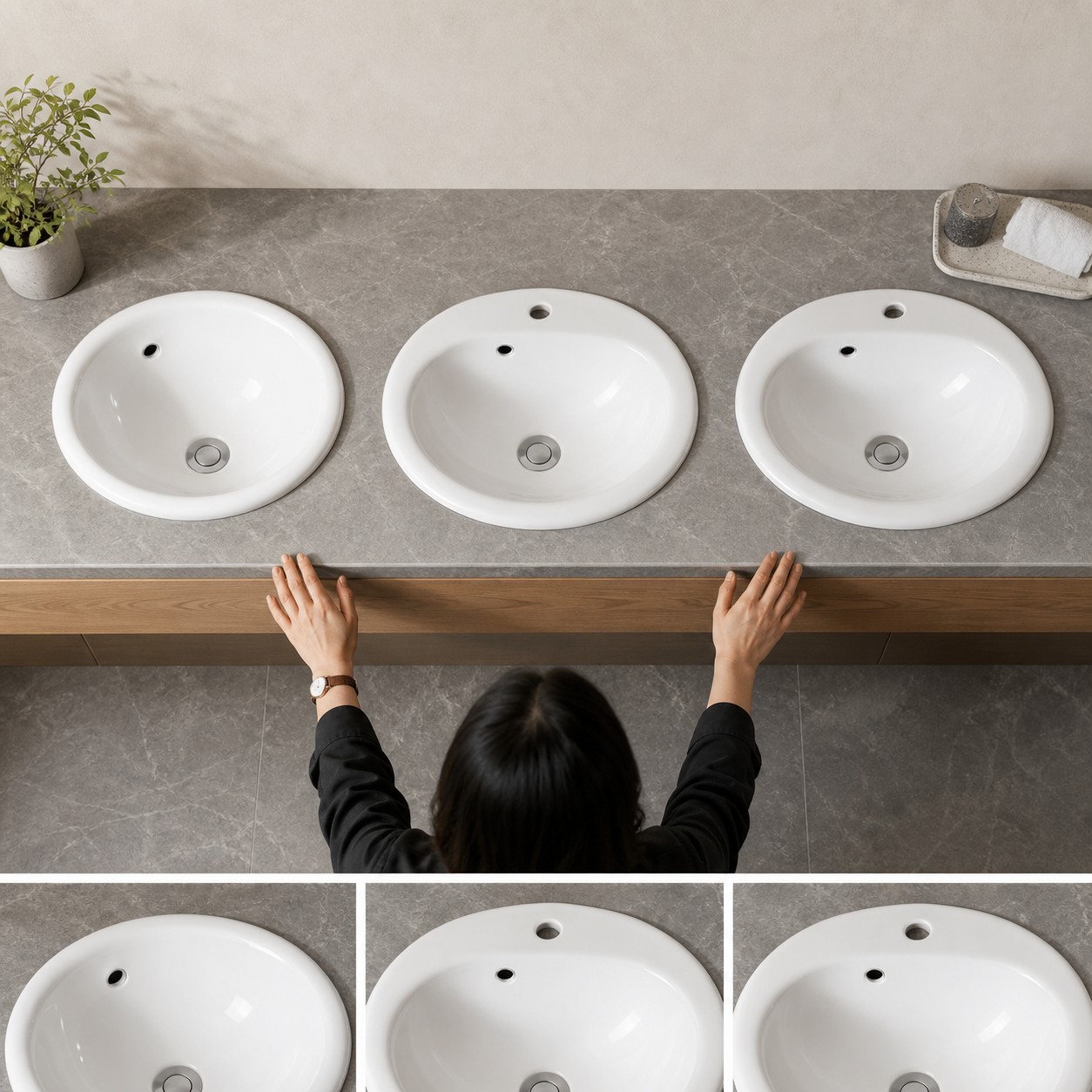
Chengda CB0116 measures 420 × 310 × 180 mm and has no faucet hole, so it uses a countertop- or wall-mounted faucet. CB0220 measures 510 × 460 × 200 mm, and CB0222 measures 560 × 480 × 200 mm; both include a faucet hole on the ceramic deck. All three are oval drop-in basins with overflow and a 45 mm drain opening. Buyers should confirm the exact hole position and compatible mixer for each SKU.
Choose a coherent range by application. A compact no-hole bowl can suit a shallow vanity with a separate mixer. Larger with-hole models simplify countertop drilling and keep the basin and faucet relationship controlled. Do not add or remove holes after firing, and never assume two similar ovals use the same opening.
03 RIM & CUTOUT
How should the countertop opening support the rim?
The opening must allow the bowl and underside features to pass through while leaving enough continuous countertop beneath the designed support rim. It should not press tightly against fired ceramic or leave the rim carrying on only a few high points. Use the current template or approved drawing and confirm whether dimensions describe the cut line or product outline.
Dry-fit the basin before applying sealant. Check that the rim seats evenly, the basin is centred, the front and rear clearances look intentional and no countertop rail blocks the overflow or drain. A rocking basin may indicate an uneven top, ceramic variation, debris or a fit problem that sealant should not be used to hide.
The visible rim can cover an opening, but it is not a license to overcut. Sufficient overlap is required around the complete perimeter, and the countertop itself must retain adequate strength. Countertop cutting and edge treatment should follow the material supplier's instructions.
04 FAUCET & DRAINAGE
Which faucet and overflow details must be confirmed?
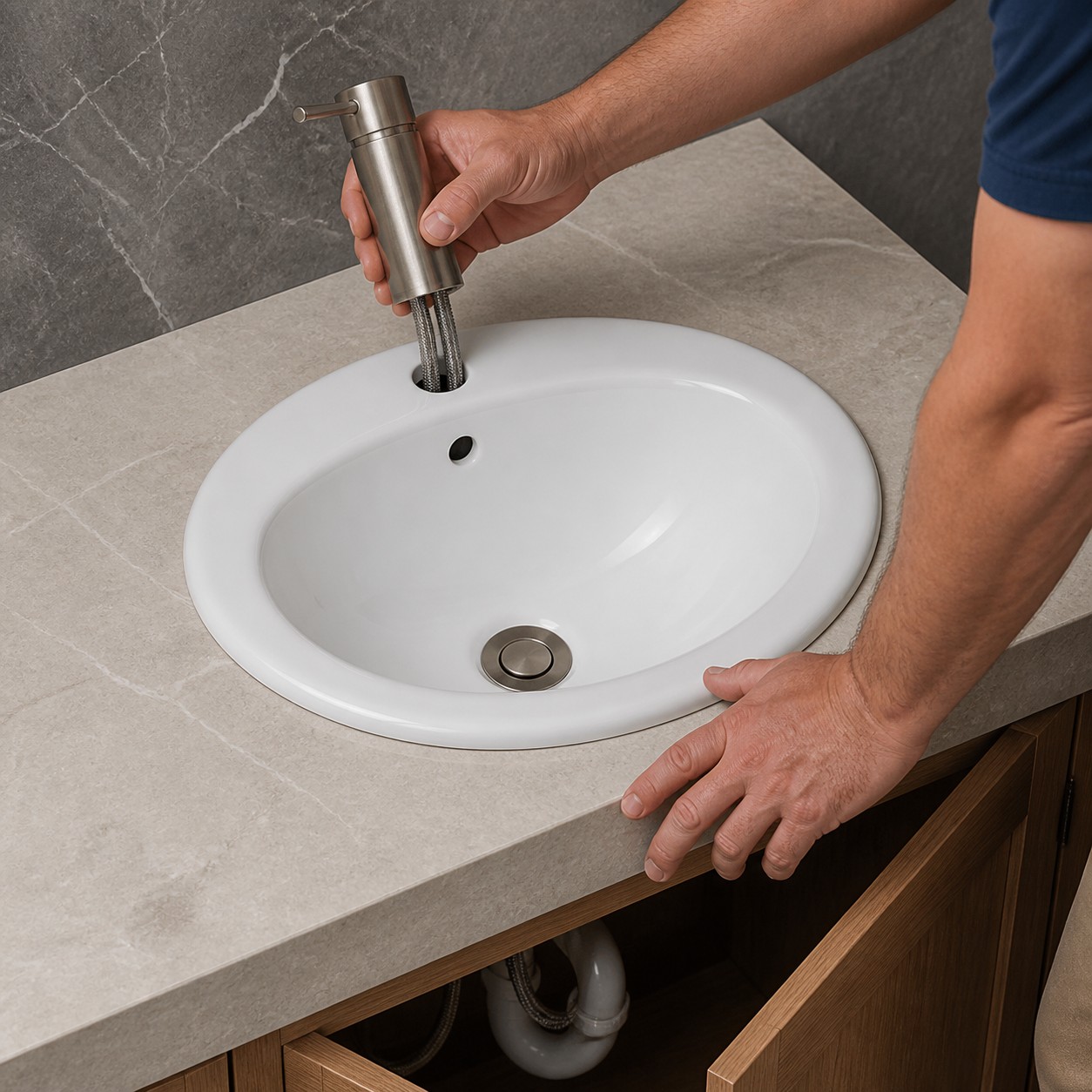
For a with-hole model, the faucet must pass through the basin's own ceramic deck. Confirm hole diameter, deck thickness, mixer base, shank length and room for the fixing nut. For a no-hole model such as CB0116, position the faucet on the countertop or wall and check spout reach against the installed bowl. Never illustrate a no-hole basin with a tap growing through its ceramic rim.
The faucet stream should land in the useful centre without striking a steep bowl wall. Test normal and higher flow for splash, hand clearance and drainage. Confirm whether the basin overflow requires a slotted waste, and map the assembled waste and trap against the cabinet interior.
List what the supplier provides: basin only, fixing or sealing materials, waste, faucet or template. Destination markets may use different thread and plumbing conventions, so generic phrases such as standard waste are not enough for a controlled order.
05 COUNTERTOP MATERIALS
Which countertops work with drop-in basins?
Drop-in basins can be coordinated with natural stone, engineered stone, solid surface, compact laminate and properly detailed furniture tops. Water resistance, cut-edge treatment, thickness and fastening method must suit the material. A visible ceramic rim can protect part of the edge from direct contact, but water can still enter a poorly sealed joint.
For stone, maintain enough material around the opening and avoid unsupported narrow strips. For wood-based tops, seal the complete cut edge according to the board system. For thin surfaces, confirm whether reinforcement is required. The basin supplier should provide geometry and fit information, while the countertop specialist owns the approved fabrication method.
Colour and texture matter commercially. A white glazed basin can look crisp against saturated terrazzo, warm timber or dark stone, but sample the combination under the project's real lighting. Check that cleaners recommended for one surface will not damage another.
06 PROJECT & RENOVATION
Why are drop-in basins practical for renovation and projects?
The visible rim makes drop-in basins a practical option for apartments, midscale hotels, schools, retail furniture and refurbishment programmes. It creates a clear transition between ceramic and countertop and can reduce the visual sensitivity of the opening compared with a fully exposed undermount reveal.
For replacement work, record the existing finished opening, available rim coverage, countertop condition, cabinet depth, drain centre and faucet location. A new basin must safely cover the opening and pass through it without weakening the top. Ordering by outside size alone may produce a rim that looks large enough but an underside that cannot enter the cutout.
For repeated project rooms, approve one complete mock-up and create a room schedule that links basin, faucet, waste, countertop and cabinet. If accessibility is required, verify the complete assembly against local rules; a drop-in label does not prove height or clearance compliance.
07 QUALITY CONTROL
What should importers inspect on drop-in ceramic basins?
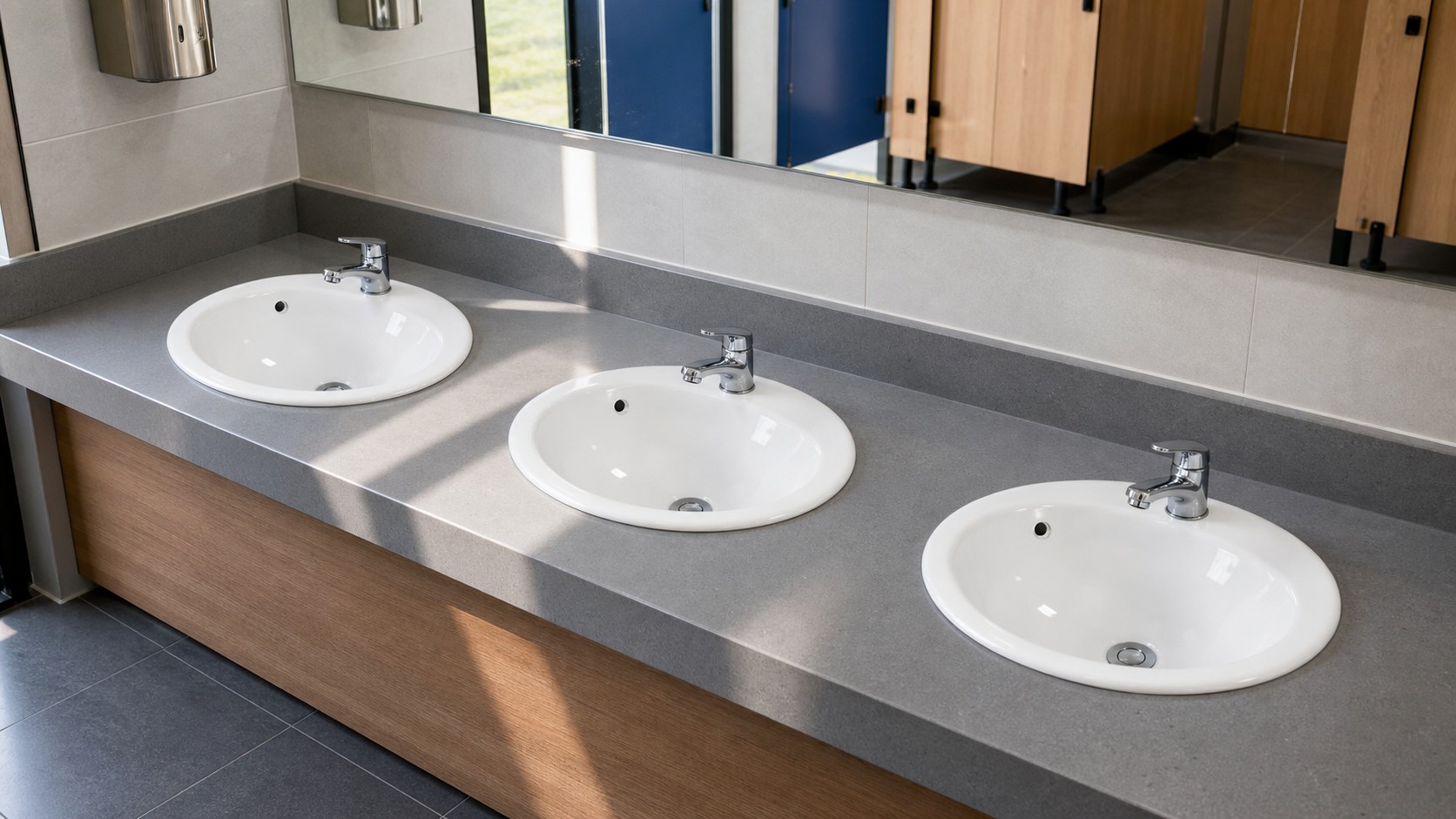
Inspect overall size, rim dimensions and flatness, bowl symmetry, drain, overflow, faucet-hole position where applicable, glaze coverage and appearance defects. Place random production basins in the approved countertop gauge to check seating, overlap and orientation. This functional fit is more useful than checking only an outside length with a tape.
Test water flow, drainage and overflow with the approved fittings. Inspect the rim underside because it contacts the counter even though customers may not see it. Define appearance zones, tolerances and measurement points in writing, and compare production with a signed sample under stable lighting.
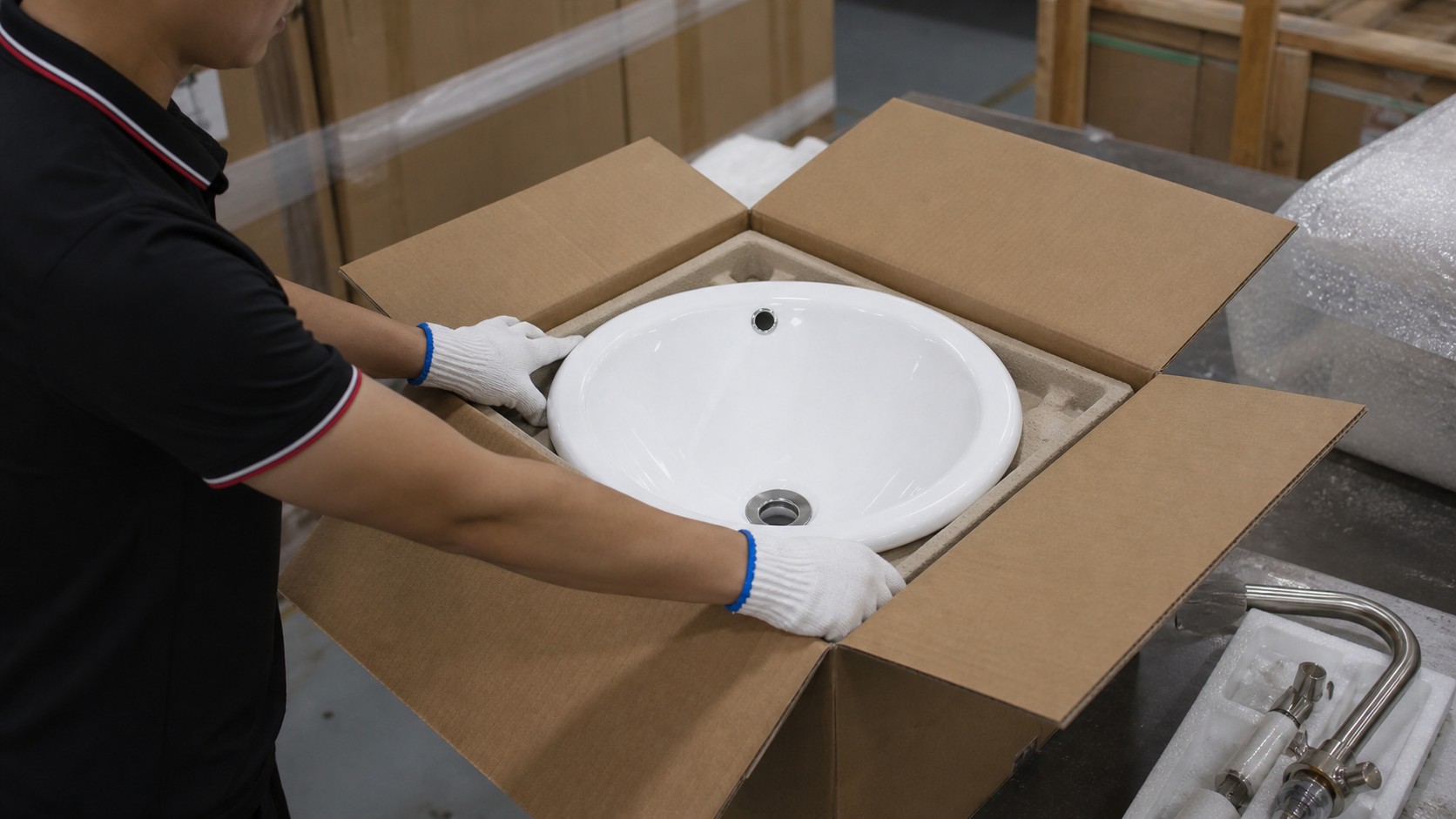
Export packing must protect the visible rim and prevent point loading. Use model-specific cushioning, keep accessories from striking the glaze and make carton identity clear. Validate the pack with the actual size; a carton that works for CB0116 may not protect a wider CB0222.
08 BUYER CHECKLIST
What should a drop-in basin order specify?
Specify SKU and revision, external dimensions, required opening, minimum rim coverage, ceramic tolerance, faucet-hole condition and location, overflow, drain, compatible waste, countertop material, sealant note, approved sample, inspection gauge, carton and spare policy. State whether faucet, waste and template are included.
Chengda supplies compact and standard oval drop-in ceramic basins for wholesalers, furniture companies and projects. Send the existing or planned countertop opening, cabinet depth, faucet preference, market and quantity. We can shortlist CB models, prepare samples and drawings, check fit and organise export QC and packing.
The reason to choose a drop-in basin is controlled practicality: a visible ceramic rim, straightforward top installation and a wide range of furniture applications. That value depends on specifying the opening and faucet configuration as carefully as the basin itself.
Define the rim, opening and fittings
SKU; revision; external size; cutout; rim overlap; tolerance; faucet-hole condition; overflow; drain and waste; countertop material; signed sample; QC gauge; carton and spare policy.
FAQ COMMON QUESTIONS
Frequently asked questions
What is a drop-in bathroom basin?
It is inserted from above into a countertop opening, with a visible ceramic rim resting on the top.
Is a drop-in basin the same as an undermount basin?
No. A drop-in rim is visible above the counter; an undermount basin is supported below and exposes the finished counter edge.
Can one drop-in basin replace another with the same outside size?
Not automatically. The new underside must pass through the existing opening, while its rim safely covers and supports around that opening.
Where should the faucet be installed?
On CB0220 and CB0222 it mounts through the ceramic deck hole. CB0116 has no faucet hole, so its faucet mounts on the counter or wall.
Should the rim be sealed?
Yes. Use a compatible sealing method to keep water out of the joint, while ensuring the rim seats evenly on the approved countertop.
What is the key QC test?
Dry-fit random production basins in the approved opening gauge and check rim seating, overlap, fittings, glaze and water performance.