Choosing the right bathroom basin size is a numbers job before it is a design job. Get the width, depth and cut-out right and installation is effortless; get them wrong and the basin fouls the tap, overhangs the vanity or drowns a small bathroom.
This is a practical guide to how to choose basin size for real projects — standard wash basin dimensions in millimetres, sensible basin depth, the difference between above-counter and undermount sizing, how to work out a countertop cut-out, and how to match a basin to a vanity or a tight bathroom. It is written the way we quote it on the factory floor, in the units your fitter and your CAD drawing actually use.
Key takeaways
- Start from the vanity, not the basin — the cabinet or countertop width sets the outer limit; the basin should sit comfortably inside it with clearance on both sides.
- Standard bathroom basin size is a range, not one number — most wash basins fall between roughly 400–600 mm wide, with cloakroom and vessel basins reaching down to 300 mm and up to 700 mm+.
- Depth and height matter as much as width — a shallow basin splashes; a tall vessel basin on a standard-height vanity can leave the rim too high to use comfortably.
- Above-counter and undermount are sized differently — above-counter uses the basin footprint, undermount uses a cut-out drawn from the manufacturer's template.
01 The dimensions
What are standard wash basin dimensions in mm?
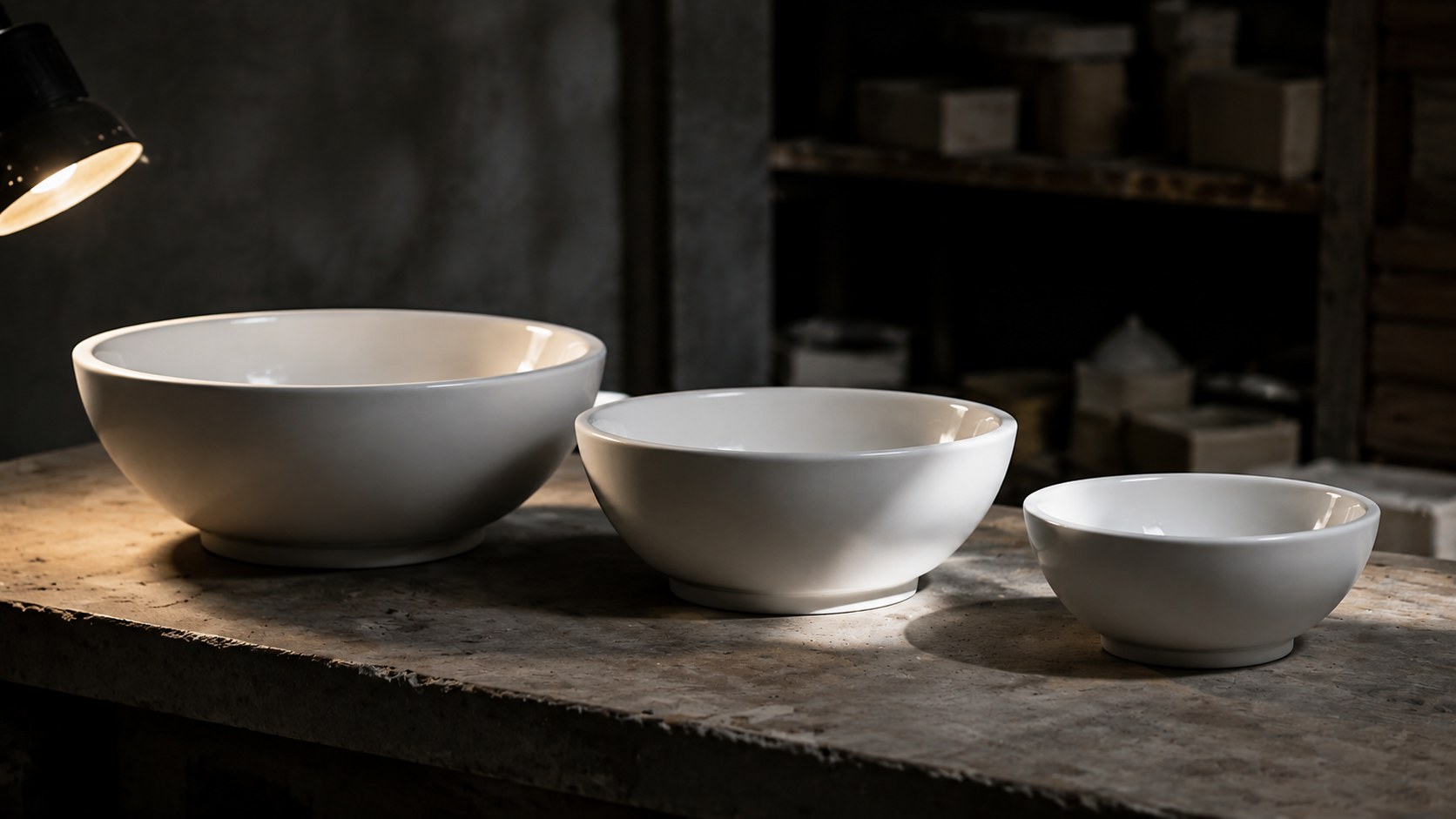
There is no single "standard" bathroom basin size — there is a working range for each basin type. Because we manufacture these to order, we think in bands rather than one fixed figure, and the band you pick should follow the space and the fixture around it. As a starting point, here are the ranges we quote most often for ceramic wash basins.
Standard bathroom basin dimensions by type (millimetres)
| Basin type | Typical width | Typical depth (front-to-back) | Bowl / basin depth | Best for |
|---|---|---|---|---|
| Cloakroom / compact | 300–400 mm | 200–300 mm | 90–120 mm | Powder rooms, tight en-suites, guest WCs |
| Standard vanity basin | 450–550 mm | 350–450 mm | 120–160 mm | Most family and hotel bathrooms |
| Above-counter vessel | 380–600 mm | 350–450 mm | 100–150 mm | Design-led bathrooms, feature vanities |
| Undermount basin | 450–600 mm | 350–450 mm | 150–180 mm | Stone / solid-surface counters |
| Double / wide unit | 1000–1500 mm | 450–550 mm | 140–170 mm | Shared and master bathrooms |
Two of those columns get overlooked. Front-to-back depth decides whether the basin actually fits the countertop from wall to edge — a 500 mm-wide basin is no use on a 380 mm-deep counter. And basin depth (bowl depth) governs splash: below about 100 mm and a strong tap will throw water onto the user; 120–160 mm is the comfortable everyday range for a wash basin.
02 Matching the space
How to choose basin size for your vanity and bathroom
The most reliable method is to work inward from the space, not outward from a basin you liked in a catalogue. Three constraints do almost all the work.
Vanity or countertop width. Measure the cabinet or the run of countertop the basin sits on, then leave clearance. As a rule of thumb, keep at least 50–100 mm of counter on each side of the basin so taps, soap and elbows have room. On a 600 mm vanity that points to a basin around 400–450 mm wide; on a 450 mm cabinet, a compact basin near 350–400 mm.
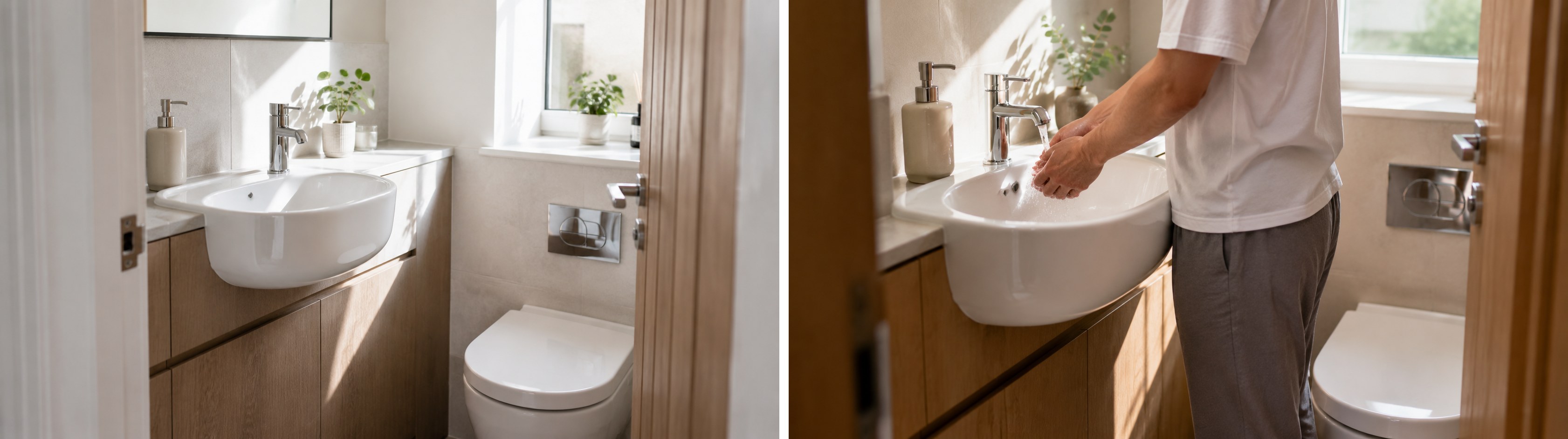
Small-bathroom sizing. In a cloakroom or tight en-suite, the door swing and the person standing at the basin matter more than the bowl. A compact basin of 300–400 mm, or a semi-recessed or corner basin, frees up floor space while still giving a usable bowl. Don't chase the largest basin that "fits" — chase the one that leaves circulation space.
Rim height. A comfortable finished rim height for most adults is around 800–850 mm from the floor. This matters most for above-counter vessel basins: the vanity height plus the basin height must not push the rim too high. If you specify a tall vessel basin, the cabinet underneath usually needs to be lower to compensate.
Then match the tap and the hole. Confirm whether the basin has one tap hole, three, or none (for wall-mounted taps), and that the tap's spout reaches over the bowl. It is a small detail that quietly ruins otherwise well-sized installations.
03 Above-counter vs undermount
Above-counter basin size vs undermount cut-out size
How you size a basin depends on how it mounts, because the number your installer needs is different in each case.
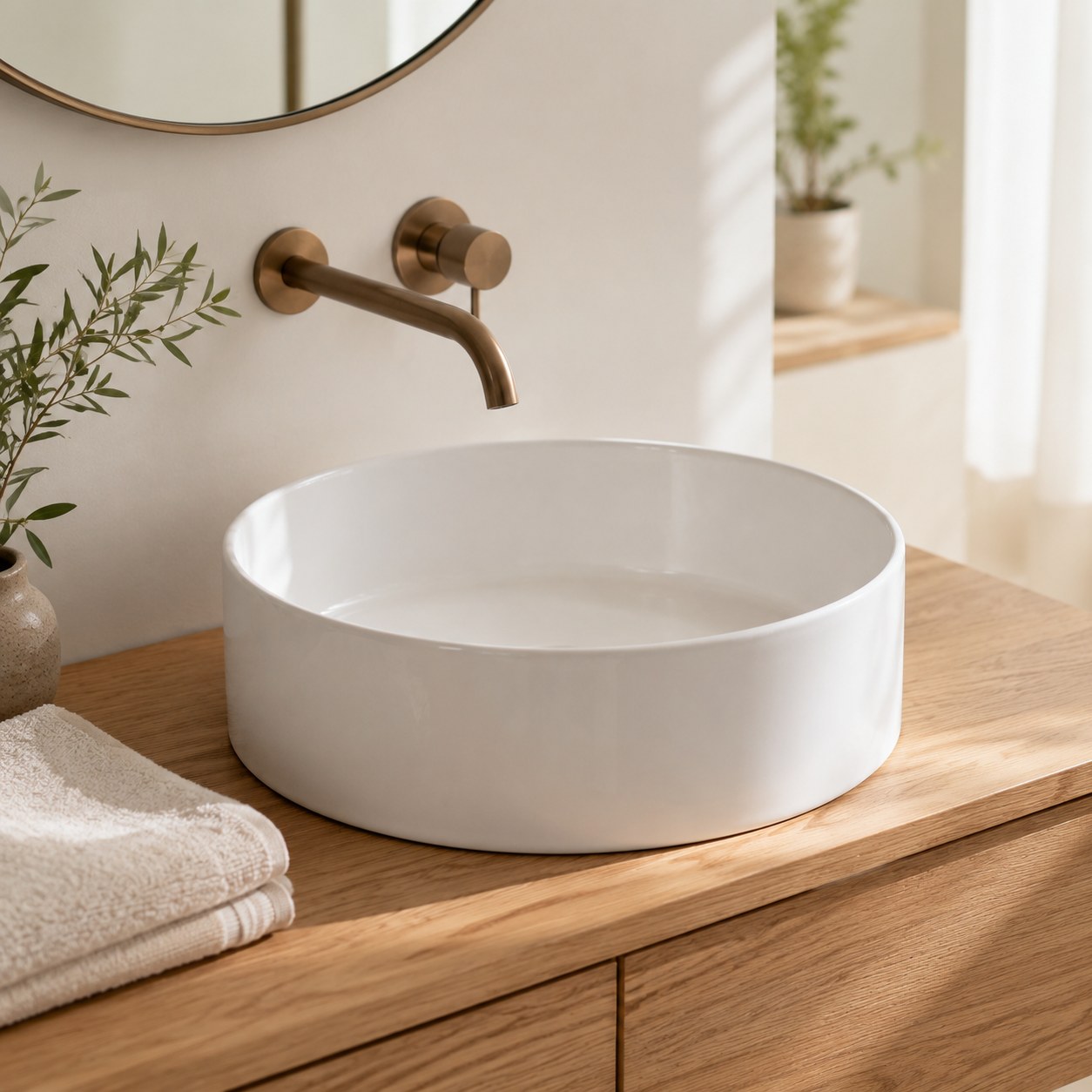
Above-counter (vessel) basins sit on top of the counter, so what matters is the basin's own footprint plus clearance around it, and the position of the drain and tap. The counter only needs a hole for the waste (and possibly the tap), not a large cut-out. The main sizing trap is height, as noted above — the basin adds its full height on top of the vanity.
Undermount basins fix beneath the countertop, so the critical figure is the cut-out size in the counter. This should always come from the manufacturer's cutting template rather than from the basin's outer dimensions, because the counter is cut to the basin's inner rim with a defined reveal (the amount of counter overlapping the bowl). A typical undermount cut-out runs a little smaller than the bowl opening; the exact numbers, corner radius and mounting-clip positions are on the template we supply with the basin.
Drop-in (self-rimming) basins sit into a cut-out but rest on their own rim, so the cut-out follows the recessed part of the basin while the rim hides the edge. For a fuller comparison of the three mounting styles, see our guides below — this article stays focused on the sizing.
Sizing what your installer actually needs
| Mounting | Key figure to specify | Where the number comes from | Common sizing trap |
|---|---|---|---|
| Above-counter | Basin footprint + rim height | Basin outer dimensions | Finished rim ends up too high to use |
| Undermount | Countertop cut-out size | Manufacturer's cutting template | Cutting to outer size instead of the template |
| Drop-in | Cut-out + rim overhang | Manufacturer's template | Cut-out too large — rim can't cover it |
| Wall-hung | Width + bracket / bolt centres | Basin drawing + fixing spec | Fixings miss the wall reinforcement |
Whichever style you choose, ask the factory for a dimensioned drawing before you commit. As an OEM/ODM ceramic sanitaryware manufacturer in Chaozhou, we provide sizing drawings and cut-out templates with samples so the counter and cabinet can be prepared to match — and so a reorder next year lands on the same millimetres.
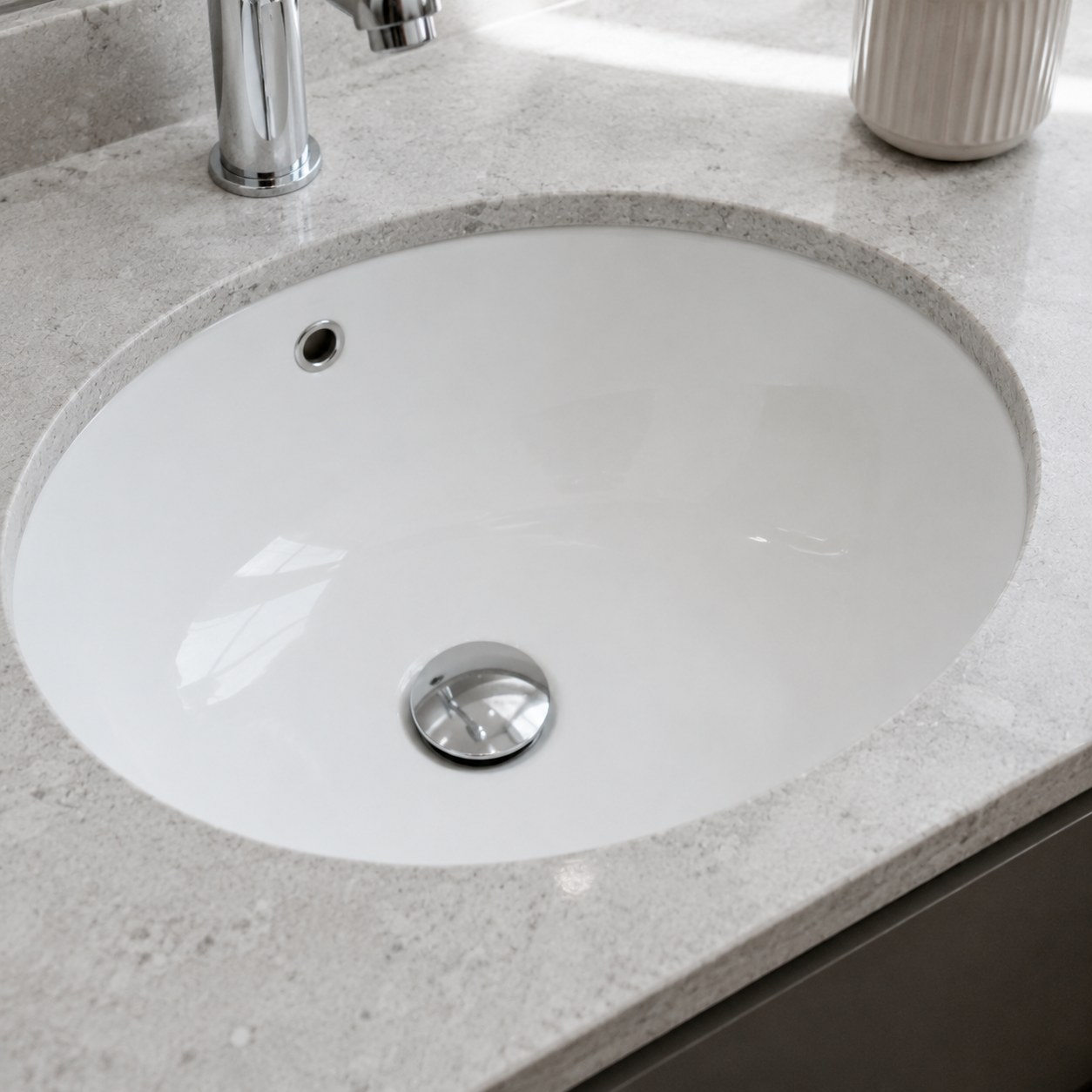
The right basin size is rarely the biggest one that fits — it's the one that leaves room for the tap, the counter and the person using it.
04 FAQ
Bathroom basin size: common questions
What is the standard size of a bathroom basin?
There is no single standard — most wash basins fall in a range of roughly 400–600 mm wide and 350–450 mm front-to-back. Compact cloakroom basins go down to about 300 mm, while wide and double units run from 1000 mm upward. Choose within the range that suits your vanity and space rather than a fixed figure.
How deep should a bathroom basin be?
For everyday use, a bowl (basin) depth of about 120–160 mm is comfortable and controls splashing. Shallower basins below roughly 100 mm can splash under a strong tap, while very deep basins can feel awkward for handwashing. Balance depth against the rim height once the basin is on its vanity.
How do I work out the countertop cut-out size for an undermount basin?
Use the manufacturer's cutting template, not the basin's outer dimensions. The counter is cut to the basin's inner opening with a defined reveal, and the template gives the exact cut-out size, corner radius and mounting positions. Cutting to the outer size is the most common undermount error.
What size basin is best for a small bathroom?
In a small bathroom or cloakroom, a compact basin of about 300–400 mm wide, or a semi-recessed or corner basin, keeps circulation space clear. Prioritise the door swing and standing room over bowl size — the largest basin that "fits" is often the wrong choice.
How much space should there be between the basin and the edge of the vanity?
Leave at least about 50–100 mm of countertop on each side of the basin. That clearance gives room for taps, soap and the user's hands, and stops the basin from looking crammed onto the cabinet. On a 600 mm vanity that suggests a basin around 400–450 mm wide.
Can a factory make a basin to a custom size for a project?
Custom sizes are possible for OEM/ODM orders, though new dimensions usually mean new moulds, so there are minimum-order and tooling considerations. It is best to share your target width, depth, mounting style and volumes early, and confirm everything against a dimensioned drawing and sample.
05 Before you order
The spec checklist before you order basins
Before you place a purchase order or approve a mould, pin down the numbers so the basin, counter and cabinet all agree. Confirm the basin width and front-to-back depth against the vanity; the bowl depth and finished rim height; the mounting style and matching cut-out or fixing spec; the number and spacing of tap holes; and the waste position. For custom dimensions, remember that a new size generally means new tooling, so it helps to settle specifications and volumes at the quotation stage rather than after sampling.
Chengda has manufactured ceramic wash basins, toilets and bathroom sanitaryware in Chaozhou for over 25 years, supplying importers and projects in more than 50 countries. If you tell us the space and the mounting style, we can recommend a basin size, send a dimensioned drawing and cut-out template, and quote for OEM/ODM production.