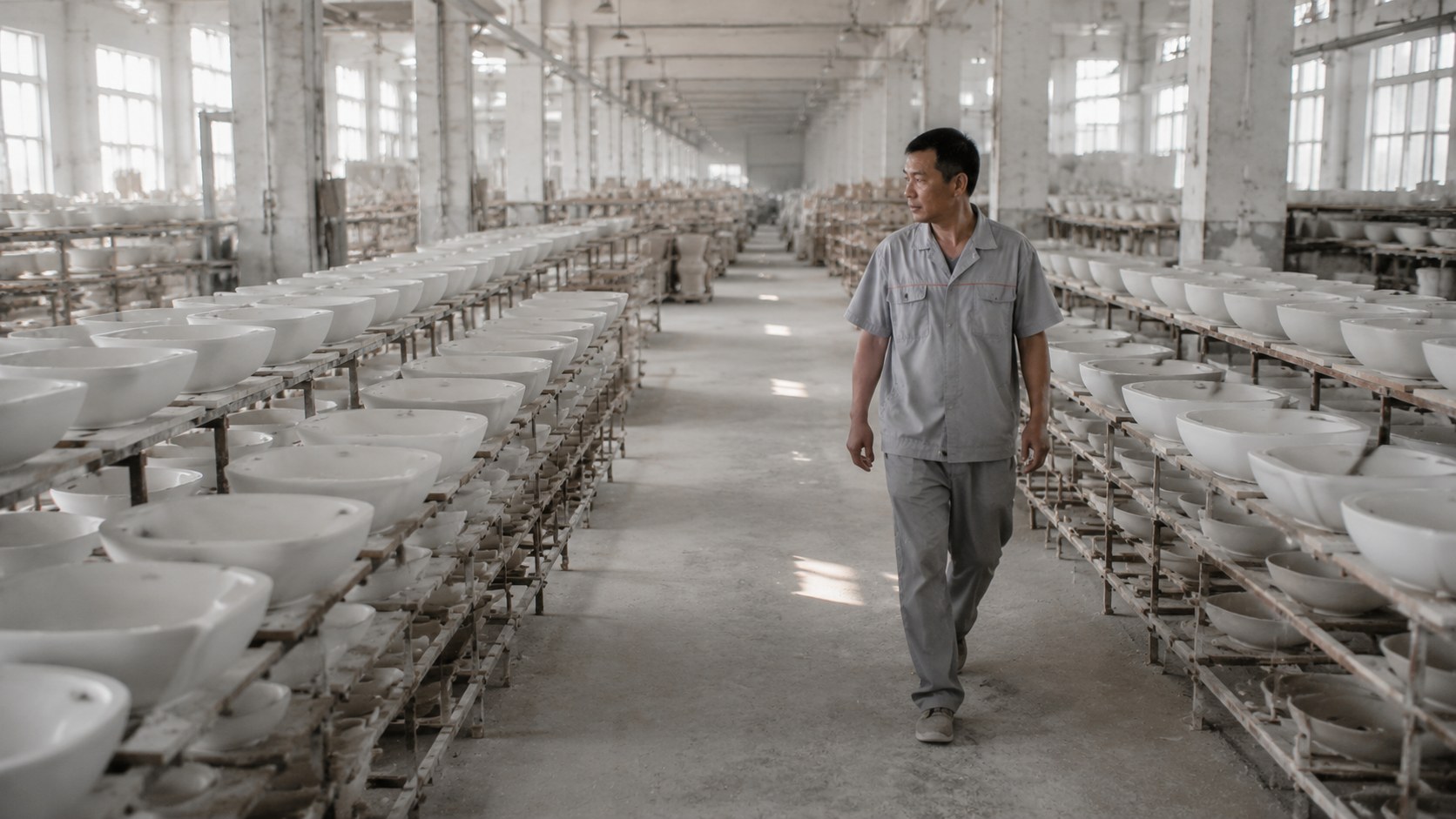
Knowing how to inspect ceramic sanitaryware before shipment is the single cheapest way to protect an order. Once a container leaves the port, a cracked rim or a hairline glaze fault is your problem — so the checks that matter all happen on the factory floor.
This is a practical pre-shipment inspection guide for importers and project buyers sourcing ceramic basins, toilets and urinals from China. It covers the defects to look for, the dimensional and functional tests to run, how AQL sampling works, and the step-by-step workflow a good factory should welcome. It continues our "inside the factory" series — the same production floor, seen through a quality lens.
Key takeaways
- Inspect at the factory, not the port — a pre-shipment inspection catches defects while they can still be sorted, reworked or re-fired.
- Know the ceramic defects — crazing, pinholes, glaze bubbles, warping and iron spots each have a different cause and a different tolerance.
- Test function, not just looks — water absorption, flush performance and dimensional fit decide whether the piece works, not only whether it's pretty.
- Use AQL sampling — a defined sample size and accept/reject limits turn a vague "looks fine" into a repeatable pass/fail decision.
01 Why it matters
Why inspect ceramic sanitaryware before shipment?
Ceramic sanitaryware is fired, heavy and brittle. Unlike most products, it can't be reworked once it's boxed and stacked in a container — a chipped basin or a warped toilet is scrap. That makes the pre-shipment window the last, and cheapest, moment to catch a problem.
Guangdong Chengda Intelligent Technology Co., Ltd. is a ceramic sanitaryware factory in Chaozhou, Guangdong, exporting basins and toilets to buyers in over 50 countries. In 25 years we've learned that the buyers who ask hard questions about quality control — and who inspect before shipment — are the ones who reorder without disputes. A factory that hides its inspection is a warning sign; one that invites you to sample the packed goods usually has nothing to hide.
A structured inspection answers three questions before your money is on the water: Is the product free of defects that a customer would reject? Does it meet the agreed dimensions and function? And is it packed to survive a long ocean voyage and rough handling at both ends?
02 The defects
What ceramic sanitaryware defects should you look for?
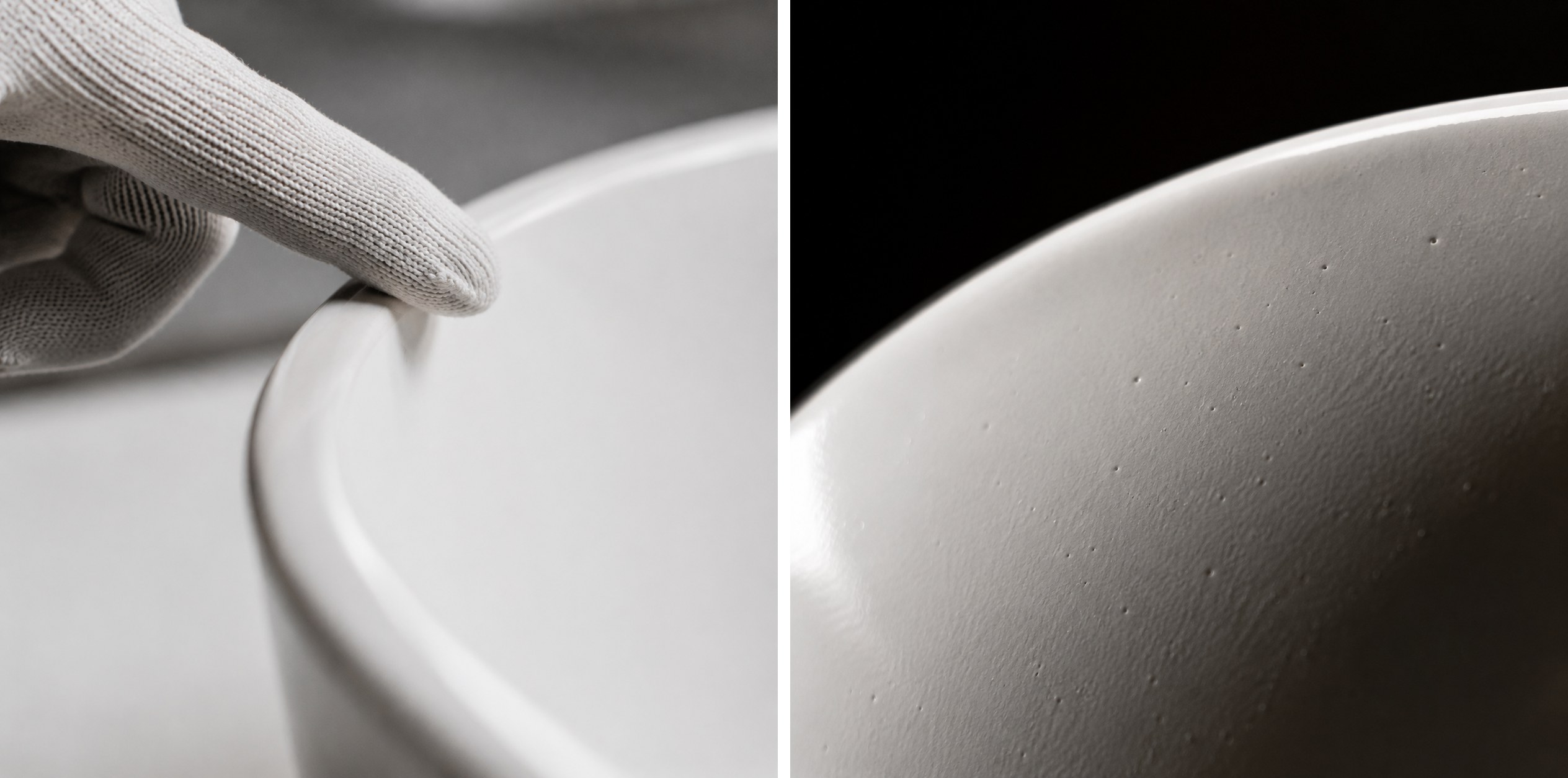
Most rejections come down to a short list of recurring faults. Learn to recognise them and you can inspect a piece in seconds. Some are cosmetic; others signal a body or firing problem that affects the whole batch. Inspect under good light, run a bare hand over the surface, and tap the piece — a sound ceramic body rings, a cracked one thuds.
Common ceramic sanitaryware defects — how to spot them and what they mean
| Defect | How it shows | What it usually means |
|---|---|---|
| Crazing | Fine hairline cracks in the glaze, like a spider web | Glaze-to-body fit or thermal mismatch; can trap dirt and worsen over time — a functional reject. |
| Pinholes | Tiny pits or holes in the glaze surface | Trapped gas or contamination during glazing/firing; small numbers may be a minor defect, clusters are not. |
| Glaze bubbles | Blisters or raised bumps under the glaze | Over-firing or gas release; affects surface hygiene and appearance. |
| Warping | Uneven rim, rocking base, out-of-round bowl | Shrinkage or firing-support issue; causes poor fit to cabinets, counters and seats — check with a straightedge. |
| Iron spots | Dark specks in the white body | Stray iron in raw materials or slip; cosmetic but very visible on white ware. |
| Chips & cracks | Edge damage, rim chips, structural cracks | Handling or a body fault; structural cracks are always a critical reject. |
It helps to sort findings into three levels, the way professional inspectors do: critical (unsafe or unusable — cracks, major leaks), major (a customer would reject it — obvious warping, heavy crazing, clustered pinholes) and minor (small cosmetic flaws within tolerance). Agree with your supplier in advance which level applies to which defect — that shared standard is what keeps an inspection objective.
03 Dimensional & functional
How to run dimensional and functional checks
A flawless-looking basin that doesn't fit the cabinet, or a toilet that doesn't flush cleanly, is still a return. Appearance is only half the inspection. These are the checks that confirm the product actually works.
Dimensional checks. Measure overall length, width, height, bowl depth and tap-hole spacing against the approved drawing or golden sample. Set the piece on a flat surface to confirm it sits without rocking, and check that rims are flat and true. Small ceramic shrinkage variation is normal, so work to an agreed tolerance rather than expecting zero deviation.
Water absorption. A well-vitrified vitreous-china body has low water absorption, which resists staining, odour and long-term cracking. Labs test this by weighing a fired fragment dry, boiling or soaking it, then reweighing. On the floor you can't do the full lab test on finished goods, but you can ask the supplier for their water-absorption data and confirm the body is properly vitrified.
Flush and water tests (toilets). For toilets, run a real flush test — check that the bowl clears, the trapway doesn't leak and the tank fittings seal. A simple ink or water test on basins confirms the drain and overflow are sound and the glaze doesn't leak at the waste.
Fittings and accessories. Confirm seats, hinges, flush valves, brackets and fixing kits are the agreed model, present in every carton and undamaged. Missing fittings are one of the most common post-delivery complaints and one of the easiest to catch.
04 Sampling & workflow
How does AQL sampling and the inspection workflow work?
You can't inspect every piece in a large order, and you don't need to. AQL (Acceptable Quality Limit) sampling uses a statistically sound random sample to judge the whole lot. The inspector draws a sample size based on the batch quantity (using the standard AQL tables), sorts every defect found into critical / major / minor, and compares the counts against pre-agreed accept/reject limits. If the majors exceed the limit, the lot fails — no arguing over a single unit.
Here is the pre-shipment inspection workflow, step by step:
1. Agree the standard first. Before production, fix the golden sample, the drawing, the defect classifications and the AQL levels in writing. An inspection is only as good as the standard behind it.
2. Inspect when goods are 100% made and ~80% packed. This is the classic pre-shipment inspection point — enough is finished to judge the whole lot, but cartons are still open enough to check.
3. Pull a random sample. Draw cartons from across the lot, not just the front row, and open them to the AQL sample size.
4. Check appearance, dimensions and function. Run the defect, dimensional and functional checks above on every sampled piece.
5. Verify quantity, labelling and packaging. Confirm counts, model numbers, barcodes and carton markings match the order.
6. Record and decide. Log every defect with photos, total the counts, and issue a clear pass or fail against the AQL limits.
05 Packing & independence
How to check packaging, loading and third-party inspection
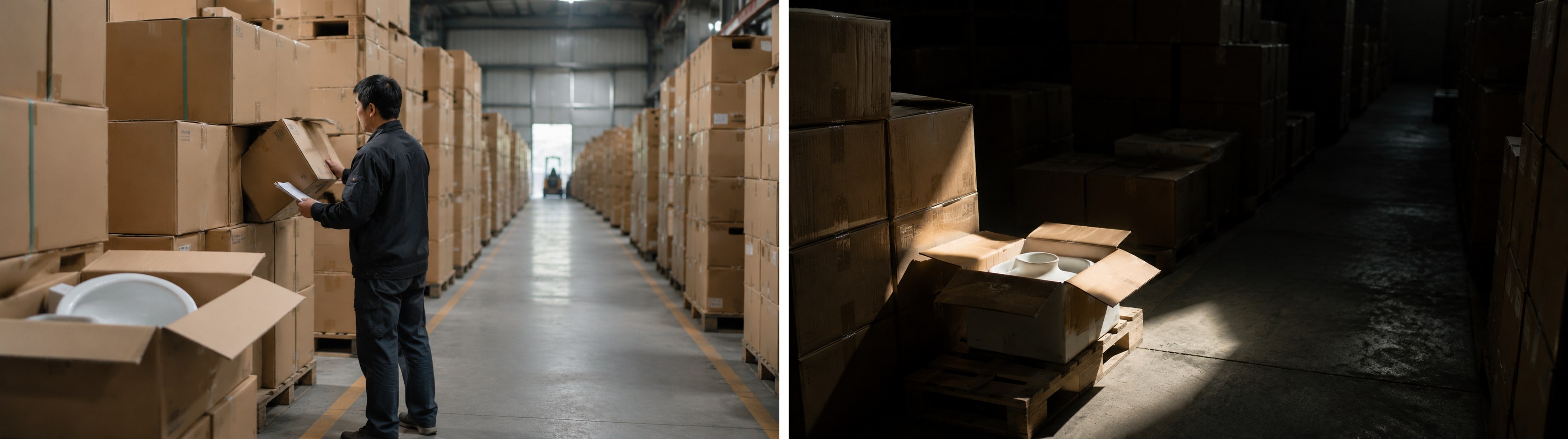
With ceramics, packing is not an afterthought — it's the difference between a clean delivery and a container of chipped rims. Even perfect goods fail if they're badly boxed.
Packaging. Check that each piece has enough foam, corner protection and inner support, that cartons are strong enough to stack, and that toilets and basins are boxed to resist point loads. Drop and stacking behaviour matters more than how the carton looks.
Container loading. A loading check confirms goods are stacked and braced so they don't shift at sea, that heavy items sit low, and that the container is dry and sound. Photos of the loaded container are cheap insurance.
Factory self-inspection vs third-party inspection. A capable factory runs its own QC at every stage and should share the results. Many buyers add an independent third-party inspection for larger or first-time orders — an outside inspector gives an unbiased AQL report. The two aren't in conflict; a factory confident in its quality welcomes both. Certification support varies by product and destination market, so ask your supplier which documents are available for your specific items and market rather than assuming a blanket claim.
The factories worth working with don't fear inspection — they build for it, and they'll hand you the light and the tape measure themselves.
06 FAQ
Pre-shipment inspection: common questions
How do you inspect ceramic sanitaryware before shipment?
Inspect a random AQL sample of the finished, packed goods on the factory floor. Check appearance under good light for defects like crazing, pinholes, glaze bubbles, warping and chips; verify dimensions against the approved sample; run water-absorption, flush and drainage checks; and confirm quantity, labelling and packaging. Record every defect and decide pass or fail against agreed limits.
What are the most common ceramic basin and toilet defects?
The recurring faults are crazing (hairline glaze cracks), pinholes and glaze bubbles, warping or an out-of-round rim, iron spots in the white body, and chips or cracks from handling. Cracks and leaks are always critical rejects; cosmetic flaws are judged against an agreed tolerance.
What is AQL inspection for sanitaryware?
AQL (Acceptable Quality Limit) sampling inspects a statistically chosen random sample rather than every unit. Defects are sorted into critical, major and minor, then compared against pre-agreed accept/reject limits. If the defect count exceeds the limit, the whole lot fails — giving both sides an objective, repeatable pass/fail rule.
Should I use a third-party inspection company in China?
For larger or first-time orders, an independent third-party inspection adds an unbiased AQL report on top of the factory's own QC. It's a reasonable safeguard and a reputable factory will welcome it. For repeat orders with a trusted supplier, many buyers rely on the factory's documented self-inspection and photos.
When should the pre-shipment inspection happen?
The standard point is when goods are 100% manufactured and roughly 80% packed. Enough is finished to judge the whole lot, and cartons are still open enough to sample, check packaging and confirm quantities before the container is sealed.
How do I check that ceramic sanitaryware is properly vitrified?
A well-vitrified vitreous-china body has low water absorption, which you confirm through the supplier's water-absorption test data and by checking the body is dense and hard. Low absorption resists staining, odour and cracking, so it's a fair spec to request and verify before shipment.
07 The series
Where inspection fits in the factory story
Inspection is the last gate in a chain that starts long before it — with stable raw materials, a controlled casting slip and the right firing temperature. If you want to understand why a piece passes or fails, it helps to see how it was made. Read the rest of the series to follow a basin from raw clay to the packed carton, and you'll inspect with a sharper eye. If you're sourcing basins, toilets or urinals, that background is the fastest way to tell a disciplined factory from an average one.