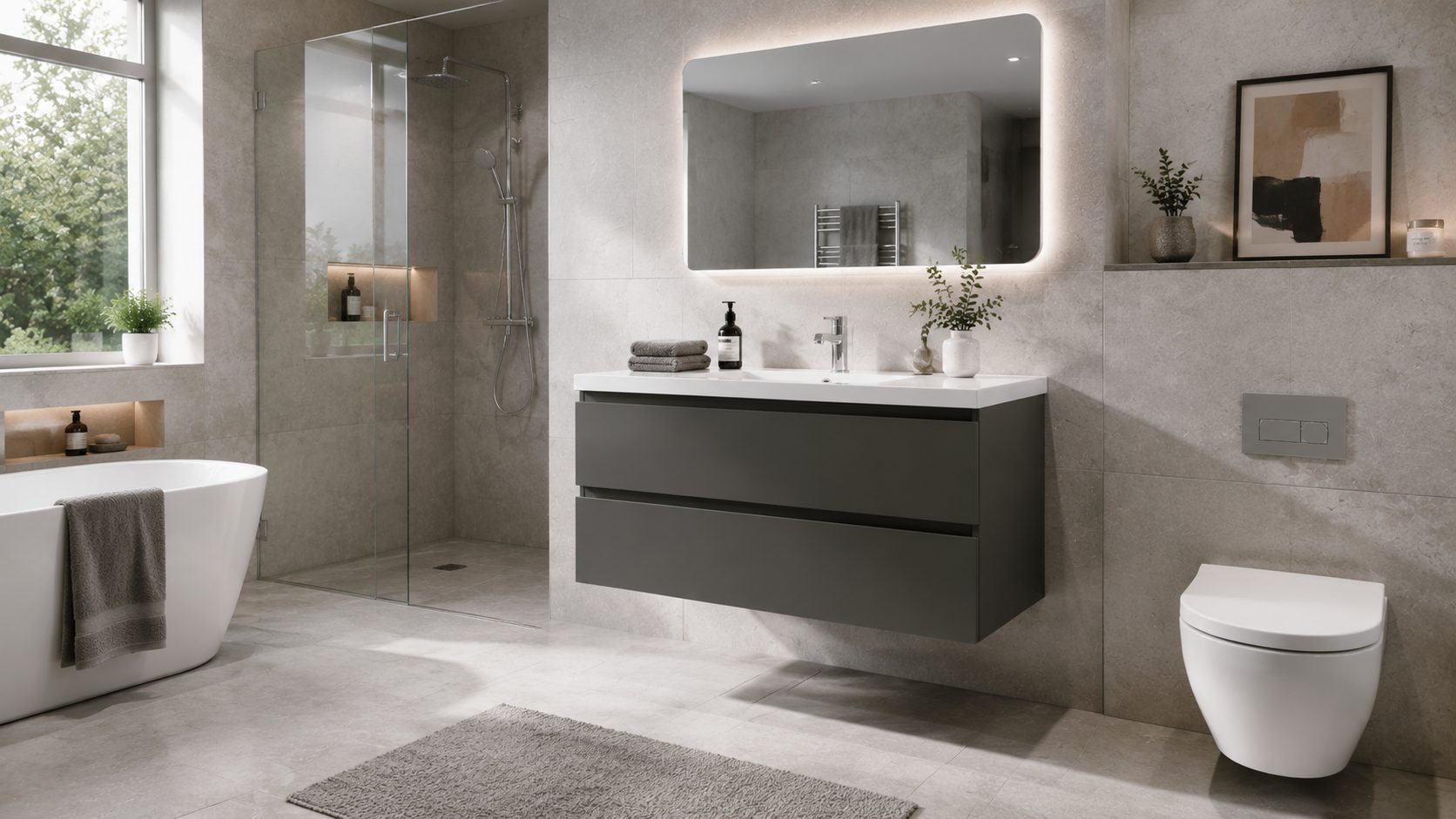
Sourcing bathroom vanity cabinets from China starts with a question most catalogues skip: what is the box actually made of? Door styles and colours are easy to change; the carcass material, the edge sealing and the hardware decide whether the cabinet still opens smoothly after five humid years. This guide gives importers, distributors and project buyers the factory-side view of buying vanities in bulk — plywood, MDF, solid wood and PVC compared honestly, the finishes and waterproofing details that actually fail, hardware and mounting choices, pairing the cabinet with a ceramic basin top, sizes and customization, container math for KD versus assembled packing, and the spec list that gets you an accurate quote the first time.
Key takeaways
- Specify the carcass first — the plywood/MDF/solid wood/PVC choice plus edge sealing decides lifespan far more than the door style does.
- Waterproofing is detail work — the under-sink cutout, edge banding and keeping the carcass off the wet floor are where vanities actually fail.
- Confirm the operational spec — hardware cycle ratings, KD versus assembled container counts, AQL inspection and realistic lead time before you order.
01 THE BOX, NOT THE DOOR
Why the carcass matters more than the door style
Most vanity sourcing starts with photos of door fronts, and that is exactly backwards. A door style — shaker, slab, fluted, handleless — can be built on almost any box, and factories will happily quote the same look on four different carcasses at four different prices. What the photo never shows is the part that fails: the board inside the cabinet, the sealing on its cut edges, and the screws holding hinges and slides into that board.
A bathroom is a hostile place for furniture. Humidity cycles daily, the floor gets mopped, and the area under the basin sees drips and the occasional real leak. Whether the cabinet shrugs that off for years or swells at the bottom edge within one is decided by carcass material and edge treatment, not by the colour of the door. So specify the box first, then choose the front.
Two quotes for the "same" vanity are only comparable when both state the carcass material, board grade and edge sealing in writing.
02 MATERIALS COMPARED
Plywood, MDF, solid wood and PVC — the honest comparison
Four materials cover almost every vanity carcass quoted out of China, and each has a real weakness worth knowing before you compare prices.
Vanity carcass materials at a glance
| Factor | Multilayer plywood | MDF | Solid wood | PVC board |
|---|---|---|---|---|
| Moisture resistance | Best of the wood boards — cross-laminated veneers resist swelling; edges still need sealing | Weakest against standing water — swells at raw edges and cutouts | Good if kiln-dried, but can move or crack as humidity swings | Fully waterproof — will not swell, rot or mould |
| Screw-holding & durability | Best — layered grain grips hinge and slide screws | Moderate — screws can strip if re-driven | Good | Weakest — needs inserts or thicker 15–18 mm board |
| Finish quality | Good; face-veneer quality varies | Excellent — smooth face, ideal for high-gloss lacquer and PET film | Real grain, premium feel under clear lacquer | Film-faced; feels lighter and less premium |
| Weight | Medium–heavy | Heavy | Medium–heavy | Light |
| Indicative price tier | Mid | Lower | Premium | Budget |
| Best use | Default export carcass for most markets | Lacquered door panels; budget carcasses if fully sealed | Design-led and premium lines | Very humid climates, rentals, budget projects |
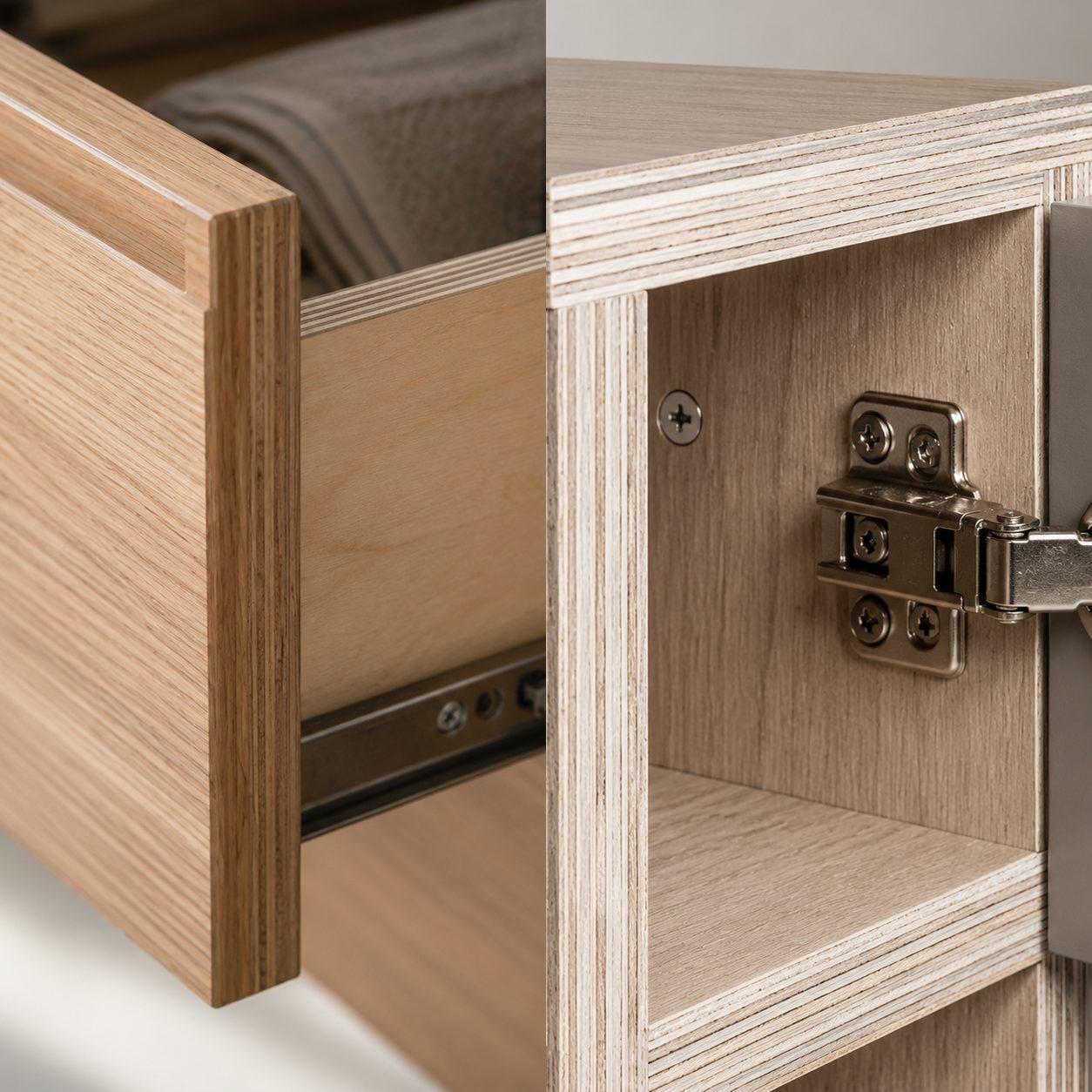
Two honest notes. First, no wood-based board is waterproof by itself — plywood earns its reputation only when its edges are sealed, and "moisture-resistant" green-core MDF slows swelling rather than preventing it. Ask for the glue and formaldehyde grade in writing (E1 as a floor, E0 where your market requires it). Second, PVC solves the water problem and creates two others: screws need inserts or thicker 15–18 mm board, and long spans can sag in heat. The most common export build is a hybrid for good reason — a plywood box for structure, MDF fronts for a flawless lacquer face.
03 FINISH AND WATER
Finishes, and the waterproofing details that actually fail
On a painted vanity, the finish is not decoration — it is the waterproofing membrane. A proper PU lacquer line runs multiple passes: two or three primer coats with sanding between, colour coats, then a matte or high-gloss topcoat, each with real drying time. More coats and proper curing buy film hardness and, critically, coverage on edges and profiles where water attacks first. When you inspect a lacquered sample, look at the edges and inside corners, not the flat face: thin edges, orange peel and dust nibs are the tells of a rushed line.
Melamine-faced board is the economical route with a huge decor range; PET film gives consistent high-gloss or super-matte faces at a lower cost than lacquer. Both live or die at the edge banding — ask whether edges are glued with PUR hot-melt, which resists moisture far better than standard EVA.
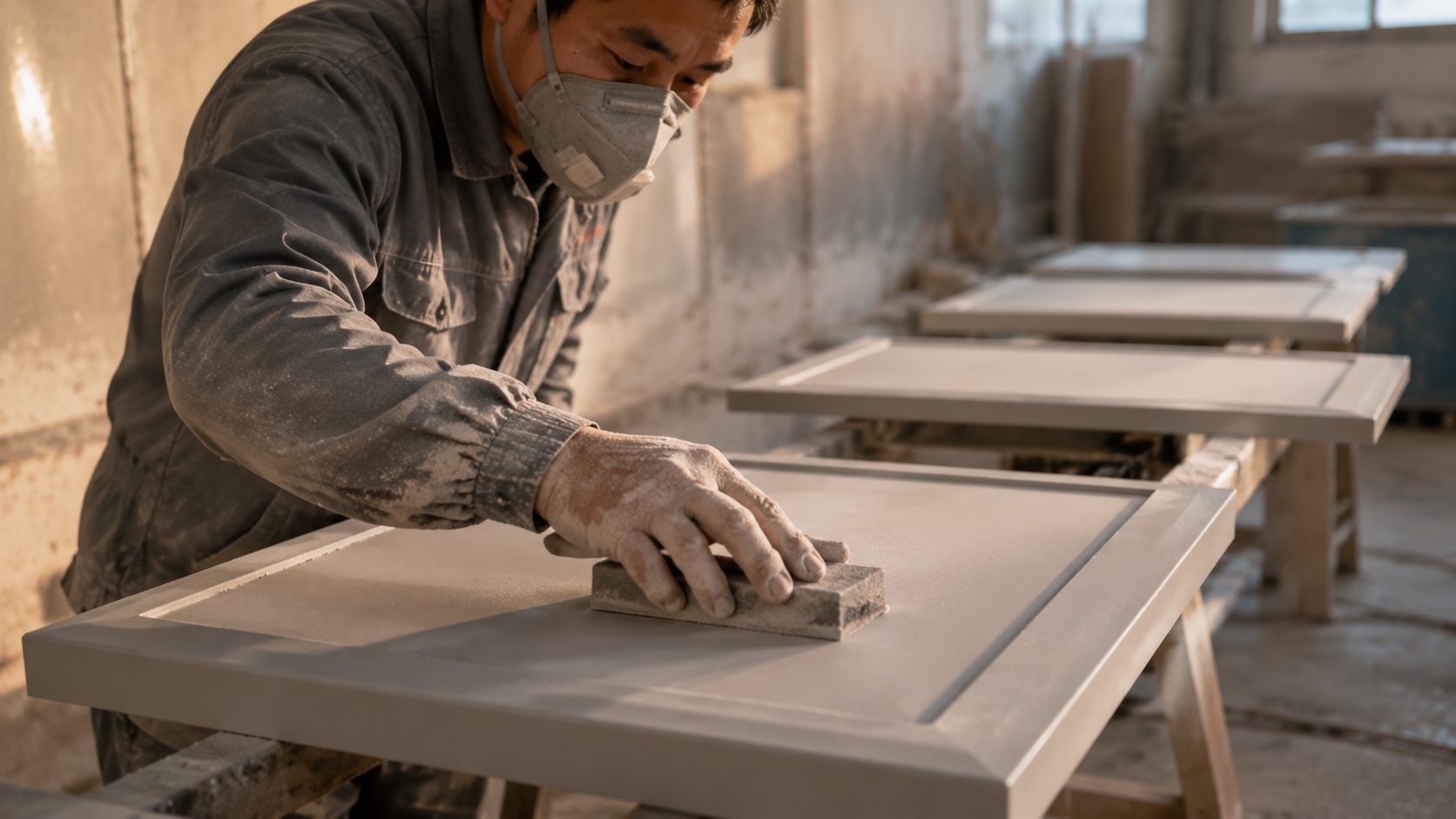
The failures we see in returned market samples are rarely the board face. They are the under-sink cutout left raw around faucet and drain holes; back-panel grooves without sealant; thin hardboard backs that wick moisture; and plinths standing in shower splash. Specify that every cut edge is sealed before assembly, that interior surfaces are faced rather than raw board, and that the carcass stays off the wet floor — wall-hung is best, metal or ABS adjustable legs a good second.
Ask how the under-sink cutout is sealed
A factory that answers precisely — edge banding, lacquer or silicone, applied before assembly — has thought about how vanities actually fail. A vague answer on this one detail tells you more than any showroom photo, because the cutout around the faucet and drain is where most swelling starts.
04 HARDWARE AND MOUNTING
Hardware that survives a wet room, and wall-hung vs floor-standing
Soft-close hinges and drawer slides are now the baseline expectation on export vanities, including budget lines — but "soft-close" spans a wide quality range. Branded hardware (Blum, Hettich, or major domestic brands such as DTC) costs more and buys consistent cycle life, corrosion resistance and easy after-sales replacement; generic soft-close varies widely. Rather than assuming, write it into the spec: hinge cycle rating, slide load rating, and stainless or nickel-plated screws in wet zones.
On mounting, wall-hung cabinets keep the carcass permanently off the wet floor, make cleaning easier and read as modern — but they need a solid wall or reinforcement, because a loaded wide unit with a ceramic top, water and stored items can exceed 60–80 kg, and plumbing usually needs a wall outlet. Floor-standing units are simpler to install and hide floor-outlet plumbing, but the base must be protected from splash. Match the choice to your market's construction norms: drywall-heavy markets need mounting rails and reinforcement guidance in the carton.
05 MIRRORS AND BASINS
Mirror cabinets, LED lighting and the ceramic basin top
A mirror above the vanity is often part of the same order, from plain and framed mirrors up to LED mirror cabinets with touch or sensor switches, defogger pads and colour-temperature switching (3000/4000/6000 K). Pin down two things before quoting: electrical safety and voltage. Bathroom electrical zones matter in the EU, UK and Australia — LED drivers and fittings for bathroom zones are commonly specified IP44, so confirm the actual driver rating for your market rather than accepting a general "waterproof" claim, and state 110 V or 220–240 V and plug versus hardwire per destination.
Then there is the top. An integrated ceramic top-basin — one fired piece sized to the cabinet — is the standard export pairing: seamless, easy to clean, no cutout to seal. The catch is tolerance: ceramic shrinks in the kiln, so top and carcass dimensions must be managed together, which is the practical advantage of sourcing basin and cabinet from one ceramic manufacturer. Vessel and art basins on wood or slab tops suit design-led work, provided the cutout is sealed and a tall faucet specified, while slab tops with undermount basins are the usual hotel route. How the pieces fit is a topic of its own — see our guide to matching bathroom cabinets with ceramic basins, and our note on wholesale ceramic wash basins if you are buying the tops in bulk too.
06 SIZES AND CUSTOM
Sizes, MOQ and OEM/ODM customization
Export vanities run in width steps of 400 / 500 / 600 / 700 / 800 / 900 / 1000 / 1200 mm — 600 and 800 are the volume sellers, and 1200+ usually means a double-basin unit. Standard depth is about 450–480 mm, with slim 350–400 mm bodies for cloakrooms; floor-standing height lands around 800–850 mm to the basin rim. Beyond stock sizes, dimensions, door style, colour, handles, basin model and mirror option are all customizable, and logo options cover silk-screen on the ceramic, printing on the cabinet and branded cartons.
MOQ follows the paint line: stock models can often ship as a small trial or part of a mixed container, while a custom size or colour commonly needs around 30–100 sets per model, because a lacquer colour change means a dedicated line run, and film or decor changes depend on board-supplier minimums. These are indicative figures to confirm per model. If you are building a brand, our overview of OEM and ODM bathroom products covers drawings, sampling and the approval flow.
07 SHIP IT RIGHT
Export packaging, QC and how to request a quote
Packing decides your freight economics. KD flat-pack — carcass knocked down, hardware bagged, assembly sheet in the box — saves roughly 40–60% of container volume and suits volume retail programs, at the cost of dealer or end-user assembly. Assembled cabinets ship ready to install, protected by foam corners, EPE wrap and five-ply cartons, with honeycomb board or crating for ceramic tops and mirrors, which always need extra protection. As a planning figure only, a 40 ft high-cube holds on the order of 150–250 assembled 600–800 mm vanity sets versus 400+ in KD — exact counts are quoted per model with a container loading plan.
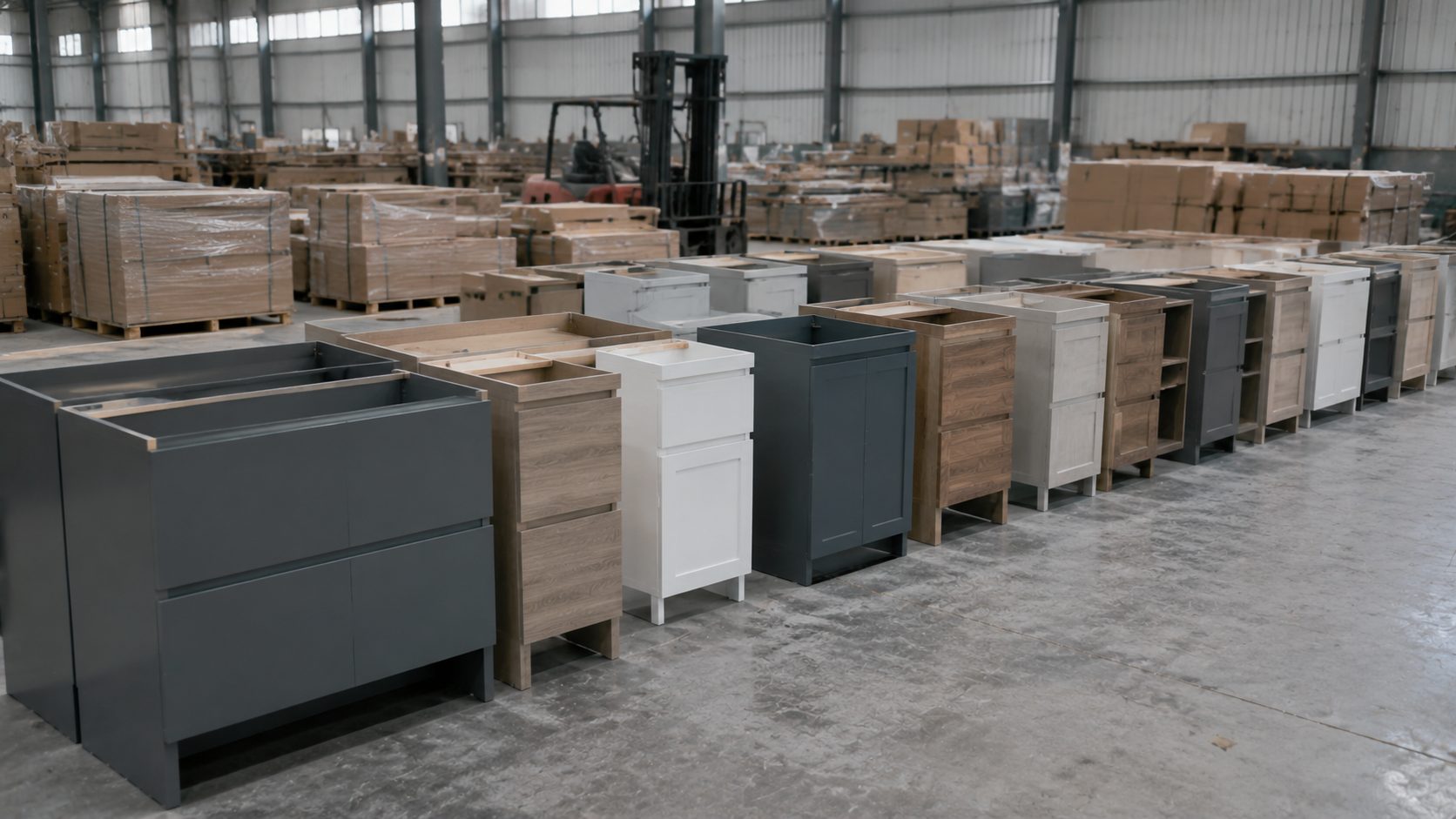
Before shipment, a serious factory checks board moisture content (roughly 8–12% for plywood and MDF, depending on destination climate), finish adhesion by cross-hatch tape test, edge-band pull, hinge and slide function with soft-close engagement, dimensions against the drawing, basin-to-cabinet fit, and powers on every LED mirror or an AQL sample. Visual inspection commonly runs at AQL 2.5 major / 4.0 minor, and buyers can request available test reports before ordering — certification support may vary by product and market.
To get an accurate quote the first time, send: width, depth and height, wall-hung or floor-standing; carcass material and finish with colour; basin type (integrated ceramic top, vessel or undermount); mirror or LED mirror cabinet requirement with voltage; hardware level; quantity and assembled versus KD packing; destination port; and any test reports your market requires. Lead time to expect: roughly 25–35 days for standard models and 35–45 days for custom colours or lacquer-heavy orders, plus sea freight — longer in peak season.
The vanity suppliers worth keeping are the ones who talk about edges, hardware and packing before they talk about door colours.
FAQ COMMON QUESTIONS
Frequently asked questions
What is the best material for a bathroom vanity cabinet?
For most export markets, a multilayer plywood carcass is the default recommendation: cross-laminated veneers resist swelling and hold hinge and slide screws well. MDF is the better substrate for smooth high-gloss lacquered doors, provided every edge is sealed. Solid wood offers a premium feel but needs kiln-dried, engineered panels and stable indoor humidity. PVC board is the choice where extreme humidity or budget dominates — fully waterproof, but lighter-feeling and weaker at holding screws. Many good vanities combine a plywood box with MDF lacquered fronts.
Is MDF OK in a bathroom, or will it swell?
MDF is fine in a bathroom if it is specified and sealed correctly, and it is the best base for painted and PET-film finishes. Its weakness is raw edges and cutouts: unsealed MDF that meets standing water will swell, and moisture-resistant green-core grades slow this down but are still not waterproof. Ask that the under-sink cutout, back-panel grooves and all cut edges are sealed before assembly, and keep the carcass off the wet floor with wall-hung mounting or legs.
Do plywood vanities last?
A well-built plywood vanity routinely outlasts the bathroom's decoration cycle. The board itself is rarely the failure point — cross-laminated plywood resists swelling and grips screws well. What fails first is detail work: unsealed edges, a raw under-sink cutout, or generic hardware that loses its soft-close action. Specify E1 or E0 glue grade, sealed edges and a named hinge cycle rating, and check board moisture content (roughly 8–12%) at pre-shipment inspection.
Can I order custom sizes, colors and my own logo?
Yes. Dimensions, door style, colour, handles, basin model and mirror option can all be customized, and branding options include silk-screen on the ceramic basin, printing on the cabinet and branded cartons. Stock models can often ship as small trial orders or part of a mixed container; custom sizes or colours commonly need around 30–100 sets per model, because a lacquer colour change requires a dedicated paint-line run. Raise logo and packaging requirements early so tooling and minimums are quoted up front.
How many vanity cabinets fit in a container?
As an indicative planning figure, a 40 ft high-cube holds on the order of 150–250 assembled 600–800 mm vanity sets, and 400 or more in KD flat-pack, which saves roughly 40–60% of container volume. Exact counts depend on model, mirror and packing design, so ask the factory for a container loading plan against your actual model mix before comparing freight costs.
Are bathroom vanities from China good quality?
Quality follows the specification, not the country. China builds everything from throwaway boxes to hotel-grade cabinetry, often in the same industrial cluster, so the buyer's job is to fix the variables in writing: carcass material and board grade, edge sealing method, finish process, hardware cycle rating, and an agreed AQL inspection before shipment. Buyers can request available test reports before ordering — certification support may vary by product and market — and a factory that answers a detailed spec precisely is usually one that can build to it.