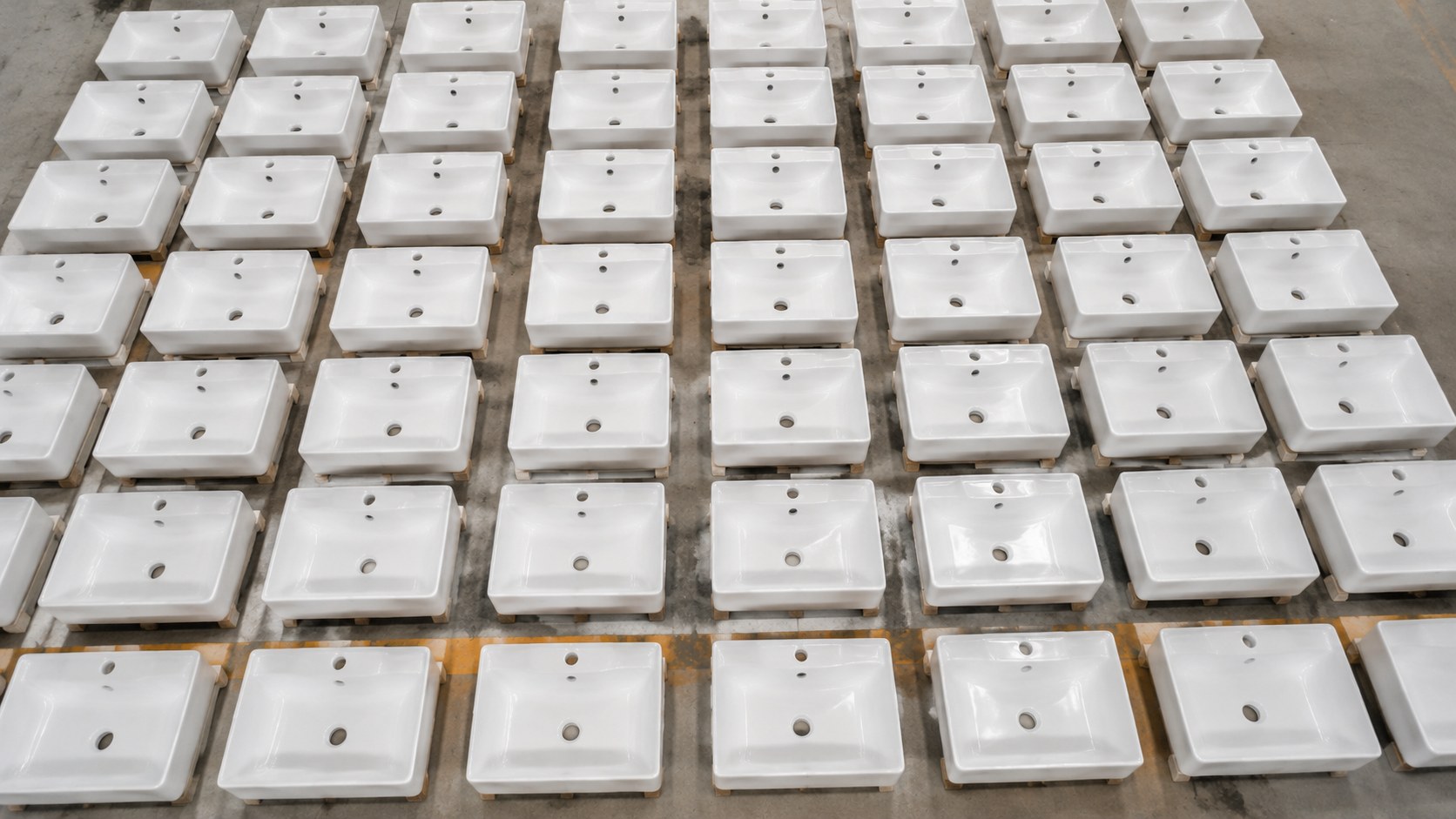
Sourcing wholesale ceramic wash basins well is less about chasing the lowest headline price and more about controlling the numbers that decide your landed cost: minimum order quantity, unit price at your real volume, how many pieces fill a container, and how the goods are checked and packed before they ship. This guide walks importers, distributors and project buyers through buying ceramic basins in bulk direct from a China factory — MOQ and pricing, container math, OEM/ODM and private label, QC and water absorption, packaging and lead time, and exactly what to send to get an accurate quote the first time.
Key takeaways
- Buy factory-direct — one margin, full control of spec and QC, and the ability to mix models to fill a container economically.
- Know the drivers — MOQ runs per model, and unit price moves with size, glaze, tooling and total volume, not a single sticker figure.
- Confirm the operational spec — pieces per 20ft/40HQ, AQL inspection, water absorption <=0.5%, export packaging and realistic lead time before you place the order.
01 WHO YOU BUY FROM
What factory-direct wholesale actually means
Wholesale ceramic wash basins reach buyers through three routes, and the route changes your economics more than the product does. Factory-direct means buying from the manufacturer that runs the casting, glazing and kiln lines — one margin, control over spec and tooling, and QC you can actually see. A trading company or agent buys from factories and resells, adding a margin and often limited spec control, and may switch source factories between orders, which is where batch-to-batch consistency slips. A B2B marketplace is useful for discovery, but many listings are traders, not producers.
Three ways to buy ceramic basins in bulk
| Factor | Factory-direct wholesale | Marketplace / trader | Local distributor |
|---|---|---|---|
| MOQ | Per model, mix to fill a container | Varies, often re-quoted per source | Low, buy from stock |
| Unit price | Lowest — one margin | Factory price plus agent margin | Highest — import margin added |
| Customization | Full OEM/ODM, controls moulds | Limited, depends on sub-supplier | None, stock only |
| QC visibility | Direct — line, kiln, inspection | Indirect, relayed | Post-import, no factory view |
| Lead time | Set by factory schedule | Adds a coordination layer | Immediate but limited range |
None of the three is automatically wrong — a distributor is right for a handful of pieces, a factory for a container. The point is knowing which one controls your quality and price. Signals of a genuine manufacturer: it owns the moulds, can run OEM/ODM changes, controls its own lead time, and issues its own test reports and export documents.
At container scale, the middle margin is not a rounding error — it is the difference between a competitive shelf price and a stranded one.
02 QUANTITY AND COST
MOQ and what really drives the price
The most common source of confusion is MOQ, because there are two of them. There is MOQ per model and colour — commonly around 100 to 500 pieces for a standard catalog item, with some factories accepting a smaller trial quantity on stock models. And there is the practical MOQ of the whole order, which is usually about filling a container economically, so buyers combine several models to reach a full container load. Custom shapes or colours carry a higher MOQ, often 500 to 1,000+ pieces, because a new mould has to be justified. These are indicative ranges; confirm the exact figure per model.
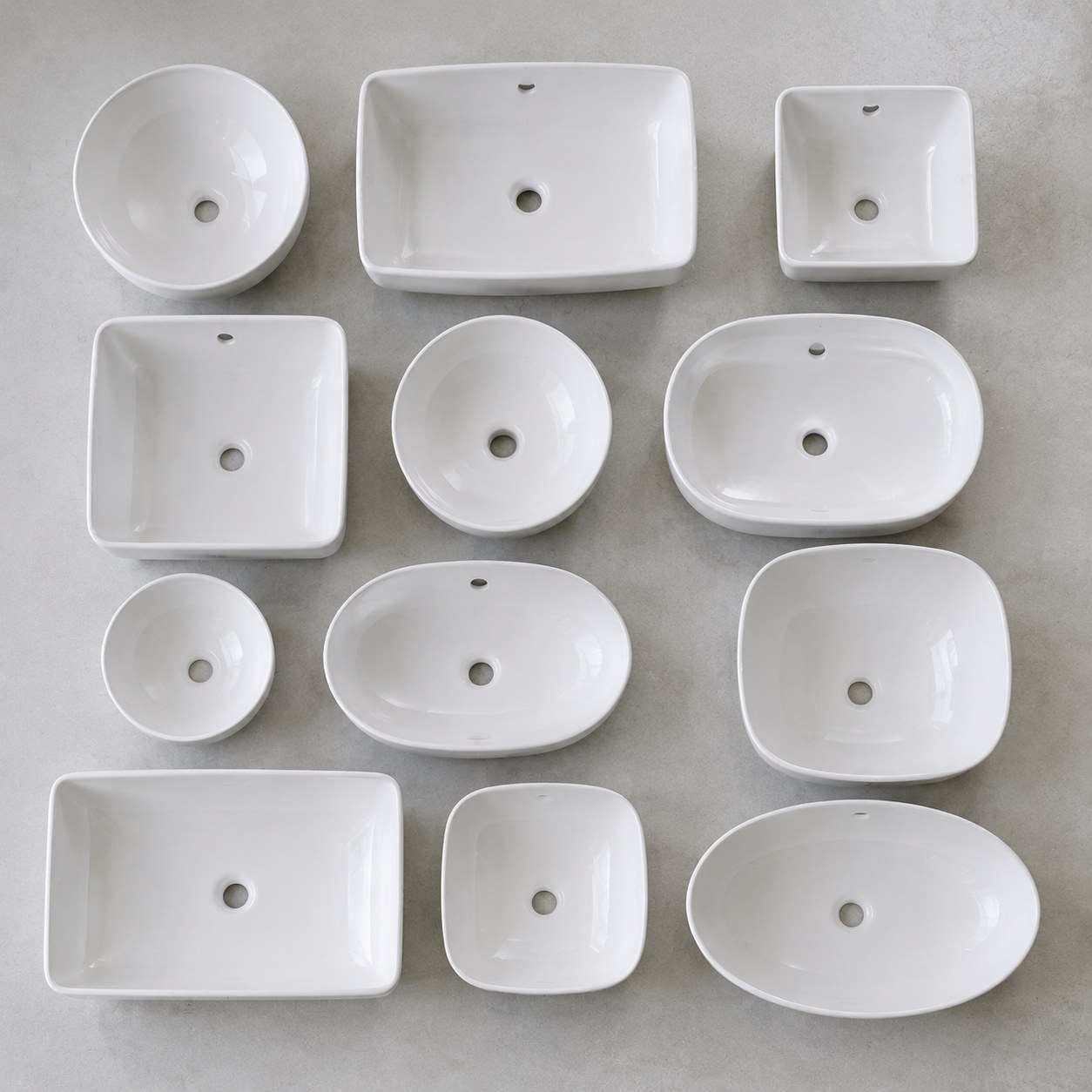
Unit price then moves with a handful of drivers, not a single number. Larger, heavier basins use more clay body and kiln space, so they cost more and pack fewer per container. Standard white glaze is the base; matte, coloured, reactive or hand-finished art glazes add cost and yield loss. Custom shapes need new tooling — a one-time charge that is either amortised into the unit price or billed separately. And unit price falls as volume rises toward full-container and multi-container quantities. When you compare two quotations, make sure you are comparing the same body type, glaze, packaging and Incoterm, or the cheaper line is not really cheaper.
03 HOW MANY FIT
Container-load math: pieces per 20ft and 40ft
Basins are bulky and packed individually with protection, so volume (CBM), not weight, usually fills the box first. As an indicative planning rule, a 20ft container offers roughly 28 CBM of usable space and a typical basin load often lands around 500 to 1,000 pieces depending on size and carton. A 40ft or 40ft high-cube offers roughly 58 to 68 CBM and often carries about twice that, in the range of 1,000 to 2,000+ pieces.
Model mix changes the count. Countertop and art basins pack differently from pedestal or wall-hung sets, where traps, brackets and pedestals add volume. The only reliable figure is a loading plan for your exact model mix, so ask the factory to calculate pieces per 20ft and 40HQ against the specific SKUs you intend to order. That plan is also what lets you balance an order to fill the container without paying to ship air.
Ask for a loading plan, not just a per-piece price
Request pieces per 20ft and 40HQ for your actual model mix, plus carton dimensions and CBM per model. It turns a vague quote into a real landed-cost calculation and prevents a half-empty container.
04 BRANDING AND DESIGN
OEM, ODM and private label options
If you are building a brand or specifying for a project, customization capability matters as much as the product itself. OEM means the factory produces to your design or drawings; ODM means you select and adapt the factory's existing designs. Private-label options typically include a custom logo, branded cartons and colour boxes, barcodes and SKUs, and custom manuals or inserts. A logo on the ceramic body itself — stamped or printed under the glaze — usually needs tooling or screen setup and a minimum quantity, so raise it early.
Custom moulds carry a one-time tooling cost and a longer first-run lead time, and it is fair for a factory to say so. Existing models need only sample approval before mass production. If you want the full workflow — mould cost, timeline, mould ownership and the sample-approval flow — our overview of OEM and ODM bathroom products covers how to brief a factory so the quote comes back accurate the first time.
05 QUALITY YOU CAN VERIFY
QC, AQL and water absorption ≤0.5%
Two technical points separate a serious bulk supplier from a gamble. The first is the body. Fully vitrified sanitary ware — vitreous china — is defined by low water absorption, a rate of ≤0.5%. Lower absorption means a denser body that resists staining, crazing and frost and lasts longer. Earthenware and semi-vitreous bodies absorb more and are not equivalent, so ask which body type you are being quoted, and request the available water-absorption test report before ordering.
The second is inspection. Export orders are typically sampled to an agreed AQL (Acceptable Quality Limit) per ISO 2859-1 before shipment — a common working point for sanitary ware is AQL 2.5 for major and 4.0 for minor defects, but agree the level in advance. Inspection covers dimensional accuracy, glaze defects such as pinholes, crazing and colour variance, warpage, cracks, drain and overflow fit, and a water test for leaks. A genuine factory will let you appoint a third-party inspector. For a practical checklist of what to look at, see our guide to inspecting sanitary ware before shipment.
06 GETTING IT THERE INTACT
Export packaging and realistic lead time
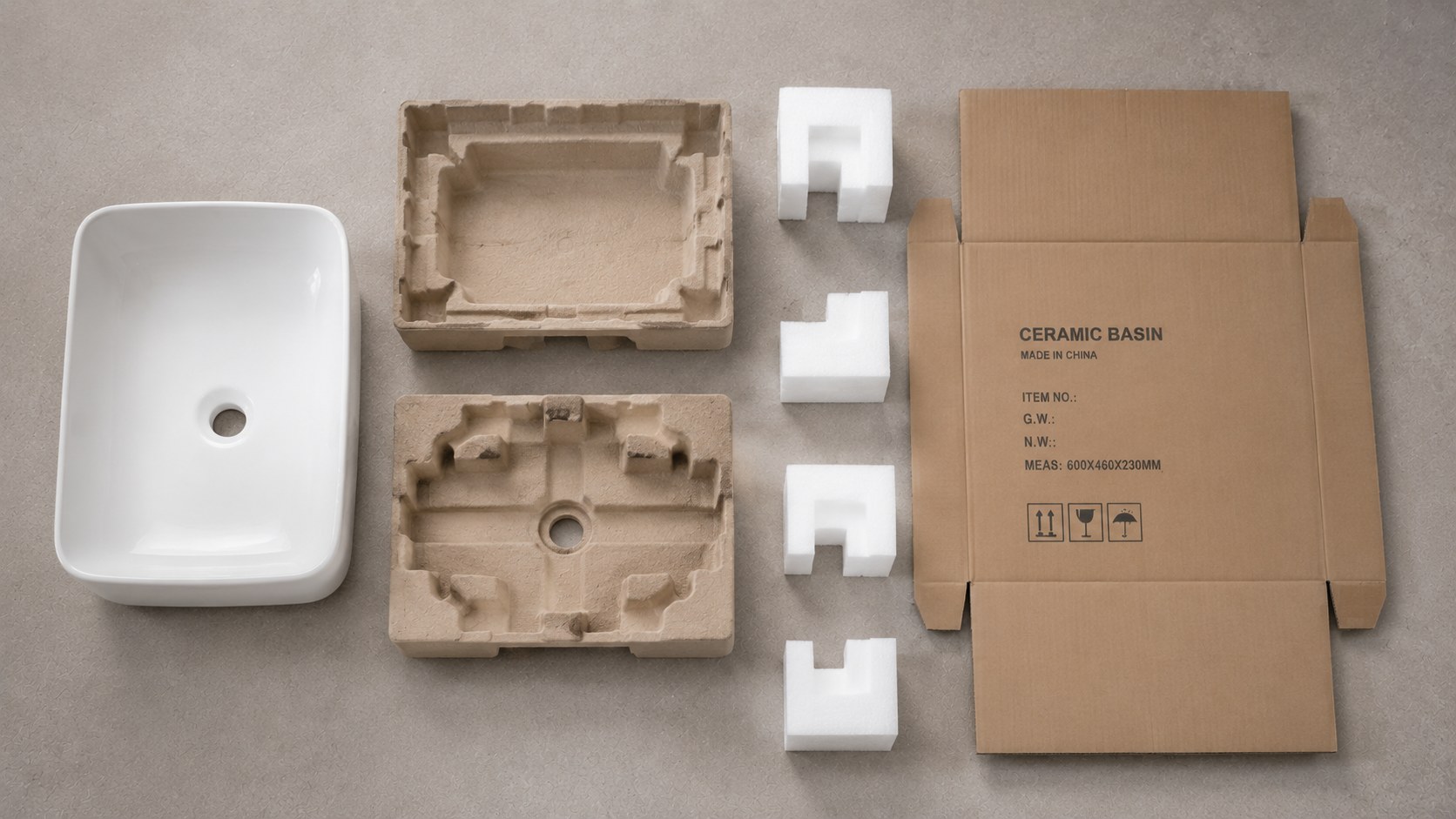
Ceramic is heavy and brittle, so packaging is the difference between a clean container and a claim. Good export packing protects each basin individually — EPE foam, moulded pulp or foam corners — inside a fitted export carton, typically five-ply, with corner boards and edge protectors and extra cushioning at the drain and overflow. Fragile or high-value art basins may go on wooden pallets or in plywood crates with strapping, plus fragile and this-way-up labelling and layer limits so lower cartons are not crushed. Ask to see the packing spec and how a basin is actually packed, not just a photo of a box.
On timing, plan two clocks. Samples of existing models run roughly 7 to 15 days; custom samples needing new tooling run about 20 to 35 days, since a mould has to be made and fired. Bulk production is typically about 30 to 45 days after deposit and artwork sign-off, longer in peak season or for large multi-container orders. Firing cannot be rushed — drying, glazing, the kiln cycle and cooling all take real time — so a realistic window protects quality. These are indicative ranges to confirm per order.
07 BUYERS AND THE BRIEF
Who buys wholesale, and how to request a quote
Wholesale ceramic wash basins are bought by importers and distributors stocking a regional market, by building-material dealers supplying local retailers and plumbers, by e-commerce sellers needing private label and reliable restock, and by project procurement for hotels, apartments and real-estate developments — often in matched sets delivered by phase. Project and contract supply has its own rhythm around spec-matching and staged delivery; our note on being a sanitary ware supplier for hotels and apartments covers that in depth.
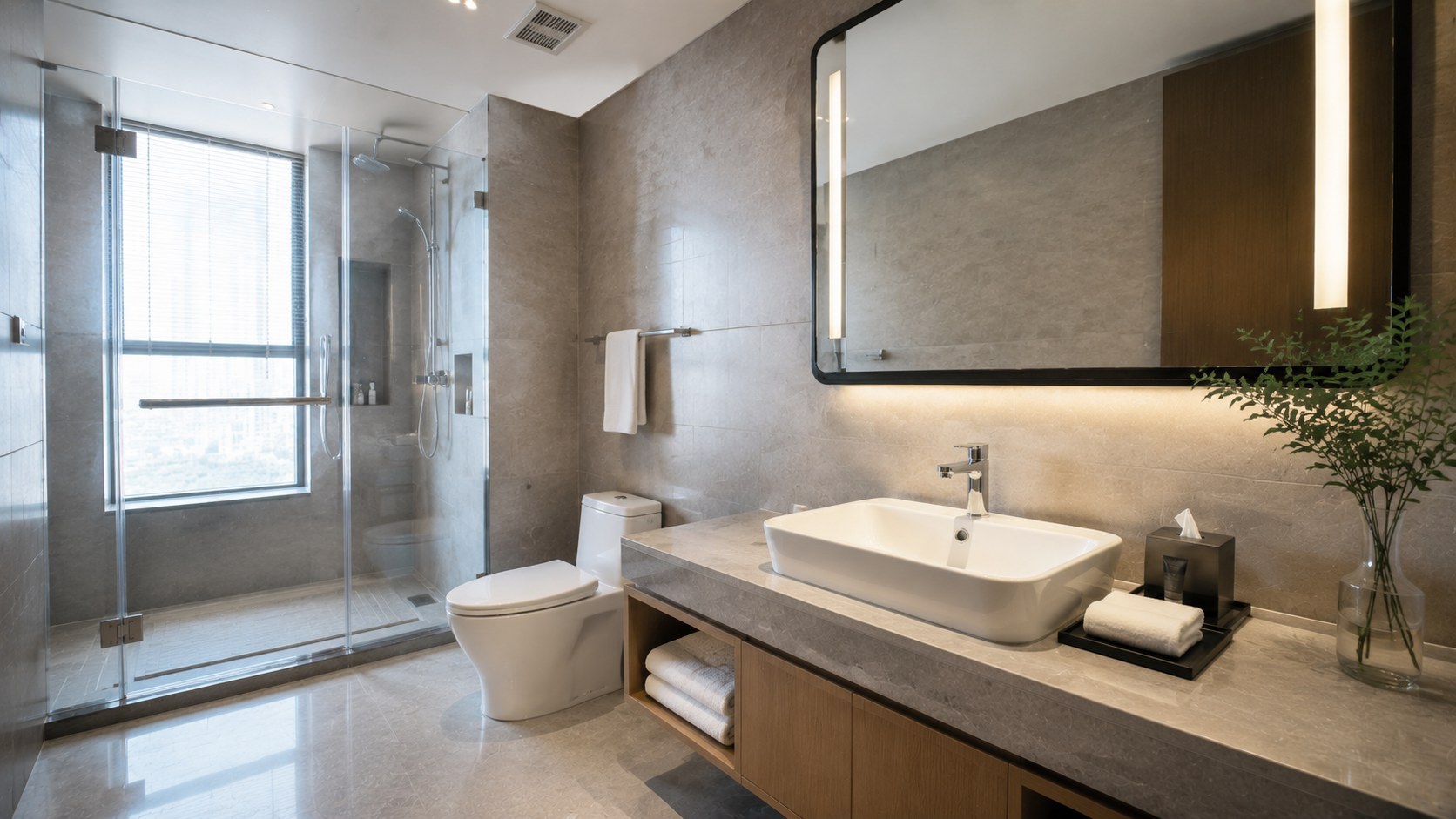
To get an accurate quote the first time, send as much of this as you can: product type and model (undermount, countertop, vessel, art, pedestal, wall-hung) or a reference photo; dimensions (L×W×H) and tap-hole configuration (0 / 1 / 3 holes) with or without overflow; colour or glaze; quantity per model and target container size; whether you need vitreous china at ≤0.5% absorption; branding and packaging requirements; destination port and Incoterm (FOB or CIF); target market and any required test reports; and your timeline, including whether you need a pre-production sample. A supplier that answers that brief cleanly is telling you most of what you need to know.
The wholesale partners worth keeping are the ones who quote the whole picture — MOQ, container math, QC and packing — before you have to ask twice.
FAQ COMMON QUESTIONS
Frequently asked questions
What is the MOQ for wholesale ceramic wash basins?
There are two MOQs to consider. Per model and colour, a standard catalog item is commonly around 100 to 500 pieces, and some factories accept a smaller trial quantity on stock models. Custom shapes or colours usually start higher, around 500 to 1,000+ pieces, because a new mould has to be justified. For the whole order, buyers typically combine several models to fill a container economically. These are indicative ranges; confirm the exact figure per model when you request a quote.
How many ceramic wash basins fit in a container?
Basins are bulky and packed individually, so volume rather than weight usually fills a container first. As an indicative planning rule, a 20ft container often holds around 500 to 1,000 pieces and a 40ft high-cube roughly twice that, in the 1,000 to 2,000+ range, depending on basin size, model mix and carton dimensions. Ask the factory for a loading plan calculating pieces per 20ft and 40HQ against your exact SKUs.
Can I put my own logo or brand on wholesale ceramic basins?
Yes. Private-label options typically include a custom logo, branded cartons and colour boxes, barcodes and SKUs, and custom manuals or inserts. A logo on the ceramic body itself, stamped or printed under the glaze, usually requires tooling or screen setup and a minimum quantity, so raise it early. OEM production works to your design, while ODM adapts the factory's existing designs.
How do you prevent breakage when shipping ceramic basins?
Good export packing protects each basin individually with EPE foam, moulded pulp or foam corners inside a fitted five-ply carton, with corner boards, edge protectors and extra cushioning at the drain and overflow. Fragile or high-value art basins may go on wooden pallets or in plywood crates with strapping, plus fragile and this-way-up labelling and layer limits so lower cartons are not crushed. Ask to see the packing spec, not just a photo of a box.
What is the lead time for a bulk order of ceramic wash basins?
Plan two clocks. Samples of existing models run roughly 7 to 15 days, while custom samples needing new tooling run about 20 to 35 days because a mould has to be made and fired. Bulk production is typically about 30 to 45 days after deposit and artwork sign-off, and longer in peak season or for large multi-container orders. Firing cannot be rushed, so treat these as indicative windows to confirm per order.
How do I find a reliable ceramic wash basin factory in China?
Verify you are dealing with a real manufacturer, not a trader: it should own its moulds, run OEM/ODM changes in-house, control its own lead time, and issue its own test reports and export documents. Ask for a live video walk-through of the line and kilns, a current sample, the water-absorption figure (target 0.5% or lower) and the AQL it inspects to, and confirm it allows third-party inspection before shipment. Guangdong (Chaozhou) produces the majority of China's ceramic sanitary ware and is the usual place to concentrate sourcing.