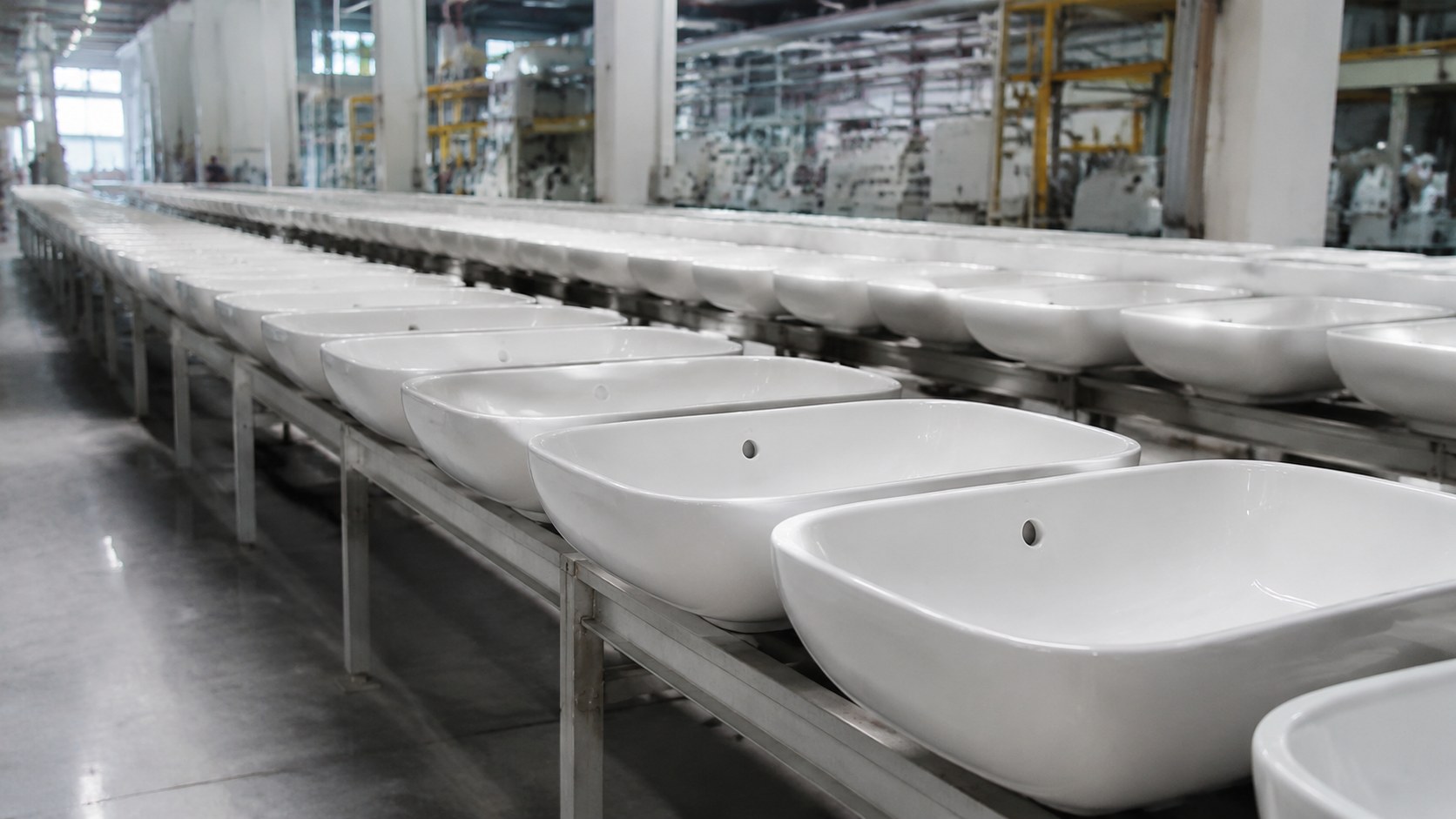
Choosing a ceramic basin manufacturer china buyers can trust is less about finding the lowest quotation and more about verifying who actually makes the product, how it is fired, and how it is checked before it leaves the kiln. This guide walks importers, wholesalers and project buyers through the things worth confirming — material and firing, glaze and QC, OEM/ODM capability, MOQ and lead time, packaging, and the red flags that separate a real factory from a middleman.
Key takeaways
- Verify the maker, not the catalog — a broad, mismatched product range often signals a trading company, not a production line.
- Ask for the numbers — high-fired vitreous china should reach water absorption of <=0.5%, and a real factory can explain its firing and AQL inspection.
- Confirm the export basics — MOQ, lead time, tap-hole and overflow options, sea-freight packaging and pre-shipment inspection before you commit.
01 WHERE VALUE COMES FROM
Why the factory behind the basin matters
A ceramic wash basin looks simple, but almost everything that determines whether it survives shipping, resists staining and holds a clean glaze line is decided inside the factory — in the body recipe, the firing curve and the inspection standard. When you buy through an intermediary, those decisions are made by someone you never speak to, and you inherit whatever they choose.
Sourcing directly from the maker changes what you can control. You can specify tap-hole configuration and overflow, request a specific glaze finish, ask for a sample from the exact production line, and get a straight answer on tolerances and lead time. That control is the real reason to spend time identifying a genuine ceramic basin manufacturer rather than the first supplier that replies quickly.
Price tells you what a basin costs. The factory tells you what it will actually be.
02 WHO YOU ARE TALKING TO
Factory vs trading company: how to tell them apart
China's ceramic sanitary ware supply chain is full of trading companies, and many are competent partners. The problem is not that they exist — it is not knowing which one you are dealing with, because it changes who controls quality and how quickly problems get fixed. A real factory specialises: it makes basins, toilets and related vitreous china, and it can talk in detail about its own kilns, glaze line and defect rates. A trader tends to present a very broad catalog assembled from several workshops.
Signals that separate a factory from a middleman
| Factor | Real factory | Trading company |
|---|---|---|
| Product range | Focused — basins and related ceramics | Very broad, mixed categories |
| Technical answers | Explains firing, absorption, QC first-hand | Relays answers from a workshop |
| Factory audit | Welcomes visits and video walk-throughs | May delay or avoid on-site checks |
| Certificates | Issued in the production entity's name | Often in a third party's name |
| Customisation | Controls moulds, glaze and tolerances | Limited, depends on sub-supplier |
Neither model is automatically wrong, but you should know which you are buying from. If a supplier hesitates on a video walk-through of the line, or the business license and export certificates carry a different company name than the factory you were shown, treat it as a signal to ask more questions. A short look inside a working sanitary ware factory makes the difference obvious.
03 BODY AND KILN
Material and firing: what high-fired vitreous china means
The single most useful technical question you can ask is about the body and the firing. Quality wash basins are made from high-fired vitreous china — the clay body and glaze are fused at high temperature, typically around 1250°C, into a dense, non-porous ceramic. The measurable result is low water absorption: a properly vitrified basin should reach a water absorption rate of ≤0.5%. That density is what makes the surface resist staining, water penetration and long-term crazing.
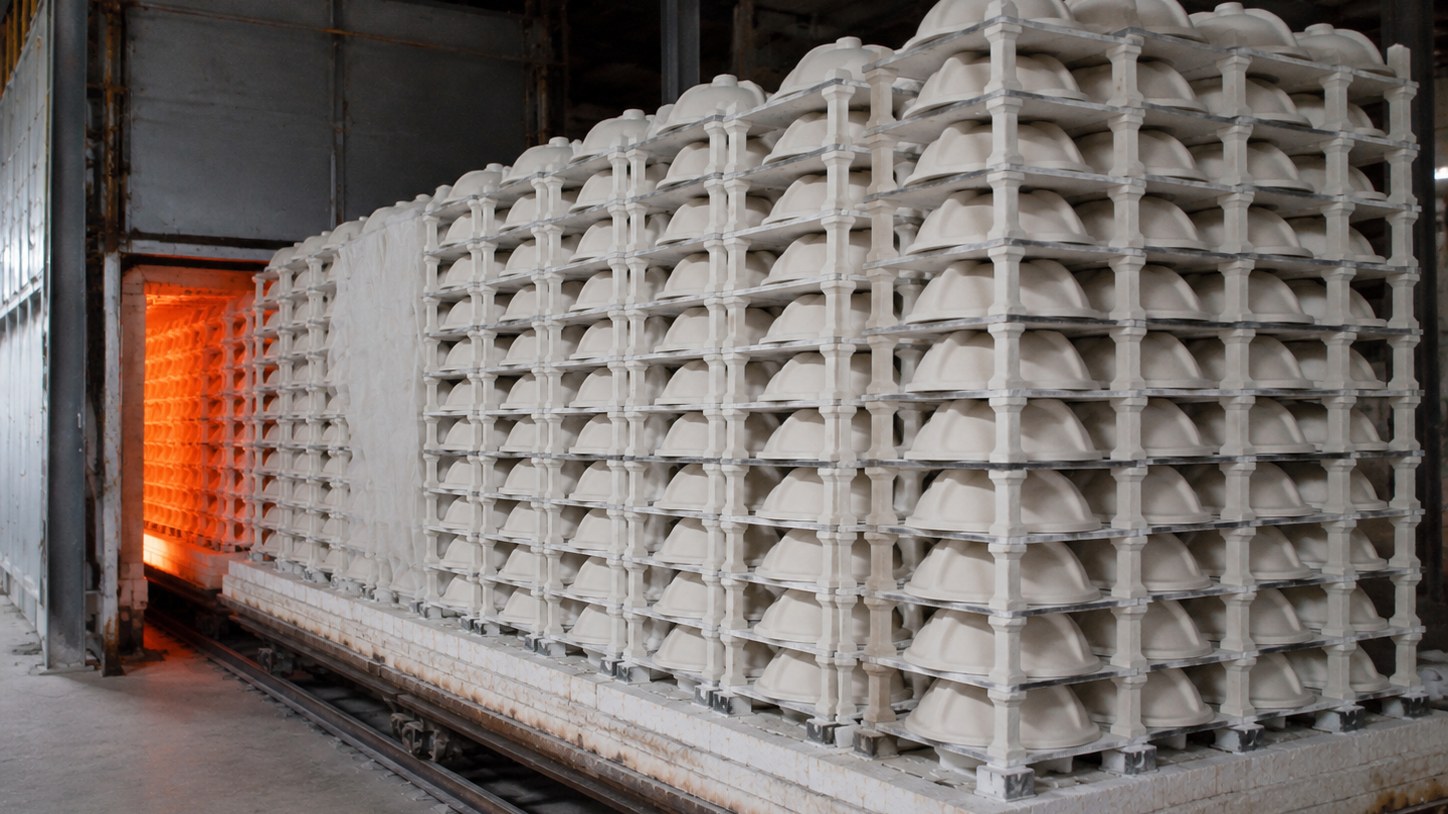
A factory that controls its own kilns can explain its firing curve, its raw-material sourcing and why the number matters. If a supplier cannot tell you the water absorption of its own product, or treats vitreous china and lower-fired ceramic as interchangeable, that is worth probing. We go deeper into why firing temperature matters and how it links to durability in a separate note.
Ask for the absorption figure in writing
Request the water absorption rate (target ≤0.5%) and, if the market requires it, the relevant test report. A real manufacturer can supply or arrange this; reluctance usually means the answer is not favourable.
04 FINISH AND INSPECTION
Glaze quality, QC and the AQL standard
After firing, two things decide whether a basin looks premium on arrival: the glaze and the inspection. A good glaze line produces an even, smooth surface without pinholes, orange-peel texture, colour drift or visible waves under light. This is partly craft and partly control — consistent spraying, clean kilns and stable raw materials.
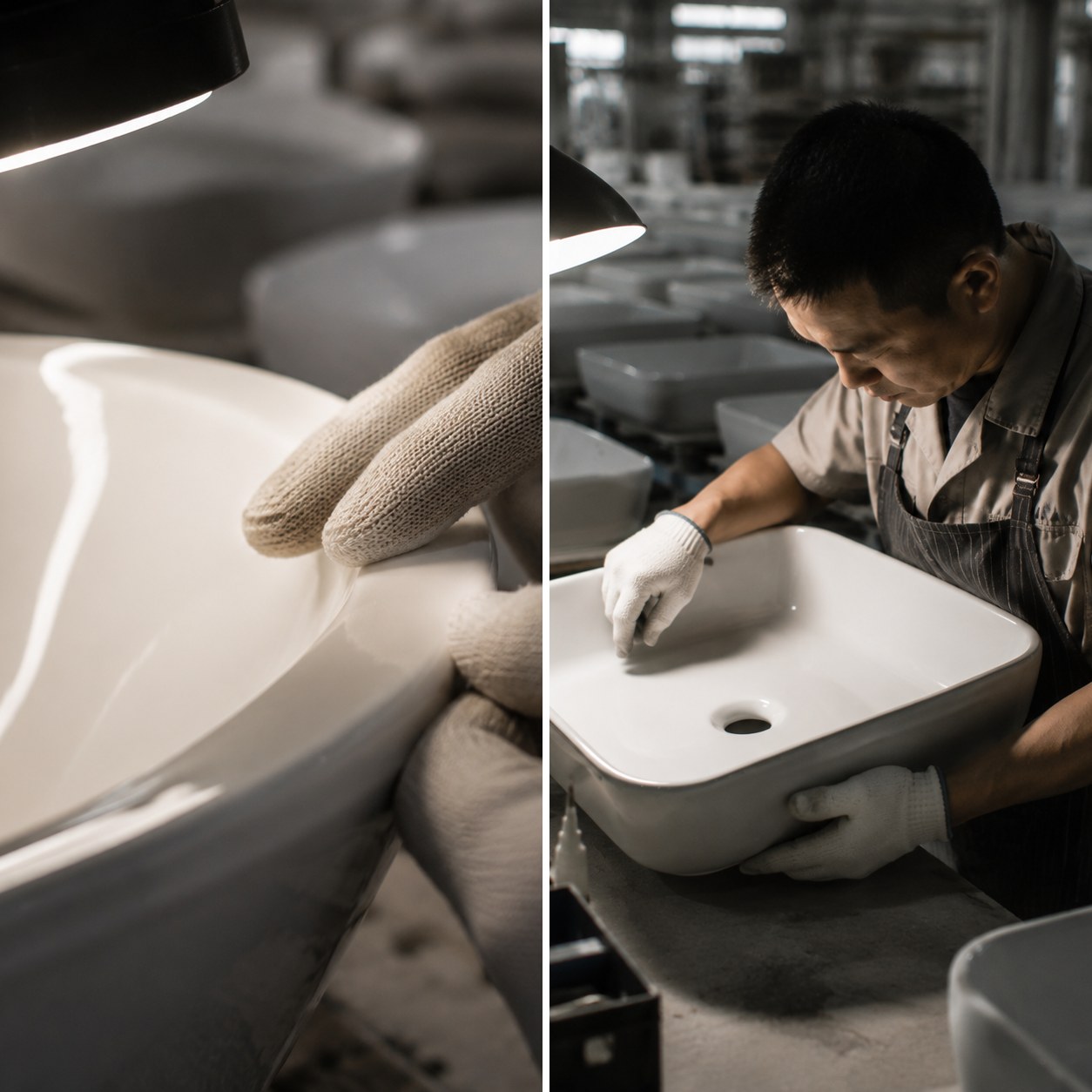
Inspection is where a serious factory shows its discipline. Basins are checked piece by piece for cracks, glaze blemishes, warping and dimensional accuracy, and export orders are typically sampled to an agreed AQL (Acceptable Quality Level) before shipment. Ask what AQL the supplier works to, whether you can appoint a third-party inspector, and how they handle rejects. If you want a practical checklist, our guide to inspecting sanitary ware before shipment lays out exactly what to look at.
05 BUYING TERMS
OEM/ODM, MOQ and lead time realities
If you are building a brand or specifying for a project, OEM/ODM capability matters as much as the product. A real manufacturer can open moulds for a new shape, adjust tap-hole count (0, 1 or 3 holes), add or remove an overflow, tune the glaze colour, and print or emboss your logo — within honest limits. Custom moulds carry tooling cost and a longer first-run lead time, and it is fair for a factory to say so.
Set expectations on the commercial basics early. Stock models usually carry a lower MOQ than fully custom items; new moulds raise both the MOQ and the timeline. Production lead time depends on order size, firing capacity and season, so ask for a realistic window rather than an optimistic one. Our overview of OEM/ODM bathroom products covers how to brief a factory so quotes come back accurate the first time.
Confirm before you place the order
MOQ per model and per colour · unit price and tooling cost · production lead time · tap-hole (0/1/3) and overflow option · glaze finish and colour · logo/branding method · sample approval · packaging and inspection terms.
06 GETTING IT THERE INTACT
Packaging and export experience
Ceramic is heavy and brittle, so packaging is not a detail — it is the difference between a clean container and a claim. A factory used to exporting will pack basins in fitted foam or moulded pulp inside sturdy cartons, palletise where needed, and load to protect the corners and rims that break most often in transit. Sea freight is the norm for bulk orders, and good suppliers plan the packing around it.
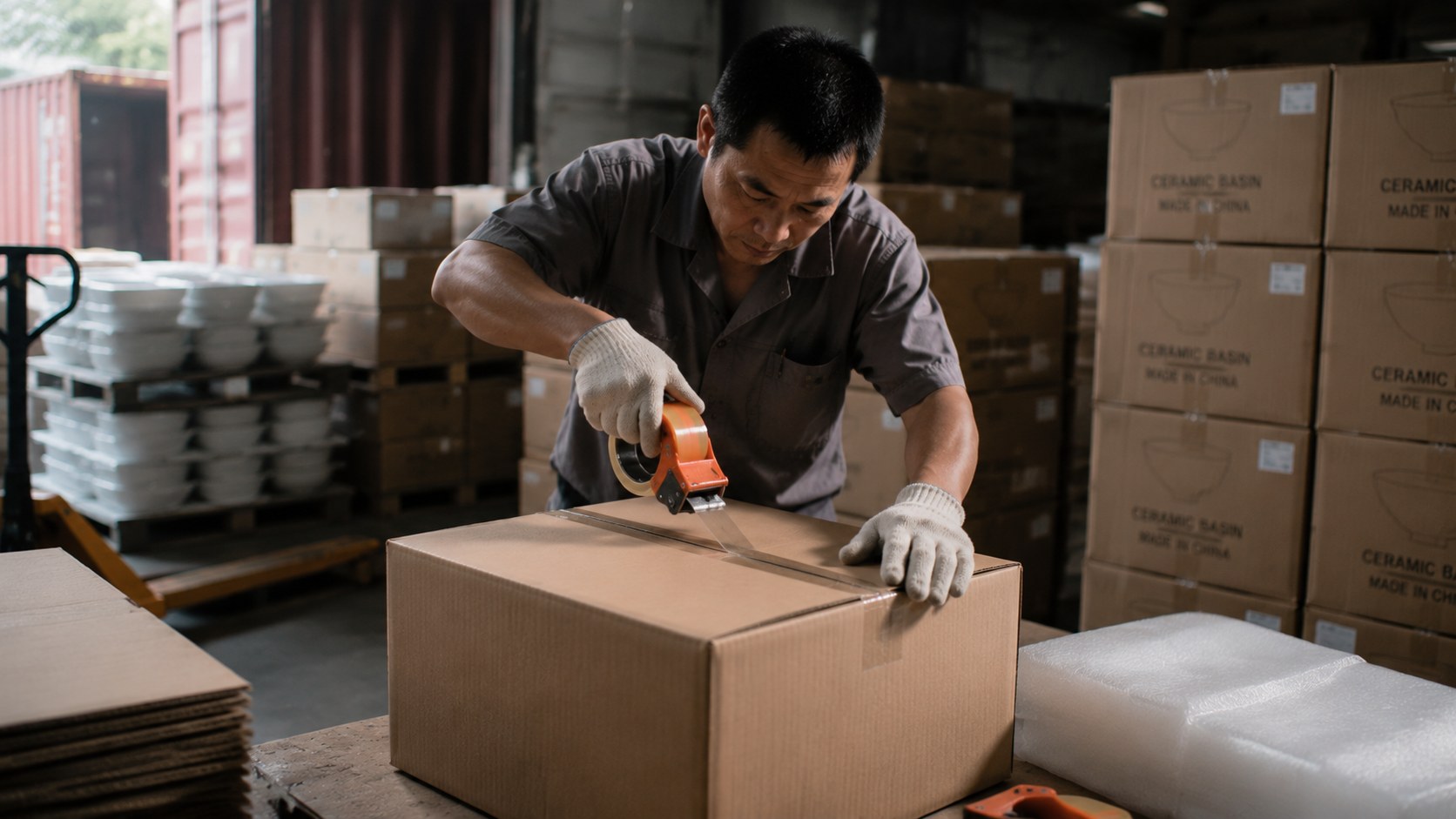
Ask to see how a basin is actually packed, not just a photo of a box. Export experience also shows up in the paperwork: a manufacturer that ships regularly will handle documentation, container loading and inspection scheduling without friction. That fluency is itself a quality signal.
07 DUE DILIGENCE
How to run a practical factory check
You do not need to fly in to vet a supplier, though a visit is ideal. A structured remote check catches most problems. Start with the business license and confirm the registered company matches the entity issuing your invoice and certificates. Then verify it through China's official National Enterprise Credit Information Publicity System, so you are checking a real record rather than a brochure.
Next, ask for a live video walk-through of the production line, the kilns and the QC area — not a pre-recorded clip. Request a current sample from the model you intend to buy and inspect it for glaze evenness, dimensional accuracy and finish. Finally, agree on a pre-shipment inspection, whether by your own agent or a third party. A factory with nothing to hide will accommodate all of this; hesitation is the most reliable warning sign there is.
The suppliers worth keeping are the ones who answer the technical questions before you have to insist.
08 THE FINE PRINT
Certifications, red flags and where Chengda fits
Certification is real but nuanced. Support for schemes such as cUPC, CE or WaterMark varies by product and by destination market, and the honest position is that a factory can arrange or provide the relevant test reports on request rather than claiming blanket approval for everything. Be cautious with suppliers that wave a single certificate over an entire catalog, or whose certificates are issued in a different company's name than the one you are contracting with.
The clearest red flags are consistent: a refusal to allow a factory audit or third-party inspection, evasive answers on water absorption or AQL, a mismatched business license, and prices that sit far below the market with no explanation. As a ceramic sanitary ware factory in Guangdong (Chaozhou) — the region that produces the large majority of China's ceramic ware — Chengda's own approach is to keep these things transparent: high-fired vitreous china, water absorption held at ≤0.5%, piece-by-piece and AQL inspection, OEM/ODM support, and export packaging built for sea freight. If you are comparing factories, send your target sizes, tap-hole and overflow needs, and target market, and ask for a sample and the catalog — a straight answer to that request tells you most of what you need to know.
FAQ COMMON QUESTIONS
Frequently asked questions
How do I know if a Chinese ceramic basin supplier is a real factory or a trading company?
A real factory specialises in basins and related vitreous china, answers technical questions about its own firing and QC first-hand, welcomes a live video walk-through, and issues certificates in the production entity's name. A very broad mixed catalog, reluctance to show the line, or a mismatched business license usually points to a trading company. Neither is automatically wrong, but you should know which one controls your quality.
What water absorption rate should a quality ceramic wash basin have?
High-fired vitreous china should reach a water absorption rate of 0.5% or lower. That density is achieved by firing at high temperature (typically around 1250C) and is what makes the surface non-porous and stain-resistant. Ask the manufacturer to state the figure in writing, and request the relevant test report if your market requires it.
What is a typical MOQ and lead time for OEM ceramic basins from China?
Stock models usually carry a lower MOQ and shorter lead time, while fully custom items with new moulds raise both the minimum quantity and the timeline because of tooling. Actual lead time depends on order size, firing capacity and season, so ask the factory for a realistic window and confirm MOQ per model and per colour before ordering.
Which region in China is best for sourcing ceramic wash basins?
Guangdong Province, especially Chaozhou and Foshan, is the main hub and produces the large majority of China's ceramic sanitary ware. The region has mature raw-material access, skilled labour and established export infrastructure, which is why many buyers concentrate their sourcing there. Chengda is a ceramic sanitary ware factory based in Guangdong (Chaozhou).
Can the factory provide certifications like cUPC, CE or WaterMark?
Support varies by product and by destination market. A reputable manufacturer can arrange or provide the relevant test reports on request rather than claiming one blanket approval for its entire catalog. Be cautious if a single certificate is presented as covering every product, or if certificates are issued in a different company's name than the one you are contracting with.
How can I inspect basins before shipment?
Agree a pre-shipment inspection to an accepted AQL, carried out by your own agent or a third party. Basins are checked piece by piece for cracks, glaze defects, warping and dimensional accuracy. A serious factory will accommodate independent inspection without friction; reluctance to allow it is a strong warning sign.