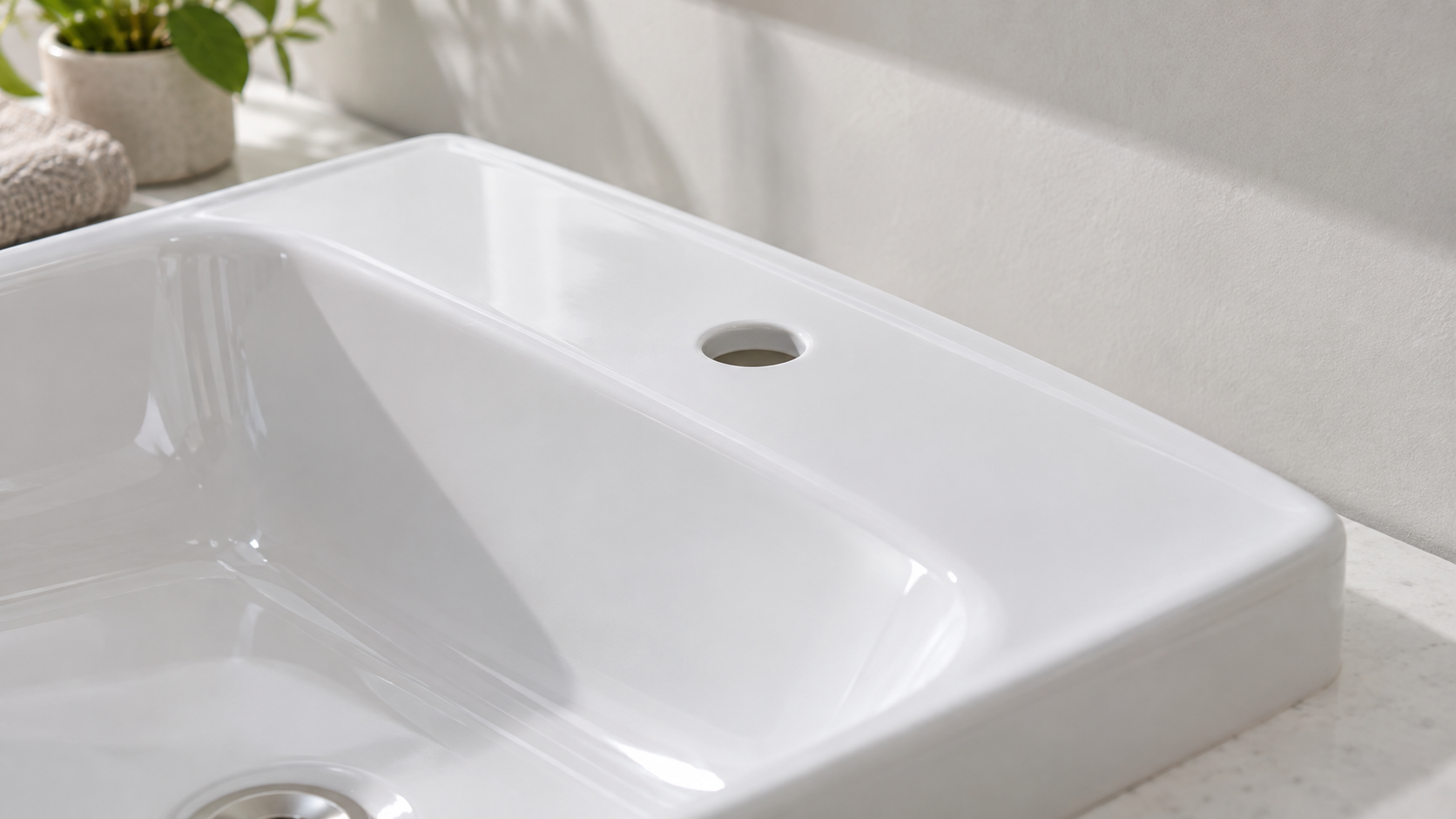
A ceramic basin with no visible tap hole is not automatically a basin waiting to be drilled. It may be a finished no-hole version, a model with a manufacturer-prepared opening position, or a product whose identity has not yet been confirmed. Those possibilities require different decisions.
The important distinction is between completing an opening specifically provided for that model and creating a new hole in an unapproved part of the fired ceramic. “Knockout” describes a product provision; it does not establish a universal technique. Start with the manufacturer’s identification and instructions, not a tool recommendation.
01 BATHROOM KNOW-HOW
Separate an open hole, a prepared position and an unapproved location
An open tap hole already passes through the mounting deck. A prepared position is a location the manufacturer identifies for later opening under its own instructions. An unapproved location may look conveniently flat, but there is no established permission to alter it. A depression or circular mark on the underside is evidence to photograph, not sufficient identification by itself.
Keep the physical observation separate from the sales wording. “One tap hole” can describe the intended fitting arrangement without telling you the delivery condition clearly enough. Ask whether the opening is supplied complete, prepared but closed, or absent on the exact item being delivered.
| What you have confirmed | What follows |
|---|---|
| An existing open hole | Check it against the intended tap and fittings. |
| A documented prepared position | Obtain the exact model’s opening instructions. |
| No documented preparation | Do not infer an opening method from appearance. |
02 BATHROOM KNOW-HOW
Prove the prepared position belongs to this exact basin
Villeroy & Boch’s O.novo 434036R1 specification lists two side tap holes as ‘pre-drilled’ on a sanitary-ceramic handwashbasin for a one-hole mixer. This identifies a particular configuration; that term alone does not confirm whether the delivered holes are fully open or require further work. Confirm the supplied condition and any permitted opening method with the manufacturer. Do not infer hidden knockouts in other no-hole basins.
Match the product code on the carton, the basin identification and the current drawing. Ask the supplier to point to the intended location in both the drawing and a photograph of your actual piece. If the diagram and delivered product disagree, keep the item unmodified while the discrepancy is resolved.
Also identify what is being opened: the basin’s ceramic deck, a separate countertop or another material entirely. A video about one surface cannot authorise work on the others. The model name without its hole-configuration suffix may still be incomplete.
03 BATHROOM KNOW-HOW
Factory hole processing and site modification are different evidence
Duravit’s manufacturing description places tap-hole processing within its production account before discussing glazing and firing. Seeing holes made during ceramic manufacture therefore does not establish that an installed, finished basin can be treated the same way. Its account describes its manufacturing process, not a repair instruction for every ceramic product.
Likewise, the word knockout does not reliably tell you which tools a manufacturer specifies. Franke’s ceramic inset kitchen-sink FAQ describes its own method for pre-punched positions, involving drilling as part of that method. That is a kitchen-sink example only; it is not a procedure for opening your bathroom basin.
The decision is whether the location and method are approved together for the exact product. This article gives no hammering sequence, drilling speed or drill-bit specification. For background on the ceramic surface itself, see our basin glaze and colour guide; surface appearance cannot establish modification permission.
04 BATHROOM KNOW-HOW
If the mark or instructions are missing, keep the question open
A missing label does not prove that a prepared position exists, and a visible circle does not prove that it is a usable tap location. Send clear top and underside photographs to the manufacturer or authorised supplier, together with the full code and intended tap arrangement. Ask for a written identification and the relevant instruction revision.
Do not enlarge an existing opening or add a new one merely because a tap’s base could cover the result. Base coverage does not answer questions about the body beneath it, the required fastening space or whether that modification is permitted. Likewise, another owner’s successful alteration is not approval for your model.
Where the manufacturer cannot confirm a permitted operation, ask about the correct basin variant or a compatible alternative tap arrangement. Our tap-hole versus no-hole basin guide handles that selection decision without assuming the ceramic can be changed.
05 BATHROOM KNOW-HOW
Prefer the specified hole configuration before the basin is shipped
When the tap arrangement is known, ask first for a basin supplied in that configuration. Kohler’s published Serif K-2075 sheet uses separate model suffixes for different hole layouts. This shows why a shared collection name or matching exterior photograph is not enough to identify the ordered item. Confirm present availability with the supplier rather than treating an older sheet as a stock list.
For a project order, record which positions are open at delivery, which are intentionally left closed, and whether any later opening is expressly allowed. If a supplier offers factory preparation, get the delivered condition confirmed on the order drawing. Do not assume that every no-hole design has such an option.
Keep this decision separate from faucet fit. Once the approved configuration is established, our basin tap-hole size and spacing guide covers the hole dimensions and hardware interfaces. An approved opening location does not automatically approve a particular tap.
06 BATHROOM KNOW-HOW
Check the delivered condition before installation starts
Compare the received basin with the order drawing while its identifying labels are available. Record the open holes, any documented prepared positions and visible edge condition. Photograph discrepancies before the fixture is installed. A different hole condition should trigger a clarification, not an improvised correction to make the delivery match the picture.
If opening a prepared position is genuinely required, give the experienced installer the exact manufacturer instructions and the agreed tap specification. Have the supplier clarify who is responsible for that work and how any damage or mismatch will be handled. Warranty treatment belongs to the applicable product terms; there is no universal warranty outcome asserted here.
The handover should leave one clear answer: supplied ready for the selected tap, awaiting a specifically authorised operation, or not yet confirmed. Keeping those states visible prevents an unverified assumption from becoming an irreversible alteration.
Official references
FAQ COMMON QUESTIONS
Frequently asked questions
Does every ceramic basin without a tap hole have a knockout?
No such assumption is justified. Confirm the exact product’s drawing and delivery condition with its manufacturer or supplier.
Is a circular mark underneath enough to identify a knockout?
No. Photograph it and match it to the identified model and official instructions before deciding what it represents.
Does knockout always mean no drilling is involved?
No. Terminology does not establish the method. Some manufacturers describe procedures that include drilling for specific prepared products; those instructions do not transfer to another basin.
Should I add a hole to use the tap I already bought?
First ask for a compatible factory-supplied basin configuration or another approved arrangement. Do not treat an existing tap purchase as permission to modify the ceramic.
NEXT · RELATED READING