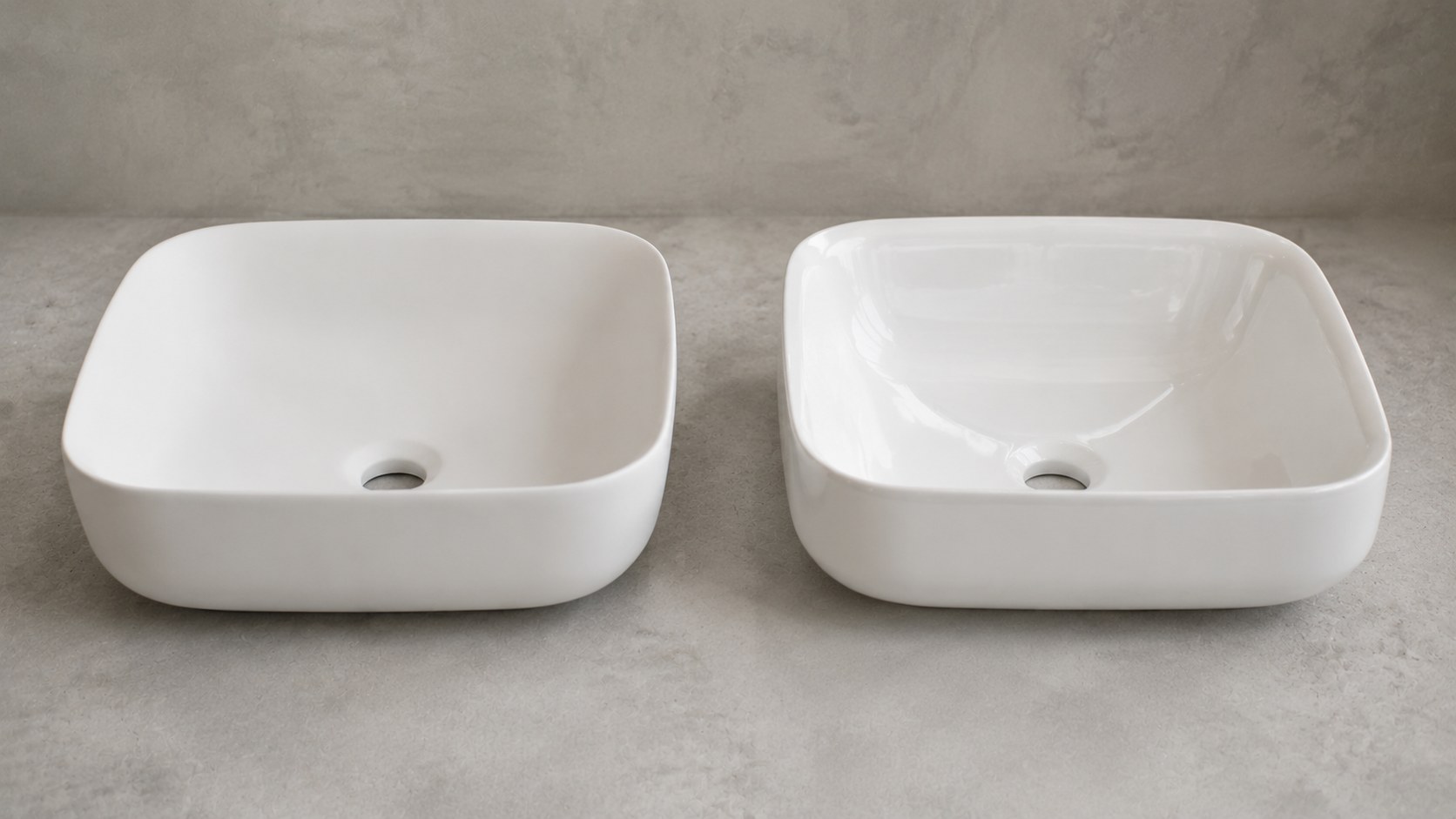
Buyers ask us this almost weekly: in the ceramic vs porcelain basin debate, which material is actually better for a bathroom? The honest answer is that the two words are not opposites at all. Porcelain is a type of ceramic — just a denser, higher-fired one. Understanding that single fact clears up most of the confusion, and it changes how you read a supplier's spec sheet.
Key takeaways
- Porcelain is ceramic — fired hotter and denser, with far lower water absorption than ordinary earthenware ceramic.
- Most quality basins are vitreous china — a glazed, high-fired porcelain with water absorption at or below 0.5%.
- The real question is grade, not the label — ask for firing temperature, absorption rate and glaze quality, not just the word on the box.
01 THE TERMS
Is porcelain a type of ceramic?
Yes. Ceramic is the broad family — any clay body shaped and hardened in a kiln. Porcelain is a specific member of that family, made from a finer, more refined clay (rich in kaolin) and fired at much higher temperatures. So when a listing says "ceramic basin" it may mean anything from a low-fired earthenware to a fully vitrified porcelain. When it says "porcelain," it is telling you something more specific about density and firing.
That is why comparing "ceramic" against "porcelain" as if they were rivals is slightly misleading. A better way to frame it: ordinary low-fired ceramic versus high-fired porcelain / vitreous china. Once you frame it that way, the differences in water absorption, durability and price line up logically instead of feeling arbitrary.
02 VITREOUS CHINA
What is vitreous china, and where does it fit?
Almost every serious bathroom basin, toilet and pedestal you will see is made from vitreous china. This is a high-fired porcelain body finished with a vitreous (glass-like) glaze that is fused to the surface during firing. The glaze gives the hygienic, high-gloss, easy-clean surface buyers expect; the dense body underneath gives the strength.
In practice, "porcelain basin" and "vitreous china basin" describe the same product for most sanitaryware. The term "ceramic basin" is often used loosely to cover all of them in marketing — which is fine, as long as you check the underlying grade rather than trusting the word alone. At our own kilns, standard wash basins are fired as vitreous china precisely because a bathroom needs low absorption and a durable glaze far more than a decorative plate does.
The label on the box tells you less than the firing curve behind it.
03 DENSITY & FIRING
Water absorption and firing temperature: the real dividing line
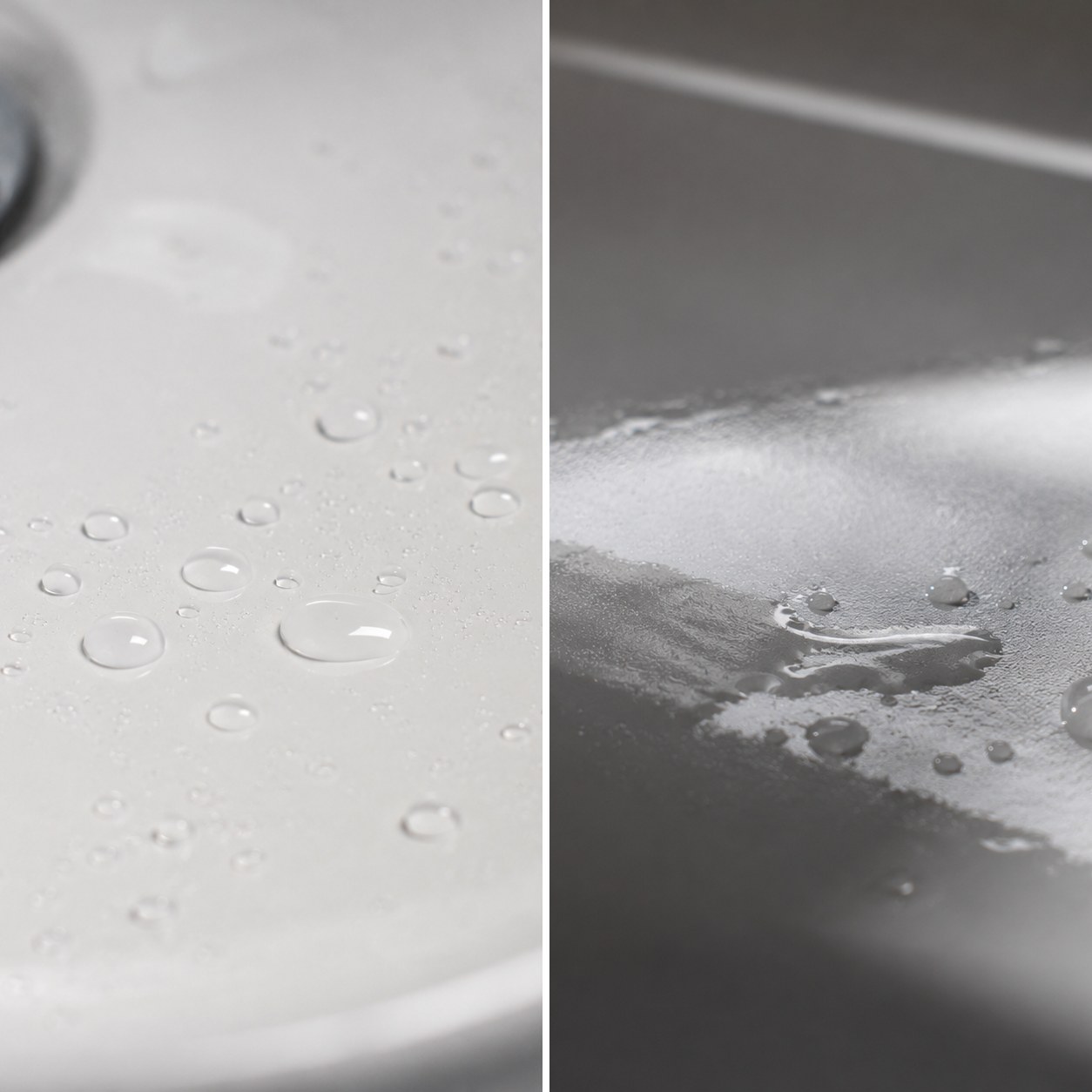
The single most useful number in this whole comparison is water absorption — how much moisture the fired body can soak up, measured as a percentage of its weight. It is the honest signal of density, and density is what firing temperature buys you.
Ordinary low-fired ceramic (earthenware) is fired below roughly 1,200°C and stays comparatively open and porous, so its absorption can run several percent. High-fired porcelain and vitreous china are fired hotter — our sanitary bodies are matured at around 1,250°C — which drives true vitrification, closing the internal pores. Quality vitreous china reaches water absorption of 0.5% or lower. That is why a good porcelain basin resists staining, odour and hairline crazing far better than a cheap ceramic one: water and grime simply cannot work their way into the body. If you want the deeper story on that firing threshold, see why 1250°C matters.
Ask for the absorption number
Don't accept "it's porcelain" as proof of quality. Ask the supplier to state the water absorption rate (a quality sanitary body should be ≤0.5%) and, if the project needs it, request the test report. The number, not the noun, tells you what you are buying.
04 DURABILITY & GLAZE
Durability, glaze and staining in daily use
Because it is denser and harder, a high-fired porcelain / vitreous china basin is more resistant to chipping, thermal shock and everyday wear than low-fired ceramic. The fused glaze is the other half of the story: an even, well-applied glaze gives a smooth, non-absorbent surface that wipes clean, resists limescale build-up and holds its gloss for years.
Low-fired ceramic can still make a perfectly acceptable basin for light residential use, but it is more prone to surface staining over time, to crazing (fine cracks in the glaze) and to chipping if something heavy is dropped in it. The visible difference on a showroom shelf can be subtle; the difference after three years of hotel service is not. Glaze quality — thickness, evenness, freedom from pinholes — is where a factory's control really shows, which is a good part of what our AQL inspection checks before packing.
05 SIDE BY SIDE
Ceramic vs porcelain basin: a side-by-side comparison
Here is the practical picture, treating "ceramic" as ordinary low-fired earthenware and "porcelain" as high-fired vitreous china — the two ends most buyers are really choosing between.
Ordinary ceramic vs porcelain / vitreous china
| Factor | Ordinary ceramic (earthenware) | Porcelain / vitreous china |
|---|---|---|
| Firing temperature | Below ~1,200°C | ~1,250°C, fully vitrified |
| Water absorption | Higher (several %) | ≤0.5% |
| Durability | Good for light use, chips more easily | Harder, more chip- and shock-resistant |
| Staining & crazing | More prone over time | Highly resistant |
| Glaze finish | Adequate, can craze | Dense, high-gloss, hygienic |
| Weight | Similar, sometimes lighter | Dense, solid feel |
| Price | Lower | Higher, but longer service life |
| Best for | Budget residential, retail volume | Hotels, projects, long-term use |
06 PRICE, WEIGHT & SHIPPING
Price, weight and shipping considerations
Porcelain / vitreous china generally costs more than ordinary ceramic, because the finer clay body, higher firing temperature and tighter quality control all add cost. For most buyers that premium is modest at the unit level and easily justified by the longer service life and lower complaint rate — especially in commercial settings.
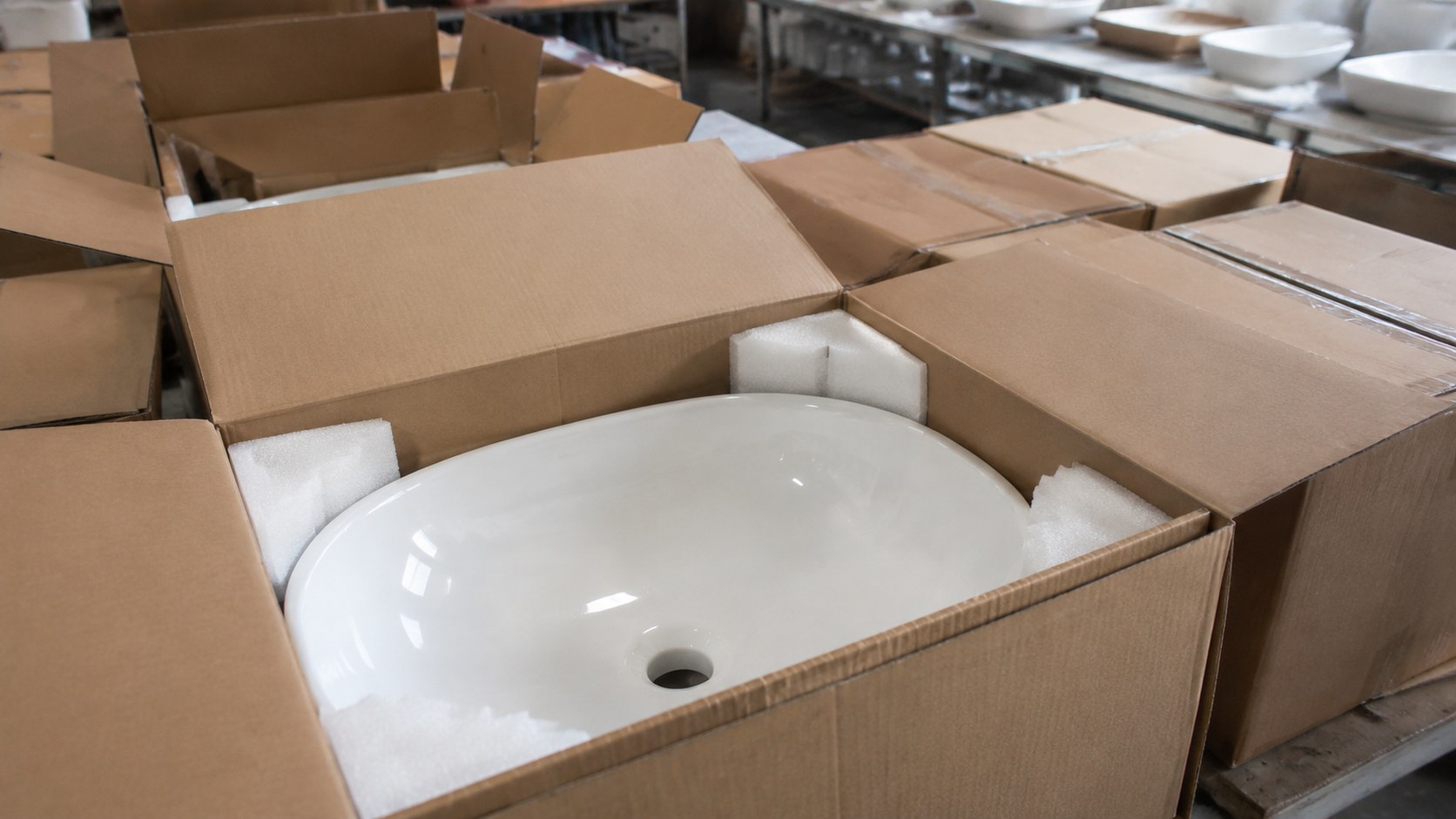
Weight matters for export. A dense vitreous china basin has a solid, quality feel, but it also means real freight weight, so packaging has to protect the piece and the glaze through long ocean transit. We pack basins in foam and reinforced cartons rated for stacking, and for containers we palletise to control breakage — the difference between a good factory and a cheap one often shows up not in the kiln but on arrival.
07 WHICH TO BUY
Which should you buy — hotels, homes or retail?
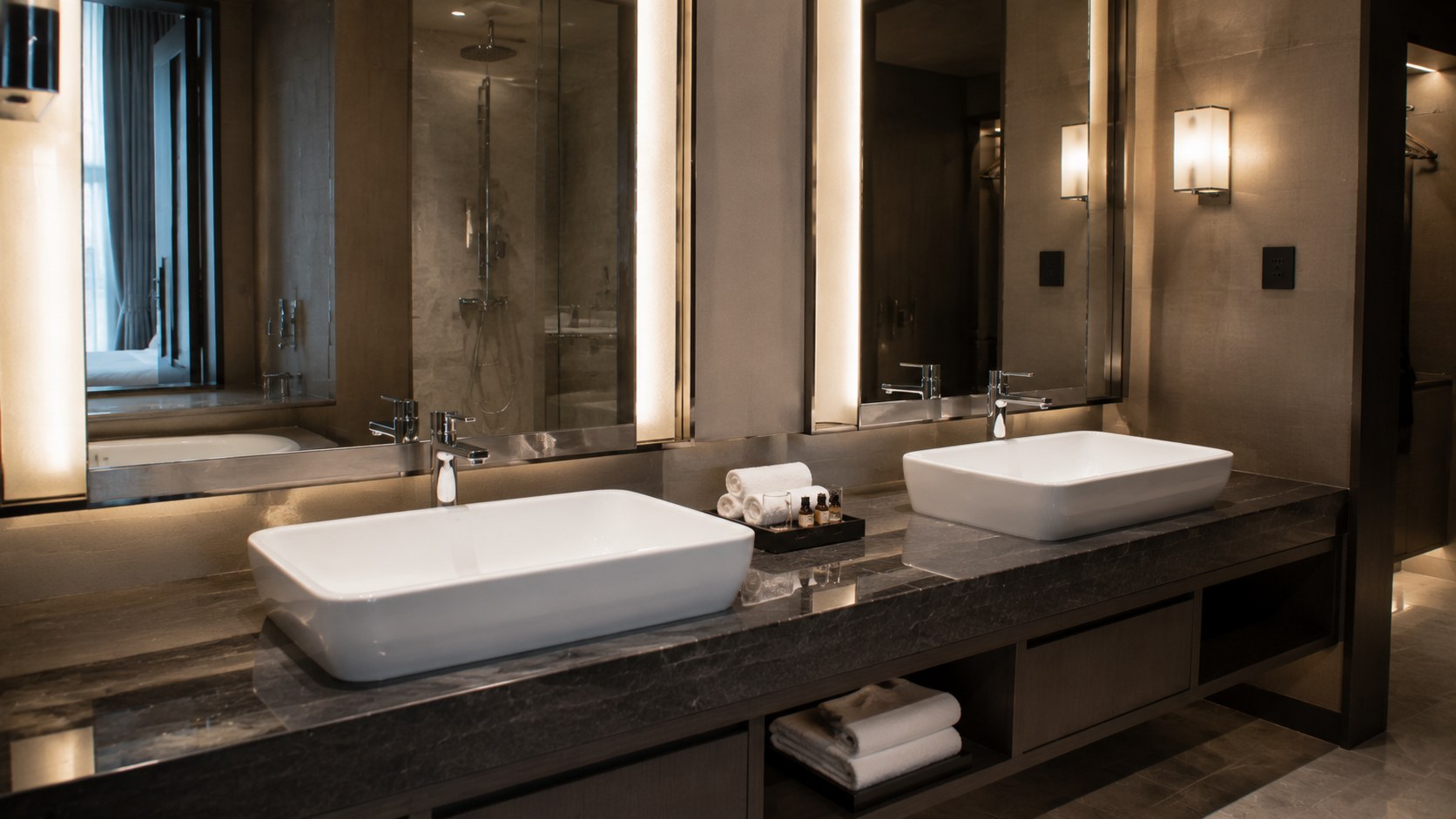
Match the grade to the use. For hotels, apartments and projects, specify high-fired vitreous china without hesitation: the traffic is heavy, the cleaning is aggressive and any warranty claim is expensive, so the denser, glaze-hard body pays for itself. Our project buyers almost always take vitreous china for exactly this reason — more on that in supplying hotels and apartments.
For everyday homes, vitreous china is still the sensible default, and the price gap is small enough that most people never regret it. Ordinary low-fired ceramic can be a reasonable budget choice for light-use guest bathrooms or price-driven retail lines, where the lower cost matters more than a few years of extra life. For retail and distribution, many buyers carry both: a vitreous china core range plus a value ceramic line to hit an opening price point. If you are still weighing shapes and grades, our guide on how to choose a ceramic basin walks through it.
Before you order, confirm
Water absorption rate (≤0.5% for a quality body); firing type (vitreous china vs low-fired ceramic); glaze grade and inspection standard (AQL); tap-hole option (0 / 1 / 3) and overflow yes/no; export packaging spec; MOQ and lead time. Get these in writing and the material debate largely takes care of itself.
08 SPECIFYING WITH A FACTORY
How to specify basins with a factory
The takeaway for buyers is simple: don't shop the word, shop the grade. "Ceramic" and "porcelain" overlap so much in marketing that the label alone won't protect you. Ask for firing temperature, water absorption, glaze standard and inspection level — the honest numbers behind the noun — and you will be comparing like with like across quotes.
As a Chaozhou-based manufacturer, we fire our standard wash basins as high-fired vitreous china at around 1,250°C, hold water absorption at or below 0.5%, and inspect to AQL before packing, with tap-hole and overflow configured to your market. If you can send us your sizes, shapes and target grade — or ask for our catalogue — we can quote the right basin for your project, whether that is a value line for retail or a hotel-grade vitreous china range for OEM/ODM supply.
In the end, the better basin is not the one with the fancier name — it's the one whose numbers you can actually read.
FAQ COMMON QUESTIONS
Frequently asked questions
Is a porcelain basin better than a ceramic basin?
Porcelain is a type of ceramic — just fired hotter and denser — so "porcelain" (usually vitreous china) is generally the stronger, less porous choice with water absorption of 0.5% or lower. Ordinary low-fired ceramic is cheaper and fine for light residential use, but porcelain resists staining, chipping and crazing better, which is why it dominates quality bathroom sanitaryware.
Is vitreous china the same as porcelain?
Effectively yes. Vitreous china is a high-fired porcelain body finished with a fused, glass-like glaze. In sanitaryware, "porcelain basin" and "vitreous china basin" describe the same product. It is the standard material for quality basins, toilets and pedestals because it combines a dense, low-absorption body with a durable, hygienic glaze.
What water absorption should a good bathroom basin have?
A quality vitreous china basin should have water absorption of 0.5% or lower, which is what full vitrification at around 1,250°C achieves. Lower absorption means the body resists moisture, staining and odour. Ask the supplier to state the figure, and for projects request the test report rather than relying on the material name alone.
Why does ceramic sometimes cost less than porcelain?
Ordinary low-fired ceramic uses a less refined clay body and a lower firing temperature, which reduces production cost — but also leaves it more porous and more prone to staining and chipping over time. Porcelain / vitreous china costs more because of the finer body, higher firing and tighter quality control, and it typically lasts longer, so the premium is modest per unit.
Which basin material is best for a hotel or apartment project?
High-fired vitreous china (porcelain). Commercial bathrooms face heavy use and aggressive cleaning, and any warranty claim is costly, so the denser, glaze-hard body pays for itself. Specify the water absorption rate, glaze grade, AQL inspection and export packaging in the contract to keep quality consistent across a large order.