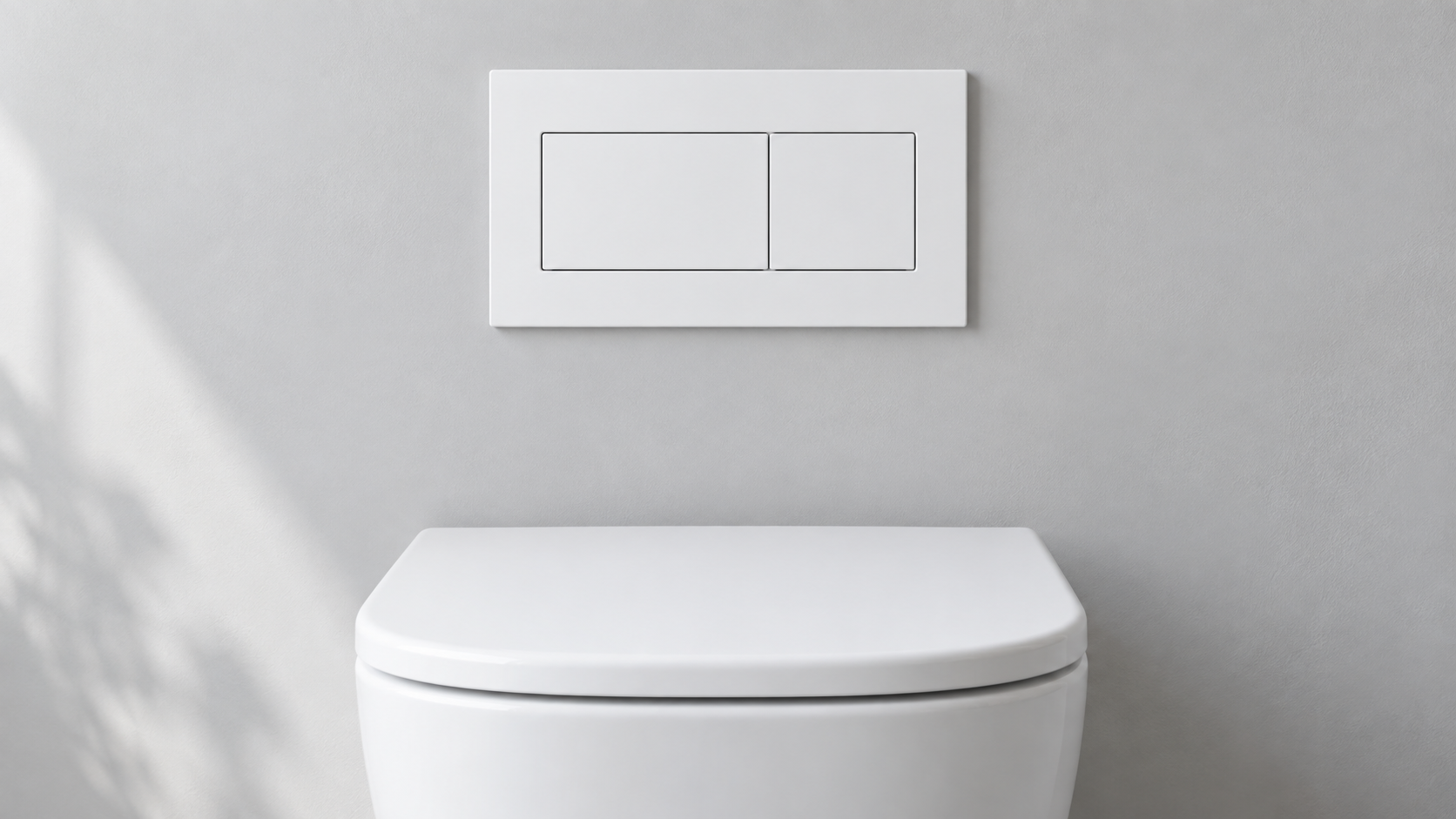
Two flush plates can look almost identical from the bathroom side and still belong to different concealed-cistern systems. Before choosing a finish, identify the tank behind the wall and the mechanism that turns a button press into a flush. The toilet bowl's shape is not enough information.
This guide separates that control interface from the frame that supports the ceramic. The manufacturer examples are specific Geberit products and documents, used to illustrate what to check. They are not a statement that another brand, a Chengda toilet or an unlisted replacement is compatible.
01 BATHROOM KNOW-HOW
Identify the cistern family before choosing the plate
Geberit's compatibility guide distinguishes its Sigma and Omega systems: a plate from one is not a replacement for the other. This shows why brand alone is too broad a description. Start with the cistern series and exact model, then check the proposed control's listed application.
For an existing bathroom, collect the original invoice, installation sheet or handover record first. If identification requires removing the plate or mounting frame, use the manufacturer's method and an appropriate specialist. Do not prise an unfamiliar cover off simply to obtain a photograph.
The bowl, frame, cistern and control may have separate references. If your question is about mounting bolts or the ceramic's water and waste connections, use our wall-hung bowl and carrier guide. Those checks do not establish which button assembly fits.
02 BATHROOM KNOW-HOW
Photograph the context as well as the number
A number printed on a loose cover is not automatically the tank's product code. The Geberit spare-parts help guide distinguishes protection-plate sticker codes from cistern identification, and points to a code inside the tank. Its examples also show separate support blocks, rods and protection components.
Ask the person identifying the assembly to retain one overall photograph and close-ups of readable markings. Note where each number was found. This gives the supplier a way to distinguish a cover, instruction label, actuator or tank reference instead of relying on an isolated string of digits.
For a building with several bathrooms, label the records by room. Do not assume the next room has the same concealed equipment because the visible plates match. Renovations and earlier repairs are reasons to verify each installation rather than carry one identification across the entire project.
03 BATHROOM KNOW-HOW
Establish whether the control uses rods, air or electronics
The control interface is more than the decorative face. Use the diagram for the actual model to trace the button's connection to the flushing assembly. The following table is an identification aid, not a conversion instruction; the presence of one familiar component does not prove the rest of a replacement kit will work.
- Geberit's Type 01 example for Sigma 8 cm is a pneumatic remote-control package including a flushing device and hose. Its application is specified; it is not a generic button that replaces every plate.
- The Sigma80 electronic example for Sigma 8 cm, range 2016 includes an electrical lifting assembly and mounting frame, with a specified power-supply installation set ordered separately. A touchless appearance therefore does not describe a faceplate-only swap.
| Arrangement to identify | Details to request |
|---|---|
| Mechanical linkage | The specified mounting frame, rods or linkage, and adjustment instructions |
| Pneumatic control | The listed actuator, hose connection and matching flushing device |
| Electronic control | The control reference, lifting assembly, connectors and specified power supply |
04 BATHROOM KNOW-HOW
Check the opening and service route, not just the outer rectangle
Record the finished-wall opening, mounting arrangement and actuation position. Ask the supplier to review them against the replacement's installation drawing. A plate that visually covers the opening has passed only a cosmetic comparison; the fixing and operating relationships still need confirmation.
For a tiled or furniture-front installation, show the surrounding finishes and available removal space. Ask how the plate, frame and service components will be reached after completion. If a remote button is proposed, identify the tank's separate service route as well. A smaller visible control is not evidence that the maintenance opening can be permanently closed.
Keep the toilet format separate from this access decision. Our close-coupled and back-to-wall comparison explains the broader layout choices. For the control order, a section through the finished installation and the matching service instructions are more useful than a room photograph alone.
05 BATHROOM KNOW-HOW
Check the generation and the complete replacement kit
Even after finding the family name, inspect the relevant age and version notes. The Geberit parts guide separates some pre- and post-2016 support components and different electronic supply versions. Those examples justify retaining generation information; they do not establish a date rule for every cistern or another manufacturer's products.
Ask whether the quotation supplies the visible plate alone or includes its mounting and actuation parts. List any required conversion set separately and request the manufacturer reference supporting its use. If a seller says a kit fits an older tank, have them identify that tank and the exact conversion rather than accepting a general statement that it fits old models.
Also separate the desired flushing options from the amount of water delivered. Our dual-flush and single-flush guide covers that choice. A two-button face is not a measurement of flush volume, nor does its appearance verify the complete installed system.
06 BATHROOM KNOW-HOW
Make compatibility a documented order item
Send one concise package: room identifier, cistern make and model, available age information, contextual photographs, current control details and the proposed replacement reference. Ask the supplier to state compatibility, necessary additional parts and any unresolved information in writing.
Once fitted, ask the installer to check the specified operating actions and show the service access method. Keep the old and new references with the building records. If a button sticks or flushing changes after replacement, record that behaviour and have the installation checked; buying another colour or pressing harder does not identify the cause.
For repeated project orders, approve a trial assembly before extending the selection to other rooms. Preserve the exact bill of materials. Substituting a newer-looking plate later should trigger another compatibility review, even when the overall dimensions look unchanged.
Official references
FAQ COMMON QUESTIONS
Frequently asked questions
Are flush plates universal if their outside dimensions match?
No. Outside dimensions describe the visible cover. Confirm the cistern application, mounting and actuation parts, version requirements and service arrangement for the proposed replacement.
Can I identify the concealed cistern from the toilet bowl's brand?
Use the cistern's own records and identification. A bowl label is useful for the ceramic, but it does not establish the identity of every component behind the wall.
Can a mechanical button be upgraded to touchless operation?
Only assess that against a documented compatible control package and installation requirements. Check the actuation hardware and specified power arrangement. Do not assume that changing the visible panel supplies the other required parts.
Does an older cistern always need replacing when its plate breaks?
Do not decide from age alone. Identify the exact system and ask its manufacturer or specialist supplier about supported plates, spare parts or conversion sets. Availability and the work required need confirmation for that particular installation.
NEXT · RELATED READING