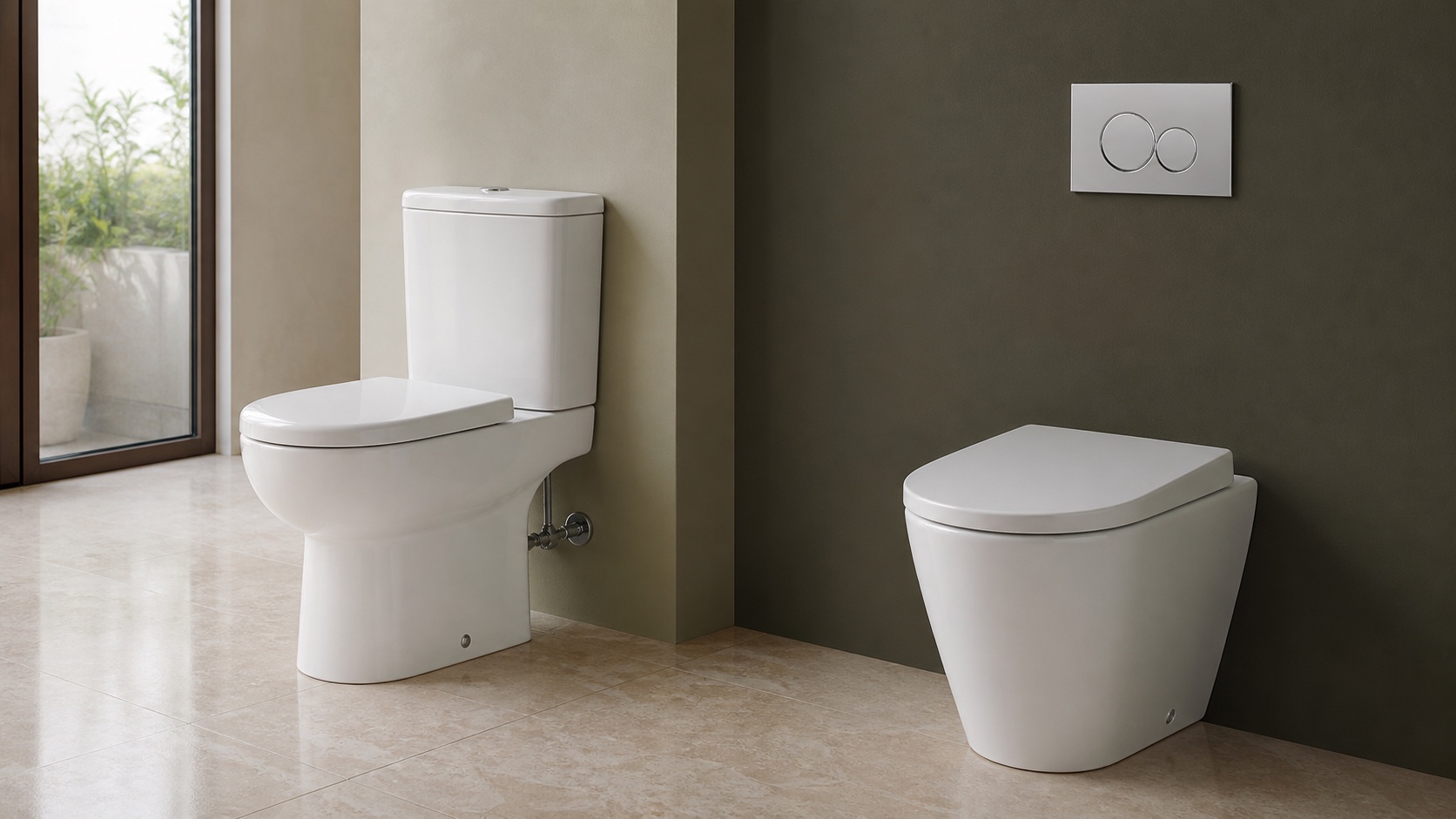
For importers, distributors and project buyers, the close coupled vs back to wall toilet decision affects the visible design, installation sequence, service access, packing list and total delivered cost. A close-coupled toilet keeps the cistern visible and attached to the pan. A true back-to-wall toilet uses a floor-standing pan against the finished wall or furniture, with the cistern concealed behind it. The cleaner-looking option is not automatically smaller, easier to maintain or better at flushing. Buyers must compare the complete installed system.
Key takeaways
- Names are often confused: a fully shrouded close-coupled toilet still has a visible cistern; a back-to-wall pan normally uses a separate concealed cistern.
- Installed depth matters: include the service wall or furniture housing, not only the ceramic pan projection.
- Buy the tested combination: pan, cistern, flush pipe, actuator, valves and outlet connection must be coordinated and documented.
01 PRODUCT DEFINITIONS
What is the difference between close-coupled and back-to-wall toilets?
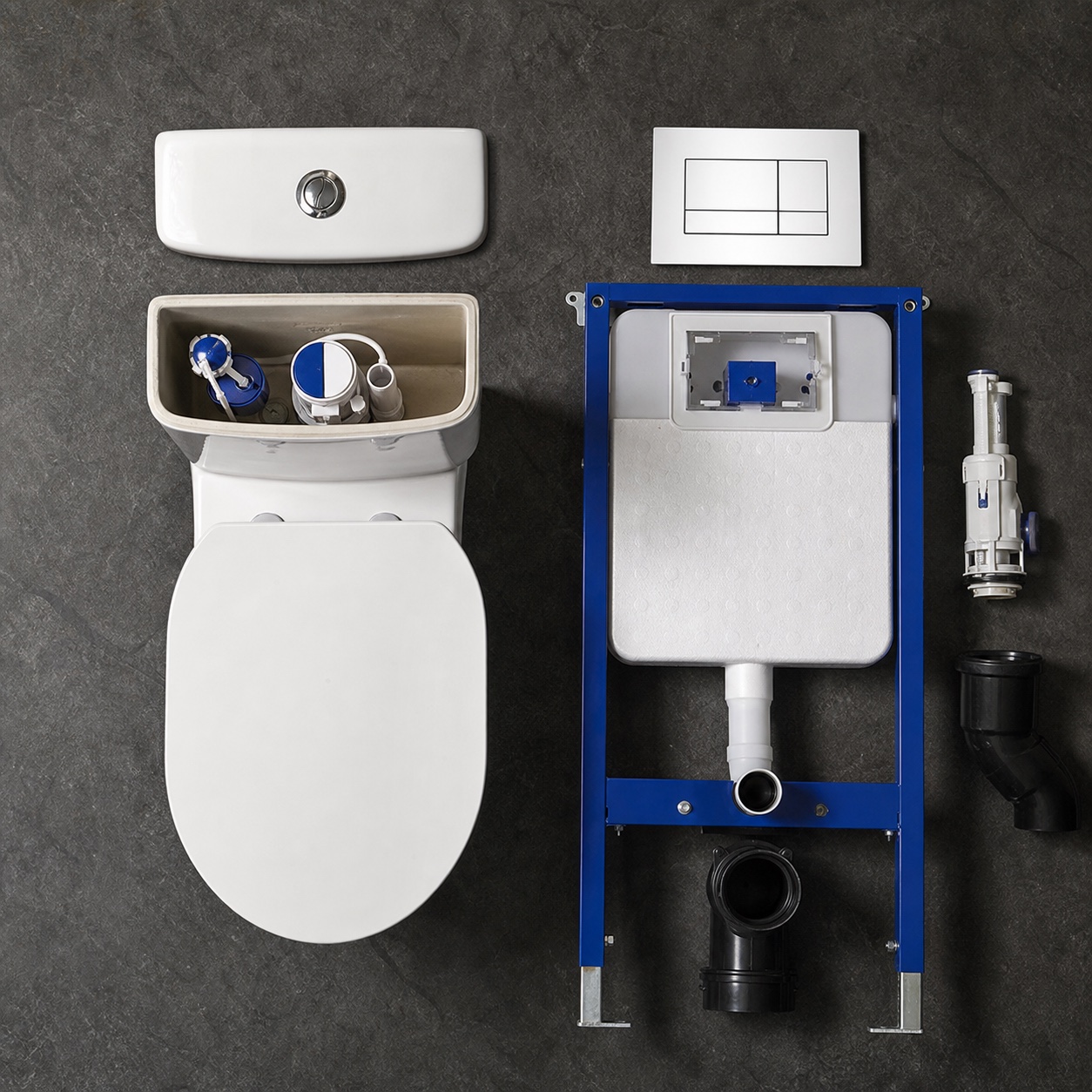
A close-coupled toilet has a visible cistern fitted directly behind and above the ceramic pan. The tank may be ceramic or another approved material, and the toilet may use a top button, front button or lever. Internal valves are reached by removing the cistern lid. This format is familiar in retail, replacements, rentals and large projects because the complete toilet can be installed after walls and floors are finished.
A back-to-wall toilet in this comparison is a floor-standing ceramic pan whose rear face sits close to the finished wall or furniture panel. The cistern is separate and concealed inside a wall void, service duct or WC furniture unit. A flush plate or furniture-mounted button remains visible. The pan carries the user load through the floor, unlike a wall-hung toilet that requires a structural carrier.
There is a naming trap. Many modern close-coupled toilets have a fully shrouded pan that hides the soil connector and inlet pipe while the cistern remains visible. Retailers may call these “back-to-wall close-coupled” or “wall-faced” suites. They are not the same supply package as a separate back-to-wall pan with concealed cistern. Put a product drawing and component list beside every name.
02 BUYER COMPARISON
Close-coupled vs back-to-wall toilet: key differences
Commercial comparison for buyers
| Buying factor | Close-coupled | Back-to-wall |
|---|---|---|
| Cistern | Visible, attached to pan | Separate, concealed |
| Pan support | Floor standing | Floor standing |
| Service access | Through removable lid | Through flush plate or panel |
| Installation sequence | Usually after finishes | Cistern before wall or furniture closure |
| Visual effect | Complete visible suite | Minimal pan and flush control |
| Common project fit | Retrofit, value retail, easy service | Design-led hotels, apartments, furniture ranges |
These are system tendencies rather than quality rankings. A premium close-coupled model can have a fully shrouded base, rimless bowl and refined seat. A poorly coordinated concealed system can create difficult servicing, noise or leaks. Compare actual drawings, approved samples, certification, spare supply and installed cost.
03 SPACE & INSTALLATION
Which toilet uses less space after installation?
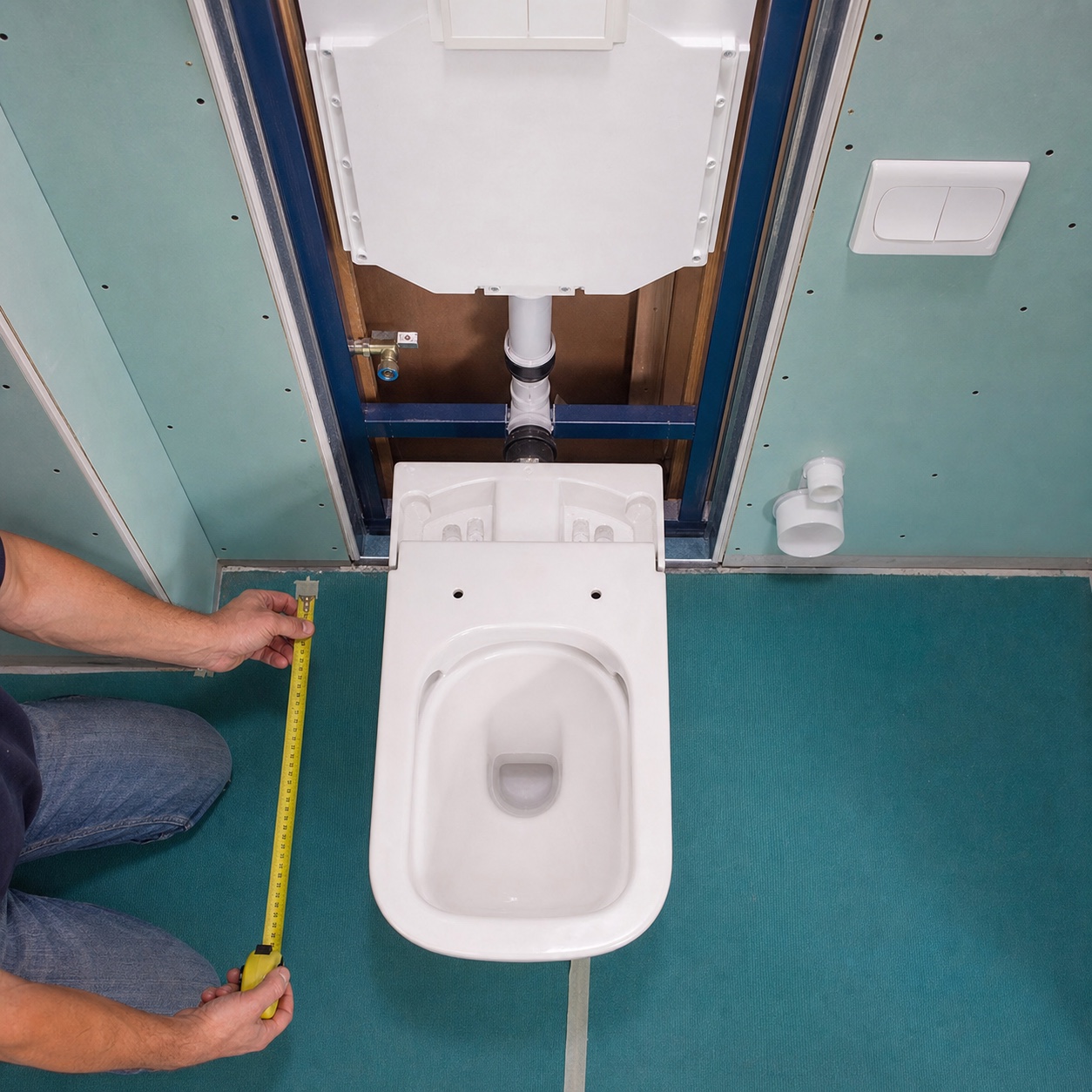
Do not compare pan projection alone. Measure from the final wall face behind the system to the front of the installed seat. A back-to-wall pan may be compact, but the cistern needs a wall void or furniture depth. Building a service wall into the room can cancel part of the apparent saving. A concealed cistern placed within an existing duct may create a genuine reduction.
Close-coupled toilets generally suit like-for-like replacement because the cistern, valves and actuator remain accessible. A fully shrouded design still needs enough rear space for the soil connector, water inlet and installer’s hands. Check whether the toilet can reach the existing rough-in without forcing the ceramic away from the wall.
Back-to-wall systems require earlier coordination. The cistern, flush pipe, outlet, isolation valve and access opening must be positioned before the wall or furniture is closed. The finished wall must be plumb, and the pan must meet it without a large gap. New builds and full renovations can accommodate this sequence more easily than occupied-room replacements.
04 OUTLET & ROUGH-IN
Which dimensions must buyers confirm before ordering?
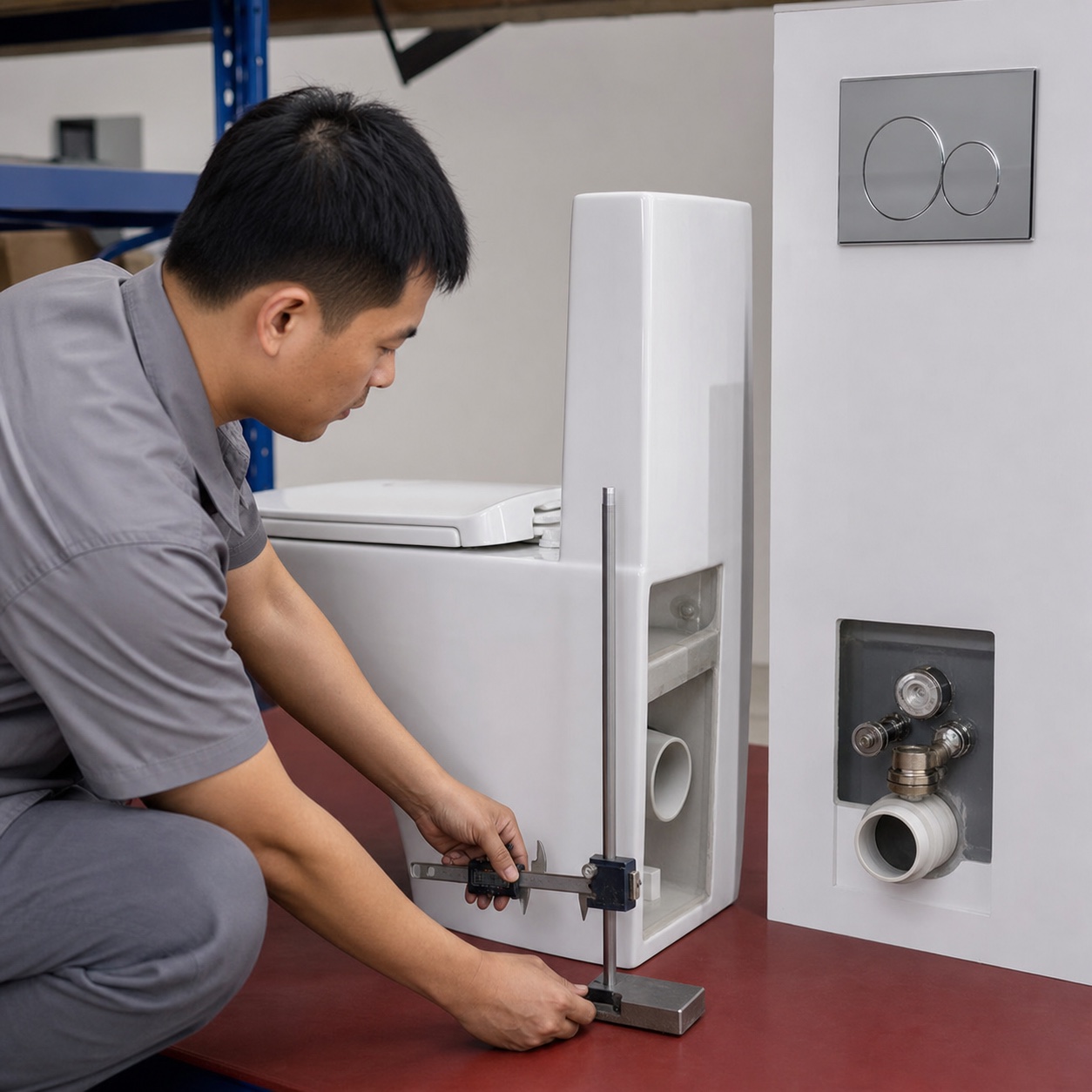
Request a dimensioned drawing for the exact SKU, not a family brochure. Confirm overall projection and width, seat height, flush inlet centre, waste outlet centre, outlet outside diameter, rear ceramic void, fixing-hole position and clearance for the pan connector. Specify whether the project uses a floor outlet, wall outlet or approved adapter. Our S-trap vs P-trap rough-in guide explains why outlet direction and set-out cannot be guessed from the toilet silhouette.
For close-coupled suites, also record cistern width, height, coupling-hole centres, wall-fixing points and water-inlet side. For back-to-wall systems, record finished-wall depth, flush-pipe centre, concealed-cistern outlet, actuator location and service-opening size. Check skirting, tile thickness and wall tolerance because the ceramic rear edge is visually unforgiving.
Dry-fit a signed pan against a representative finished wall. Install the real connector, fill and flush the system, then remove and reinstall it to confirm serviceability. A technical drawing should show the reference surface clearly; dimensions measured from an unfinished stud or hidden frame can be misread on site.
05 SERVICE ACCESS
Are concealed cisterns difficult to repair?
Routine servicing can be straightforward when access is designed correctly. Many concealed systems allow the flush plate to be removed so the fill valve, flush valve and seals can be reached through the opening. Furniture-mounted cisterns may use a removable top or front panel. This access method is product-specific; do not promise that every component can pass through every plate opening.
Approve the cistern and actuator as a matched set. Mechanical rods, cables or pneumatic tubes have different installation limits. Confirm plate dimensions, wall thickness range, valve codes, isolation-valve access and the removal sequence. Keep a real service trial in the sample-approval record: replace the inlet valve and flush-valve seal without damaging the finished panel.
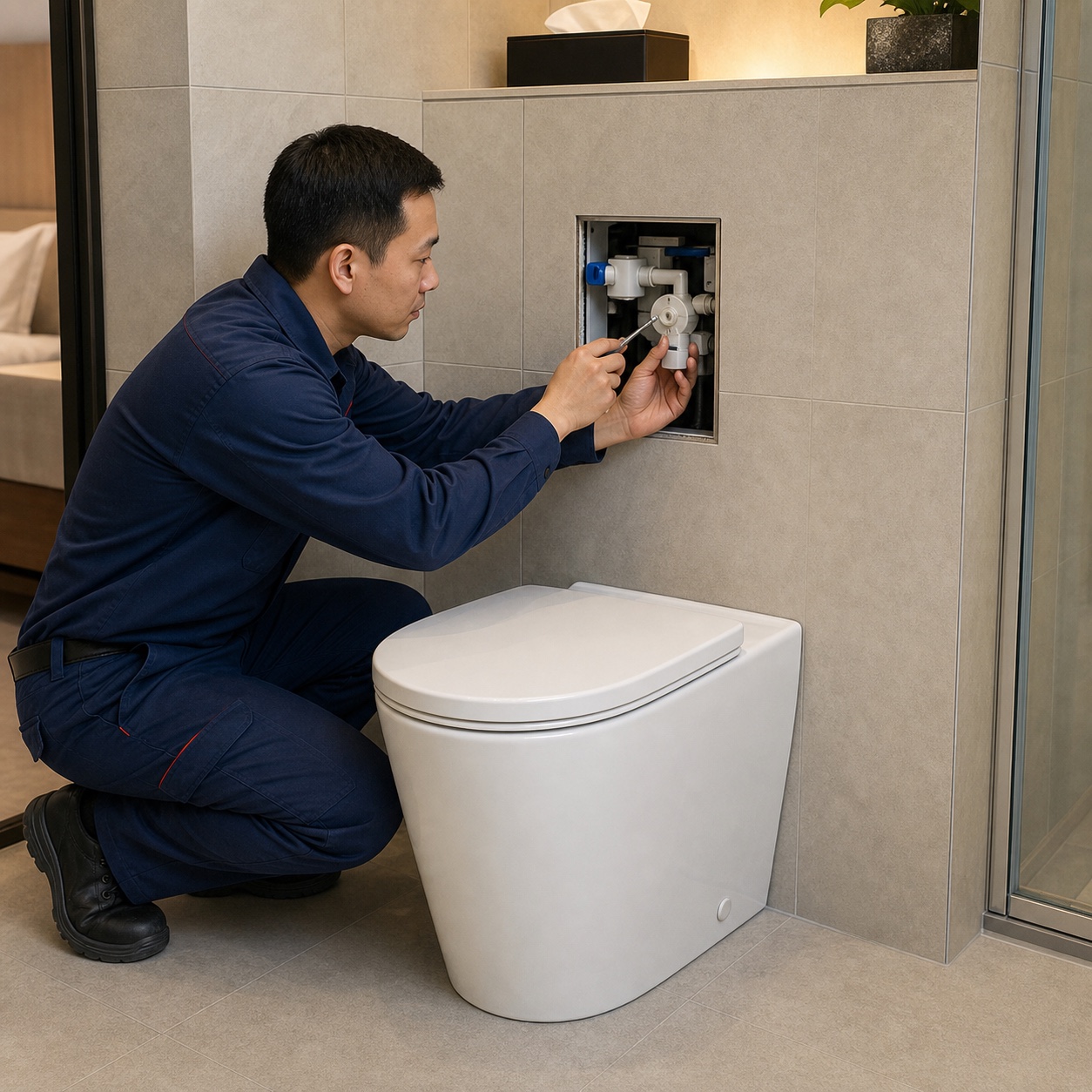
Close-coupled toilets expose more of the system, but they are not maintenance-free. Lid clearance, valve height, button rods, tank bolts and coupling seals still need control. For either type, give hotels and apartment managers exact spare codes and an illustrated service sheet rather than asking them to identify parts years later from photographs.
06 PERFORMANCE & CERTIFICATION
Does cistern position change flush performance?
Flush performance depends on the coordinated bowl, water volume, valve, flush pipe and installation, not simply whether the cistern is visible. Test bowl wash, waste extraction, water-seal restoration, refill, leakage and drainline transport under the destination-market method. A long or incorrectly aligned flush pipe can change how energy reaches a back-to-wall pan.
Certification must follow the actual combination. EPA’s WaterSense product guidance, for example, identifies compatible tank and bowl combinations and requires third-party certification for labelled products. A certified bowl cannot automatically be mixed with any concealed cistern or carrier. The same purchasing discipline applies in other markets: list the pan, cistern, valves and actuator model codes on the report and specification.
Do not confuse product format with other features. Both toilet types may be rimmed or rimless, single or dual flush, round or elongated, depending on the model and market. Use the dual vs single flush guide and rimless vs rimmed guide as separate decisions.
07 PROJECT & RETAIL FIT
Which toilet type fits hotels, apartments and retail?
Close-coupled toilets work well for value and mid-market retail, rental apartments, replacement programmes and projects with local plumbers familiar with exposed cisterns. The complete suite is easy to display and quote. A fully shrouded pan can hide pipework while keeping the tank accessible, giving a cleaner look without a concealed installation.
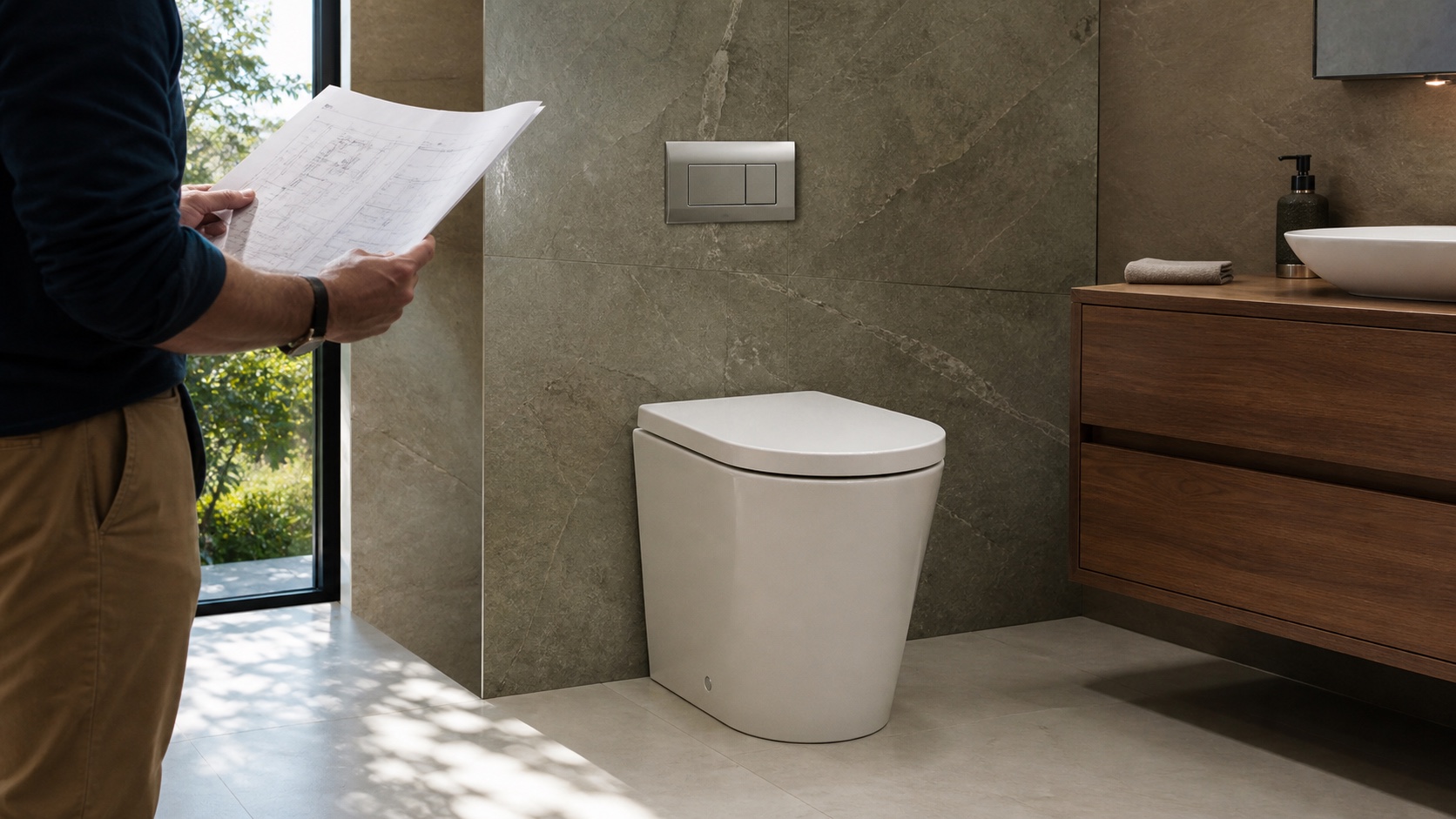
Back-to-wall pans suit coordinated furniture ranges, design-led apartments and hotel bathrooms where the architect wants a quiet wall line. They can use a service wall to create a shelf or place the cistern within a WC unit. The project team must approve the flush plate finish, access strategy and local availability of concealed parts.
Do not let appearance decide alone. Compare installer skill, construction programme, room downtime, wall system, service responsibility and spare-stock location. For suspended bowls, use the separate wall-hung toilet installation guide; a floor-standing back-to-wall pan does not require the frame to support user weight.
08 ORDER & QUALITY CONTROL
What should importers specify and inspect?
Control the complete installed system
1. Product name and configuration. 2. Pan model and drawing. 3. Visible or concealed cistern code. 4. Floor or wall outlet and set-out. 5. Flush-pipe and connector codes. 6. Flush volumes. 7. Inlet and flush valves. 8. Button, lever or plate. 9. Seat shape and fixing centres. 10. Wall or furniture depth. 11. Service-opening method. 12. Destination certification. 13. Spare-parts package. 14. Carton marks and installation instructions.
During inspection, check ceramic dimensions and flatness, outlet geometry, glazing, seat fit, water volume, leakage and flush performance. Assemble random units from different cartons. For concealed systems, build a simple test wall or furniture jig so the pan, pipe and actuator can be checked in their installed relationship.
Pack components according to the actual supply route. A close-coupled suite may ship pan, cistern, seat and fittings in separate protected sections or cartons. A back-to-wall order may require pan, seat, concealed cistern, frame or brackets, flush pipe, outlet connector and plate. Use linked carton numbers so the site does not receive pans without compatible controls. Our pre-shipment inspection guide covers the wider order.
Chengda supplies ceramic toilet pans and coordinated sanitary ware packages for importers, distributors, hotels and apartment projects. Send the destination market, toilet format, outlet and rough-in, room drawing, certification requirement, target price and quantity. We can prepare the ceramic, cistern, seat, fittings, spares and export packing as a controlled model.
Choose close-coupled or back-to-wall by the complete installed system: dimensions, access, certified performance and service support must all fit the destination project.
FAQ COMMON QUESTIONS
Frequently asked questions
What is the difference between a close-coupled and back-to-wall toilet?
A close-coupled toilet has a visible cistern attached to the pan. A back-to-wall toilet in this comparison is a floor-standing pan with a separate concealed cistern behind a wall or furniture panel.
Is a fully shrouded close-coupled toilet the same as a back-to-wall toilet?
No. A fully shrouded close-coupled toilet hides pipework around the pan but still has a visible cistern. A true back-to-wall pan normally uses a concealed cistern and separate flush control.
Do back-to-wall toilets save more space?
Sometimes, but compare total installed depth. A compact pan may need a service wall or furniture unit that projects into the room. Existing ducts can make concealed systems more space-efficient.
Can a concealed cistern be serviced without removing tiles?
Many systems allow routine valve and seal service through a removable flush plate or furniture panel. Access varies by model, so buyers should perform a real service trial on the approved combination.
Which toilet is better for hotels?
Back-to-wall toilets support a minimal design, while close-coupled models simplify access and replacement. The project should decide from room design, installer capability, downtime, local spares and certification.
Can any concealed cistern be used with any back-to-wall pan?
Do not assume compatibility. Flush volume, pipe geometry, inlet and outlet centres, actuator and certification must match the exact pan-and-cistern combination.