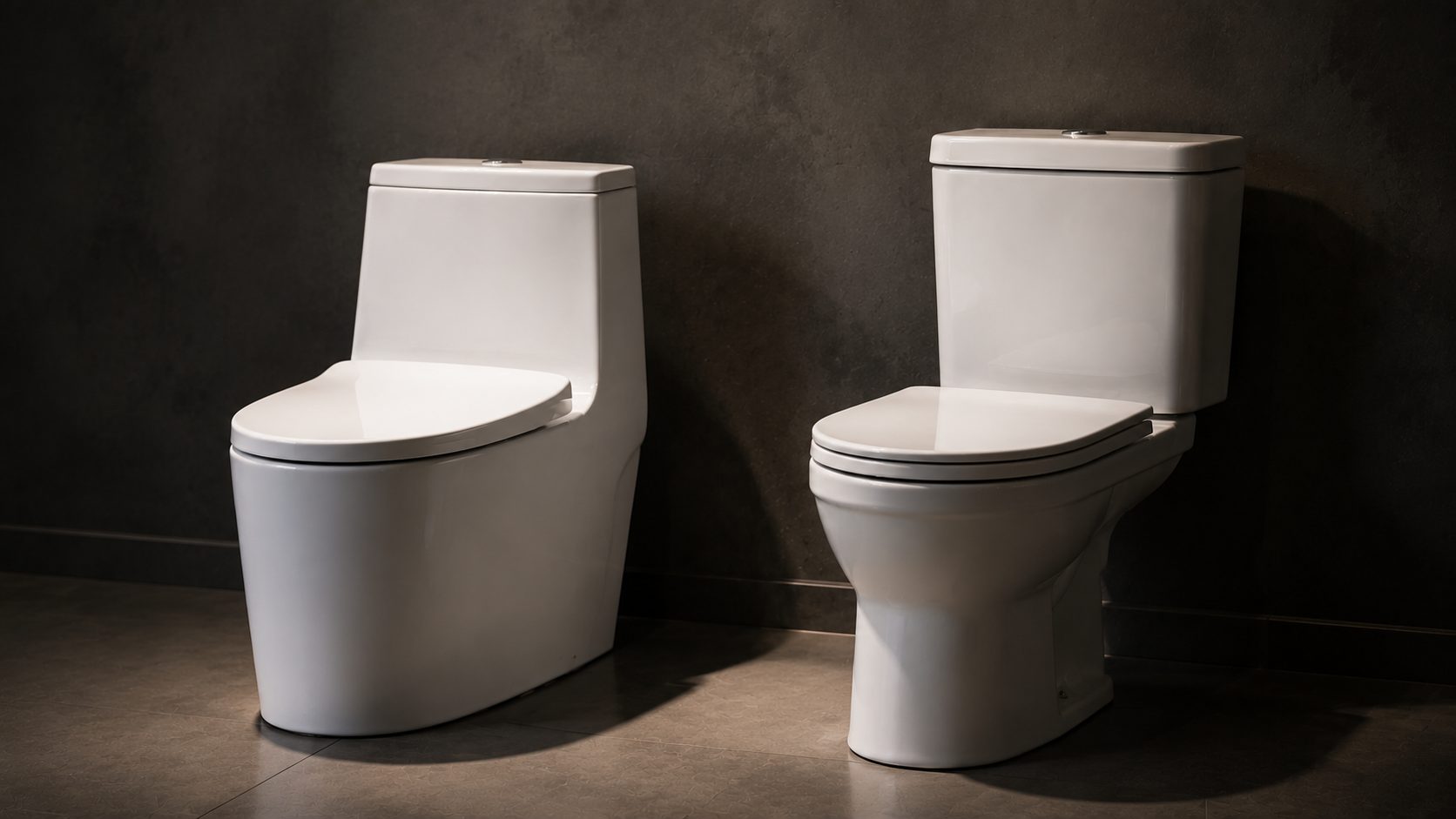
Put a one-piece and a two-piece toilet side by side and the difference is obvious within seconds — one is a single seamless ceramic body, the other a separate tank bolted to the bowl. What the showroom does not show is why that difference exists, and what it costs. The one piece vs two piece toilet decision is really a decision about kiln yield, freight, spare parts and after-sales — so here is the comparison from the factory floor as well as the bathroom.
Key takeaways
- One-piece wins on looks and hygiene — a seamless glazed body with no tank-to-bowl joint to leak or trap grime, but it is harder to cast and fire, so it costs more ex-factory and ships heavier.
- Two-piece wins on price, freight and spares — two simpler castings mean higher kiln yield, tighter container packing and a tank or bowl that can be replaced on its own.
- Flush performance belongs to neither body — siphonic or washdown, single or dual flush are specified separately, and rough-in spacing is the spec that most often goes wrong in imports.
01 SIDE BY SIDE
One-piece vs two-piece toilet: quick comparison
Here is the practical picture before the detail. Both types are the same fired vitreous china, and both can carry the same flush technology; what separates them is whether the tank and bowl leave the kiln as one body or two — and everything that follows from that.
One-piece vs two-piece at a glance
| Factor | One-piece toilet | Two-piece toilet |
|---|---|---|
| Manufacturing & yield | One large, complex casting; lower kiln yield | Two simpler castings; higher yield, cheaper defects |
| Look | Seamless, low-profile, modern; skirted designs common | Traditional silhouette with a visible tank seam |
| Leak points & cleaning | No tank-to-bowl joint; smooth wipe-down exterior | Gasket and bolts can weep with age; seam collects grime |
| Ex-factory price | Typically higher for a comparable spec | Generally lower — the value choice |
| Shipping & packing | One large, heavy carton; fewer units per 40'HQ | Nesting cartons; better container utilisation |
| Spare parts | Whole unit replaced if the tank is damaged; some model-specific valves | Tank or bowl replaced individually; standard fittings |
| Installation weight | One heavy lift, often a two-person job, fewer steps | Lighter cartons, one extra assembly step |
| Best-fit projects | Hotels, premium residential, showroom retail | Rental housing, value retail, parts-sensitive distributors |
02 ONE-PIECE
What is a one-piece toilet?
A one-piece toilet has its tank and bowl slip-cast and fired as a single vitreous-china unit. There is no joint, no gasket and no bolts between tank and bowl — the glazed surface runs in one continuous line from the tank lid to the base. Many designs go further with a skirted trapway, hiding the trap curves behind a flat ceramic side for an even cleaner profile.
The result reads modern and premium: a lower, more compact silhouette that suits contemporary bathrooms and is quick for housekeeping to wipe down. The trade-offs are physical and commercial. It is one large, heavy piece — often a two-person lift at installation — and some models use low-profile, model-specific fill valves rather than fully universal parts, so spare-part supply is worth confirming at ordering. And because the whole body is one casting, it costs more to make, as the next sections explain.
03 TWO-PIECE
What is a two-piece toilet?
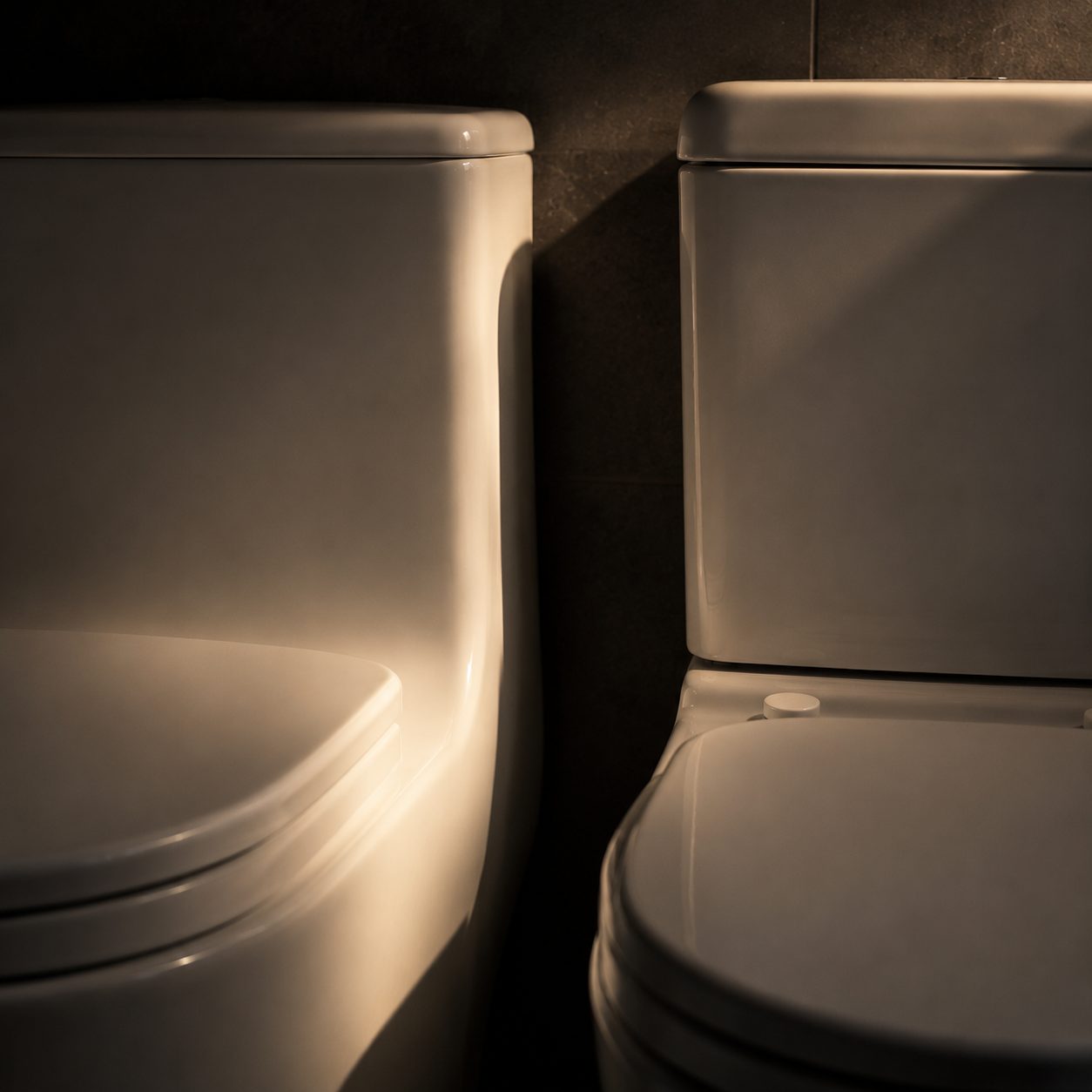
A two-piece toilet is exactly what the name says: the bowl and the tank are produced as separate castings and bolted together at installation, sealed by a tank-to-bowl gasket. The horizontal seam where the rectangular tank meets the bowl is its visual signature — and its practical logic. Two smaller castings are easier to make, the cartons are lighter to handle, and the tank generally accepts standard universal fill and flush valves.
That modular construction is why the two-piece remains the volume standard in many markets: if a tank cracks — in the kiln, in the container or in year eight of service — you replace a tank, not a toilet. The cost is a joint that must be maintained, and a seam that housekeeping has to clean around.
A two-piece toilet makes its tank-to-bowl joint on site with a gasket; a one-piece made that joint in the kiln — and paid for it in yield.
04 FACTORY VIEW
Why one-piece costs more: the factory view
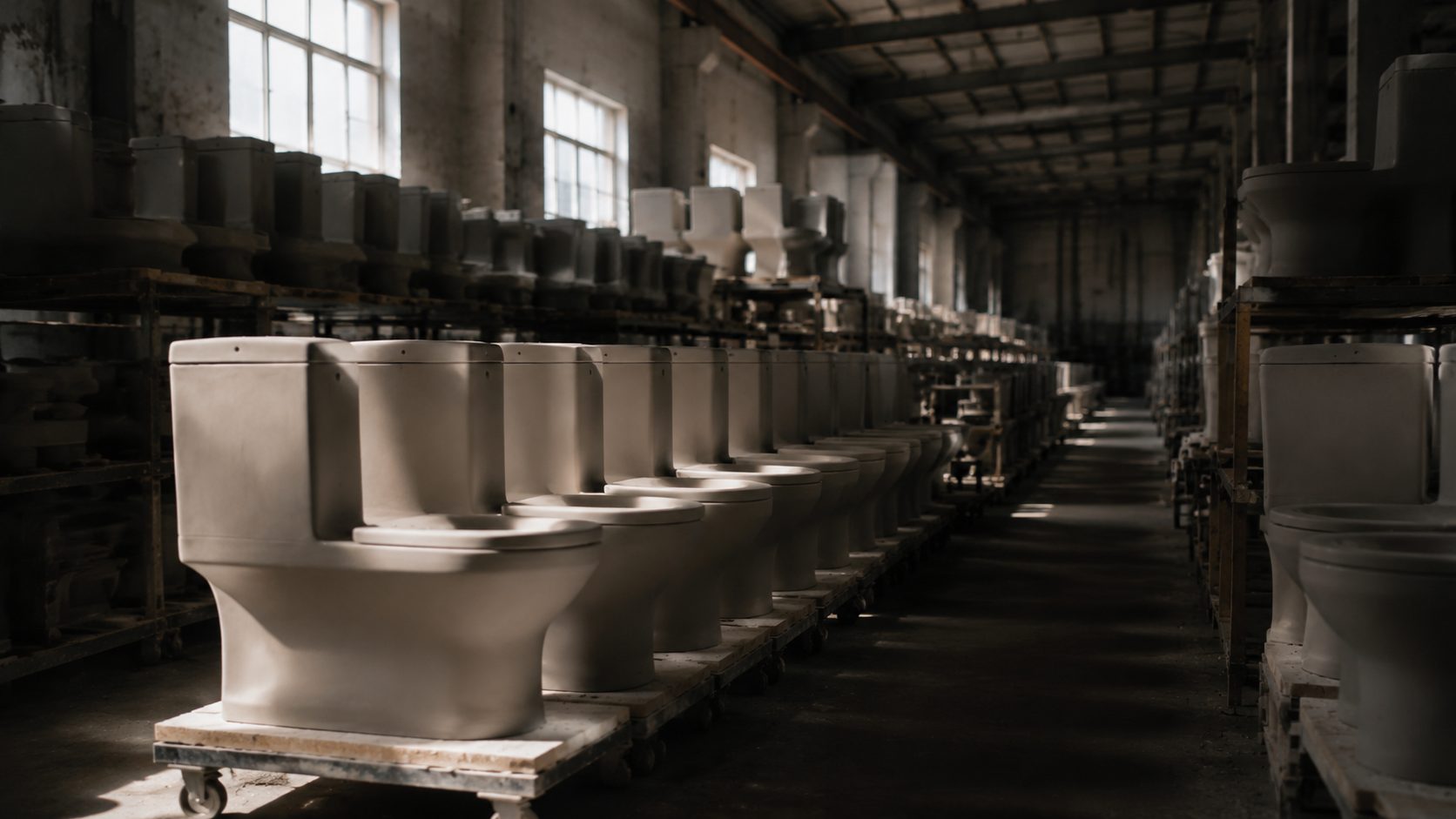
Consumer guides state the price gap; the factory can explain it. Both types start as slip casting — vitreous china slip poured into multi-part molds. A two-piece order is two smaller, simpler castings that dry evenly, fire predictably and load kiln cars efficiently. A one-piece body is a single large, hollow casting in which the internal trapway, the rim and the tank cavity are formed together: more mold sections, longer demolding, and more hand-finishing at the junctions before the piece is even dry.
Then comes the kiln. Fired at around 1,250 °C, a large one-piece body carries a higher risk of warping and of cracking at the tank-to-bowl transition, and any single defect scraps the entire unit — where a cracked two-piece tank scraps only a tank. Lower first-pass yield, more finishing labour and heavier protective packaging all land in the ex-factory price. So a one-piece typically costs more than a comparable two-piece — not because of branding, but because of arithmetic. Buyers should compare like-for-like flush systems and quality grades, and can see how finished units are checked in our guide to inspecting sanitaryware before shipment.
05 HYGIENE & DURABILITY
Cleaning, leak points and everyday durability
On hygiene, the one-piece has the honest edge — but only on the outside. Its continuous glazed exterior has no seam, no bolt recesses and no gasket line, so a single wipe covers it; in hotels that saves housekeeping minutes every day, multiplied across every room. A two-piece asks slightly more: the seam and bolt caps collect grime and need deliberate attention. Inside the bowl the two are equivalent — bowl hygiene depends on glaze quality and rim design (rimless versions exist in both), not on body construction.
On leaks, the picture reverses. The two-piece carries a known wear point: the tank-to-bowl gasket and bolts can weep after years of service — an inexpensive, well-understood fix, and the tank can even be replaced outright. The one-piece has no joint to leak at all; but if its tank section is ever damaged, the entire unit is replaced. The ceramic itself lasts the same either way — both are the same fired vitreous china.
06 LOGISTICS
Shipping, packing and spare parts
For importers this section often decides the order. A one-piece ships as one large, heavy carton per unit — higher cube, higher weight, and more sensitive to handling damage, so reinforced cartons and foam corners are standard practice. Fewer units fit a 20' or 40'HQ container, and freight per unit runs higher. A two-piece nests: the tank and bowl travel as two cartons or one split-cavity carton, container utilisation improves, freight per set drops — and if one component is damaged in transit, you replace a component, not a set.
Spare parts follow the same logic at project scale. Across a 200-room hotel or a rental portfolio, a two-piece fleet can be serviced with universal valves and, years later, a spare tank. A one-piece fleet needs its model-specific seats and valve sets confirmed at ordering, and ideally purchased alongside the units. Neither is a problem — unless nobody specified it.
Ask for the packing spec with the quotation
Request the carton construction, units per 40'HQ and drop-test practice before comparing prices — freight changes the landed cost ranking. Then add an attrition allowance: spare seats and fittings for both types, plus a small percentage of complete spare units on large one-piece orders, since a damaged one-piece cannot be repaired by half.
07 WHICH TO CHOOSE
Which should you choose?
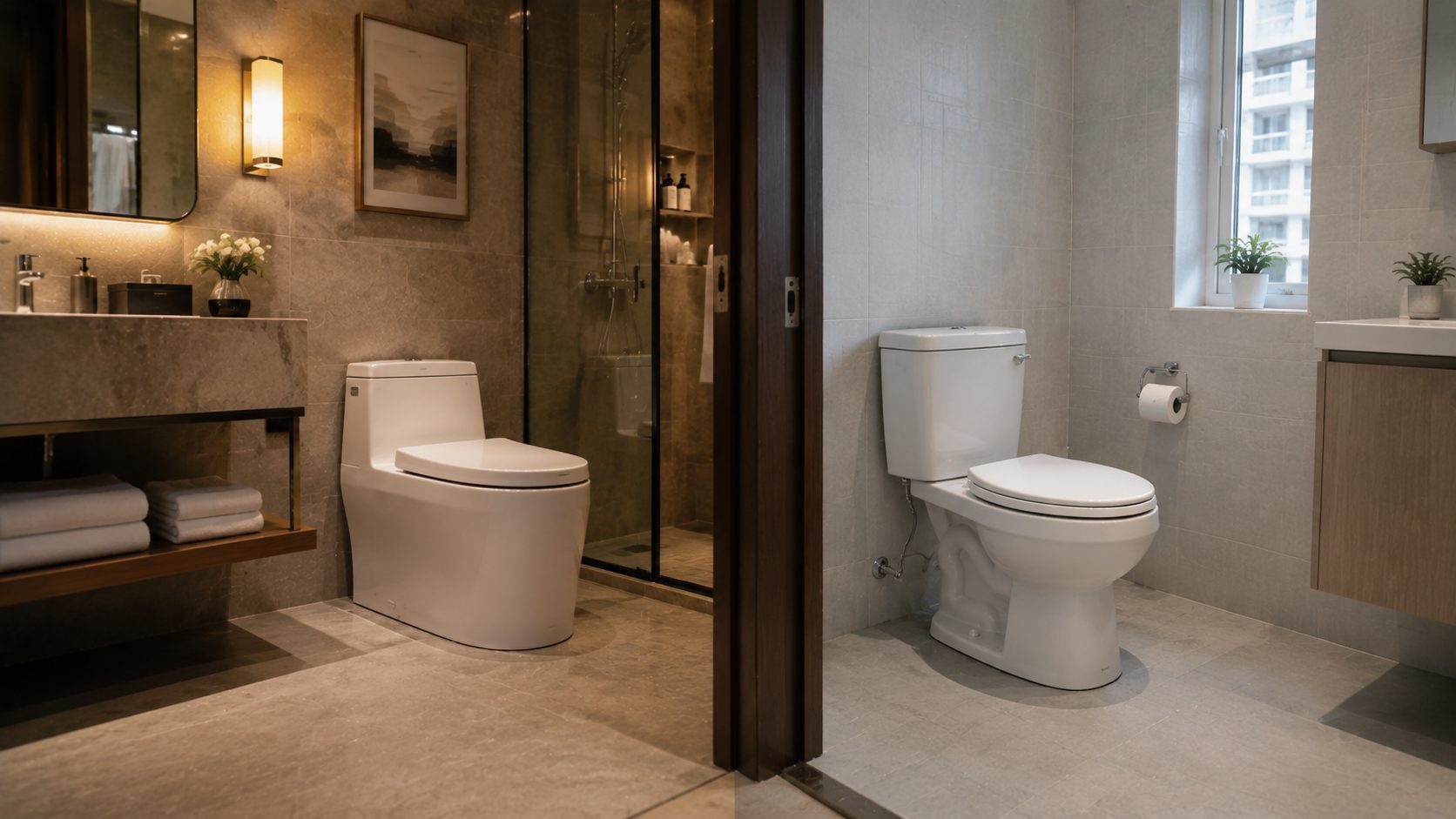
Choose a one-piece toilet where the seamless look and fast housekeeping justify the premium: hotels, serviced apartments, premium residential and showroom-led retail. It is the format we most often quote for guest bathrooms in hospitality work — see our guide to supplying hotels and apartments. Choose a two-piece toilet where price, freight and long-term serviceability lead: rental housing, value retail lines, DIY-heavy markets and any distributor whose after-sales depends on standard parts.
Regional habit matters too. North America historically favours the two-piece siphonic format with standard parts, though one-piece siphonic models are growing in mid and high-end retail; many European, Middle Eastern and Southeast Asian markets buy washdown designs, and hotels there increasingly specify one-piece — or wall-hung as a third option. In practice, many buyers order both: one-piece for the flagship range, two-piece for the volume line.
Before you specify, confirm
Rough-in distance (300/400 mm, or 10/12/14 inch); flush type (siphonic or washdown) and flush volume to local water norms; bowl shape (elongated or round); seat type and spare-seat supply; packing spec and container loading quantity; MOQ and lead time. Pin these down and most import problems never arise.
08 WHAT TO SPECIFY
What to specify when ordering in bulk
Body type is only half the order. The single most common spec error in toilet imports is rough-in spacing — the distance from the finished wall to the drain centre. China-market models are built for 300 mm or 400 mm floor outlets; the US standard is a 12-inch rough-in, with 10-inch and 14-inch variants for retrofit. A model designed for one spacing cannot simply be swapped to another, so confirm it before tooling or ordering. Then fix the flush spec: siphonic or washdown, single or dual flush, and the volume your market expects — flush performance is engineered independently of whether the body is one piece or two.
As a Guangdong-based manufacturer, we produce both one-piece and two-piece ceramic toilets alongside smart toilets, ceramic basins and bathroom cabinets, with OEM/ODM support for custom tank heights, seats, dual-flush options, branding and packaging. Certification support varies by product and market, and buyers can request available test reports before ordering. Tell us the target market, rough-in and price position, and we will recommend the body type and quote it.
There is no universal winner — only the body that fits your market's plumbing, price point and after-sales reality. Fix the rough-in and the flush spec first, and the one-piece vs two-piece decision largely makes itself.
FAQ COMMON QUESTIONS
Frequently asked questions
Is a one-piece toilet better than a two-piece toilet?
Neither is universally better — they serve different briefs. A one-piece has a seamless glazed body that is easier to wipe down and has no tank-to-bowl joint to leak, which suits hotels and premium bathrooms, but it costs more ex-factory and is heavier to ship and install. A two-piece is cheaper, lighter to handle and uses standard parts, so a tank or bowl can be replaced individually — the practical choice for rentals and value retail. The ceramic and the available flush technology are the same in both.
Why are one-piece toilets more expensive?
Because they are harder to make, not because of branding. A one-piece is a single large, complex casting — trapway, rim and tank cavity formed in one hollow body — requiring more mold sections and hand-finishing. Fired at around 1,250 °C, the large body risks warping or cracking at the tank-to-bowl transition, and any defect scraps the whole unit, so first-pass yield is lower. Add heavier protective packaging and higher freight per unit, and the ex-factory price gap follows.
Do two-piece toilets leak?
The tank-to-bowl gasket and bolts are a known wear point that can weep after years of service, but it is an inexpensive, well-understood fix — re-gasketing or, at worst, replacing only the tank. A quality gasket installed at the correct bolt torque gives years of trouble-free use. A one-piece has no tank-to-bowl joint to leak at all, though if its tank section is damaged the whole unit must be replaced.
Which is easier to clean, a one-piece or a two-piece toilet?
The one-piece, on the outside. Its continuous glazed exterior has no seam, bolt recesses or gasket line, so a single wipe covers it — a real time saving for hotel housekeeping across many rooms. A two-piece has a seam and bolt caps that collect grime and need deliberate attention. Inside the bowl the two are equivalent: hygiene depends on glaze quality and rim design, and rimless versions exist in both.
Which is easier to install, a one-piece or a two-piece toilet?
Each is easier in a different way. A two-piece ships in lighter cartons that one person can carry, with one extra step on site — bolting the tank to the bowl with its gasket. A one-piece has fewer steps and no joint to assemble, but it is one heavy lift, often a two-person job. Both must match the rough-in spacing of the drain, which matters more than the body type.
Which type is best for hotels and rental properties?
Hotels usually favour one-piece: the seamless body cleans faster for housekeeping and reads premium in the guest bathroom. Rental housing and multi-unit portfolios usually favour two-piece: lower unit cost, universal spare parts, and the ability to replace only a damaged tank or bowl across many units. Many projects split the order — one-piece for premium rooms, two-piece for volume units.