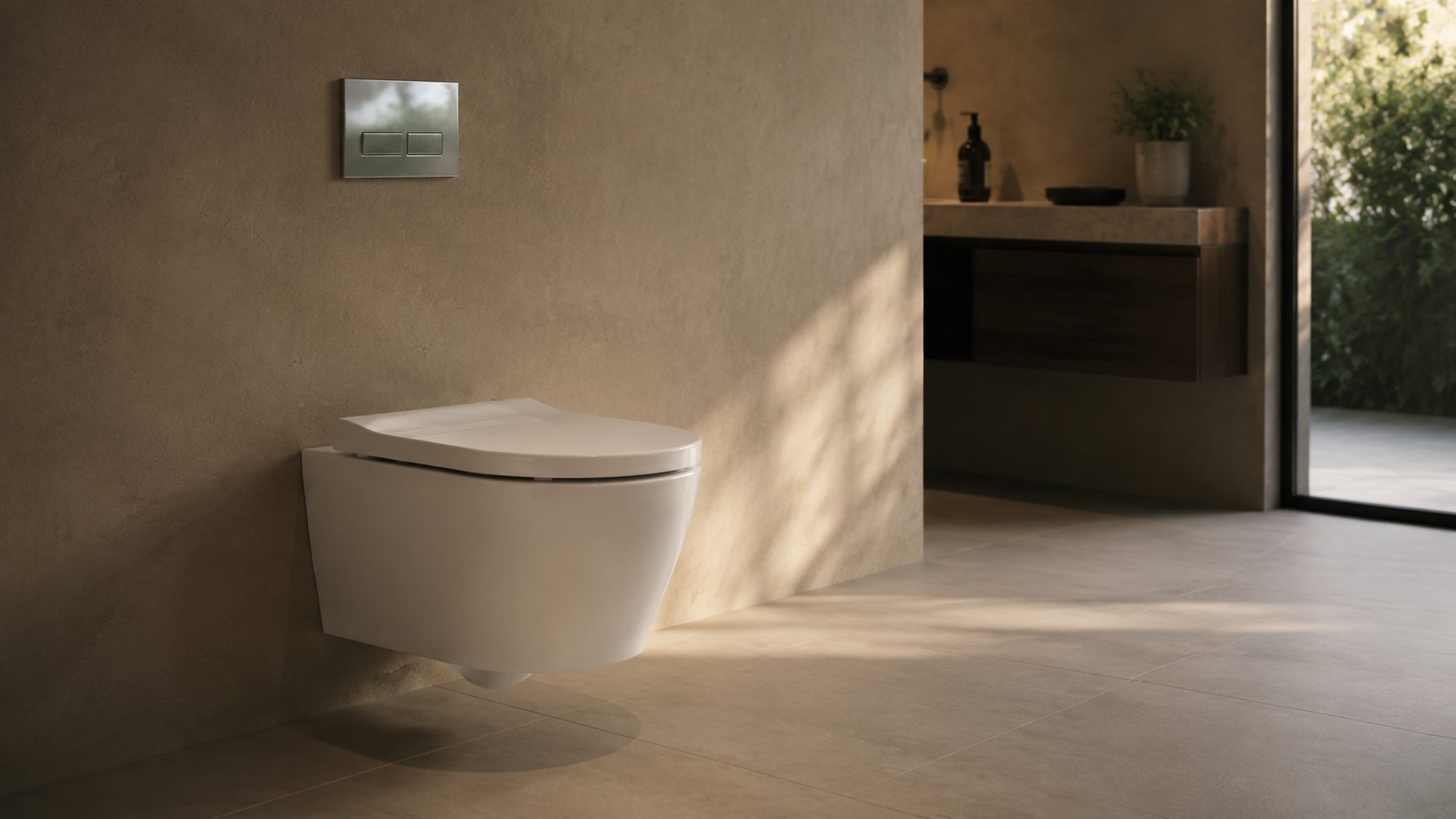
A wall-hung toilet installation looks like magic in the finished bathroom — a ceramic bowl floating clear of the floor, no visible tank, no pedestal, nothing but open tile underneath. There is no magic in it, only a decision made early: a steel carrier frame and a concealed cistern buried inside the wall before the tiles ever go up. For importers and contractors, that timing is the whole story. Get the frame, the outlet and the rim height right at the rough-in stage and a wall-hung project is clean and fast; get them wrong and there is no fixing it without opening the wall. Here is how the system works and exactly what to plan before you order.
Key takeaways
- The wall carries the load, not the floor — a bolted steel carrier frame anchored to studs or a solid wall takes the weight (quality frames rate to around 400 kg / 880 lb); the ceramic bowl only hangs on it.
- Everything is planned before tiling — the concealed cistern, carrier frame and horizontal wall outlet must be roughed in first; the set rim height (typically 380–480 mm / 15–19 in) is chosen at that stage and fixed for good.
- Order it as a matched system — bowl + carrier frame + flush plate must be compatible; confirm outlet position, load rating and flush-plate fit in writing, because a wall-hung set is not three parts you buy separately and hope will line up.
01 SIDE BY SIDE
Wall-hung vs floor-standing at a glance
Before the how-to, the trade-off. A wall-hung toilet buys a floating look, an open floor and easier cleaning — and asks for a solid wall, in-wall plumbing planned ahead, and a higher installed cost in return. A floor-standing toilet reverses every line. Here is the whole comparison before the detail.
Wall-hung vs floor-standing toilet
| Factor | Wall-hung toilet | Floor-standing toilet |
|---|---|---|
| Installation | Carrier frame + concealed cistern built into the wall before tiling | Bowl bolts to the floor; tank sits on the bowl — straightforward retrofit |
| Support | Steel carrier frame anchored to studs/solid wall carries the load | Floor carries the load through the bowl base |
| Floor cleaning | Nothing touches the floor — mop straight under the bowl | Base and bolt caps trap dust; more nooks to clean |
| Rim height | Adjustable at rough-in, ~380–480 mm — set once | Fixed by the model you buy |
| Cistern access / repair | Via the flush plate opening; tank hidden in wall | All parts exposed and easy to reach |
| Space | Frees ~200–300 mm of visual floor depth; looks larger | Occupies the full floor footprint |
| Installed cost | Higher — frame + more labour at rough-in | Lower — fewer parts, faster fit |
| Best fit | Modern apartments, hotels, minimalist and small bathrooms | Renovations, budget builds, retrofits without wall access |
02 THE SYSTEM
How a wall-hung toilet actually works
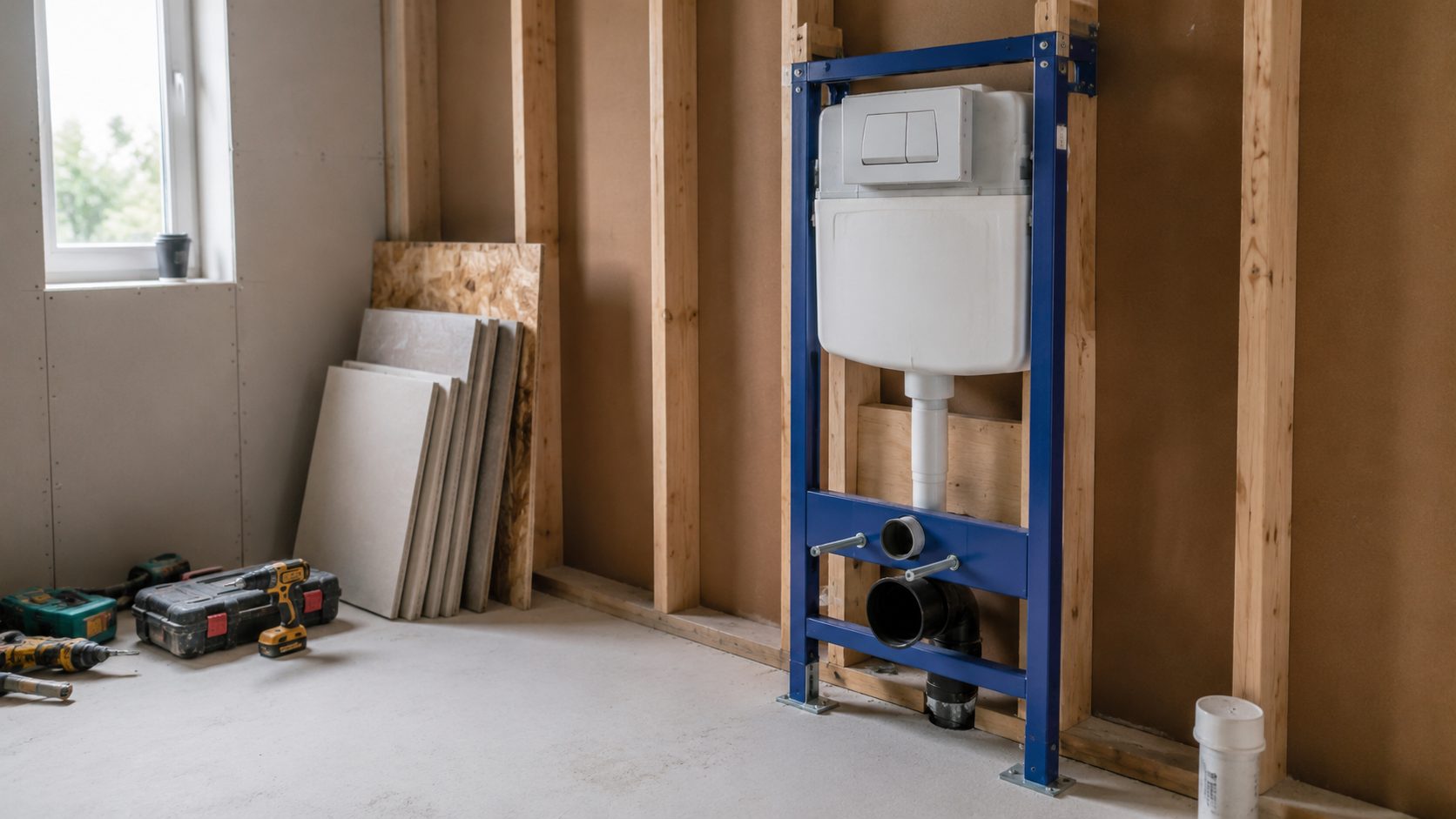
A wall-hung toilet is not a single product but a matched system of three parts. The carrier frame — a heavy steel support frame, often called an in-wall frame or installation system — is the backbone. It is bolted to the floor and to the studs or a solid masonry wall, and it is this frame, not the ceramic, that carries the sitting load: quality frames are rated to around 400 kg (880 lb). Onto that frame goes the concealed cistern, a slim plastic tank designed to hide inside a standard stud cavity, and from the frame protrude two threaded bolts that the bowl hangs on, plus the waste and water connections.
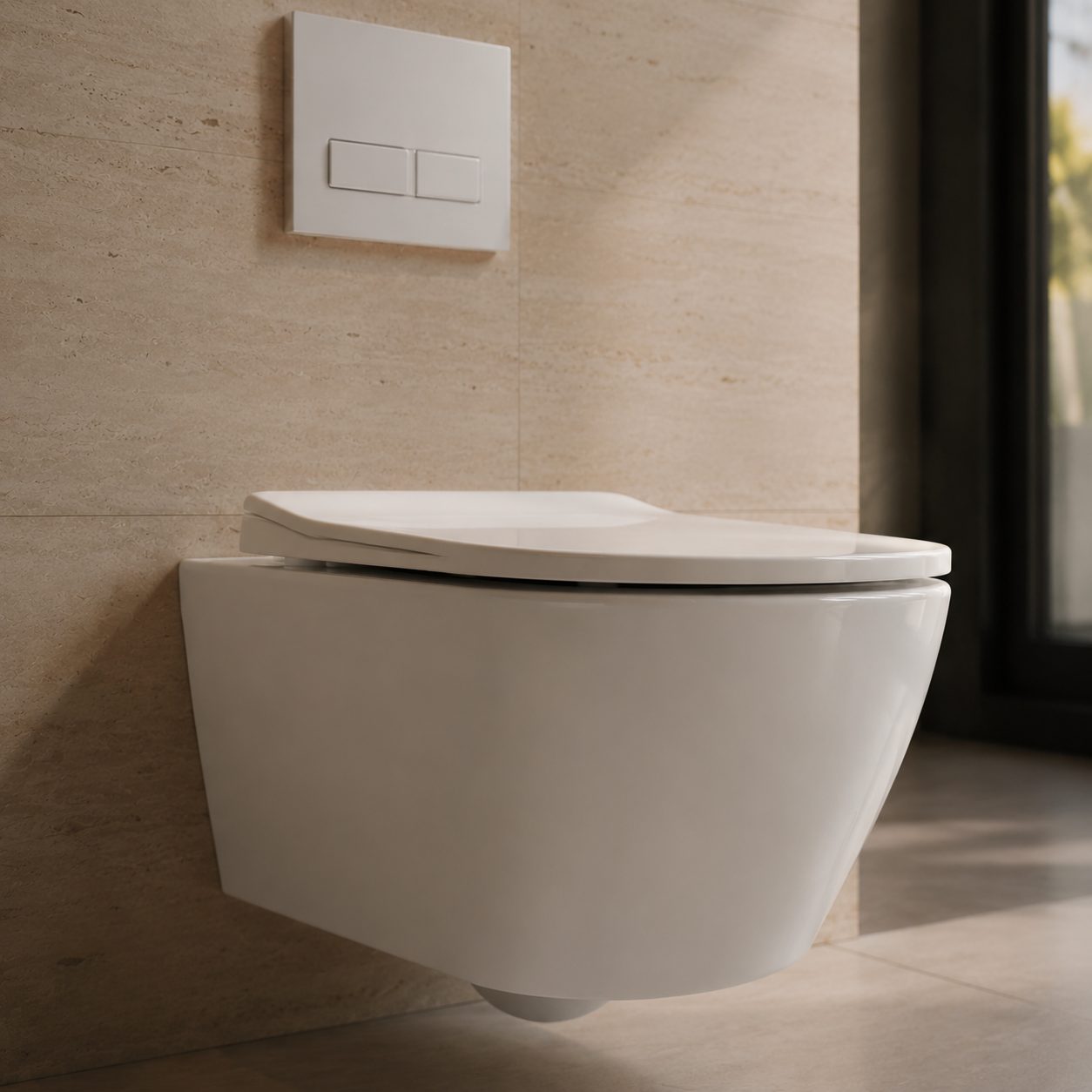
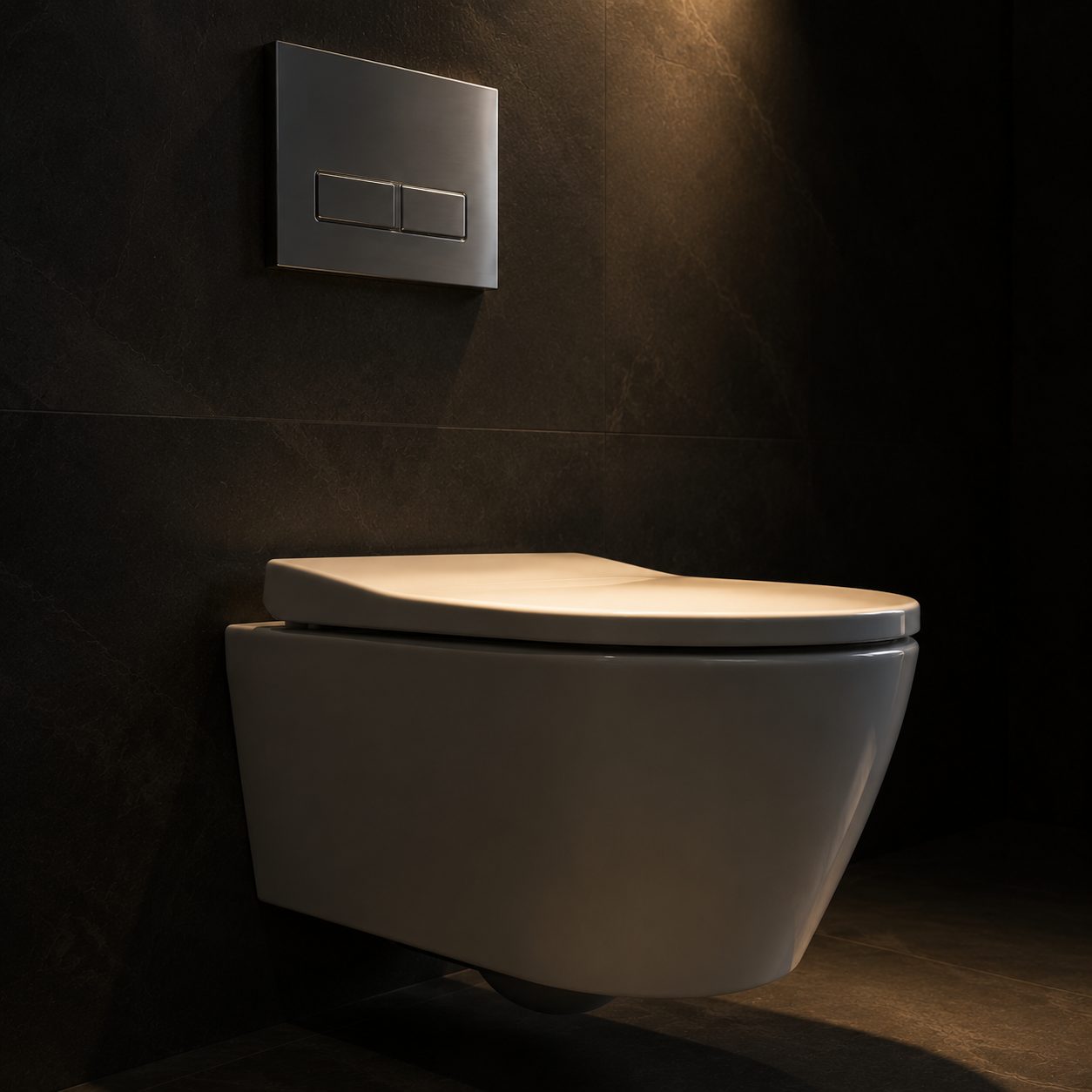
Once the wall is closed and tiled, the only visible parts are the ceramic bowl floating on its two bolts and the flush plate (actuator) on the wall above it. Press the plate and it operates the concealed cistern's dual-flush valve through a short linkage. Because the tank and all its fittings live in the wall, servicing is done through the flush-plate opening — which is why that opening, and the access it gives, is a real design detail rather than a cosmetic one.
The wall carries the person; the bowl only carries the look. Every load path runs through the steel frame, which is why the frame — not the ceramic — is the part that must never be under-specified.
03 BEFORE THE TILES
Rough-in, wall outlet and set rim height
Almost everything that decides whether a wall-hung installation succeeds happens before the wall is closed. First, the outlet: wall-hung bowls use a horizontal wall outlet (a P-trap / wall-outlet arrangement), so the drain must be brought to the correct height and position in the wall behind the frame, not through the floor. Second, the rough-in: the frame is levelled and anchored, the waste and supply are connected inside the cavity, and every joint is pressure-checked while it is still reachable — this stage alone typically takes a couple of hours and cannot be rushed.
Third, and easy to overlook, the set rim height. A wall-hung frame lets you choose the seat height at rough-in — commonly 380–480 mm (15–19 in) to the rim — and once the frame is fixed and tiled, that height is permanent. Standard comfort sits around 400–430 mm; accessible or premium-hotel rooms often go higher. Decide it deliberately for the room's users before the frame is bolted, because there is no adjustment afterwards.
Confirm the wall before you confirm the toilet
A wall-hung toilet needs a genuinely solid backing — studs the frame can bolt to, or a braced steel carrier frame in a partition wall. A thin non-structural partition will not hold a loaded bowl on its own. On projects, verify the wall build-up and the frame's fixing method before committing quantities; retrofitting solid support after the fact is far more expensive than specifying the right frame up front.
04 THE HONEST BALANCE
Pros and cons, stated plainly
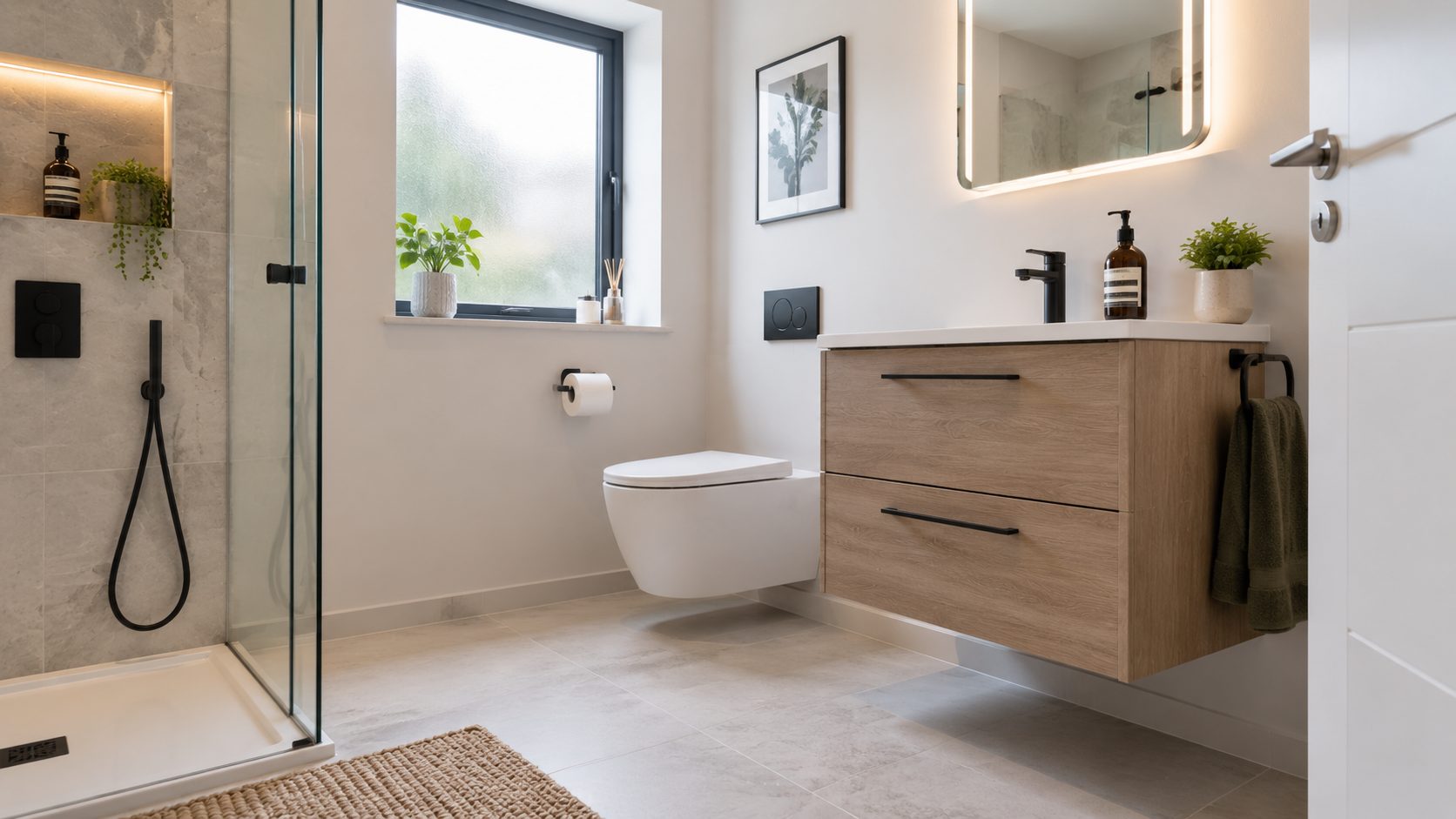
The pros are real and mostly about space and hygiene. The floating bowl frees the floor visually, making small bathrooms read larger — you recover roughly 200–300 mm of apparent depth. Cleaning is genuinely easier: nothing meets the floor, so a mop passes straight underneath, and with the tank hidden there are far fewer crevices and bolt caps to scrub. The adjustable rim height is a comfort and accessibility advantage no fixed floor model can match, and the concealed cistern gives the whole room a calm, modern, minimalist line.
The cons are equally honest. You need a solid wall or a braced steel carrier frame, and the in-wall plumbing has to be planned before tiling — this is not a weekend swap. Installed cost is higher because of the frame and the extra rough-in labour. And repairs mean working through the flush-plate opening rather than lifting a lid, so buyers should value good access design and reliable concealed-cistern fittings. None of these is a deal-breaker for the right project; all of them are reasons wall-hung is a planned choice, not an afterthought.
05 THE MONEY
Price vs floor-standing — where the cost really sits
A wall-hung set costs more installed than a comparable floor-standing toilet, but the extra is not mostly in the ceramic. It is in the carrier frame and the added rough-in labour: industry comparisons commonly put wall-hung fitting labour at several times the cost of setting a floor model, because the frame must be anchored, the cistern connected and the wall closed and tiled around it. The bowl itself is priced in the same range as any quality ceramic pan.
For an importer or contractor, that changes how you quote. Sell the wall-hung offer as a complete system — bowl, frame and flush plate together — and cost the labour honestly, rather than pricing a bare bowl against a floor-standing one and losing on the frame at site. On volume projects the frame is where specification discipline pays off: a consistent, well-rated frame across a development keeps installation predictable and warranty risk low, which matters more than shaving a few dollars per unit.
06 THE ORDER
What to specify when ordering
A wall-hung order is a system order. The single most common mistake is buying a bowl, a frame and a flush plate as three loose items and hoping they line up — they must be confirmed as compatible before production. As a Guangdong ceramic manufacturer we supply the wall-hung bowl and coordinate the matched frame and flush plate, and the lines worth pinning down are the same ones site teams later ask about. Body construction, flush behaviour and outlet all interact with the rest of the range — the wall-hung format pairs naturally with washdown flushing, a choice we cover in our siphonic vs washdown toilet comparison.
Confirm in writing before production
Bowl + carrier frame + flush-plate compatibility (matched system, not loose parts); frame load rating (target ~400 kg / 880 lb) and fixing method (stud wall or braced free-standing); wall outlet position and height, and the waste connection; set rim height chosen for the room's users; cistern fittings and dual-flush volume with the target water norm; flush-plate finish and style; seat type and hinges; carton construction and units per 40'HQ.
Two of those lines quietly decide the whole job: the outlet position and the frame load rating and fixing. Both are free to get right on the specification sheet and painfully expensive to correct once the wall is tiled. Confirm the destination market's water norm and any required flush-plate style at the same time, so the concealed cistern and actuator match on arrival.
07 WHERE IT WINS
Best-fit projects — and when to choose it
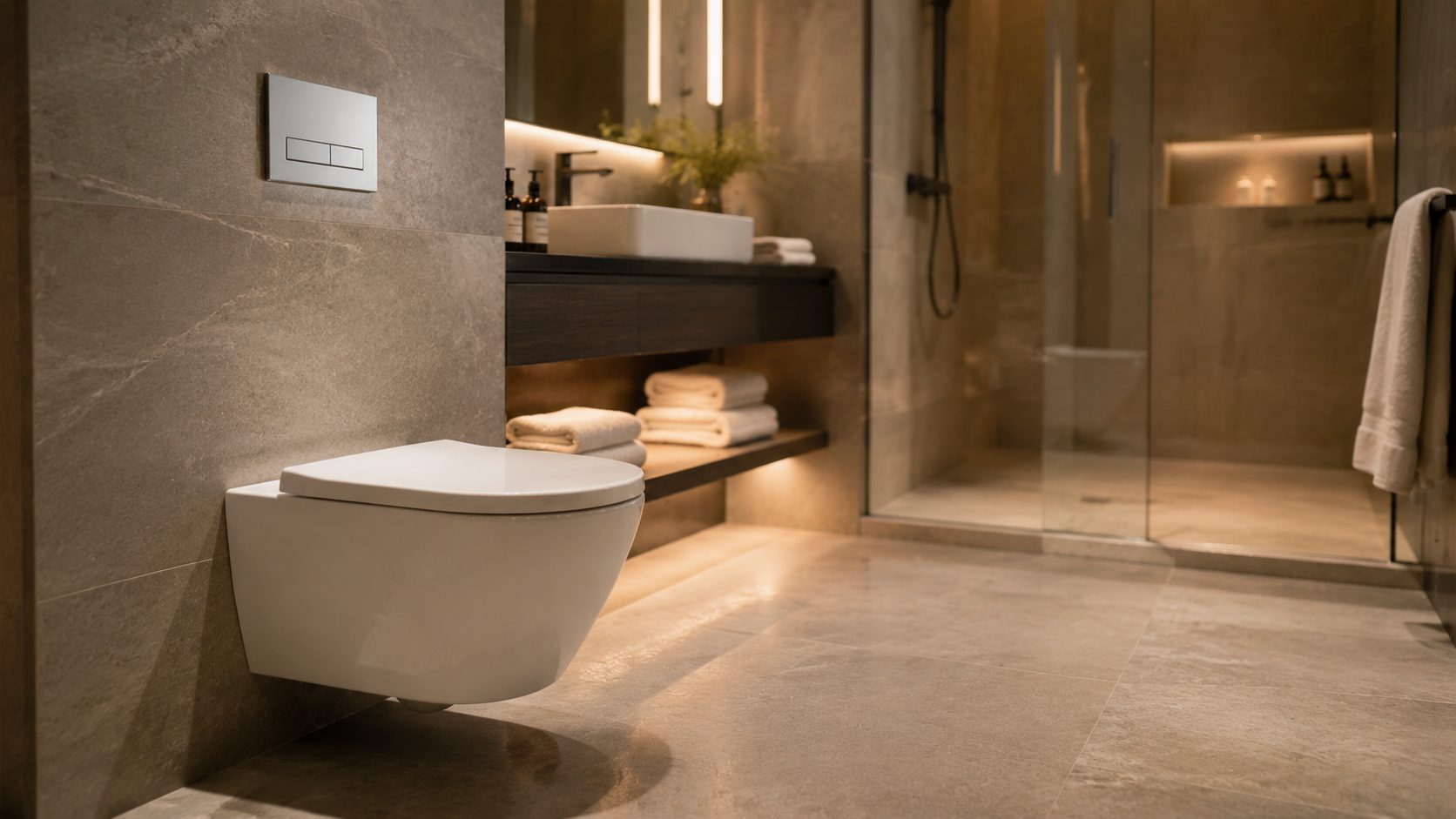
Wall-hung toilets earn their extra effort in modern apartments and hotels, where the floating look, the easy-clean floor and the adjustable rim height all pull in the same direction. In compact urban apartments the reclaimed floor space is a genuine selling point; in hotels the seamless line and the housekeeping-friendly open floor justify the frame and labour many times over across a build. This is exactly the format we quote most for European-style hospitality work — our guide to supplying hotels and apartments shows where it fits in a project package.
Choose floor-standing instead for renovations without wall access, budget-driven builds, or retrofits where opening and re-tiling a wall is not on the table. The rule for buyers is simple: wall-hung is a design decision made at the rough-in stage, so it suits new build and full-gut projects far better than quick replacements.
As a Guangdong-based manufacturer we produce wall-hung and floor-standing ceramic toilets — one-piece and two-piece, siphonic and washdown — alongside smart toilets, ceramic basins and bathroom cabinets, with OEM/ODM adaptation of outlet and frame configuration to destination-market standards. Certification support varies by product and market, and buyers can request available test reports before ordering. Tell us the project type, the wall build-up and the outlet situation, and we will recommend the matched wall-hung system and quote it.
A wall-hung toilet is only as good as the wall behind it and the plan before it. Fix the frame, the outlet and the rim height at rough-in, order the bowl, frame and flush plate as one compatible system, and the floating result takes care of itself.
FAQ COMMON QUESTIONS
Frequently asked questions
How is a wall-hung toilet supported if it doesn't touch the floor?
By a steel carrier frame hidden inside the wall, not by the ceramic. The frame is bolted to the floor and to the wall studs (or built as a braced free-standing frame in a partition), and the bowl simply hangs on two threaded bolts that protrude from it. Quality frames are rated to around 400 kg (880 lb), so the load path runs entirely through the steel — the wall carries the person, and the ceramic bowl only carries the look. This is why the frame is the part that must never be under-specified.
Can I install a wall-hung toilet on any wall?
Not on any wall. You need a genuinely solid backing — timber or metal studs the carrier frame can bolt to, or a braced steel carrier frame set into a partition wall. A thin, non-structural partition cannot hold a loaded bowl on its own. On projects, verify the wall build-up and the frame's fixing method before committing quantities; adding solid support after tiling is far more expensive than specifying the right frame at the start.
What rim height should a wall-hung toilet be set at?
A wall-hung frame lets you choose the seat (rim) height at the rough-in stage, commonly 380–480 mm (15–19 in) to the rim. Standard comfort sits around 400–430 mm; accessible bathrooms and premium hotel rooms often go higher. The important point is that the height is fixed once the frame is anchored and tiled — there is no adjustment afterwards — so it should be decided deliberately for the room's users before the wall is closed.
Are wall-hung toilets harder to repair than floor-standing ones?
They are less exposed. Because the cistern and its fittings sit inside the wall, servicing is done through the flush-plate (actuator) opening rather than by lifting a tank lid, so most concealed cisterns are designed to be accessible through that panel. Routine adjustments are straightforward, but the tank itself is not out in the open the way a floor-standing toilet's is. That makes good access design and reliable concealed-cistern fittings worth specifying up front.
Do wall-hung toilets cost more than floor-standing toilets?
Installed, yes — but the extra is mostly in the carrier frame and the added rough-in labour, not the ceramic bowl. The frame must be anchored, the concealed cistern connected, and the wall closed and tiled around it, which is why fitting labour typically runs several times that of setting a floor model. The bowl itself is priced like any quality ceramic pan. Importers should quote the wall-hung offer as a complete system and cost the labour honestly.
What should I confirm when ordering wall-hung toilets in bulk?
Order it as a matched system, never as loose parts. Confirm in writing that the bowl, carrier frame and flush plate are compatible; the frame's load rating (target ~400 kg) and fixing method; the wall outlet position and height and the waste connection; the set rim height; the cistern fittings, dual-flush volume and target water norm; and the flush-plate finish. The two costliest errors are an unstated outlet position and an under-rated or mismatched frame — both are free to fix on the spec sheet and expensive to fix once the wall is tiled.