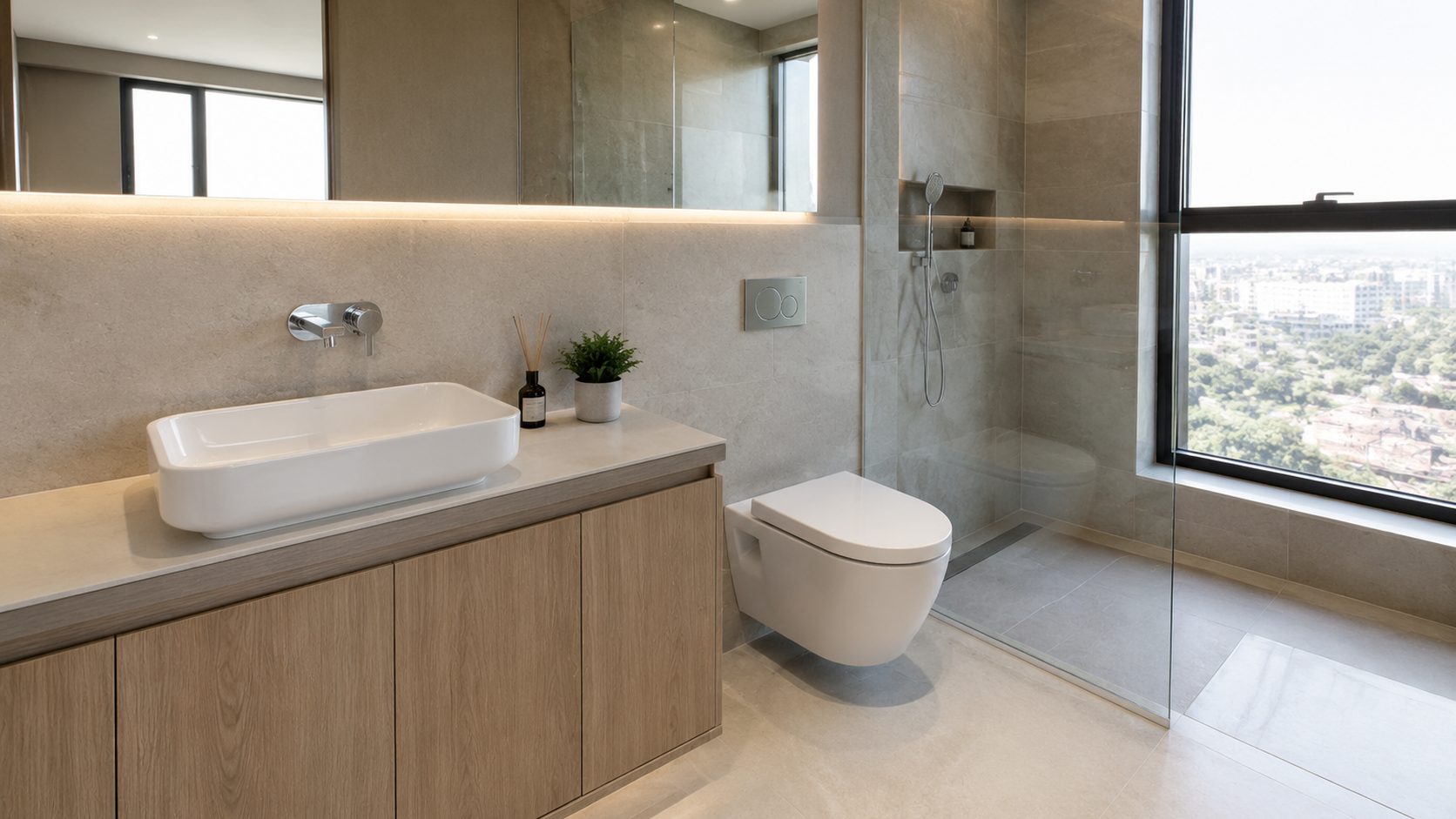
Sourcing bathroom products for apartment projects is a different job from stocking a retail range. A developer buys a handful of SKUs in the hundreds, against a construction programme that does not move, and every basin, cabinet and toilet must match the approved show flat at handover. This guide walks developers, contractors and project importers through factory-direct sanitary ware for residential developments — how project buying differs from retail import, building a spec package per unit type, keeping 500 bathrooms identical, staging deliveries to the construction schedule, QC and spare-stock planning, and what a developer RFQ should include so the first quotation is the accurate one.
Key takeaways
- Buy one spec package per unit type — basin + cabinet + toilet bundles in standard and premium tiers, governed by an approved golden sample.
- Protect consistency — fewer, larger production runs, glaze fixed against the sample, and spares ordered in the same run as the main lot.
- Plan backwards from handover — RFQ out 5–7 months before bathrooms are installed, deliveries staged to fit-out, AQL and water absorption ≤0.5% agreed in writing.
01 A DIFFERENT KIND OF ORDER
How developer procurement differs from retail import
A retail importer buys twenty SKUs in modest quantities and restocks when the warehouse runs low. A developer buys three to six SKUs in the hundreds — one spec repeated across every unit of a type — with delivery anchored to a construction programme, not a stock level. That moves the risk. Approval of a single golden sample per unit type governs the entire project, so sample sign-off carries far more weight than in retail. A container that lands late can idle plumbing crews across a whole floor; one that lands early has nowhere dry and secure to sit on site.
Project procurement vs retail import vs local wholesale
| Factor | Developer project procurement | Retail import | Local wholesale |
|---|---|---|---|
| Spec consistency | One approved sample governs hundreds of identical units | Variety across a catalogue matters more | Whatever is in stock this season |
| Volume pattern | 3–6 SKUs × hundreds of pieces | Many SKUs × small quantities | Pieces to pallets, ad hoc |
| Delivery scheduling | Anchored to construction fit-out dates | Anchored to warehouse restocking | Immediate, from stock |
| QC standard | Tight AQL, every lot checked against the golden sample | Standard export AQL | Post-import, no factory view |
| After-handover support | Matched spares through the defects-liability period | Standard returns handling | Subject to stock changes |
The liability tail is different too. Developers commonly carry a defects-liability period of twelve to twenty-four months after handover, depending on market and contract. Every defective basin found at snagging is a trade revisit inside a finished apartment, not a returned SKU — which is why per-piece inspection standards and spare-stock economics matter more on project lots. Project orders also tend to run on a fixed bill of quantities, staged deliveries and payment tied to delivery milestones, and a factory used to project work will accommodate that structure.
A late container on a retail order costs storage. A late container on an apartment project idles trades and puts a contractual handover date at risk.
02 ONE PACKAGE PER UNIT TYPE
Building a spec package per unit type
The working document for a residential development is not a shopping list but a spec package: one fixed bundle of bathroom products per unit type. A typical standard tier for studios and one-bedroom units pairs a wall-hung or countertop ceramic basin with a compact bathroom cabinet, a one-piece or two-piece ceramic toilet and a soft-close seat. A premium tier for penthouses or serviced units steps up to an undermount or vessel basin, a larger cabinet with upgraded hardware, and a smart toilet — or a standard ceramic pan with a smart seat, which costs less and lets the seat be replaced independently of the ceramic. Smart toilets need an electrical outlet beside the pan, and it must be on the electrical drawings before walls close.
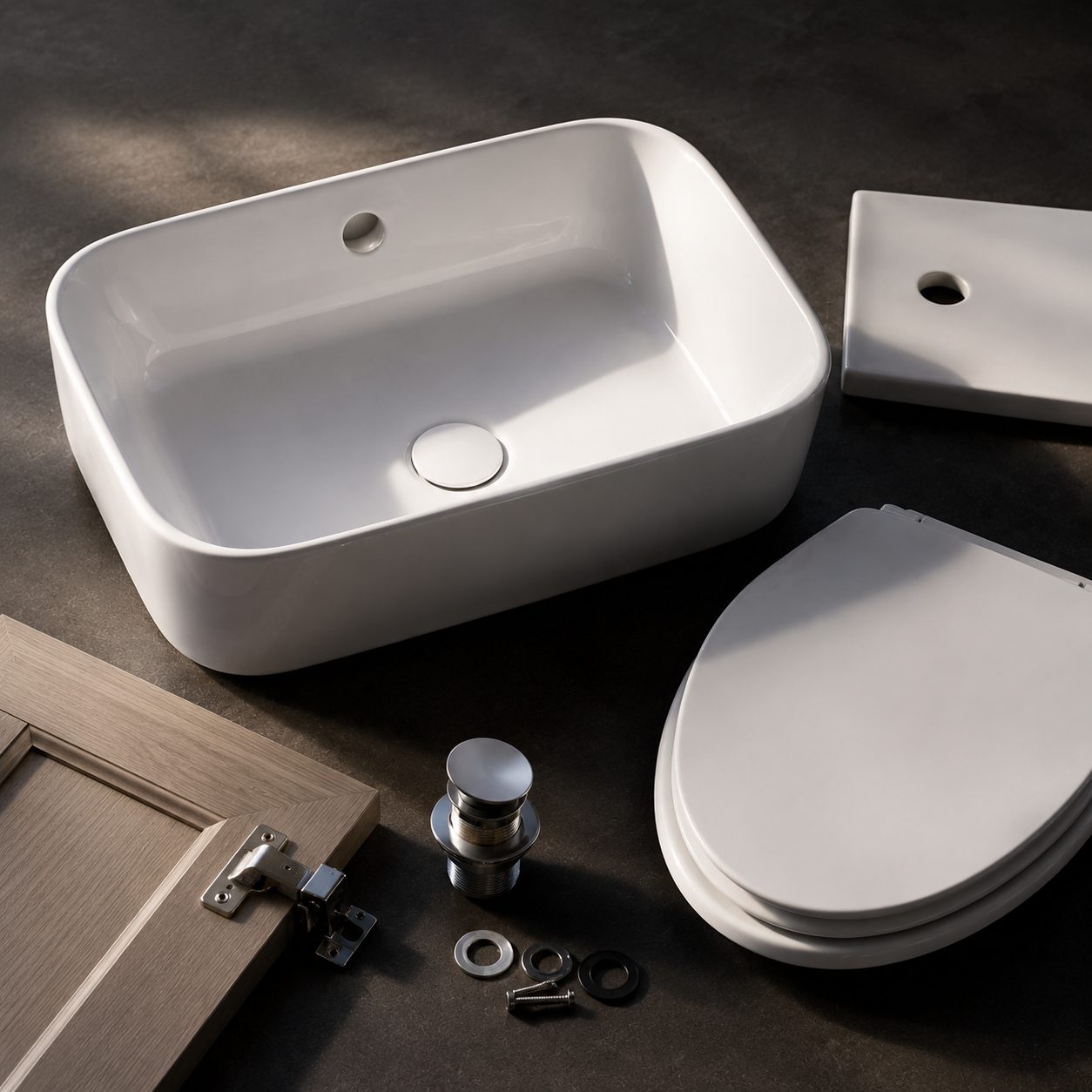
Each bundle's spec sheet should fix what installers cannot improvise: model and dimensions, glaze colour code, mounting type, and the rough-in and drainage dimensions — floor versus wall outlet, trap distances — because the plumbing is already cast into the slab. Keep the number of distinct ceramic SKUs low and differentiate tiers through cabinets, seats and smart features rather than new ceramic moulds; it is cheaper and carries less tooling risk. One approved sample set per unit type, retained by both sides and referenced in the contract, closes the loop. For developer-branded ceramics or custom packaging, the workflow in our guide to OEM and ODM bathroom products applies directly.
03 KEEPING 500 BATHROOMS IDENTICAL
Batch and glaze consistency across production runs
Ceramic glaze colour varies subtly with the glaze batch, a piece's position in the kiln and the firing curve. Within one continuous production run this is controlled; across runs placed months apart, drift is possible — and in a development where adjacent units are compared during sales viewings, a visible difference between two "identical" bathrooms is a real problem.
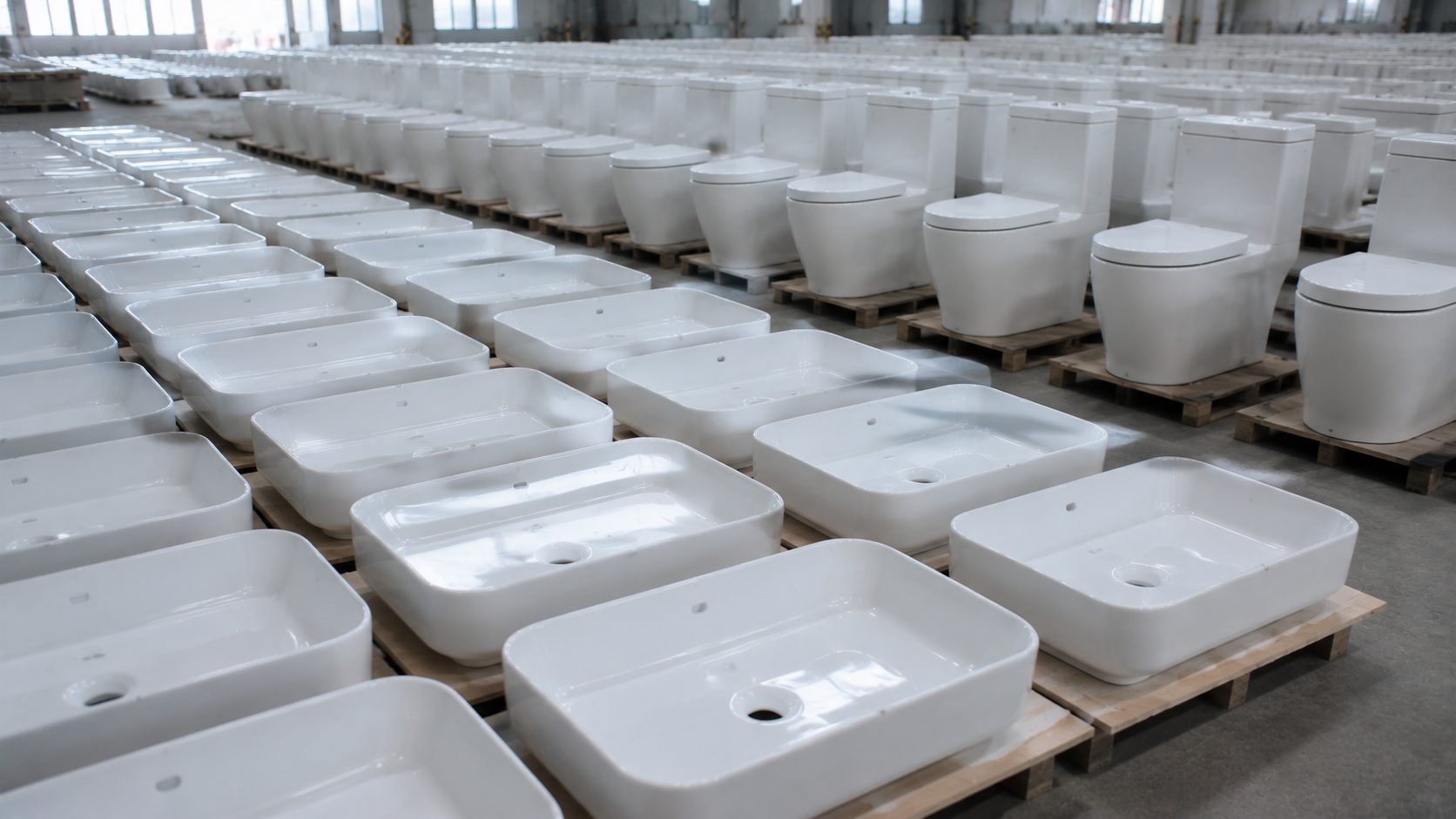
The buyer's levers are straightforward. Fix the glaze colour against the approved sample and require each production lot to be checked against it. Prefer fewer, larger production runs over many small ones. If staged production is unavoidable, ask the factory to keep glaze batch and recipe records, and to group deliveries so any minor variation lands in different buildings or floors rather than side-by-side units. The same logic applies to cabinets: fix the finish or laminate batch and the hardware brand and model, so replacements after handover still match.
04 DELIVERY MEETS THE PROGRAMME
Staged deliveries matched to the construction schedule
One bulk shipment gives the best freight economics and a single QC event, but few sites can store hundreds of ceramic crates dry and secure for months, and on-site breakage and loss are real. Fully staged production matches the installation sequence but multiplies consistency risk. The practical middle path for most projects: produce in one continuous run for consistency, then ship in two or three tranches aligned to fit-out phases — by building or by floor block — with storage terms agreed for goods held at the factory in between.
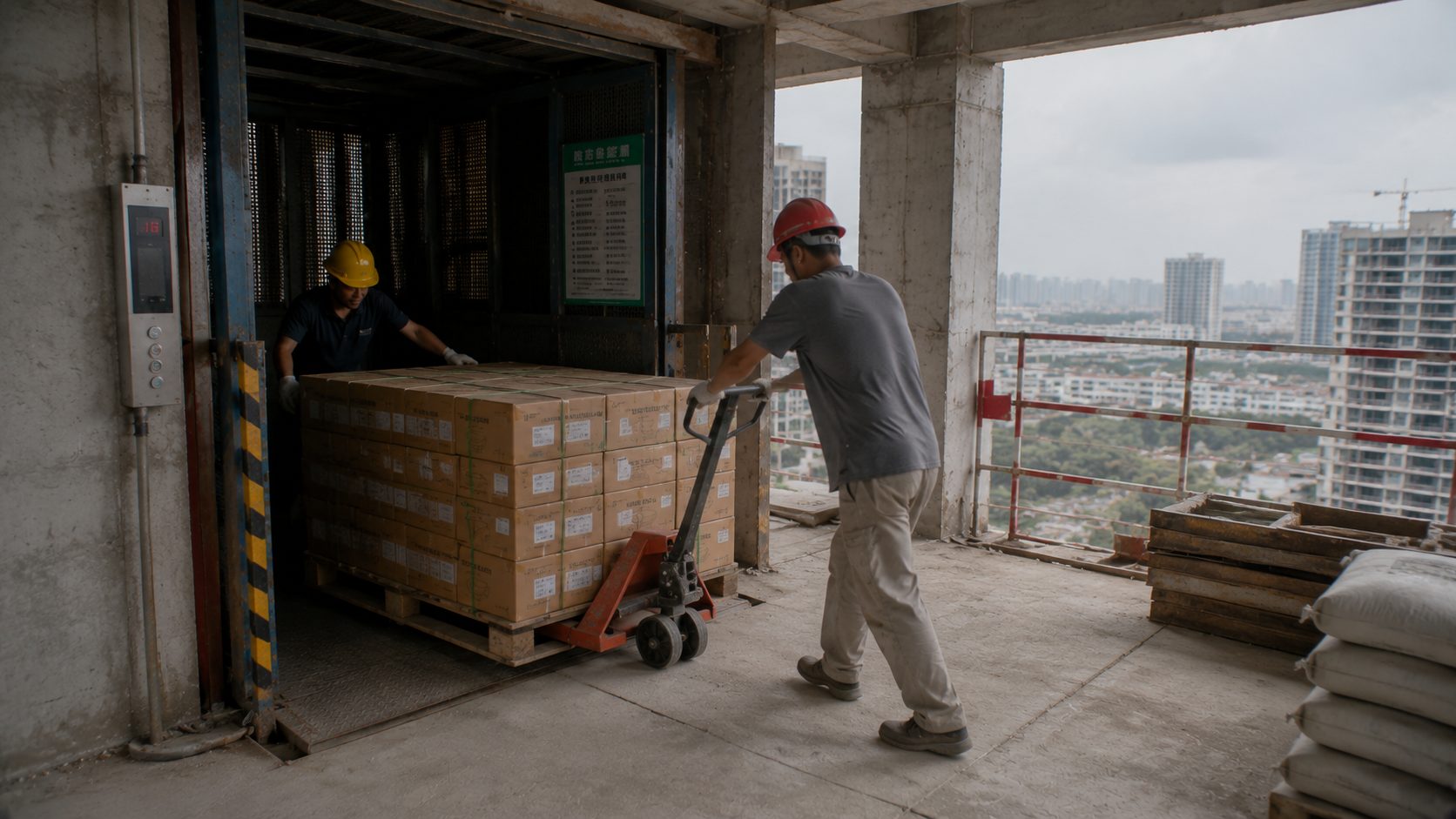
Ceramic is heavy and low in value per cubic metre, so project lots almost always move as full-container sea freight. Plan the container mix early: toilets and pedestal basins consume volume quickly, and cabinets ship knocked-down or assembled — assembled costs cube. Ask the factory for a loading plan per tranche against your actual bundle quantities.
Label cartons by building, floor and unit type
Per-unit labelling — unit type, building, floor — costs the factory little at packing and dramatically speeds distribution on site. Put it in the RFQ, not in a later email.
05 QUALITY ON PROJECT LOTS
QC, AQL and water absorption ≤0.5%
Sanitary ware factories typically inspect ceramic pieces one by one for cracks, glaze defects and deformation before packing; the buyer's own or third-party pre-shipment inspection then samples the lot, usually under ISO 2859-1 (ANSI/ASQ Z1.4) General Level II. For project lots it is reasonable to set zero tolerance for critical defects — cracks, leaks, functional failure — a tighter-than-retail AQL for major cosmetic defects on visible surfaces, and a looser level for minor marks on concealed ones. Toilets should be flush-tested and checked for trap glazing and seat fit; for smart toilets, a per-unit electrical function test is a fair request.
On the body itself, specify vitreous china with water absorption of ≤0.5% — the threshold that separates a dense, stain- and crazing-resistant body from more porous ceramics, and the right spec for rental stock that takes hard use across tenant turnover. Buyers can request available test reports before ordering; certification support varies by product and destination market, so confirm what your market requires early rather than at shipment. Our checklist on inspecting sanitary ware before shipment covers what a project inspection should look at, piece by piece.
06 AFTER THE HANDOVER
Spare and attrition stock planning
Ceramic breaks in transit, in site handling, during installation and during the defects-liability period — and a discontinued or colour-drifted replacement is the classic post-handover headache. Reasonable practice is to order roughly 2–3% extra on ceramic pieces for a well-managed project, and up to about 5% where site handling is rough or the liability period is long. Seats, cabinet hardware and smart-toilet remotes and valves deserve their own small spare allocation, because small parts go missing first.
Two rules make the spares actually useful. Order them in the same production run as the main lot so the glaze matches, and store them — reordering thirty pieces a year later is expensive per piece and may not colour-match. And standardise parts across the project — the same seat model, the same fill and flush valves, the same drain fittings — so maintenance stock is one bin rather than ten.
07 TIMELINE AND THE BRIEF
Lead-time planning and the developer RFQ
Work backwards from the bathroom fit-out start date, not the handover itself. Indicatively: sample development and golden-sample approval take two to four weeks; mass production of a ceramic project lot — casting, drying, glazing, firing, inspection — commonly runs 30 to 60 days, with cabinets and smart toilets in parallel; inspection, booking and loading add one to two weeks; ocean freight runs roughly two to six weeks by lane plus customs and inland delivery; and a project deserves two to four weeks of contingency, especially around Chinese New Year. Net: issue the RFQ five to seven months or more before bathrooms are installed, and lock the order at least three to four months before the required-on-site date — locking the full quantity even if it ships in tranches.
A developer RFQ that earns an accurate first quotation includes: unit count per unit type and destination port; the bundle spec per unit type with dimensions, mounting and rough-in details; bathroom drawings, or at least outlet positions and available basin and cabinet widths; quantities plus a spare percentage per SKU; the delivery plan with required-on-site dates; quality requirements — inspection standard and AQL, the approved-sample reference, requested test reports; destination-market compliance needs; packaging and labelling requirements; Incoterm and payment structure; and any customisation scope. A factory that manufactures the whole bundle — basins, toilets, smart toilets and cabinets — can quote it as one package on one schedule; the project rhythm around spec-matching and phases is covered in our note on being a sanitary ware supplier for hotels and apartments, and the container-level mechanics in the wholesale ceramic wash basins guide.
The project suppliers worth building with are the ones who ask for your unit mix and fit-out dates before they talk about price.
FAQ COMMON QUESTIONS
Frequently asked questions
How do developers buy bathroom fixtures in bulk?
Project procurement runs on a spec package rather than a shopping list: one fixed bundle of basin, cabinet, toilet and seat per unit type, in standard and premium tiers, governed by an approved golden sample. The developer or contractor issues an RFQ with unit counts, rough-in dimensions, delivery dates and quality requirements, approves samples, then locks the full quantity — usually shipped as full containers in tranches matched to the construction fit-out schedule.
How far ahead should a project order sanitary ware?
Work backwards from the bathroom fit-out start date. Sample approval takes roughly two to four weeks, mass production of a ceramic project lot commonly 30 to 60 days, inspection and loading one to two weeks, and ocean freight roughly two to six weeks plus customs — with two to four weeks of contingency for factory queues and holidays. In practice, issue the RFQ five to seven months or more before bathrooms are installed, and lock the order at least three to four months before the required-on-site date.
How do you keep 500 apartment bathrooms consistent?
Glaze colour varies subtly with glaze batch, kiln position and firing curve, so consistency is protected by process: fix the colour against the approved sample, check every production lot against it, and prefer one continuous production run over many small ones. If staged production is unavoidable, ask the factory to keep glaze batch records and group deliveries so minor variation lands in different buildings or floors, never side-by-side units. Fix cabinet finish batches and hardware models the same way.
Should apartment projects order spare units?
Yes. Ceramic breaks in transit, site handling, installation and during the defects-liability period, and a replacement ordered a year later may not colour-match. A reasonable allowance is roughly 2–3% extra ceramic pieces for a well-managed project, up to about 5% where handling is rough or the liability period is long — ordered in the same production run as the main lot and stored. Seats, cabinet hardware and smart-toilet remotes and valves deserve their own small spare allocation.
What is the MOQ when ordering sanitary ware for a project?
MOQ is rarely the constraint on a development: a project of 100+ units usually clears a factory's per-model minimum on every SKU in the bundle. The practical planning unit is the container — ceramic is heavy and bulky, so lots move as full-container sea freight, and the bundle quantities per unit type determine the container mix. Custom shapes, colours or developer branding raise minimums because tooling has to be justified, so raise customisation early in the RFQ.
What quality checks should a developer require before shipment?
Expect the factory to inspect ceramic pieces individually for cracks, glaze defects and deformation, then agree a pre-shipment sampling inspection under ISO 2859-1 — with zero tolerance for critical defects, a tight AQL for major cosmetic defects on visible surfaces, and checks against the approved golden sample. Specify vitreous china with water absorption ≤0.5%, flush-test toilets, and request per-unit electrical function tests on smart toilets. Buyers can request available test reports before ordering; certification support varies by product and market.