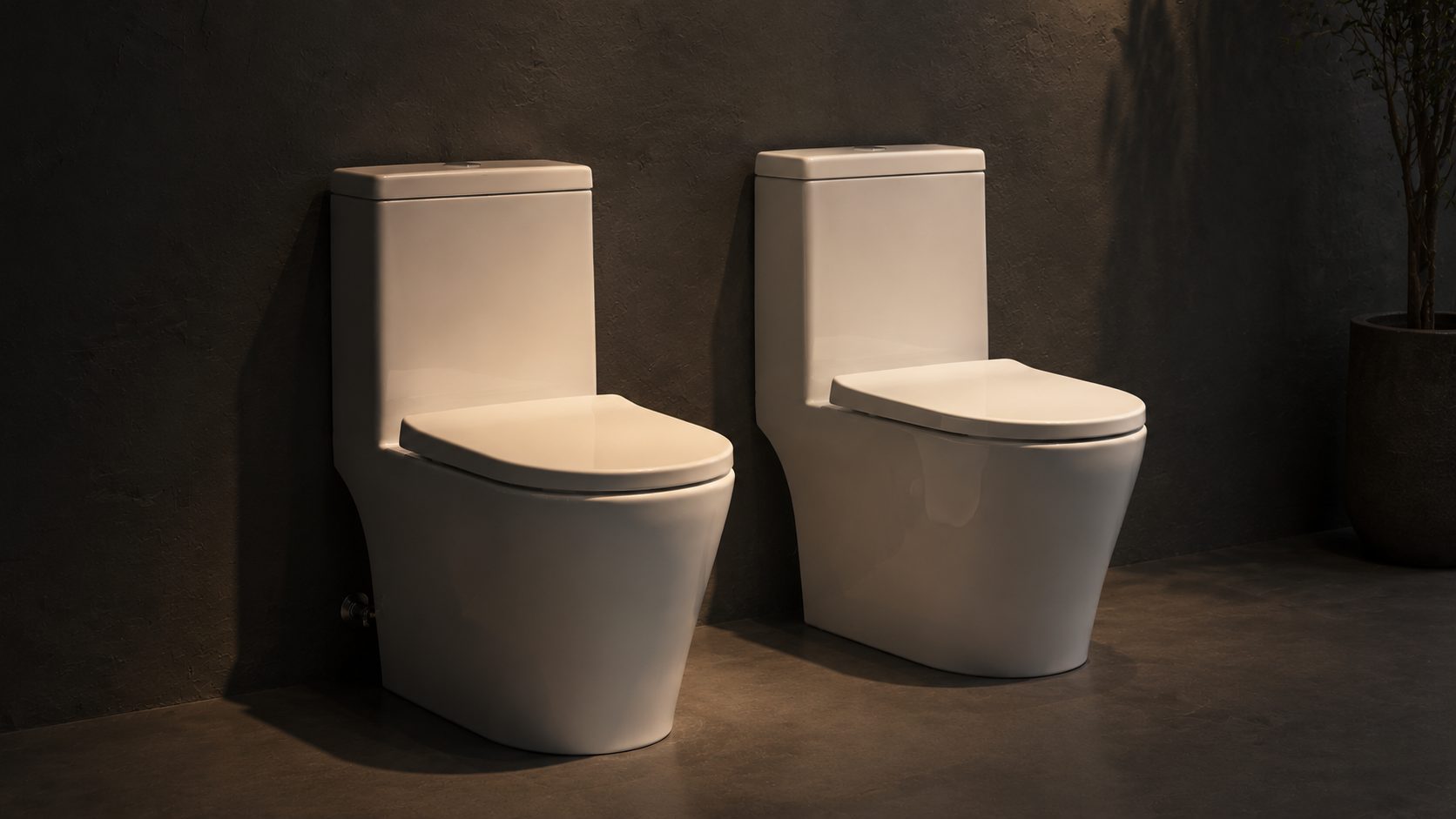
Lift the lid on two modern toilets and they can look like twins — the same glazed white bowl, the same clean lines. The real difference hides where you cannot see it: under the rim. A traditional rimmed toilet carries a hollow channel around the top edge that feeds water into the bowl; a rimless toilet throws that channel away and flushes from an open, exposed rim instead. That single change touches almost everything a buyer cares about — hygiene, cleaning time, splashing, water use, price and how hard the piece is to cast. Here is the rimless toilet vs rimmed toilet comparison, from the bathroom and from the factory floor.
Key takeaways
- Rimless removes the hidden channel — with no covered rim cavity, there is far less place for bacteria, limescale and stains to build up, and cleaning is often a single wipe around an open edge.
- Rimmed is the established, lower-cost design — a proven under-rim channel, the widest choice of models and the lowest unit price, at the cost of a hard-to-reach cavity that needs regular scrubbing.
- Rimless costs more for a real reason — the open-rim water path is harder to cast and glaze evenly, so factory reject rates run higher and good rimless flushing has to be engineered, not assumed.
01 SIDE BY SIDE
Rimless vs rimmed toilet: quick comparison
Both are ordinary vitreous-china toilets — one-piece or two-piece, floor-standing or wall-hung, siphonic or washdown. The only thing that changes is the top of the bowl: whether water arrives through a hidden rim channel or is thrown out from an open rim. Small change, wide consequences. Here is the whole argument in one table before the detail.
Rimless vs rimmed at a glance
| Factor | Rimless toilet | Rimmed (open-rim) toilet |
|---|---|---|
| Rim design | No hidden channel; water leaves an open, exposed rim | Hollow channel under the rim distributes water |
| Hygiene | No covered cavity for bacteria, mould or limescale | Under-rim channel traps grime and is hard to reach |
| Cleaning | One quick wipe around a visible edge | Needs an angled brush to scrub inside the rim |
| Flush coverage | Engineered jets sweep the full bowl in one direct sheet | Water fans out from many small holes under the rim |
| Splashing | Possible if poorly engineered; controlled on good designs | Rim contains the water, so splashing is rarely an issue |
| Water use | Same as rimmed — typically 4.5/3 L or a single flush at 1.28 gpf | Same volumes; distribution differs, not quantity |
| Price | Higher — more demanding casting and QC | Lower — mature, high-yield production |
| Model choice | Growing but still narrower range | Widest range across every price tier |
| Best fit | Hotels, apartments and projects that prize hygiene | Budget-led and value projects, broad retail |
02 THE RIM
What 'rimless' actually means
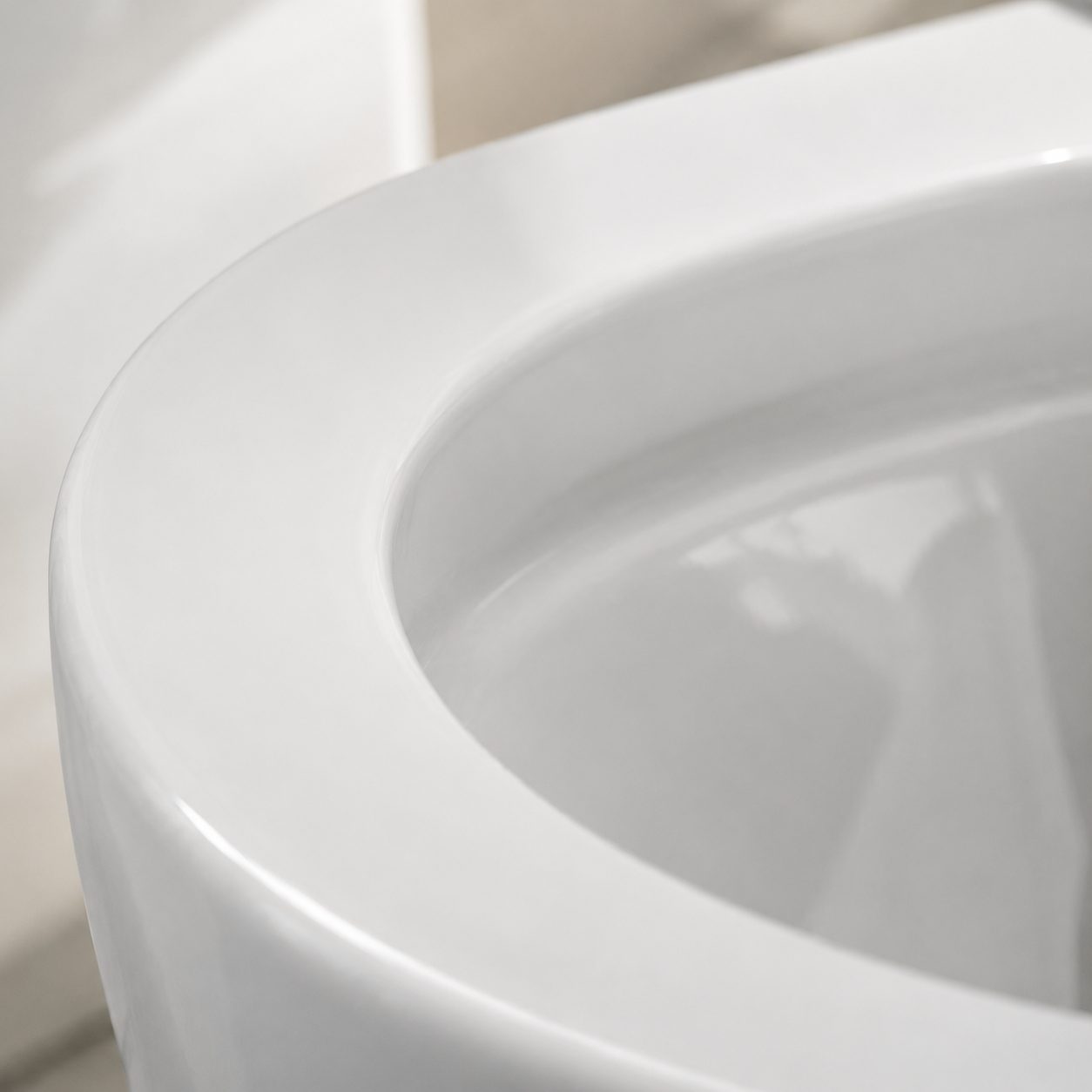
On a conventional rimmed toilet, the top edge of the bowl is hollow. Water leaves the cistern, runs into that enclosed rim channel, and escapes through a ring of small holes on the underside, fanning down the bowl walls. It is a proven design that has flushed bathrooms for a century — but the channel is a sealed cavity you can never fully see or reach.
A rimless toilet deletes that cavity. Instead of a hollow ring, the bowl has an open rim with one or two shaped outlets — usually a wide channel at the back — that launch water in a single controlled sheet, racing around the inside of the bowl to meet at the front. Nothing is hidden; the entire flushing path is glazed ceramic you can see and wipe. Because the water is directed rather than merely released, the geometry of that open rim has to be exact — which is where the manufacturing story begins.
03 HYGIENE
Hygiene and cleaning: where rimless earns its name
This is the reason rimless exists. The hollow channel of a rimmed toilet is warm, damp and dark — an almost perfect home for bacteria, mould and limescale, and the black staining that creeps out from under the rim over time. Because the channel is closed, a normal brush cannot reach most of it; cleaners resort to angled brushes, thin blades or chemicals, and still miss the parts they cannot see.
A rimless bowl has nowhere for that to hide. Every surface the water touches is open, glazed and visible, so a single pass with a brush or cloth cleans the whole edge. For any setting where hygiene and cleaning labour matter — hotels, healthcare, and busy public and commercial washrooms — that is the headline benefit, and it is why housekeeping teams increasingly ask for rimless by name.
A rimmed toilet asks you to clean a cavity you can't see. A rimless toilet only has surfaces you can — that is the whole idea, and every other difference follows from it.
04 FLUSH & WATER
Flush mechanics, splashing and water use
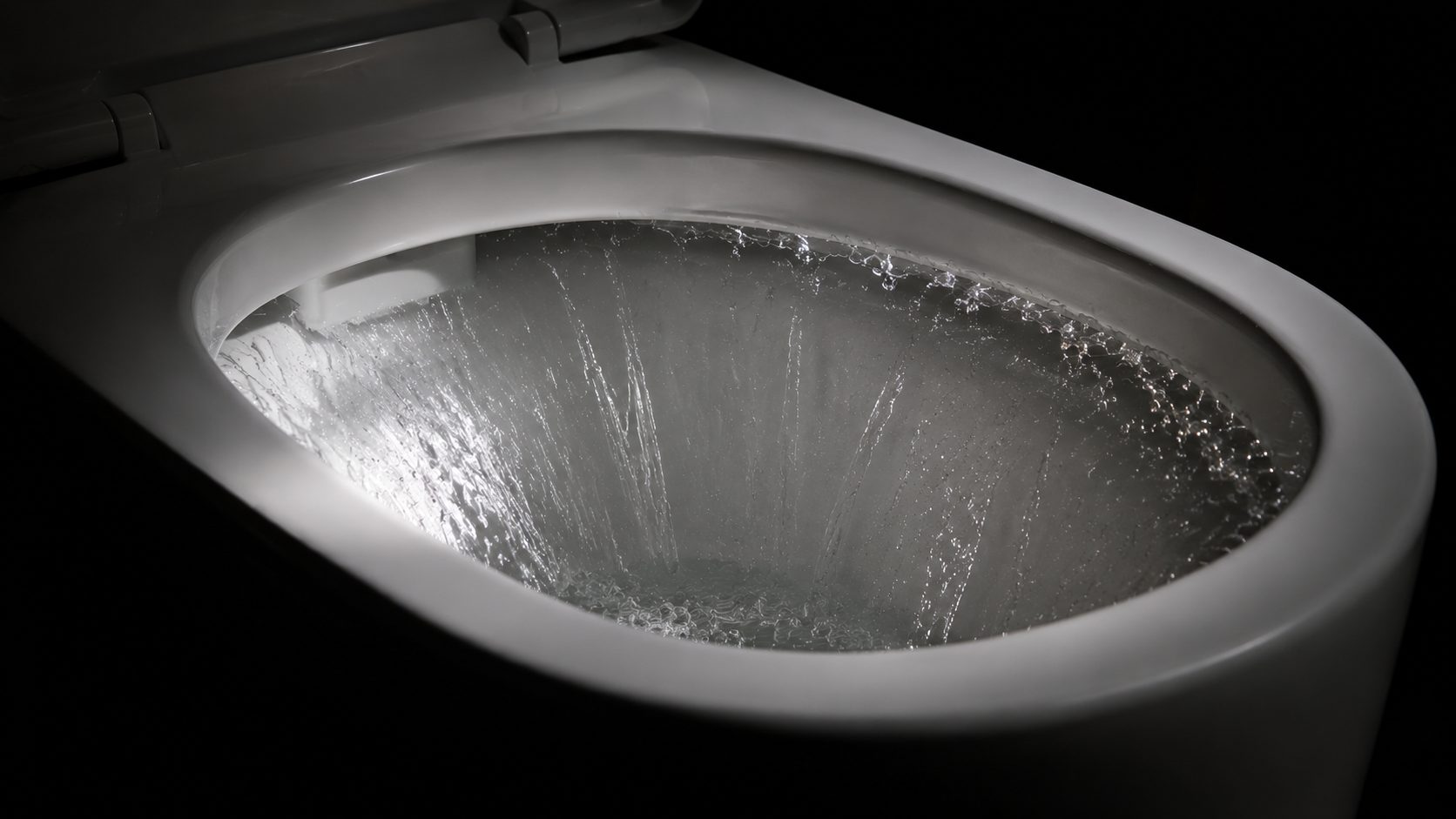
A rimless flush works by aim, not by spread. Water leaves the rear outlet with enough force, and at the right angle, to sweep the full circumference of the bowl in one continuous sheet before draining away. Done well, coverage is excellent — often better than the patchy fan a rimmed toilet produces from its ring of small holes, some of which can scale up and block over the years.
The honest caveat is splashing. Because the water is more exposed and moving faster, a badly engineered rimless bowl can spit droplets over the front edge. Reputable designs solve this through the outlet shape, flush volume and bowl geometry, so in a well-made unit splashing is a non-issue — but it is exactly why cheap, poorly cast rimless toilets earn bad reviews. On water, there is a common myth to clear up: rimless toilets do not use more water. They run the same volumes as their rimmed equivalents — commonly a 4.5/3 litre dual flush in Europe or a single flush at US WaterSense levels — because only the distribution changes, not the quantity. Rim style is a separate question from the flush system itself; whether a bowl is siphonic or washdown is covered in our siphonic vs washdown toilet guide, and both can be built rimless or rimmed.
05 FACTORY VIEW
Price and why rimless is harder to cast
Consumers ask why rimless costs more; the answer lives in the mould shop. A rimmed bowl is a mature casting: the hollow rim is a familiar form, drying and glazing are well understood, and yield is high. A rimless bowl replaces that with a precisely shaped open rim and rear water channel whose geometry directly controls how the flush behaves. If that cast section is a little thin, warped in firing, or unevenly glazed, the flush can miss the front of the bowl or splash — and unlike a hidden defect on a rimmed rim, a customer notices immediately.
That tighter tolerance means more scrap. Rimless lines carry higher reject rates, more careful slip-casting and drying, and stricter after-firing inspection and flush testing before a unit passes. Those real costs, not a marketing premium, are most of the price gap. For a buyer the lesson is to treat rimless as a quality-sensitive purchase: ask how the rim is cast, ask about the flush-test sampling plan, and build both into inspection. Our guide to inspecting sanitaryware before shipment shows where a rimless flush-and-coverage check belongs in a pre-shipment routine.
Buy rimless on the flush test, not just on photos
Two rimless bowls can look identical and flush completely differently. Before you commit, ask the factory to confirm full-bowl coverage with no front splashing at the target flush volume, and agree that pre-shipment sampling includes an actual flush test — not only a visual and dimensional check.
06 PROJECTS
Which suits hotels, apartments and projects
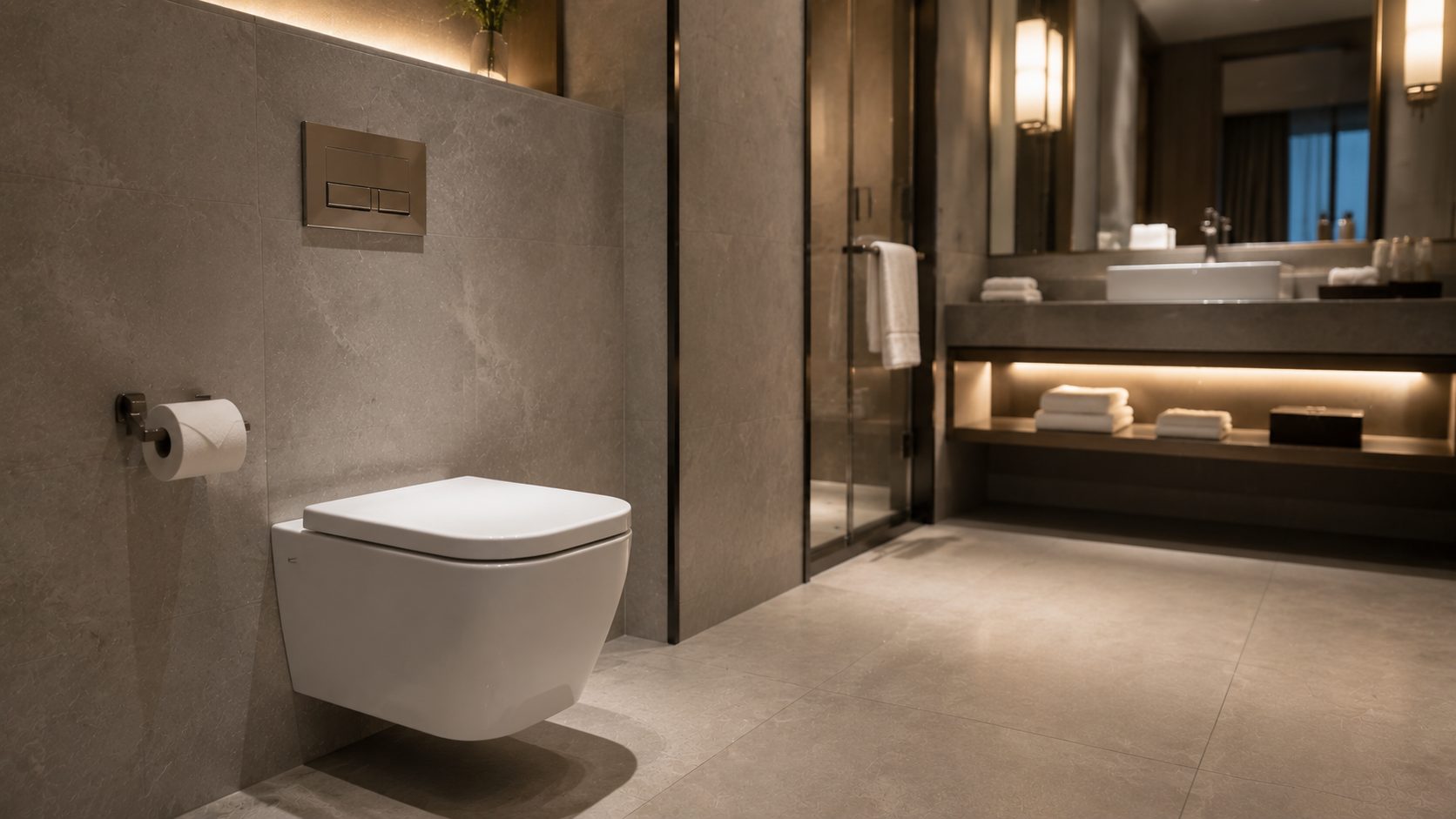
Rimless has become the default for hospitality and premium residential work, especially paired with wall-hung pans and concealed cisterns. The reasoning is operational: in a hotel or serviced apartment, faster cleaning and a visibly more hygienic bowl cut housekeeping time and guest complaints, and the sleek open rim reads as modern and high-end. Across European hotel and apartment projects, wall-hung plus rimless is now one of the most requested specifications, and we quote it heavily for that kind of work — see our guide to supplying hotels and apartments.
Rimmed still holds the value and budget end, and there is nothing wrong with that. For cost-led housing, back-of-house facilities, or markets where the lowest landed price wins the tender, a well-made rimmed toilet is proven, available in every configuration, and cheaper per unit. Many mixed developments specify rimless in front-of-house and guest areas and rimmed where budget rules — a perfectly sensible split.
07 WHICH TO CHOOSE
Which should you choose?
Choose rimless when hygiene, cleaning speed and a modern look drive the specification, and when the destination market and budget support a higher unit price — hotels, healthcare, premium apartments, and any project where housekeeping labour is a real cost. Choose rimmed when the lowest unit price wins, when you need the widest possible model range, or when a market is price-led and the under-rim cavity is an accepted trade-off. Neither is universally better; the right answer depends on the project, the market and the buyer the goods are going to serve.
Whichever you pick, quality still varies by factory more than by rim style. A cheap rimless bowl that splashes will disappoint more than a good rimmed one — which is why the casting and flush-test questions above matter as much as the label on the box.
Before you specify, confirm
Rim style (rimless or rimmed) matched to the project tier; flush system (siphonic or washdown) and outlet direction; rough-in or wall-outlet height; flush volume and target water norm; rimless flush-coverage and no-splash confirmation; trapway and rim glazing quality; seat and fittings; carton spec and units per container.
08 WHAT TO SPECIFY
What importers should specify when ordering
Rim style is one line of the order, not the whole order. It sits alongside body construction — our one-piece vs two-piece toilet comparison covers that — the flush system, the outlet direction and the water norm, and any of those can be got wrong independently. For rimless specifically, put the flush requirement in writing: full-bowl coverage, no front splashing at the stated volume, and a flush test in the inspection scope. Around those sit the usual details that decide whether a container sells through — seat type, cistern fittings, dual-flush mechanism, packing and loading quantity.
As a Guangdong-based manufacturer, we produce both rimless and rimmed ceramic toilets — one-piece and two-piece, floor-standing and wall-hung, siphonic and washdown — alongside smart toilets, ceramic basins and bathroom cabinets, with OEM/ODM adaptation to destination-market standards. Certification support varies by product and market, and buyers can request available test reports before ordering. Tell us the project tier, the market and the flush requirement, and we will recommend rimless or rimmed and quote the right models.
Rimless or rimmed is not really a contest — it is a choice between an open, easy-to-clean bowl at a higher price and a proven, lower-cost design with a hidden channel. Decide what the project values most, confirm the flush behaves, and the rest of the specification falls into place.
FAQ COMMON QUESTIONS
Frequently asked questions
Are rimless toilets more hygienic than rimmed toilets?
Yes, and this is the main reason they exist. A rimmed toilet has a hollow channel under its rim that stays warm and damp — an easy home for bacteria, mould and limescale, and a place a normal brush cannot fully reach. A rimless toilet removes that channel entirely, so every surface the water touches is open, glazed and visible. Independent testing has found rimless bowls significantly more hygienic, and in practice they clean in a single wipe rather than needing an angled brush to scrub a cavity you cannot see.
Do rimless toilets splash more than rimmed toilets?
A poorly engineered one can. Because a rimless flush throws a faster, more exposed sheet of water, a badly cast bowl may spit droplets over the front edge. A well-designed rimless toilet solves this through the outlet shape, flush volume and bowl geometry, so splashing is a non-issue — which is exactly why cheap, poorly made rimless models get bad reviews. When sourcing, confirm full-bowl coverage with no front splash at the target flush volume, and make it part of your inspection.
Do rimless toilets use more water than rimmed toilets?
No. This is a common myth. Rimless toilets run the same flush volumes as their rimmed equivalents — commonly a 4.5/3 litre dual flush in Europe or a single flush at US WaterSense levels. Only the way the water is distributed changes, not the quantity. If anything, because a good rimless bowl covers the whole surface in one pass, users are less likely to need a second flush, which can save water over time.
Why are rimless toilets more expensive?
The extra cost is mostly manufacturing, not margin. A rimmed bowl is a mature, high-yield casting. A rimless bowl replaces the familiar hollow rim with a precisely shaped open rim and rear water channel whose geometry directly controls the flush. Tighter tolerances mean more units warp, glaze unevenly or flush poorly and are rejected, so reject rates and inspection effort are higher. Those real production costs, plus flush testing on every batch, account for most of the price gap.
Do rimless toilets flush as well as rimmed toilets?
A properly engineered rimless toilet flushes as well as — and often more evenly than — a conventional rimmed one, because the water is aimed in a single sheet around the whole bowl instead of fanning out from small holes that can scale up and block over the years. The caveat is engineering: rimless performance depends heavily on the cast geometry, so quality varies more between factories. Buy on a verified flush test rather than on photos.
Are rimless toilets worth it for hotels and apartments?
For most hospitality and premium residential projects, yes. Faster cleaning and a visibly more hygienic bowl cut housekeeping time and guest complaints, and the open rim reads as modern — which is why wall-hung plus rimless is now one of the most requested specifications in European hotel and apartment work. For cost-led housing or back-of-house areas, a well-made rimmed toilet is still the sensible, cheaper choice, and many developments simply split the specification by area.