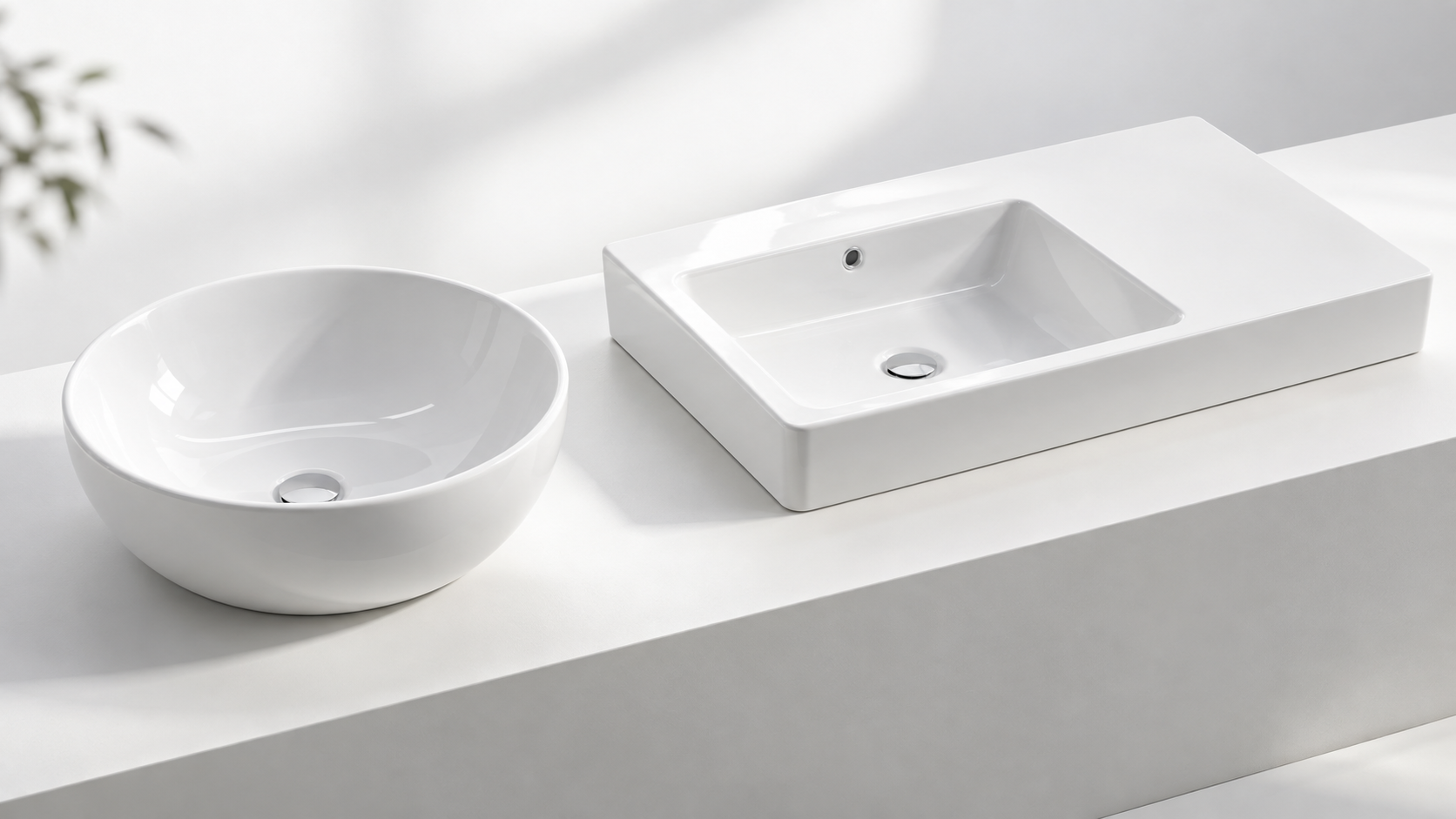
Fine fireclay and vitreous china are material descriptions, not first- and second-class quality labels. Both appear in manufacturers’ washbasin ranges. A sensible comparison asks why a particular material was chosen for a particular design, then checks whether that finished basin suits the intended installation.
The distinction becomes useful when two white basins look similar in a catalogue, or when a long ceramic top is offered as an alternative to a separate bowl. Neither the photograph nor the material name answers the whole buying question. Here is how to read those descriptions without turning them into an unsupported ranking.
01 BATHROOM KNOW-HOW
What do the two material names tell you?
In a washbasin specification, these names identify the manufacturer’s declared ceramic material. They give you a starting point for understanding the product, but they do not identify its complete formulation, dimensions, surface finish or installation method. Ask for the material against the exact model code, rather than copying a statement from the brand’s general catalogue.
Keep three descriptions separate: the ceramic body, the surface finish and the complete basin. A glossy-white finish describes what you see; a material entry describes something different. Neither tells you where the fixing points sit. Our ceramic and porcelain terminology guide provides the broader vocabulary; this comparison focuses on the decision between two named washbasin materials.
02 BATHROOM KNOW-HOW
Why is fine fireclay discussed for large, flat designs?
A long ceramic shelf and a compact bowl place different demands on shape control during manufacture. In its fine-fireclay explanation, LAUFEN links the addition of chamotte with reduced shrinkage and the production of larger forms. That explains one manufacturer’s material choice; it does not establish a universal maximum size or shrinkage rate.
The useful question for a large vanity top is therefore how the supplier controls the finished shape. Ask how the rear edge meets the wall, how the underside meets its support and which dimensions have agreed tolerances. A material selected to help manufacture a shape still needs a finished-part inspection. It does not remove the need to coordinate the basin with the room.
03 BATHROOM KNOW-HOW
Can you identify the material from the basin’s shape?
No reliable buying rule says that every small bowl is vitreous china and every large rectangular basin is fine fireclay. Ideal Standard’s Edit L S0816 is a 400 × 400 × 135 mm vessel basin whose specification names Finefireclay. It is a concrete example of that material in a compact product.
Conversely, LAUFEN’s vitreous-china discussion describes its ability to produce large level surfaces and precise edges. Together, these examples show why appearance is an unreliable shortcut. Read the model’s material declaration. If a seller uses only a broad word such as ceramic, request clarification instead of inferring the body from colour, weight or sharp-looking corners. A photograph cannot confirm a formulation.
04 BATHROOM KNOW-HOW
Does one material automatically make a better basin?
A material name alone does not establish which of two finished models is better for your project. First define what better means: suitable dimensions, the required mounting arrangement, acceptable surface appearance, reliable drainage or a particular cleaning routine. These are questions about the supplied product and its use.
For example, a smooth-looking basin still needs its waste fitting checked. A precise-looking edge still needs to meet the chosen support correctly. Ask for relevant product documentation and, where a performance claim matters, the report identifying the tested model, method and conditions. Avoid transferring a result from an unrelated basin just because both share a material label. Likewise, a brand’s explanation of its manufacturing approach is useful context, but is not a comparative test of every competing material.
05 BATHROOM KNOW-HOW
What should change in the installation discussion?
Start with the exact basin’s instructions. Confirm where it is supported, which fixing kit is required, how it meets the wall or counter and which edges remain visible. Do not assume that two similarly shaped basins use the same brackets or that a material described as stable permits unsupported installation.
For a long top, request a drawing showing the support arrangement and the relevant finished dimensions. For a vessel basin, confirm its intended contact surface, waste and faucet arrangement. Check the assembled parts before repeating the detail across several rooms. The firing shrinkage and dimension guide explains why finished measurements matter. A general material description cannot replace the dimensions and installation detail for the model being purchased.
06 BATHROOM KNOW-HOW
How can you compare two supplier quotations fairly?
Place the exact model codes and declared materials beside the same project requirements. Compare the finished size, mounting type, tap-hole and overflow configuration, supplied fittings, care instructions and the evidence behind any claimed performance. If one offer includes a complete ceramic top and the other only a bowl, record that difference before comparing prices.
Then request the missing information and an appropriate sample or fitting review. Keep the approved drawing and product version attached to the order. Our basin specification-sheet guide explains how to organise those details. The result should be a decision about two documented products, with any unanswered questions visible, rather than a winner chosen from two material names.
Official references
FAQ COMMON QUESTIONS
Frequently asked questions
Is fine fireclay only used for large washbasins?
No. The compact Ideal Standard example above shows otherwise. Large-format capability can help explain a manufacturer’s choice, but does not define every product made from the material.
Can a white glazed surface reveal which ceramic body is underneath?
Do not rely on appearance. Check the manufacturer’s material entry for the exact model. Similar-looking finishes are insufficient evidence of an identical ceramic formulation.
Does the material name tell me which cleaners are suitable?
Use the care instructions for the exact basin and finish. A general material label is not a cleaning-product approval and does not cover the separate waste fitting or faucet finish.
Can I substitute one material for the other on a project?
Treat it as a product change requiring review. Recheck the proposed model’s dimensions, support, fittings and required performance, even if the catalogue shape looks similar.
NEXT · RELATED READING