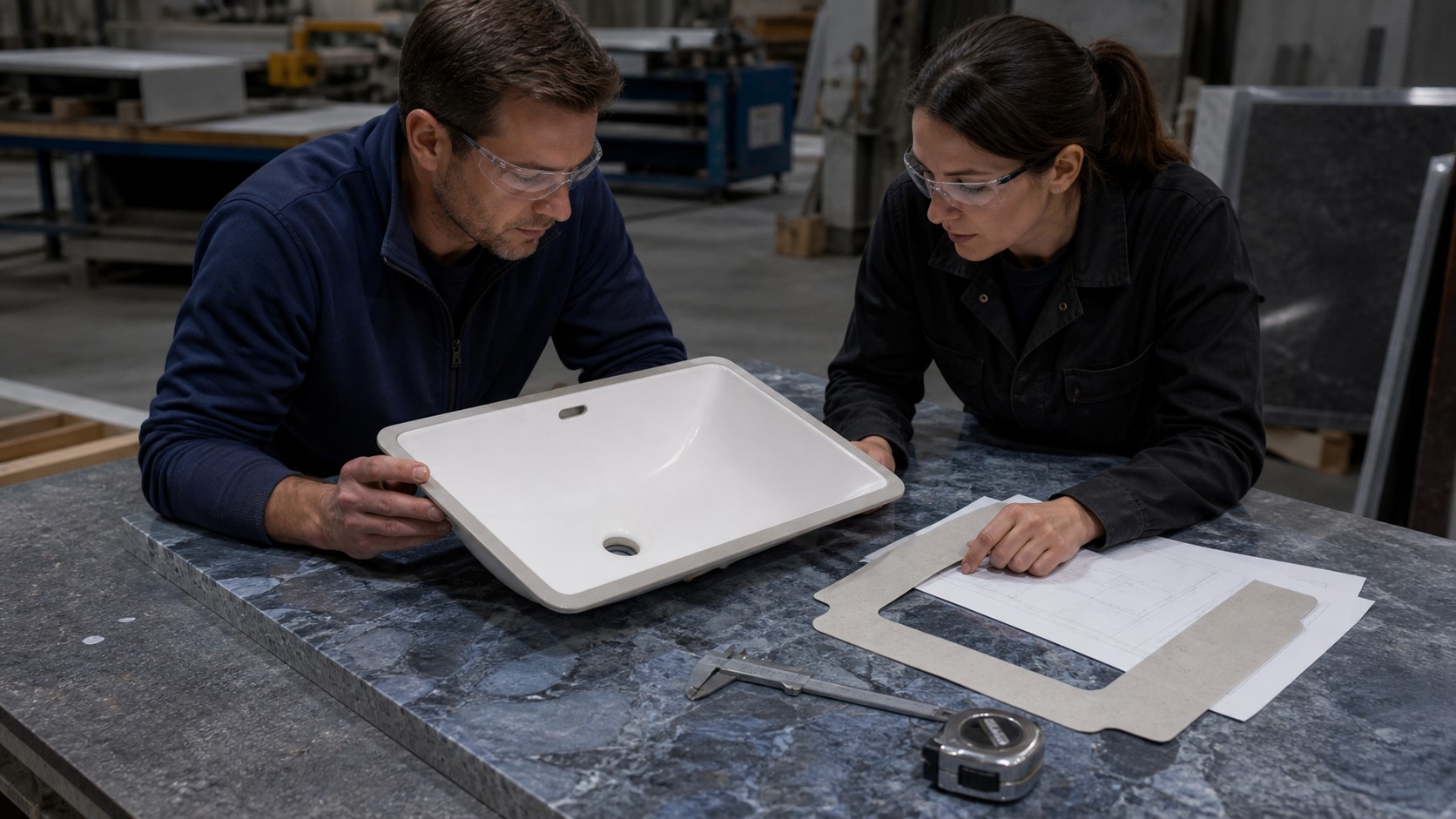
A bathroom sink spec sheet works only when every number is tied to the correct surface, datum and installation task. Overall L × W × H describes the ceramic envelope, not the internal bowl depth, usable water depth or countertop cutout. This guide shows project buyers how to read those fields without inventing a specification.
Key takeaways
- Separate four measurement layers: ceramic envelope, internal bowl, installation geometry and fitting interfaces.
- Never calculate a cutout from overall size: release countertop work only against the current model-specific template and approved installation detail.
- Define depth by endpoints: exterior height, interior bowl depth and usable water depth are different fields.
- Control the revision: reconcile the product code, drawing, template, sample and purchase order before cutting or production.
01 READING ORDER
Which measurements belong to which layer?
Start by sorting every note into four layers. The envelope layer is overall length × width × height. The bowl layer covers the internal opening, interior depth and any stated usable water depth. The installation layer covers the rim, deck, cutout, reveal, supports, clips and countertop thickness. The interface layer covers the tap hole, overflow, drain opening, waste, trap and faucet landing point.
This order prevents a common procurement error: treating the largest plan-view outline as the cutout, or treating the overall side height as bowl depth. A sheet may show several nested outlines and vertical dimensions. Trace every extension line to its endpoints; if an endpoint or datum is unclear, mark the value “definition to confirm” instead of naming it.
Check the model code, revision date, units and scale before reading the geometry. PDF scale can change, so written dimensions control. Confirm orientation: Kohler's official guide uses length side to side and width front to back, but catalogues differ. Put an agreed L/W/H convention on the project schedule.
02 CERAMIC ENVELOPE
How do you read overall L × W × H?
Overall length is the maximum side-to-side ceramic extent, overall width is the maximum front-to-back extent under the agreed orientation, and overall height is the maximum exterior top-to-bottom extent. These dimensions help reserve cabinet, wall and transport space. They do not define how much countertop remains, where the bowl begins or how deep water can stand.
Record the maximum envelope and its datums. A rounded basin may reach maximum width at one curve; a rear deck may create maximum height; an undercounter rim can sit above the bowl yet remain hidden. Use the tolerance stated for the exact model and project, never one borrowed from another product.
For early layout, compare the envelope with the vanity, drawer, wall, mirror and faucet zones using our bathroom basin size guide. Before approval, replace any generic symbol with the exact model drawing and a verified sample. A nominal 460 mm basin is not a complete cabinet instruction.
03 BOWL & WATER
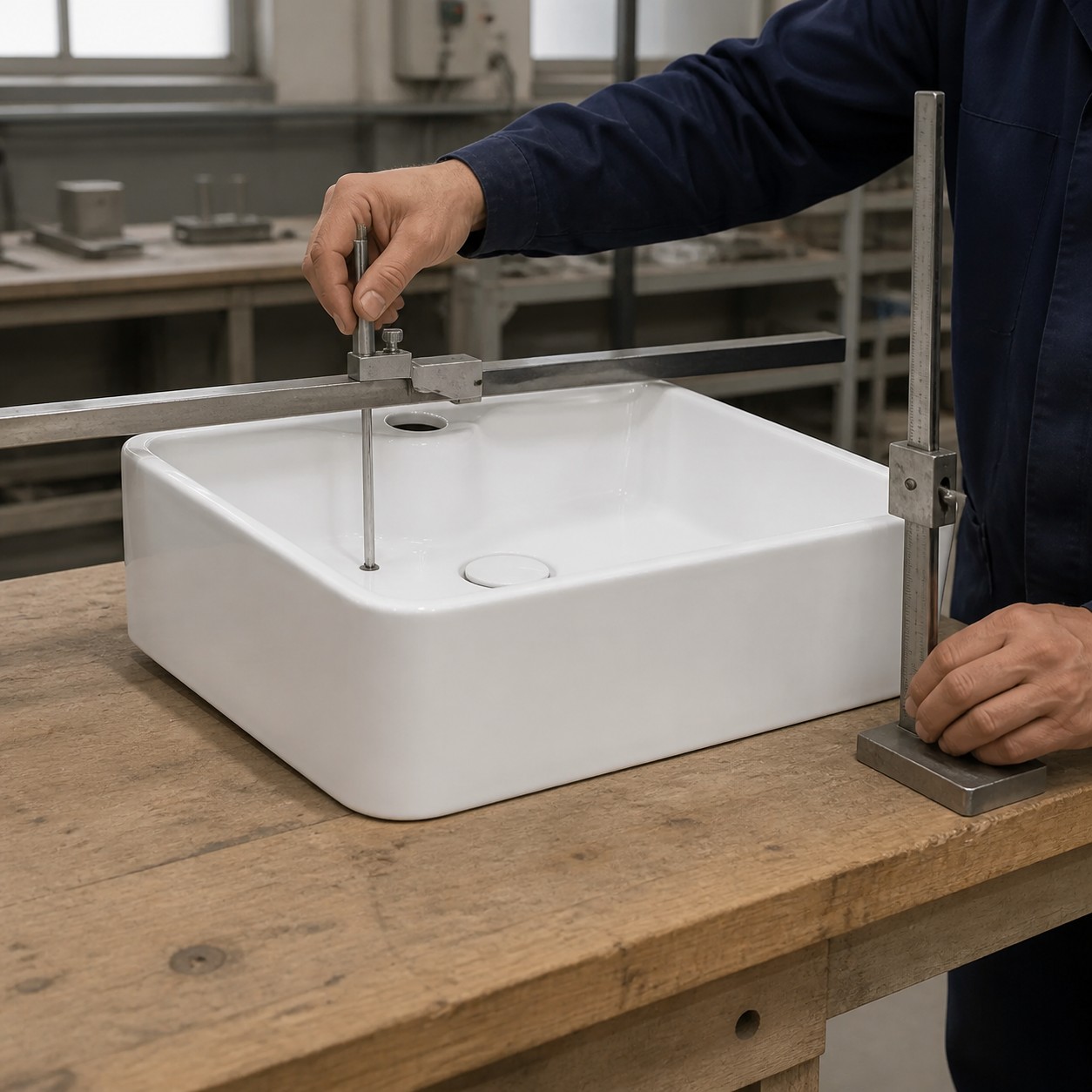
Is sink height the same as bowl depth?
No. Kohler's official guide distinguishes exterior height from interior depth and states that an overflow basin is measured from the deepest point to the overflow. Villeroy & Boch's professional product data likewise publishes external height and “interior depth” as separate fields. These examples show the right data structure, not a universal measurement for another model.
Ask what the depth endpoints mean. “Internal bowl depth” may run from the deepest ceramic point to a stated rim or overflow datum. “Usable water depth” may be limited by the overflow or selected waste. A no-overflow basin still needs an explicit upper datum; curved surfaces make visual subtraction unreliable.
Chengda's current public data for CB0116, UB0118, VB107 and A101 does not state an approved internal bowl depth or usable water depth. Their overall heights therefore must not be relabelled as depth. If a project needs capacity, splash or hand-clearance analysis, request a signed cross-section with defined endpoints and confirm it on the physical sample; do not infer a value from the side profile.
04 SUPPORT SURFACES
What do rim and deck dimensions tell the installer?
The rim is the ceramic perimeter around the bowl. It may remain visible and support a drop-in basin, sit below the counter on an undercounter basin, or form part of a countertop or vanity-mounted product. The deck is a usable horizontal platform, often behind or beside the bowl, that may carry a faucet or accessories. A rim is not automatically a faucet deck.
Installation type changes what must be coordinated. Chengda CB0116 is a drop-in oval basin, so the visible rim, bearing surface, sealed joint and opening all matter. UB0118 is rectangular and undercounter, so the reveal, underside support, clip or bracket locations, sealant joint and polished counter edge matter. For more context, use the drop-in basin guide and undermount sink cutout guide.
Do not assume the ceramic rim alone carries every project load. Ideal Standard's S2496 instructions specify fixing clips and a sealed joint below the countertop; E5027 is self-rimming for drop-in installation to its supplied template. These model-specific instructions keep support, fixing and sealing separate.
05 COUNTERTOP RELEASE
Can you calculate the sink cutout from overall dimensions?
No. The cutout is an installation boundary, not a scaled-down version of the outside ceramic. Rim width can vary around the product; corner radii, glaze return, support areas and casting geometry also affect the opening. CB0116, UB0118, VB107 and A101 are currently listed with templates available, but the exact cut line and installation detail still need the current model-specific revision.
Before cutting, confirm what the template line represents, which face is up, the required reveal, and where clips, sealant and faucet clearance belong. The fabricator must confirm material-specific edge and support requirements. Never enlarge a web image into a template.
Revision control is part of fit. Kohler's current K-2833 specification explicitly instructs the countertop maker or cutter to use the template supplied with the product or a current Kohler template. Apply the same discipline to Chengda: match model, drawing, template and approved sample, dry-fit the actual ceramic, then issue a signed cut release.
06 CONNECTIONS
How should tap hole, overflow and drain data be read?
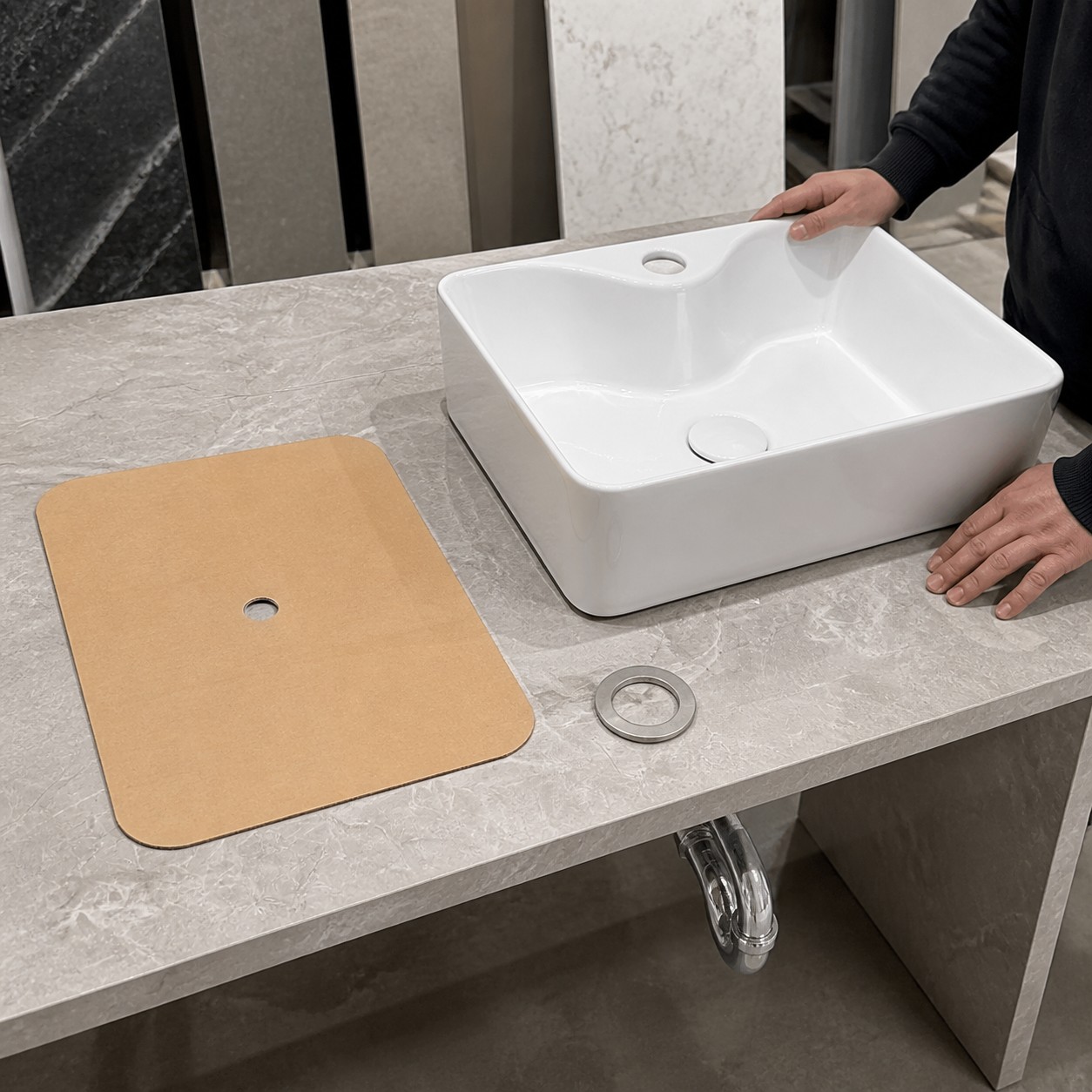
For the tap hole, record quantity, diameter, centres, position and whether the ceramic is fully punched, pre-drilled or unpunched. Then coordinate the faucet base, hoses, spout reach and landing point in the bowl. VB107 is listed with a single tap hole; CB0116 and UB0118 are listed without a tap hole; A101 is listed with a tap hole, while the exact approved arrangement should be confirmed for the order. See the tap-hole versus no-tap-hole guide.
For the overflow, record yes or no, visible opening position, internal channel and the compatible waste configuration. Current Chengda data lists an overflow for all four examples, but the signed hole configuration still controls where a visual asset does not show it. The overflow opening is also a potential datum for usable depth, but only when the signed definition says so. The overflow versus no-overflow guide covers waste coordination in more detail.
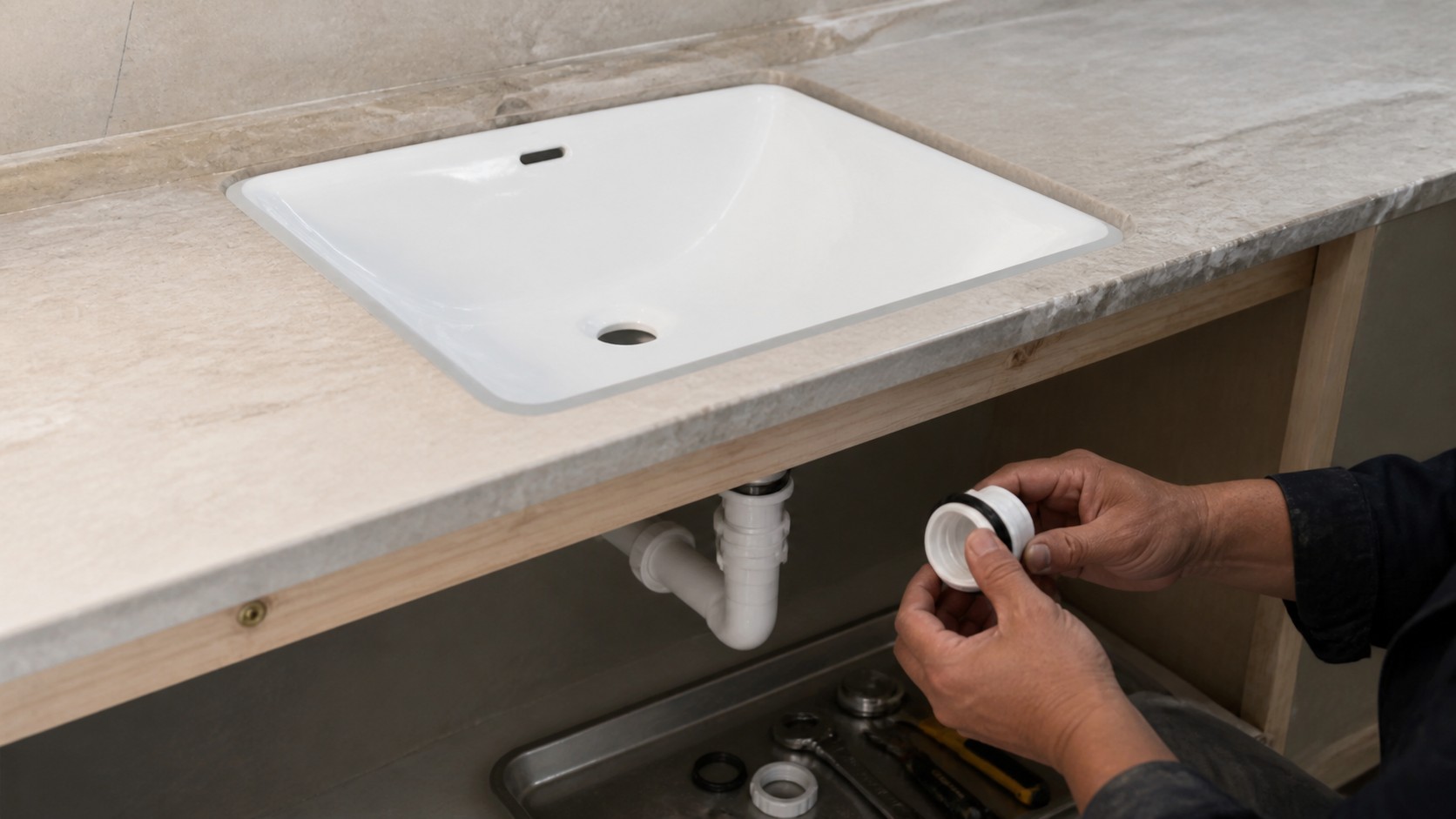
For the drain, distinguish the ceramic drain-hole diameter from the waste assembly, flange, body, thread, seal and trap connection. CB0116, UB0118, VB107 and A101 list a Ø45 mm ceramic drain opening. That number does not prove that any nominal 1¼-inch waste will fit. Kohler's K-2833 sheet lists a 44 mm hole and separately recommends specific no-overflow drains, showing that opening size and compatible fitting are separate fields. Verify faucet and basin together: Duravit's BestMatch tests splash and hand space because attractive parts are not automatically functional together.
07 WORKED EXAMPLES
How do four Chengda basin sheets compare?
The table below uses verified current Chengda product data. It is a reading exercise, not a substitute for the signed order package. “Template available” means a model template can be requested; it does not publish an exact cutout here. Internal bowl depth and usable water depth remain “confirm” because those values are not stated in the current public data.
Verified fields and unresolved fields
| Model | Installation | Overall L × W × H | Holes | Cutout and depth |
|---|---|---|---|---|
| CB0116 | Drop-in, oval | 420 × 310 × 180 mm | No tap hole; overflow; Ø45 mm drain opening | Template available; exact cutout, internal depth and water depth to confirm |
| UB0118 | Undercounter, rectangular | 460 × 340 × 200 mm | No tap hole; overflow; Ø45 mm drain opening | Template available; reveal, exact cutout, supports and depths to confirm |
| VB107 | Vanity-mounted, rectangular | 610 × 360 × 170 mm | Single tap hole; overflow; Ø45 mm drain opening | Template available; cabinet interface, exact cutout and depths to confirm |
| A101 | Countertop-mounted, rectangular | 480 × 370 × 130 mm | Tap hole present; overflow listed; Ø45 mm drain opening | Confirm signed tap-hole and overflow arrangement, current template, exact cutout and depths |
Notice what is not safe to calculate. The difference between outer and inner plan outlines is not automatically an even rim width. A vertical side-view dimension inside the profile is not automatically internal bowl depth. A Ø45 mm opening is not a waste specification. Keep each unknown visible until a controlled document or sample answers it.
08 RELEASE & QC
What should be checked before cutting, ordering and inspection?
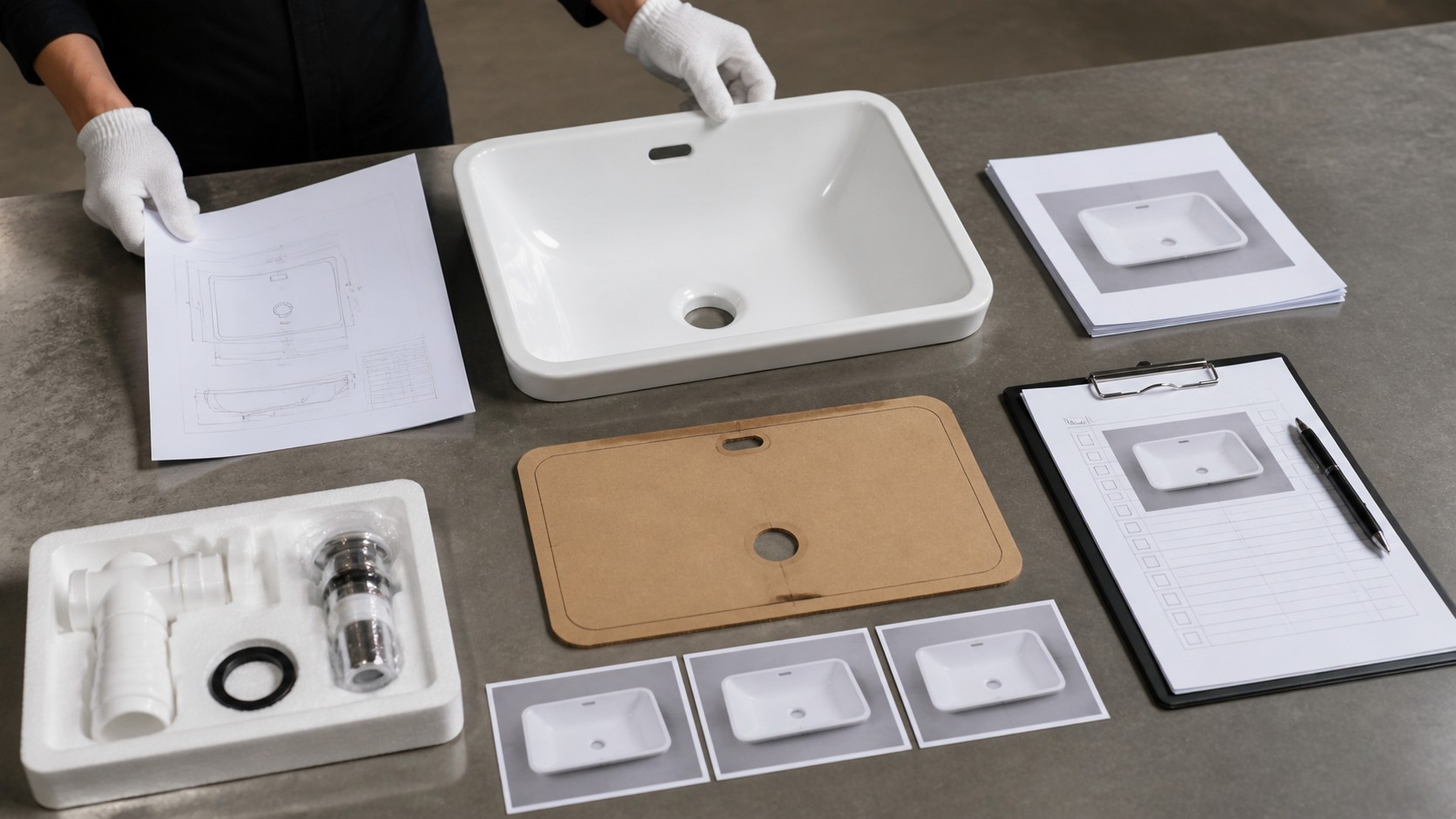
Build one controlled pack: product code and finish; current specification sheet; dimensioned plan and cross-section; model-specific cutout template; installation and support detail; tap, waste and overflow components; cabinet drawing; and signed sample or mock-up. TOTO's Clayton resources separate the spec sheet, CAD, CAD/PDF templates and installation manual—a useful document-pack model.
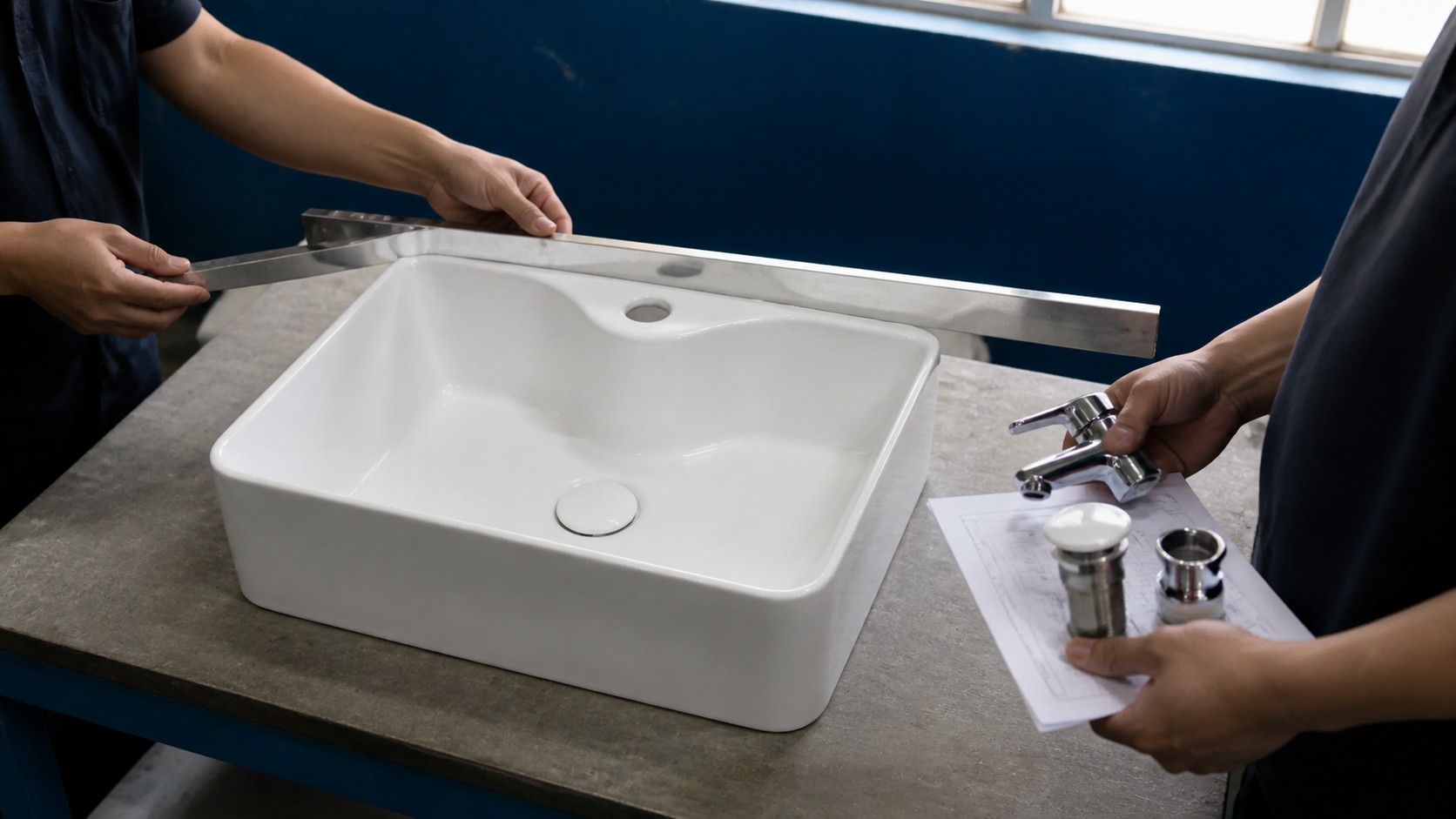
At sample approval, measure the overall envelope from agreed datums, inspect rim flatness and deck geometry, dry-fit the template, and assemble the actual faucet, waste, overflow path and trap. Run water to check drainage, pooling, splash and leakage. Coordinate drawer and service access with the cabinet and basin matching guide. Record the drawing and template revision on the signed approval.
For production QC, inspect against that approval, not a memory or marketplace listing. Check model identity, critical dimensions and tolerance, visible rim or reveal, tap and overflow condition, drain opening, glaze, deformation, fitting trial, template revision, packaging and labels. Our sanitary ware pre-shipment inspection guide covers the wider inspection workflow.
Do not let one number carry four meanings
Overall L × W × H; internal bowl opening and defined depth; usable water depth and datum; rim and deck; exact cutout and reveal; supports and seal; tap-hole arrangement; overflow; Ø45 mm ceramic drain opening; compatible waste and trap; faucet landing; drawing, template and sample revisions; functional test; QC and packing identity.
FAQ COMMON QUESTIONS
Frequently asked questions
Is bathroom sink height the same as bowl depth?
No. Height is the exterior top-to-bottom envelope; bowl depth is an internal measurement with defined endpoints. Usable water depth may be a third value, often limited by an overflow or waste operating level.
Can I calculate a bathroom sink cutout from the overall dimensions?
No. Rim width, corner radii, support surfaces and installation type make the cutout model-specific. Use the current approved template and dry-fit the actual sample before cutting.
How should bowl depth be measured on a sink with overflow?
Kohler's guide measures an overflow basin from the deepest point to the overflow. For any project, confirm the manufacturer's stated endpoints and whether the field means interior depth or usable water depth.
Does a Ø45 mm ceramic drain hole fit any 1¼-inch waste?
No. The hole diameter does not define the flange, body, thread, seals, overflow slots or trap connection. Approve the actual waste with the basin and test the complete assembly.
What if the product page, drawing and template disagree?
Stop the cut or order release. Ask the supplier to identify the current model-specific revision, reconcile the documents and confirm the result against a signed physical sample.
What documents are needed before a countertop is cut?
Use the current product specification, dimensioned drawing and cross-section, full-size model template, support and sealing detail, cabinet and faucet coordination, and an approved sample or mock-up with recorded revisions.