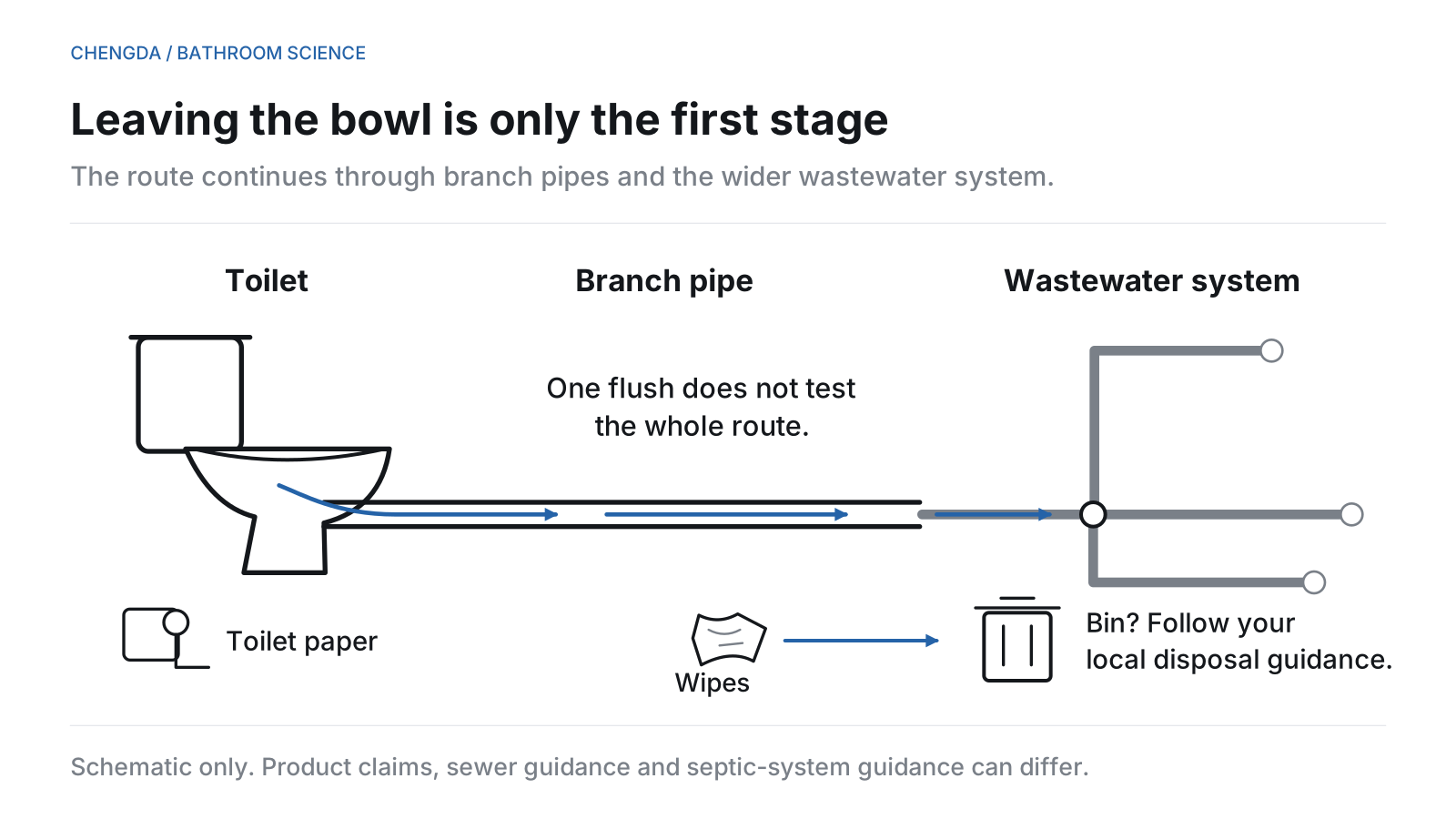
A wipe can disappear from the toilet bowl and still be the wrong item for the drainage system. The word flushable on its own does not tell you whether your local wastewater operator or your particular system accepts that product. When you cannot verify those conditions, put used wipes in the appropriate bin.
The useful comparison is what happens after flushing, not which product looks thinner or feels softer. This guide separates toilet performance, material behaviour and disposal instructions, so a bathroom purchase does not turn into an experiment with the pipes.
01 UNDERSTAND YOUR BATHROOM
Why does leaving the toilet bowl not prove a wipe is suitable?
The visible flush is only the start of a longer journey. A disappearing object tells you that it moved out of sight; it does not show what happened in the branch drain, shared sewer or downstream equipment. A useful diagram therefore has two checkpoints: leaving the fixture and remaining compatible with the system beyond it.
Thames Water explains that wastewater screening removes items such as wipes before later treatment stages. Reaching a treatment plant is not evidence that the item belonged in the toilet. Nor does a normal-looking bowl let you locate an object after it has gone. The practical question is whether disposal guidance accepts it, rather than whether one flush can move it.
02 UNDERSTAND YOUR BATHROOM
How are toilet paper, tissues and wet wipes different?
Treat the product category as more useful than its everyday name. A facial tissue, a paper towel and toilet paper may all look like paper, yet they are not interchangeable drainage products. Sydney Water distinguishes durable paper towels and tissues from toilet paper and advises keeping the former out of the toilet.
For wet wipes, softness is not a reliable guide to behaviour in water. A sheet intended to remain usable while already wet poses a different question from ordinary toilet tissue. A home jar demonstration may illustrate a difference between two samples, but it cannot certify their performance throughout a real drainage system. Do not conduct the comparison by flushing samples.
| Item in your hand | What to check before disposal |
|---|---|
| Ordinary toilet paper | Use according to the toilet and local system instructions; avoid excessive amounts. |
| Facial tissue or paper towel | Do not treat it as a toilet-paper substitute. |
| Wet wipe, including a “flushable” pack | Check the exact product and current local acceptance; bin it when uncertain. |
03 UNDERSTAND YOUR BATHROOM
Do biodegradable or plastic-free labels mean a wipe can be flushed?
These descriptions answer different questions. Plastic-free describes a material claim. Biodegradable concerns breakdown under relevant conditions. Neither wording, by itself, establishes how the complete product behaves in your drainage system or whether the operator accepts it. Read the actual disposal instruction instead of converting an environmental claim into a flushing instruction.
Thames Water warns that even wipes labelled flushable or biodegradable can contribute to blockages. Its advice is to put wipes in the bin. That does not mean every wipe has identical ingredients, contains plastic or breaks down at the same rate. The point is narrower: a favourable word on the front of a packet is insufficient evidence for disposal.
04 UNDERSTAND YOUR BATHROOM
Why can water companies give different advice about flushable wipes?
Guidance is not identical everywhere. Sydney Water currently includes an exception for products meeting the Australian and New Zealand flushable-products standard, AS/NZS 5328:2022. Thames Water tells customers to bin wipes. These are examples of different published approaches, not permission to apply one operator’s policy to another city or building.
Check the current guidance for your address, then the product’s exact instructions and any requirements for your building or treatment system. An old label or article can be misleading: Water UK announced the end of its Fine to Flush certification in March 2024. A historic certification discussion should not be presented as current universal advice.
A septic system adds another specific context. The US EPA SepticSmart poster includes baby wipes and wipes labelled flushable among items to keep out. If guidance is unclear or conflicts, use the bin and ask the responsible operator. A product label alone cannot resolve that uncertainty.
05 UNDERSTAND YOUR BATHROOM
Will a more powerful toilet make wet wipes safe to flush?
A toilet specification describes a fixture, not every object someone might put into it. Stronger-looking movement in the bowl does not establish compatibility with the downstream network. For the same reason, changing the flush setting or repeating a flush is not a product-acceptance test.
The distinction matters when choosing sanitaryware: read our guide to toilet flush-performance testing for what a test result needs to identify. Do not reinterpret a general performance claim as a wipe-disposal guarantee. The EPA’s facility guidance discusses toilet performance alongside instructions to discourage flushing inappropriate objects. Responsible use remains part of the system.
06 UNDERSTAND YOUR BATHROOM
What if you have already flushed a wipe?
One incident does not let you predict a blockage, and it does not prove future flushing is safe. Stop using the toilet as a disposal route for wipes. If water rises unusually, drains very slowly or returns through another fixture, stop flushing and contact the building’s maintenance team or a plumber. Report what was flushed and what you observed.
Do not keep adding water simply to check whether the problem has gone. Avoid reaching into concealed pipework or trying to dissolve the wipe with a mixture of cleaners. These actions do not tell you where it is. Equally, do not blame wipes automatically: an inspection may identify a different cause. A useful report separates the known event from the suspected explanation.
07 UNDERSTAND YOUR BATHROOM
How can a guest bathroom make the right disposal choice obvious?
Put a suitable bin where a seated user can see it, and keep it serviced. If wipes are supplied, place clear disposal information beside them. In a guest property, explain which paper goes in the toilet and which items go in the bin using the languages guests understand. A short instruction beside a visible bin is easier to act on than a long notice hidden behind the door.
Keep this message separate from instructions for the flush buttons. Our dual-flush guide explains the fixture choice; neither button is a rubbish-disposal mode. If a washing seat is being considered, first check the existing-toilet bidet-seat fit guide. That is a separate compatibility decision, not evidence that any wipe becomes suitable for flushing.
Technical references
FAQ COMMON QUESTIONS
Frequently asked questions
Can a wipe cause trouble even when the toilet flushes normally?
Yes. The bowl only shows the visible part of the journey. A normal flush does not establish what happens farther along the system, although it also does not prove a blockage has occurred.
Is every wet wipe made with plastic?
No. Avoid treating all formulations as identical. A plastic-free label still does not answer whether the finished product is accepted by your wastewater operator.
Can I tear a wipe into small pieces before flushing it?
Tearing it does not establish compliance with a product standard or local disposal guidance. It is not a substitute for checking acceptance. Put it in the bin if uncertain.
Are facial tissues safe when toilet paper runs out?
Do not assume so. Facial tissues and paper towels are not the same product as toilet paper. Arrange an appropriate disposal alternative and follow the system’s instructions.
Can a home jar test prove that a wipe is flushable?
It can show how one sample behaves under those test conditions. It does not establish compliance with a recognised test programme or acceptance by your sewer or septic-system operator. Do not dispose of test materials by flushing them.
NEXT · RELATED READING