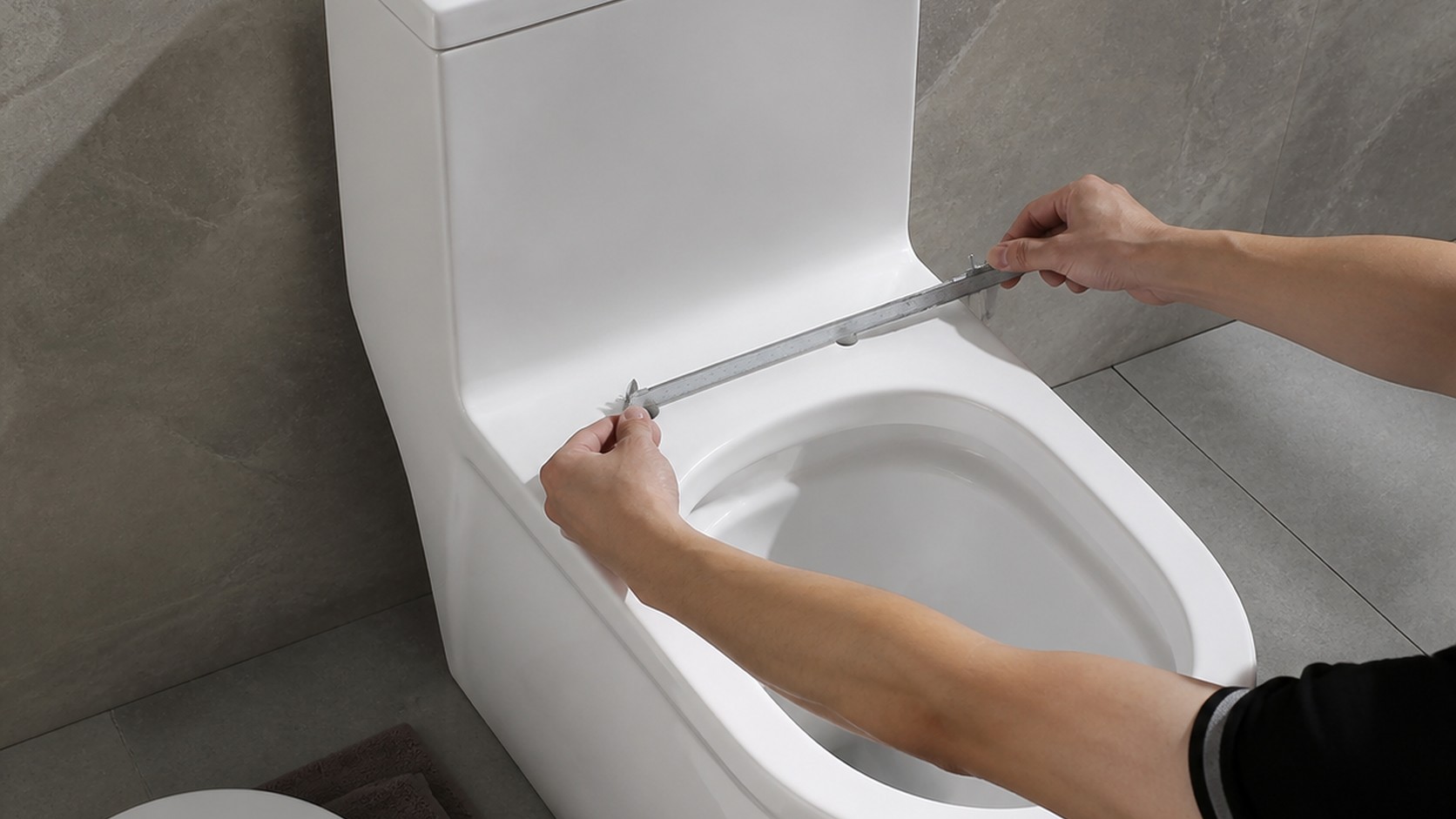
Knowing how to measure a toilet seat prevents a common replacement problem: the fixing bolts fit, but the ring is too short, too wide or poorly supported on the ceramic bowl. Homeowners need four basic dimensions, while importers and project buyers also need the hinge range, bumper positions, hardware access and a physical fit sample. This guide shows a repeatable way to measure a ceramic toilet and turn those measurements into a reliable seat specification.
Key takeaways
- Measure the ceramic: record the bowl itself, because an existing seat may already be incorrect or misaligned.
- Use four checks: hinge-hole spacing, hinge line to front, maximum bowl width and bowl outline.
- Trial-fit the exact assembly: bolts, hinges, ring, lid and bumpers must work together on the intended toilet model.
01 CORE DIMENSIONS
Which toilet seat measurements matter?
Start with the distance between the two seat-fixing holes, measured centre to centre. Next, measure from the fixing-hole centreline to the front outside edge of the ceramic bowl. Record the maximum bowl width at a line perpendicular to the centreline. Finally, describe or trace the top-view outline: round-front, elongated, D-shaped, square-front or a model-specific profile.
These dimensions describe different parts of the fit. Hinge spacing controls whether the fixing hardware can enter the ceramic. Length controls the relationship between the hinge and the front edge. Width and outline determine whether the ring follows the bowl and whether its bumpers land on supported ceramic. One matching number cannot compensate for three mismatches.
For sourcing, add fixing-hole diameter, the flat ceramic area around each hole, distance from the holes to the tank or wall, and any rear curve that limits hinge movement. Record dimensions in millimetres and retain the original photos. Do not convert rounded catalogue inches into production dimensions.
02 PREPARATION
How do you prepare the toilet for measuring?
Identify the toilet model first. Look for a code on the carton, product drawing, invoice or concealed ceramic surface. Model identity is valuable because the supplier may already hold an approved seat specification. Still measure the actual sample when the model is old, has changed factories or will receive a new hinge system.
Close the water and protect the glaze if the existing seat must be removed. Release the fixings according to their design and place the complete seat on a padded surface. Clean and dry the rear deck so the two holes and their edges are visible. Never rest metal tools directly on unprotected vitreous china.
Use a steel rule, tape measure, caliper for hole details, a square for perpendicular width checks and plain paper or cardboard for an outline template. Keep the camera directly above the bowl for the top-view record. Perspective-heavy photos make the front appear wider or narrower than it is.
03 HINGE SPACING
How do you measure toilet seat hinge spacing?
Locate exactly two seat-fixing holes in the rear ceramic deck. Measure from the centre of one hole to the centre of the other, keeping the rule straight across the deck. If the holes are large, measure between their nearest edges and add one hole diameter, or measure the outer edges and subtract one diameter. Repeat the measurement before recording it.
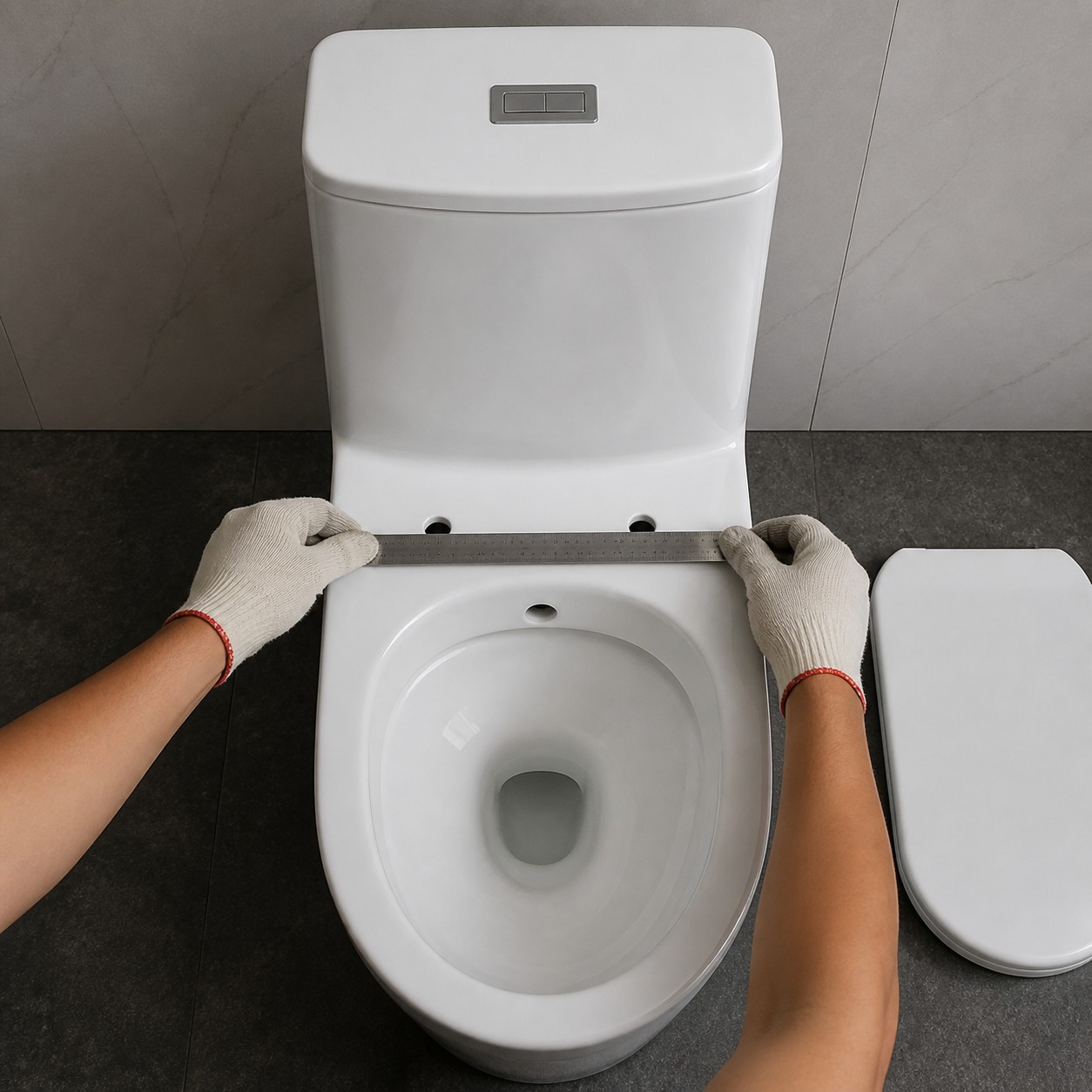
The seat's hinge adjustment range must include the measured spacing without forcing the hinge bases to their unstable limit. Also compare base diameter with the ceramic landing area. A wide hinge cover can collide with a tank, wall or raised ceramic shoulder even when the bolts line up.
Determine whether the toilet accepts top fixing, bottom fixing or either system. A fully shrouded or wall-hung toilet may not provide hand access beneath the deck, so a top-fixing expansion system may be required. The hardware must suit the ceramic hole, remain serviceable and meet the supplier's tightening instructions.
04 LENGTH & WIDTH
How do you measure toilet seat length and width?
For length, imagine a line joining the centres of the two fixing holes. Mark its midpoint, then measure straight forward to the outermost front edge of the ceramic bowl. Do not start from the back of the tank, the hinge cover or the rear edge of an old seat. The hinge line provides the repeatable reference.
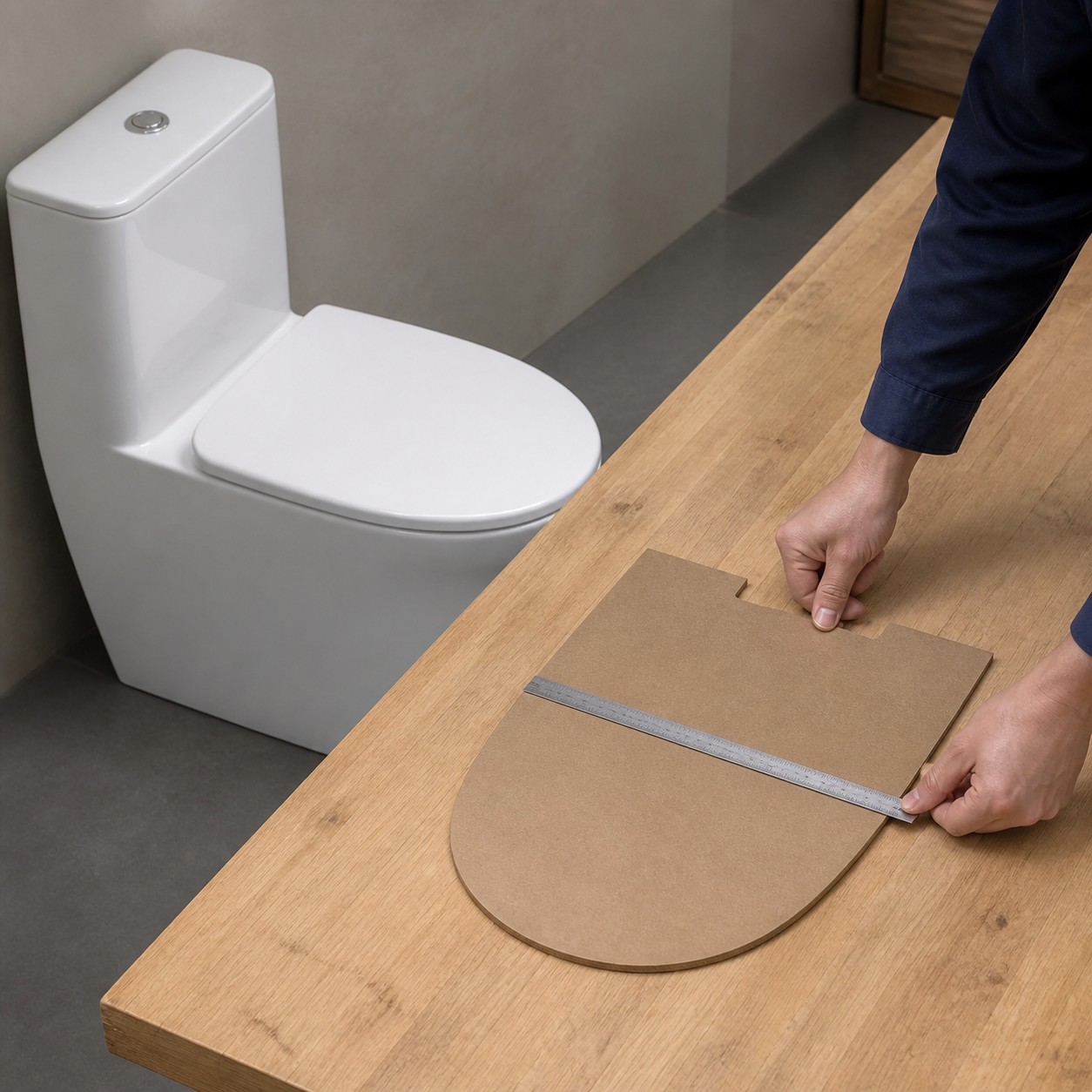
For width, find the widest part of the ceramic bowl and measure across it at right angles to the centreline. Check more than one position if the sides are nearly parallel. An elongated bowl may reach maximum width behind its midpoint, while a compact round-front model may be widest closer to the centre.
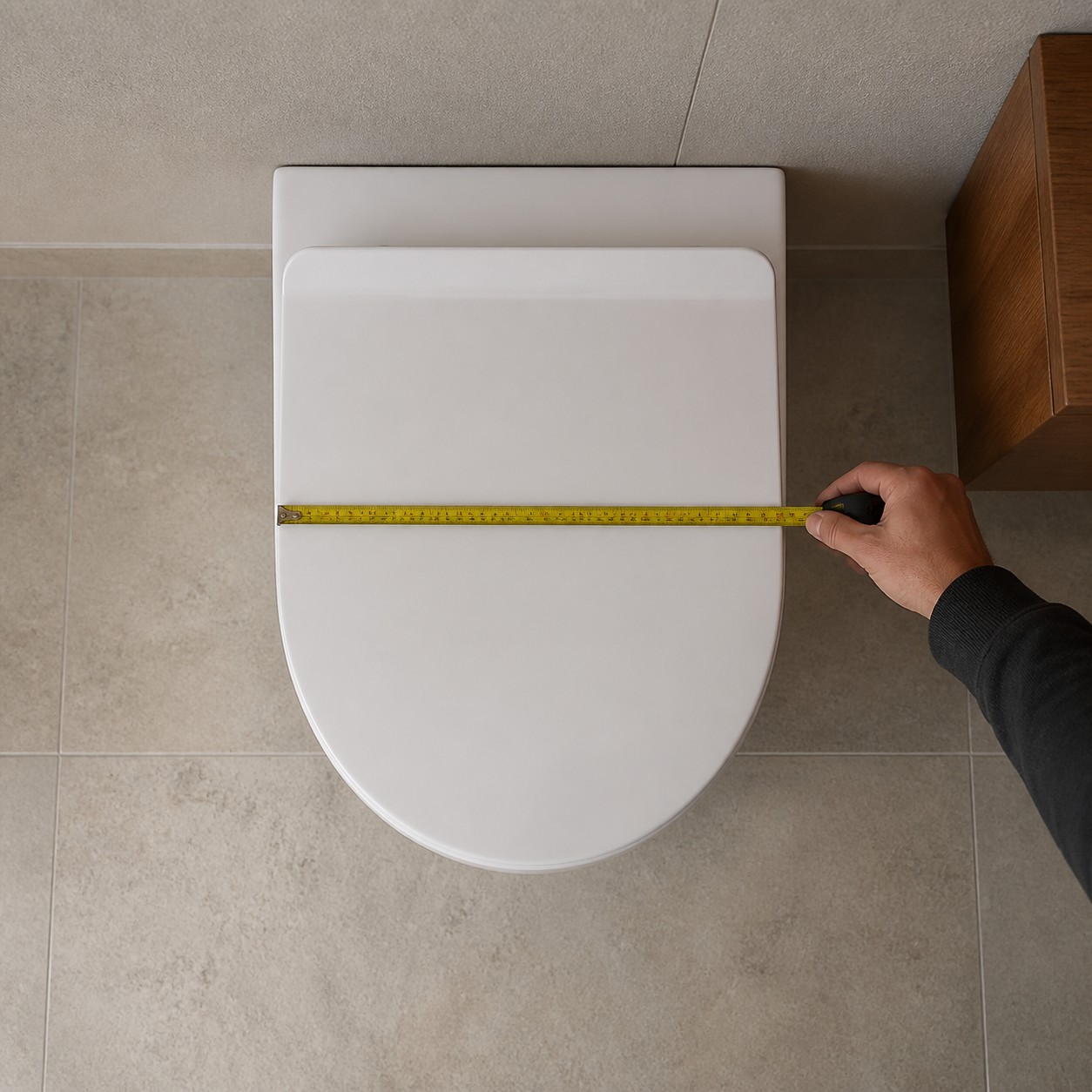
Record the ceramic dimensions separately from the proposed seat dimensions. The seat does not always finish perfectly flush with every edge, but its approved overhang or setback should be even and intentional. The ring opening must also leave comfortable usable space without exposing unsupported ceramic edges.
05 BOWL SHAPE
Is the toilet bowl round, elongated or a special shape?
Round-front and elongated are useful retail categories, especially in North America. A common US reference puts round bowls near 16.5 inches and elongated bowls near 18.5 inches from the hinge midpoint to the front, but these are category guides, not universal production dimensions. Other markets use D-shaped, square-front, compact projection and proprietary outlines.
Look from directly above. A round-front bowl has a shorter, continuously rounded nose. An elongated bowl extends further forward with more parallel side sections. A D-shaped bowl often has a straighter rear and rounded front, while square-front designs use broad corner radii rather than sharp corners.
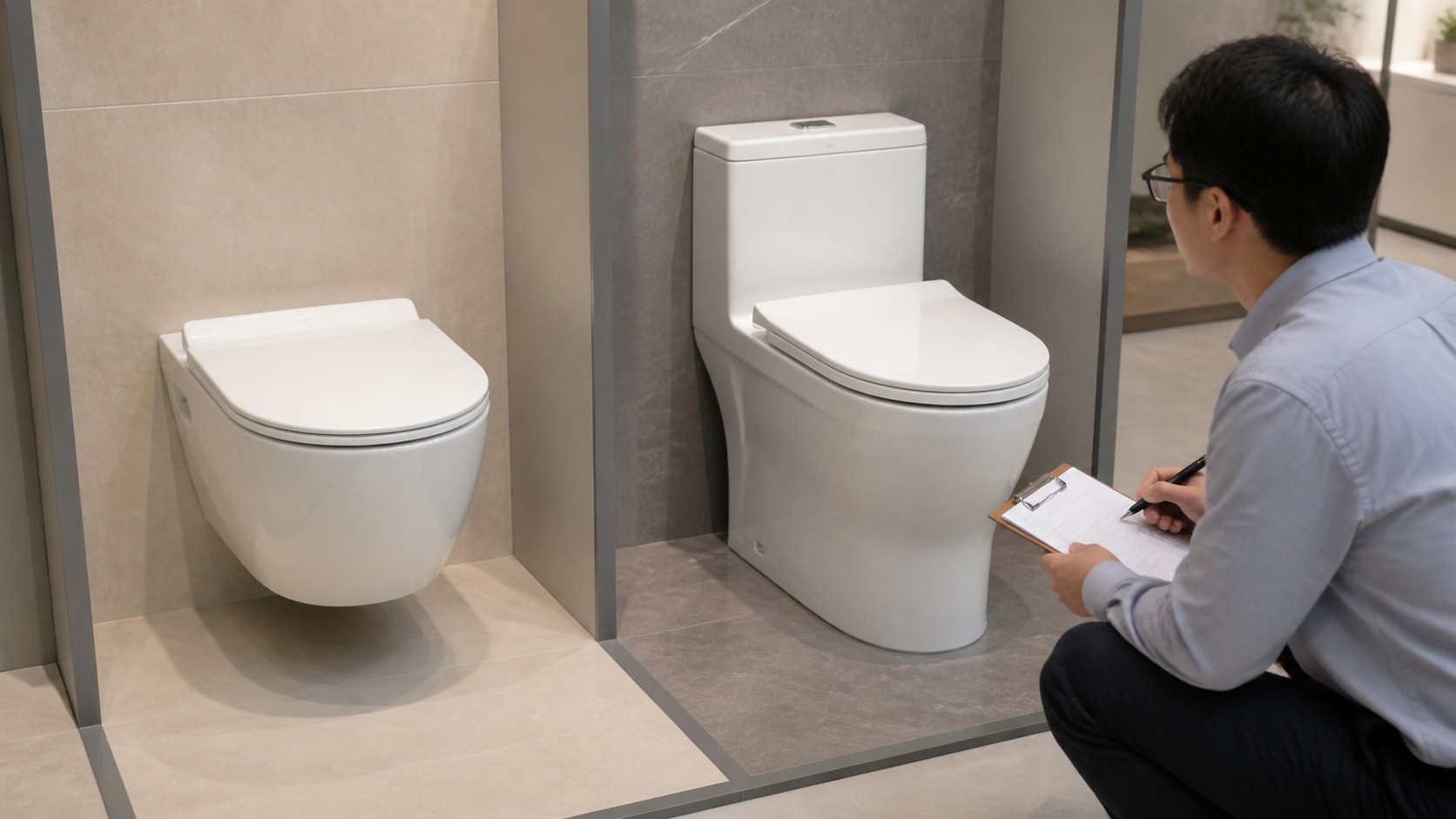
When the outline is unusual, tape plain paper together or use thin cardboard to make a full-size top-view template. Mark only the fixing-hole centres, front edge, widest points and model code. A physical toilet or scan remains preferable for final tooling because a hand-cut template may not capture compound curves precisely.
06 HINGES & HARDWARE
Which hinge and fixing details affect seat fit?
Hinges determine more than bolt spacing. Check forward-and-back adjustment, side adjustment, base footprint, rotation, quick-release mechanism and soft-close compatibility. Confirm whether adjustment remains locked after repeated opening, closing and side loading. A seat that aligns only at the extreme end of a slot has little tolerance for ceramic variation.
Check the fixing route before specifying hardware. Open-back toilets often allow a conventional bolt and nut from below. Fully skirted and wall-hung toilets may require top-fixing anchors installed entirely from above. Record ceramic thickness and hole diameter so expanding plugs do not bind or spin.
Review lid clearance against the tank, flush button, wall and any bidet-seat connection. Open the ring and lid through their full intended travel. Hardware should not scrape glaze, create a pinch point or force the lid to lean in an unstable position. Metal components need the specified corrosion resistance for the destination environment.
07 PHYSICAL FIT CHECK
How should a replacement toilet seat be trial-fitted?
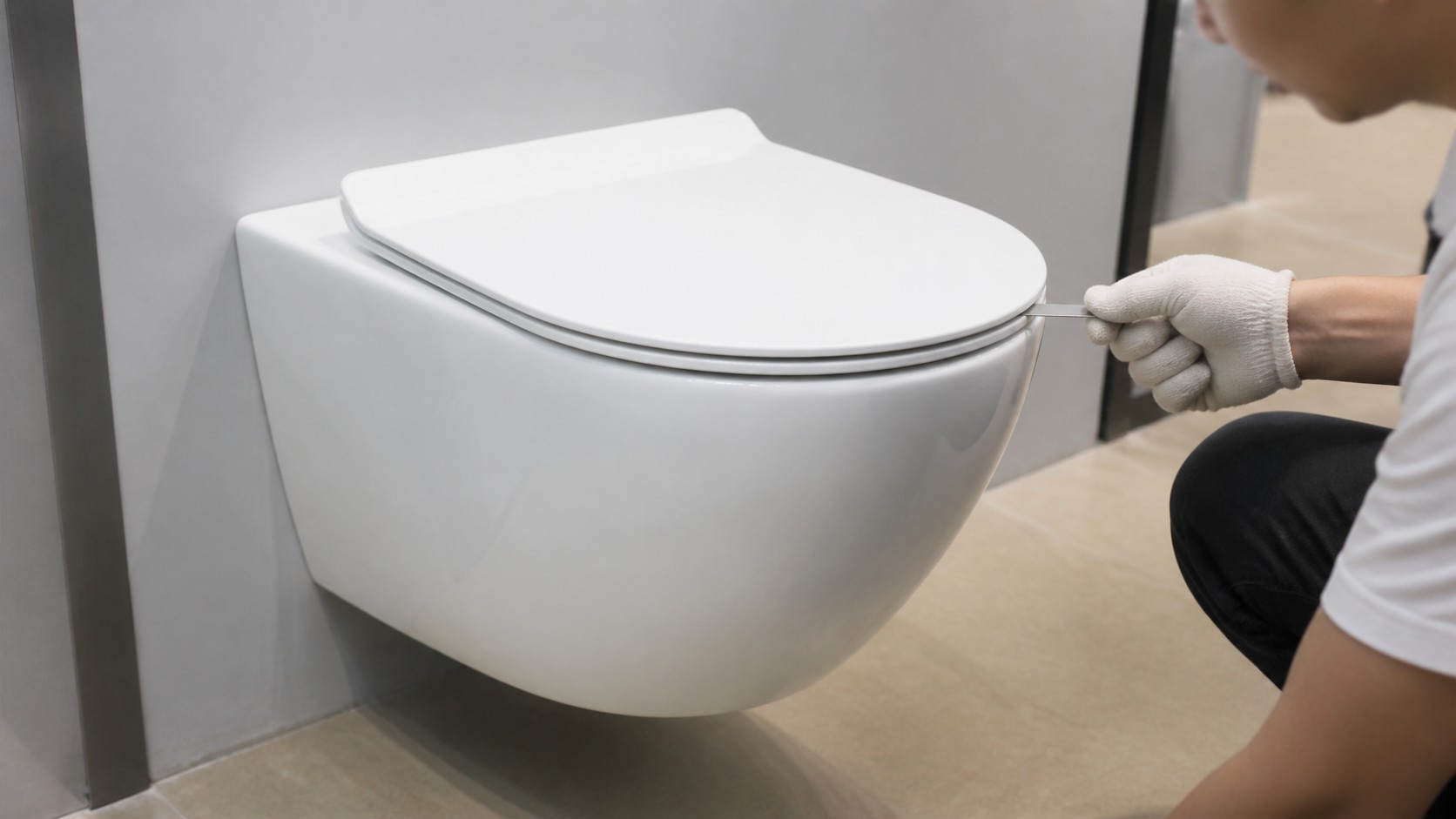
Install the final seat assembly on the intended ceramic sample using production-equivalent fixings. Centre the ring, set the front relationship and tighten to the hardware supplier's instructions. Check that hinge bases sit flat and do not bridge a curve. Open, close and quick-release the seat repeatedly, then recheck alignment.
Lower the ring slowly and inspect every bumper. Each designed bumper should contact a stable ceramic surface without hanging outside the rim. Sit-loading and side-loading tests must follow the applicable product standard and supplier method; do not improvise destructive loads on an unverified toilet. Check for rocking, twist and local contact that could stress the ring or glaze.
For a mixed toilet order, do not assume one seat fits every pan because the hinge spacing is shared. Randomly trial-fit across models and production batches. Keep a signed combination list linking toilet SKU, seat SKU, hinge kit and packing code.
08 BUYER ORDER FILE
What should a buyer send to the toilet seat supplier?
Turn measurements into an auditable specification
Toilet model; top-view photo; bowl outline; hinge spacing; hole diameter; hinge-line-to-front length; maximum width; fixing access; ceramic landing area; seat material; hinge type; soft-close requirement; bumper positions; approved fit sample and packing code.
Send dimensioned drawings as well as photos. State which dimensions were measured on ceramic and which belong to the proposed seat. If a supplier offers an adjustable universal model, request its confirmed range and a sample. Approve colour, gloss, texture and hinge finish beside the ceramic because white components can look mismatched under hotel lighting.
Pack the seat so hinges, buffers and fixing kits cannot mark the ring or lid. Keep every hardware bag traceable to the correct model. During pre-shipment inspection, open random cartons, count fittings, operate hinges and trial-fit selected seats on retained ceramic samples.
Chengda can coordinate toilet pans and matching seat assemblies for importer, retailer, hotel and apartment orders. Send the toilet model, top-view dimensions, fixing access, required material, market and quantity. The safest replacement decision comes from four careful measurements followed by one real installation test.
Measure the ceramic twice, approve the complete seat once, and keep the toilet-seat combination traceable from sample room to shipment.
FAQ COMMON QUESTIONS
Frequently asked questions
Are all toilet seats the same size?
No. Length, maximum width, fixing-hole spacing, bowl outline and hinge design vary by model and market. A seat described as universal still has a defined adjustment range that must cover the actual toilet.
Where do you start measuring toilet seat length?
Measure on the ceramic from the centreline through the two fixing holes to the front outside edge of the bowl. Use the supplier's drawing convention when checking a production seat.
How is toilet seat hinge spacing measured?
Measure centre to centre between the two fixing holes in the ceramic deck. Also record the hole diameter and available flat area because spacing alone does not confirm hardware fit.
Can a round seat fit an elongated toilet?
Usually not correctly. Even if the bolts enter the holes, the ring can overhang, finish short or place bumpers outside the ceramic support area. Match the real outline and length.
Should the old toilet seat be measured or the ceramic bowl?
Measure the ceramic bowl first. An old seat may already be the wrong model or may have moved at adjustable hinges. Record the old seat only as secondary evidence.
What should importers approve before ordering replacement seats?
Approve a physical fit sample on every toilet model, including alignment, ring support, bumper contact, hinge adjustment, opening travel, fixing access and model-specific packing.