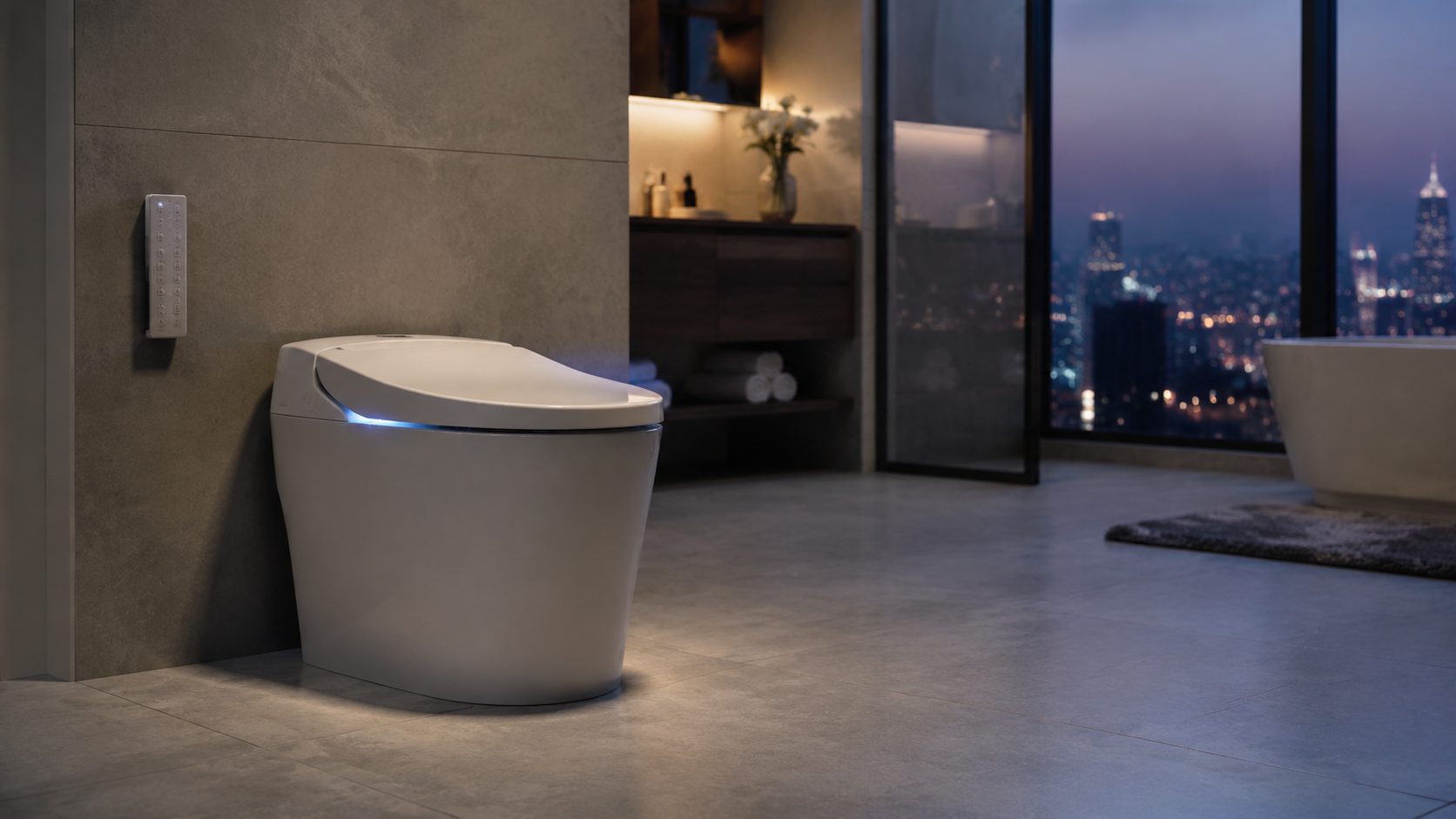
A smart toilet is two products in one carton: a fired ceramic body and a live electrical appliance. That is why sourcing well from a smart toilet manufacturer in China takes a different checklist from ordinary sanitary ware — which route you import (integrated unit or smart bidet seat), what voltage and plug your market uses, how much water pressure the flushing system needs, and how the electronics are tested before the container closes. This buying guide walks importers, distributors and project buyers through those decisions: function tiers and what really moves the price, honest certification talk, QC for ceramic-plus-electronics, spare parts and warranty strategy, container math, and the exact spec sheet to send for an accurate quote.
Key takeaways
- Choose the route by after-sales reality — integrated smart toilets sell the look; a smart seat is a minutes-long field swap. Your service network decides, not the showroom.
- Fix the electrical and water spec at order time — voltage, plug, GFCI/RCD protection and minimum pressure for tankless flushing cannot be changed after production.
- Buy spares with the container and agree a QC plan that powers units on — aging tests, seat-cycle tests and IPX4 evidence, not just a glaze check.
01 TWO WAYS IN
Integrated smart toilet or smart seat: which to import
There are two ways to put a smart toilet in a container. An integrated smart toilet builds the electronics into the ceramic body — one clean silhouette, tankless options, auto lids — at typically two to four times the factory cost of the alternative, with more weight and volume per unit. The second route pairs a standard ceramic pan with a smart bidet seat: lower cost, and the seat swaps in minutes with basic tools, which is its quiet after-sales advantage. If you want the end-user comparison first, see smart toilet vs regular toilet.
Integrated smart toilet vs ceramic pan + smart seat
| Factor | Integrated smart toilet | Ceramic pan + smart seat |
|---|---|---|
| Upfront cost | Higher — typically 2–4× a pan-plus-seat setup | Lower — standard pan plus retrofit seat |
| Look | Seamless one-piece silhouette, tankless options | Conventional toilet with a visible seat unit |
| Functions | Full range incl. auto flush, auto lid, foot sensor | Core wash/heat/dry; flush stays manual |
| Install & electrical | Model-specific; outlet planned at rough-in | Fits standard pans; needs a nearby outlet |
| After-sales & spares | Model-specific parts; board failure may need a technician | Seat is a minutes-long field swap; ceramic stays |
| Best-fit projects | Hotels, premium apartments, flagship retail | Mixed housing, renovation, markets without service networks |
The after-sales logic is the part first-time importers underweight. When an integrated unit's control board fails, the fix often needs a trained technician at the toilet; when a smart seat fails, you ship a replacement seat and the ceramic never moves. In markets without a service network, seats — or integrated models with a removable seat-and-electronics module — cut warranty cost sharply. For projects, hotels and premium apartments pay for the integrated look, while renovation programs and mixed housing stock are usually better served by pans plus seats.
The showroom argues for the integrated unit; the warranty ledger argues for the seat. Let your service network cast the deciding vote.
02 SPEC AND PRICE
Function tiers and what actually moves the price
Smart toilet functions sort into three tiers. The entry tier is the functional core: heated seat, warm-water rear and front wash with adjustable temperature and pressure, and a self-cleaning nozzle. The mid tier adds comfort — warm-air dryer, deodorizer, night light, slow-close, energy-saving mode. The high tier is where price steps up: auto flush, auto open/close lid, foot-sensor flush, remote control, instant tankless water heating and app connectivity.
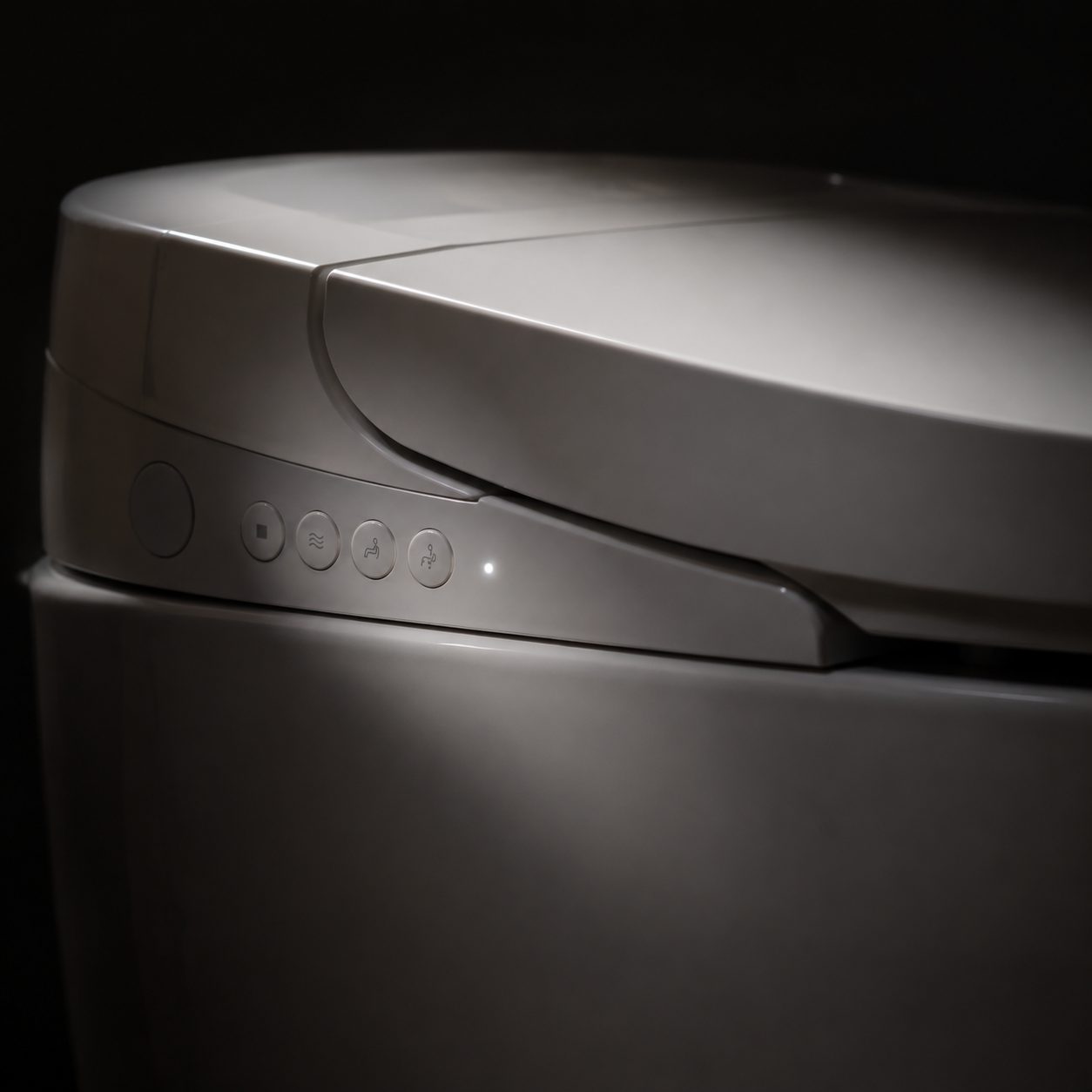
What actually moves cost is not the length of the feature list but a few components: the water-heating method (an instant ceramic heater costs more than a storage tank but gives continuous warm water), the auto-lid mechanism, the tankless flush pump, and the quality of the seat-ring heater and control board. Night lights, deodorizers and remotes are cheap to add and heavily marketed; app control impresses in a catalog and adds firmware and support burden most end users never repay. Specify the tier by your end-market price point, not by feature count.
03 POWER AND PLUGS
Voltage, plugs and GFCI: adapting to your market
Heating elements and control boards are built for one voltage. North America runs 110–120V/60Hz (Japan 100V); Europe, the UK, Australia, the Middle East and most of Asia and Africa run 220–240V/50Hz — and a unit cannot be switched after production. That has a commercial consequence: each voltage variant is its own production batch, so a split-voltage order behaves like two MOQs, not one. Confirm the plug as well — US Type A/B, European Schuko, fused UK Type G, Australian Type I — plus cord length. Safety rules differ too: North America expects a GFCI-protected outlet, Europe and the UK require RCD protection, and UK bathroom zoning restricts where a socket may sit at all. Manuals, control-panel printing and any voice prompts must be ordered in the target language — they are production items, not stickers.
Plan the outlet before the walls close
A smart toilet needs a protected outlet within about one metre of the pan. Missing outlets are the single most common cause of failed installs and returned units — write the requirement into project drawings and retail listings before anything ships.
04 THE WATER SIDE
Water pressure and flushing: tankless vs tank
Most smart toilets state a working range around 0.1–0.75 MPa (roughly 15–110 psi), but the number that matters is the flushing system. Tankless direct-flush models need minimum dynamic pressure — commonly around 0.15–0.2 MPa — and flush weakly or fail in low-pressure buildings: top floors, gravity-fed tanks, older mains common in the UK and parts of the Middle East and South Asia. Built-in tank or pump-assisted models work at low pressure at the cost of a little bulk and one more serviceable part, and are the safer default when destination plumbing is mixed or unknown. Confirm the inlet thread standard for your market (G1/2 vs NPT), and take water quality seriously: hard or sediment-heavy water clogs nozzles and solenoid valves, so specify an inline filter at the angle valve and stock filters and nozzles as consumables in hard-water markets.
05 PAPERWORK, HONESTLY
Certifications: what an honest factory will say
Ranking pages love to list certification logos; a factory should talk about evidence instead. CE marking for the EU (LVD, EMC, RoHS) is self-declared against test reports — ask to see the actual reports, not a logo on a datasheet. Genuine UL or ETL listing for North America is a real cost and lead-time item; verify listing numbers rather than accepting a certificate image. Australia and New Zealand require WaterMark on the plumbing side and RCM on the electrical side. China's CCC applies to the domestic market and proves nothing for export. The honest position — and the one we hold — is simple: certification support may vary by product and market, and buyers can request available test reports before ordering. Be wary of any catalog that claims blanket certification across every model.
06 TESTING LIVE UNITS
QC for ceramic plus electronics
A smart toilet inspection has two halves. The ceramic half reads like any toilet: firing quality, glaze defects, dimensional checks, water seal and flush performance. The electronics half is what generic inspections miss, so specify it: a powered aging (burn-in) test — several hours to 24 hours on a sample, or 100% line aging — to catch early board failures; seat, hinge and lid cycle tests on samples; nozzle extend/retract cycles with wash temperature and pressure verified; and evidence of at least an IPX4 splash-proof rating on the seat electronics. Before packing, every unit should get a 100% function check — heat, wash, dry, flush, remote pairing.
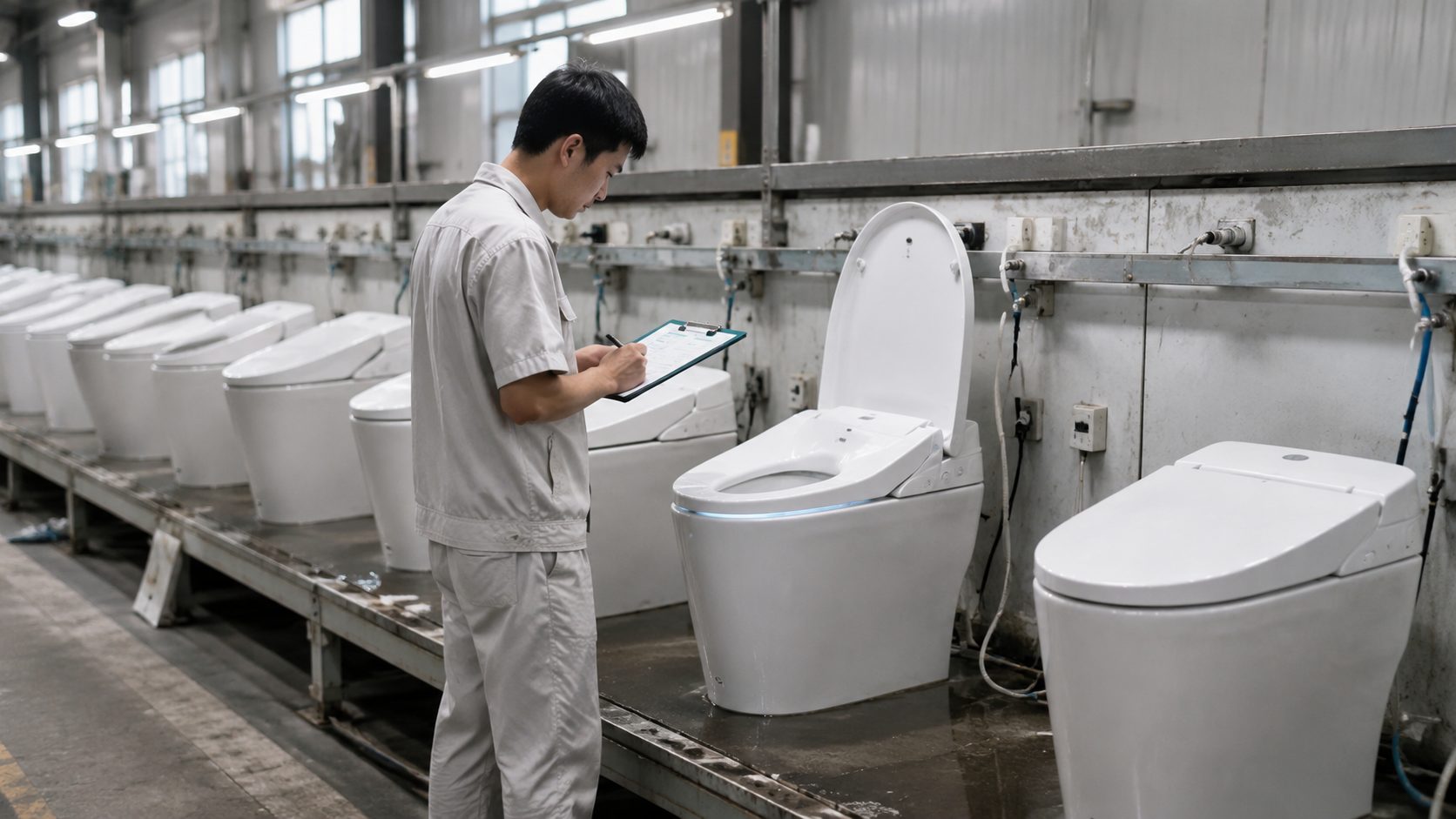
Agree separate AQL levels for cosmetic and functional defects, and treat third-party pre-shipment inspection as standard. Our guide to inspecting sanitary ware before shipment covers the ceramic half in detail.
07 AFTER THE SALE
Spare parts, warranty and container math
Order spare parts with the container, not after the first failure. A typical kit runs about 2–5% of order quantity: complete smart seats (or the electronics module, where an integrated model separates it), solenoid and inlet valves, filters, remotes, power boards and nozzles. Design after-sales around module replacement, not board-level repair, and get exploded diagrams and a basic troubleshooting guide for local staff — then ask the awkward question: how long will this model's parts stay in production? Factory warranty typically runs one to three years on electronics, supplied as replacement parts rather than on-site service, and longer on the ceramic body; the usual mechanics are photo or video fault evidence, then parts shipped free or credited to the next order. Agree freight terms for warranty parts in the contract — the importer carries local labour, so price it into margin.
On packaging, double-boxing with moulded foam is the export standard for a product that is fragile ceramic and sensitive electronics at once — drop-test the carton on samples. As indicative loading, one-piece toilets often run about 230–280 per 20GP and 500–600 per 40HQ; integrated smart units land lower with heavier packing, while smart seats alone load in the thousands. Have the factory run the load plan against your exact models.
08 THE BRIEF
What to send for an accurate quote
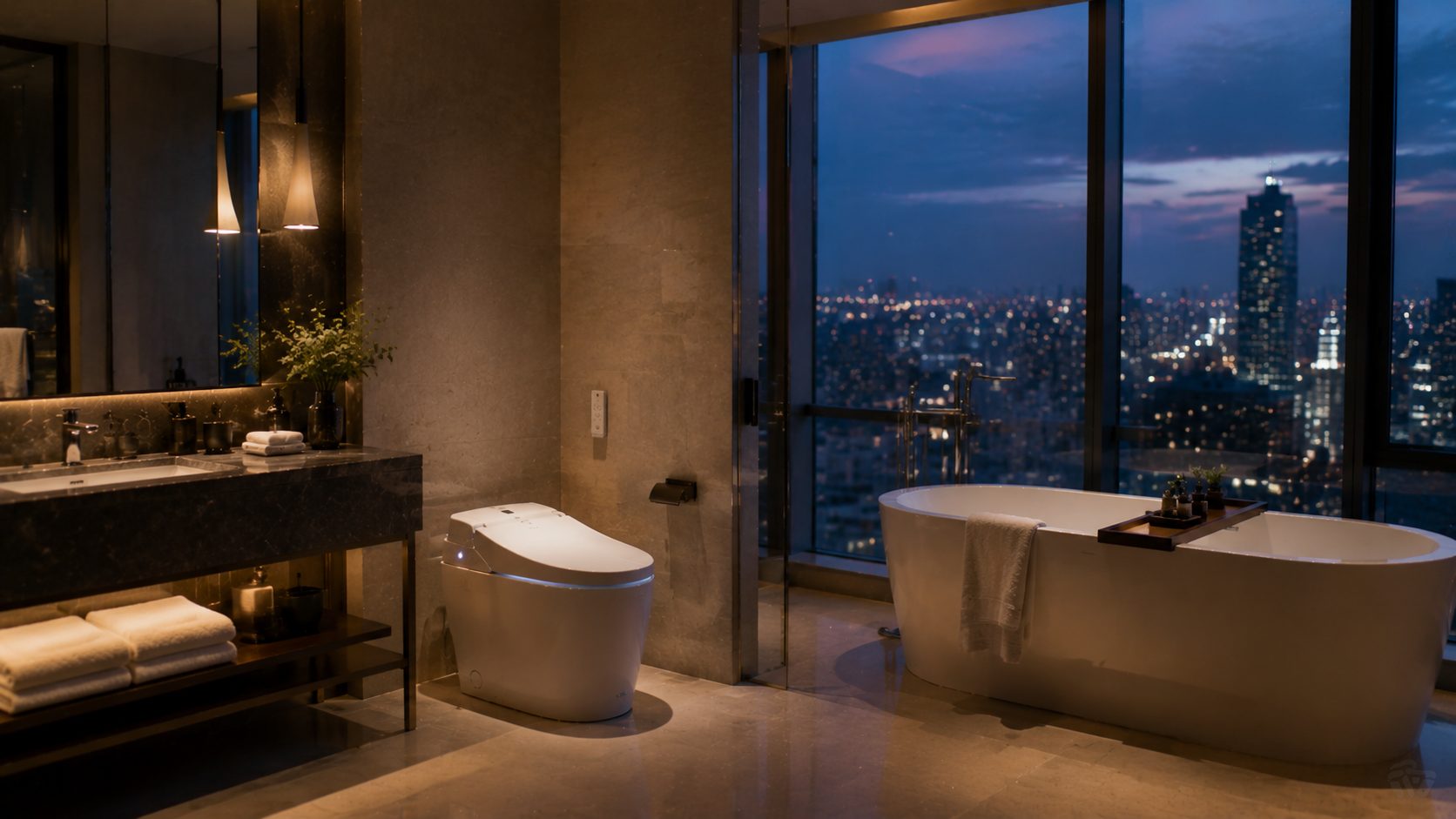
An accurate quotation starts with the destination, not the product. Send: target market with voltage, frequency and plug type; the local water pressure range — or a flag that low-pressure buildings exist, which decides tankless versus tank or pump; the function tier, split into must-have and nice-to-have; certification requirements, with a request for available test reports; quantities and order pattern (trial plus repeat) and neutral versus branded packaging; the rough-in standard (305 mm US, 300/400 mm variants, S-trap or P-trap where relevant); and your spare-parts and warranty expectations.
OEM customization — logo on seat and remote, box design, manual and firmware language, °C/°F defaults, plug and cord — follows the usual rules: stock models in neutral packing carry low MOQs, while custom firmware or tooling needs a larger commitment; our OEM/ODM guide explains how to brief it. Guangdong Chengda Intelligent Technology engineers smart toilets to the destination market — voltage, pressure, certification path — rather than shipping one universal SKU, alongside our ceramic toilets, basins and bathroom cabinets.
The suppliers worth keeping are the ones who ask about your voltage and water pressure before they show you a price.
FAQ COMMON QUESTIONS
Frequently asked questions
Are smart toilets from China reliable?
They can be — reliability tracks the factory's process more than the country of origin. What separates a dependable supplier is verifiable QC on the electronics, not just the ceramic: powered aging (burn-in) tests, seat and lid cycle tests, nozzle cycle tests, at least IPX4 splash protection on seat electronics, and a 100% live function check before packing. Ask for the inspection plan in writing, agree separate AQL levels for cosmetic and functional defects, and use a third-party pre-shipment inspection.
Do smart toilets work in low water pressure buildings?
Tankless direct-flush models usually do not — they typically need around 0.15–0.2 MPa of dynamic pressure and flush weakly on top floors, gravity-fed tanks and older mains. Built-in tank or pump-assisted models work at low pressure and are the safer default when destination plumbing is mixed or unknown, at the cost of slightly more bulk and one more serviceable part. Tell the factory your market's pressure range so the flushing system is matched before production.
What voltage do smart toilets use?
Whatever your market uses — but it must be fixed at order time. North America runs 110–120V/60Hz (Japan 100V); Europe, the UK, Australia, the Middle East and most of Asia and Africa run 220–240V/50Hz. Heating elements and control boards are voltage-specific and cannot be switched after production, and each voltage variant is effectively its own production batch. Confirm the plug type and cord length too, and note that North America expects a GFCI-protected outlet while Europe and the UK require RCD protection.
Integrated smart toilet or smart bidet seat — which should I import?
Decide by your after-sales reality. Integrated units carry the premium look hotels and upscale apartments pay for, but their parts are model-specific and a board failure may need a technician on site. A ceramic pan plus smart seat costs less, and a failed seat is replaced in minutes with basic tools — the ceramic never moves. If your market has no service network, seats or integrated models with removable electronics modules cut warranty cost sharply. Many importers run both: integrated for projects, seats for retail.
What certifications do smart toilets need for the US and EU markets?
For the EU, CE marking (LVD, EMC, RoHS) is the electrical baseline — it is self-declared against test reports, so ask to see the actual reports rather than a logo. For North America, UL or ETL listing covers electrical safety and is a genuine cost and lead-time item; verify listing numbers. Australia and New Zealand require WaterMark plus RCM. Certification support may vary by product and market, so request the available test reports for the specific model before ordering, and be wary of blanket certification claims.
What spare parts should I order with a smart toilet container?
Order them with the goods, not after the first failure. A typical kit is about 2–5% of order quantity: complete smart seats or electronics modules, solenoid and inlet valves, inline filters, remotes, power boards and nozzles — weighted toward filters and nozzles in hard-water markets. Also request exploded diagrams and a basic troubleshooting guide for local staff, confirm how long the model's parts will stay in production, and agree freight terms for warranty parts in the contract.