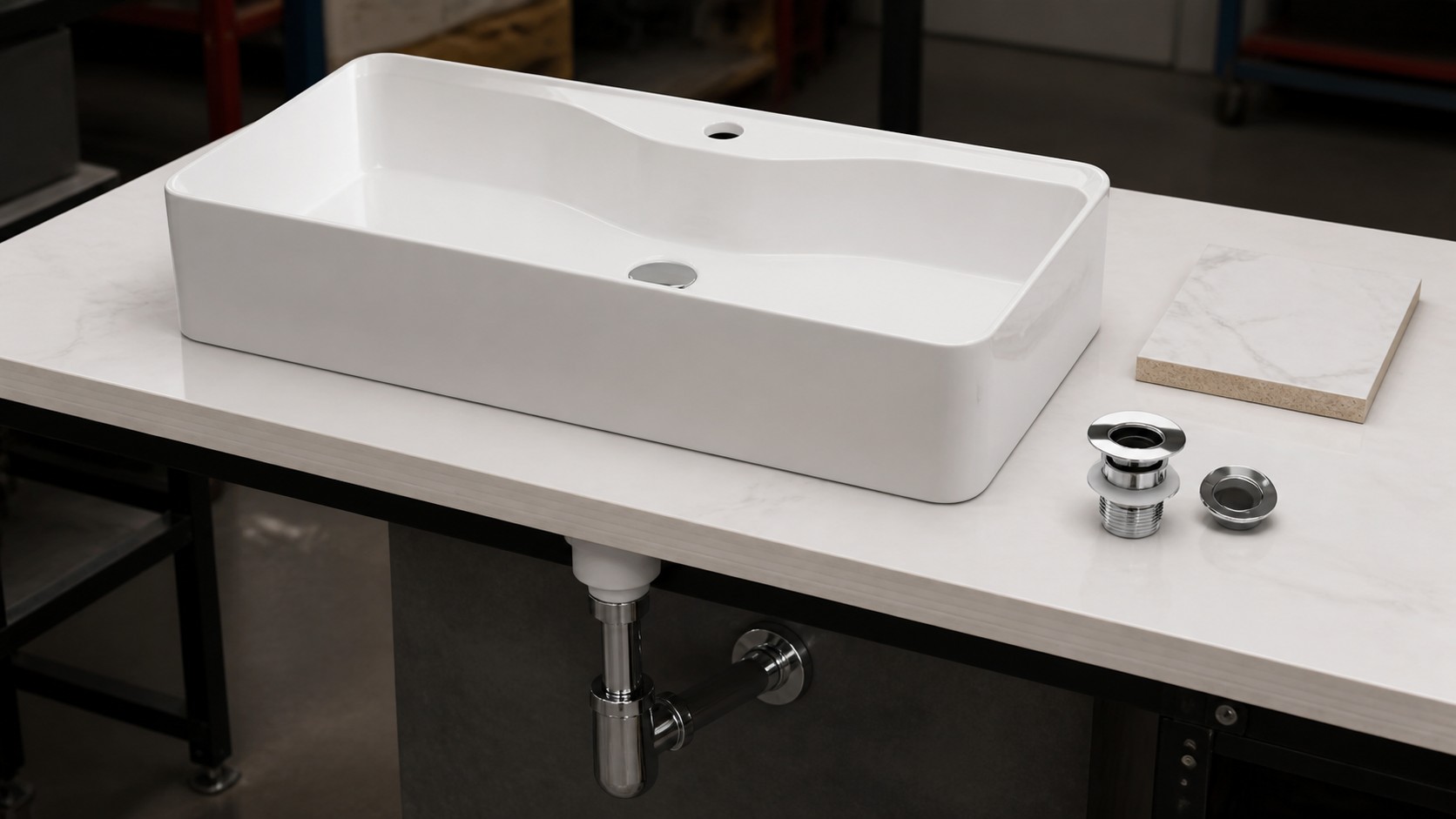
The question what size drain does a vessel sink need sounds simple because several interfaces are often described as “the drain size.” In reality, the ceramic opening, waste-body diameter, top flange, sealing surfaces, countertop passage, tailpiece and trap connection each have a different job. Overflow configuration adds another decision. This guide shows how to build a compatible chain without turning one product-page number into an unsupported universal answer.
Key takeaways
- Name the interface: basin hole, waste body, flange, counter hole and pipe connection are different.
- Match the overflow: use a drain designed for the selected basin's overflow or no-overflow path.
- Approve the actual parts: dry-fit and water-test the production-intent basin, drain, counter and trap.
01 START HERE
Which vessel sink drain dimension are you measuring?
Start with a labelled interface schedule. The ceramic opening is the hole through the basin. The waste-body outside diameter must pass through it while its flange and seals cover the correct surfaces. The countertop hole lets the installed body, gasket or mounting method pass through the top. The tailpiece then connects toward the trap, which connects to the building drainage. One catalogue phrase can refer to any of these points.
Do not convert a nominal pipe name into an exact hole-saw size, and do not assume a flange will cover an opening because the body passes through it. Threads, washers, overflow ports, wall thickness, counter thickness and service clearance all matter. Collect dimensioned drawings from the basin, drain and counter system, then mark each number against a physical interface before ordering.
02 BASIN DATA
What is the drain opening on a Chengda vessel sink?
The current audited Chengda A107-A134 and A209-A229 countertop product pages state a Ø45 mm ceramic drain opening for the models reviewed. That is a product-family field for those current pages, not a promise about every historical or future basin. It also does not by itself approve a third-party waste. Verify the selected model revision and sample with the controlled drawing before release.
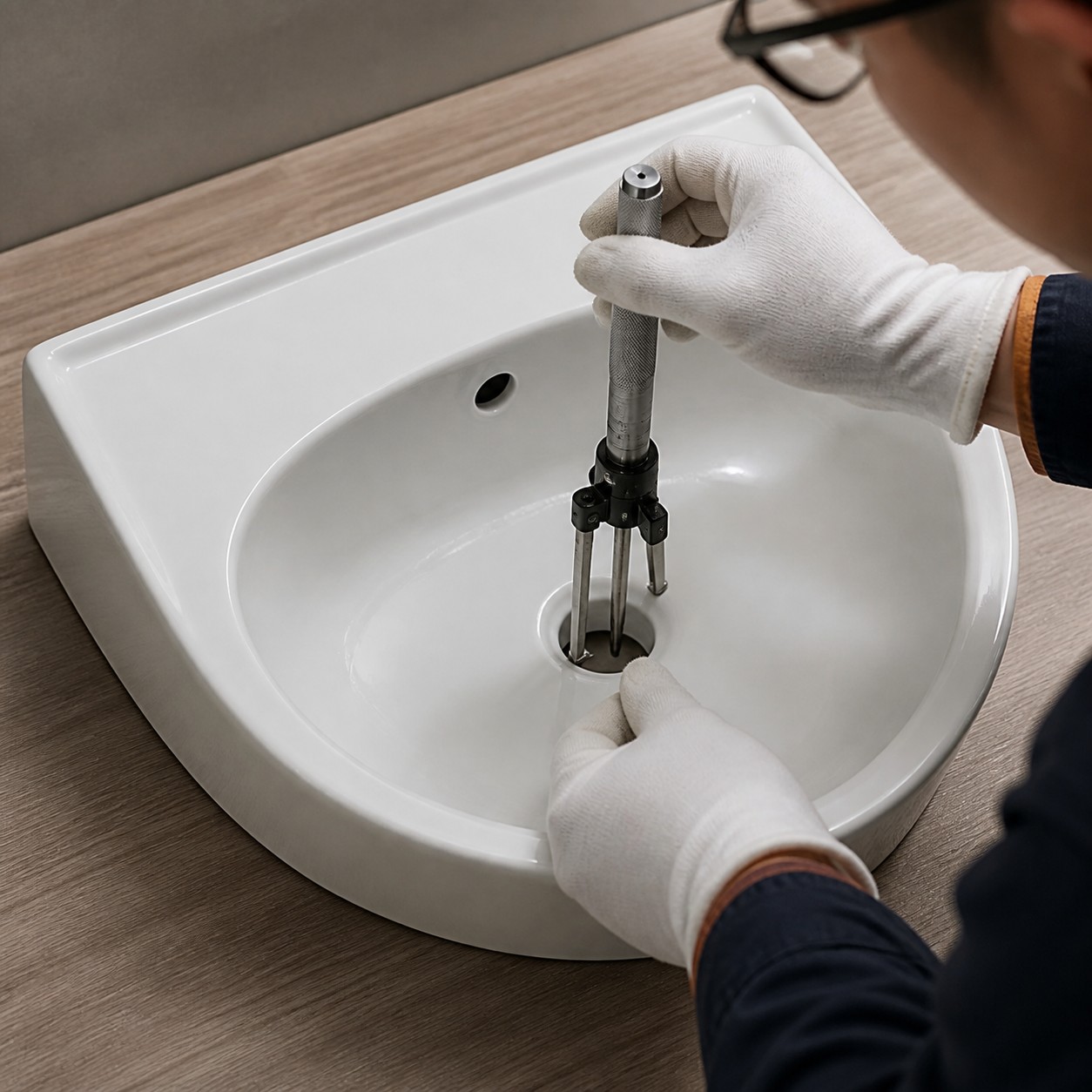
Measure the real ceramic correctly if an incoming inspection is required. Use an appropriate inside measuring tool or plug gauge at the defined reference points, protect the glaze and account for the stated tolerance. Do not place outside caliper jaws across the flange seat and call that the internal opening. Record whether the value is the narrowest clear passage, a nominal drawing diameter or another defined endpoint.
03 OVERFLOW MATCH
Does a vessel sink need a drain with or without overflow?
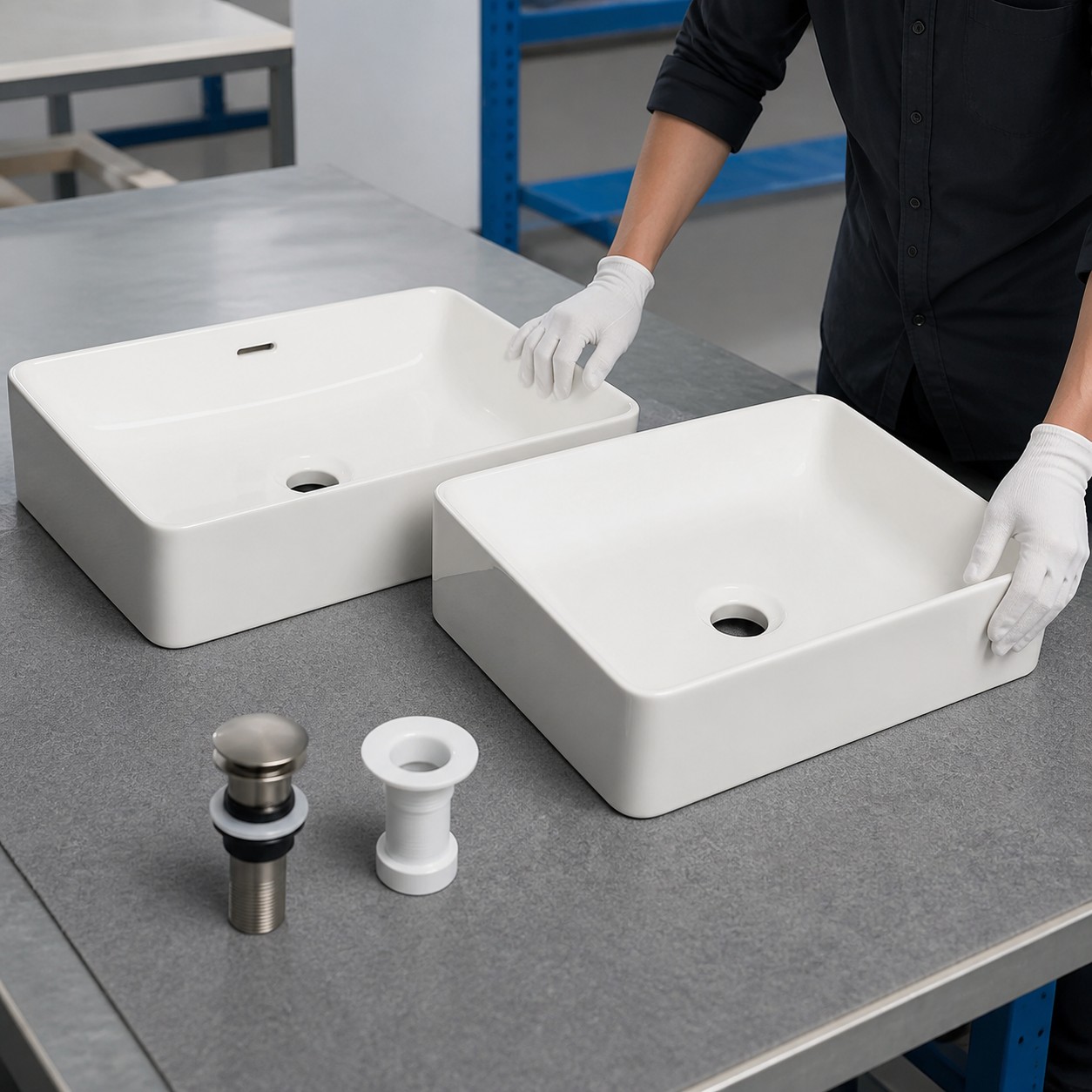
Match the drain to the basin. A basin without an overflow generally needs a waste designed for a no-overflow application, while an overflow basin needs a compatible body that accepts and conveys its internal overflow route. Official products from Ruvati, Westbrass and Novatto explicitly identify named drains for sinks without overflow, which demonstrates why the configuration is a purchase field, not an optional styling detail.
Current Chengda examples include no-overflow models such as A107 and A213, overflow models without a faucet hole such as A121 and A210, and models with both overflow and one faucet hole such as A216 and A219. The overflow inlet, hidden ceramic channel and waste ports must line up as designed. Never drill an overflow into finished ceramic or use a slotted body as evidence of compatibility without the supplier's approval.
04 POP-UP ASSEMBLY
Which pop-up drain dimensions must match the basin?
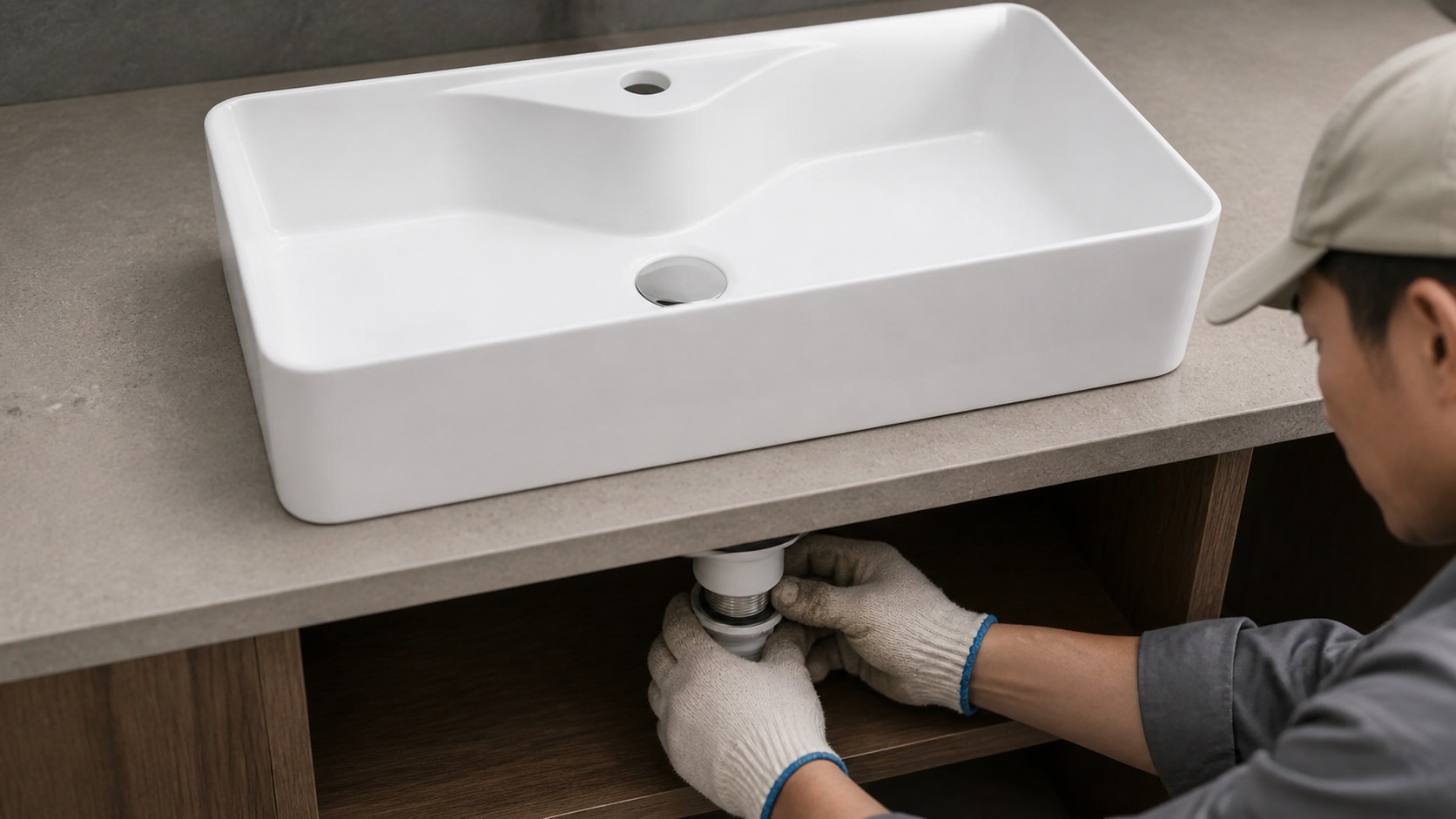
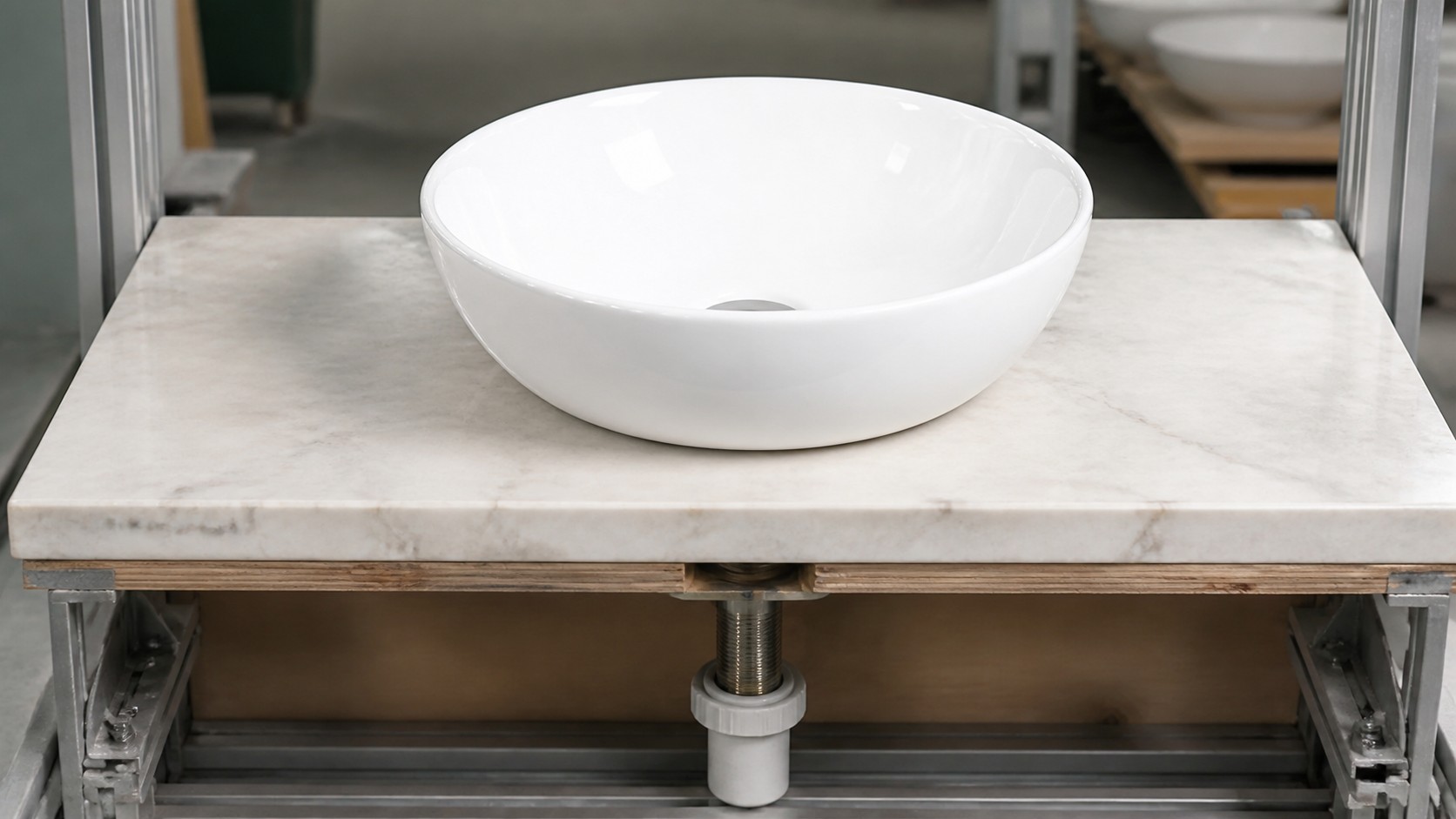
Check the waste-body passage through the ceramic, flange diameter and shape, sealing-seat geometry, thread length, washer range and nut access. If the basin sits above a thick counter, confirm that the complete assembly can pass through and tighten without running out of thread. The top flange must seat evenly without rocking on a curved or decorated surface, and the stopper must open enough for the intended flow.
Then check materials and finish compatibility, service method and replacement availability. A visually similar pop-up may use a different thread or gasket sequence. Use only the seals, compounds and tightening instructions approved by the fitting and basin makers. Overtightening to cure a mismatch can crack ceramic or distort a gasket; undertightening can leak. Compatibility is proven by the stated interface and test, not by force.
05 COUNTERTOP CUTOUT
Is the vessel sink countertop hole the same as the drain hole?
Not necessarily. The countertop passage may need to clear the drain body, a gasket, a mounting ring, the basin's recessed base or another model-specific support feature. Some vessel installations use a relatively small service passage; others use a different opening controlled by a template. The ceramic opening cannot safely specify the counter because it describes a different part.
Use the current basin installation template and the counter fabricator's approved method. Check printed template scale, centreline, edge distance, support and underside access. Dry-fit the exact drain through the uncut mock-up or a sacrificial sample where practical. The vessel sink installation guide explains why cutting should happen only after the basin, faucet, waste and cabinet have been coordinated.
06 SUPPORT METHOD
Does every vessel sink drain need a mounting ring?
No. A mounting ring may support or finish the interface for a drain-and-basin system designed to use it; Novatto, for example, sells a named no-overflow pop-up drain packaged with a mounting ring. Other basin models sit on a designed ceramic base, use a different support detail or receive model-specific fastening. A ring is therefore not a universal accessory or a remedy for an unstable product.
Follow the selected basin and drain instructions. Adding an unapproved ring changes finished height, contact geometry, sealant location and possibly the thread engagement below. Removing a required ring can concentrate load or leave an unfinished junction. If the documentation is unclear, obtain a section drawing and written confirmation, then prove the assembly on the actual counter sample.
07 PIPE & TEST
How do you connect and test the vessel sink drain system?
Connect the tailpiece to the specified trap adapter and building drain without using the pipe to pull the waste into alignment. Maintain the required water seal, fall, venting and service access under applicable plumbing rules. Cabinet drawers and shelves must clear the complete trap, and pipework should be supported independently. The basin overflow guide explains the upstream overflow decision; downstream pipe coordination still follows the approved project plumbing design.
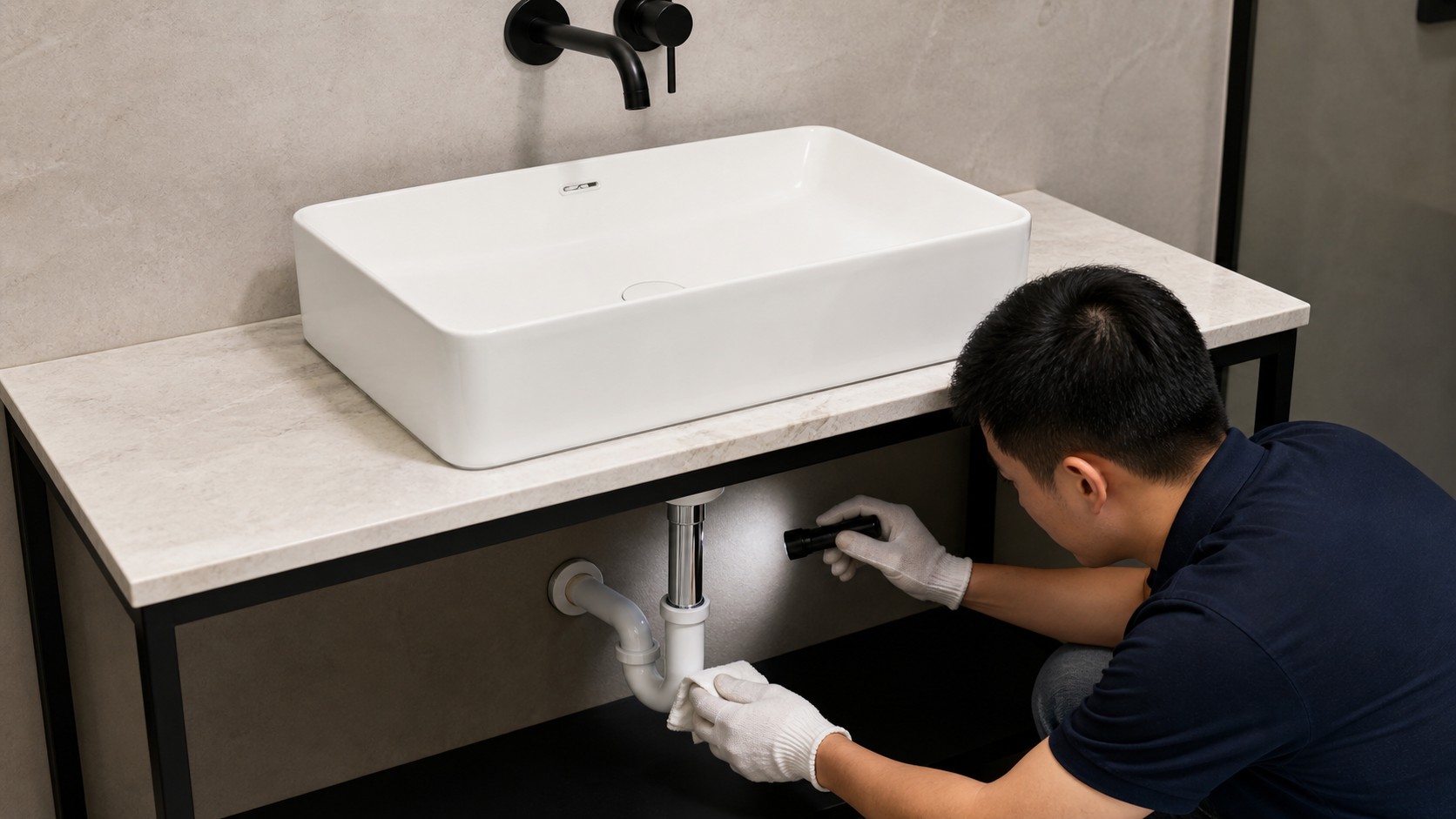
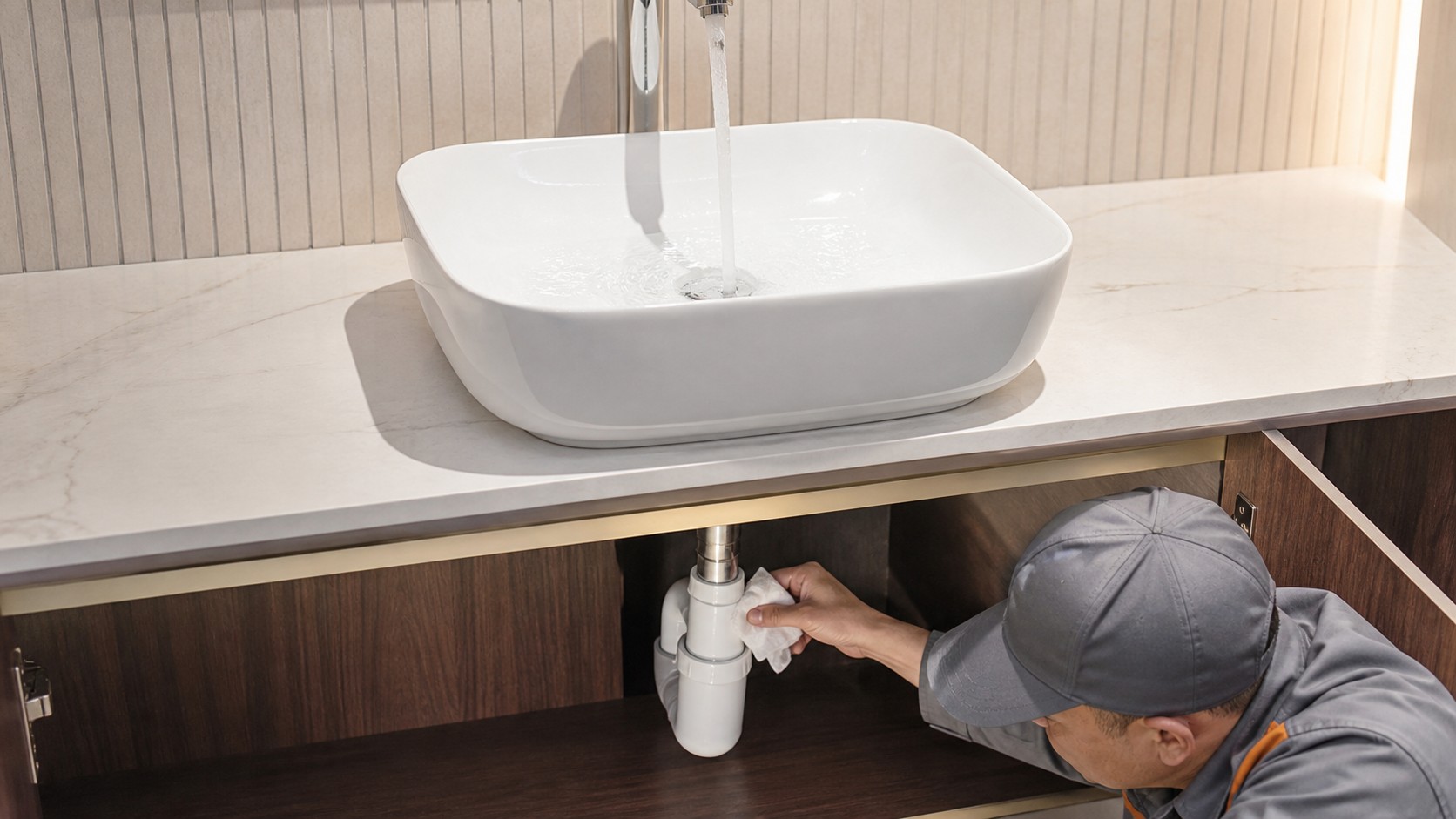
Test the assembly in stages. With dry surfaces and tissue at each joint, run low then normal flow, operate the stopper repeatedly and observe drainage. Where the basin has an overflow, perform only the controlled test permitted by the instructions and never leave filling water unattended. Inspect the flange, basin underside, counter passage, waste nut, tailpiece and trap immediately and again after standing.
08 PURCHASE CONTROL
What should a vessel sink drain schedule contain?
For every approved basin, record model and revision, ceramic-opening definition, overflow configuration, waste manufacturer and model, flange finish, installation components, countertop template, tailpiece and downstream connection. Attach the current drawings and a photograph of the working signed sample. Do not list only “standard pop-up,” because that phrase cannot control the interfaces or overflow path.
For import and development projects, order enough production-intent drains for sampling before mass basin release. Check carton allocation, spare quantities, finish consistency and replacement availability. Incoming inspection can verify the critical named interfaces using agreed gauges. The safest answer to vessel sink drain size is therefore a controlled assembly record: it tells each supplier exactly which dimension belongs to which part and proves that the chain stays dry.
FAQ COMMON QUESTIONS
Frequently asked questions
What size pop-up drain fits a vessel sink?
Choose from the exact basin opening, overflow configuration, flange seat, counter thickness and downstream connection; confirm with drawings and a dry fit.
Do Chengda vessel sinks have a 45 mm drain opening?
The current audited A107-A134 and A209-A229 countertop pages state Ø45 mm for their ceramic opening. Verify the selected model revision and sample.
Can I use a drain with overflow on a sink without overflow?
Do not assume so. Use a drain explicitly approved for the selected no-overflow basin and its sealing arrangement.
Is the countertop cutout also 45 mm?
Not automatically. The counter hole is controlled by the model-specific installation and may need to clear other components or support geometry.
Does every vessel sink need a mounting ring?
No. Use one only when the selected basin-and-drain system specifies it.
Why does my vessel sink drain leak?
Possible causes include wrong overflow type, mismatched flange or seals, poor seating, damaged parts, incorrect assembly, side load, over- or undertightening. Stop use and inspect the exact interface.