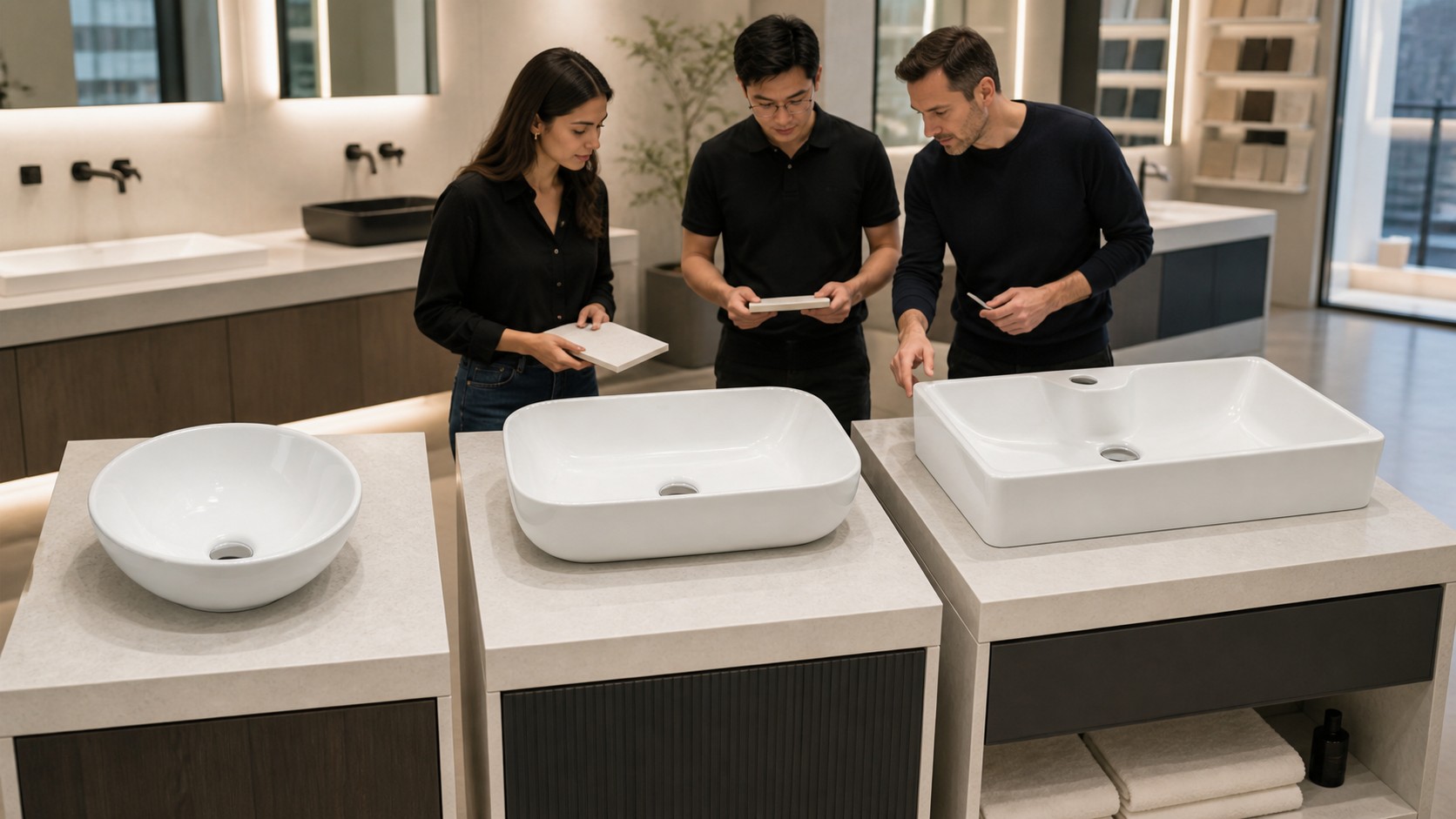
Searches for vessel sink dimensions usually start with one question: what is the standard size? The useful answer is that there is no single standard vessel sink size. Above-counter basins vary by shape, overall length, front-to-back width, height, internal bowl geometry and mounting footprint. This guide turns those variables into a repeatable sizing method for homeowners, project designers, vanity suppliers and importers.
Key takeaways
- No universal size: compare the exact model drawing and sample.
- Fit the whole assembly: basin, faucet, counter, cabinet, waste and user height must work together.
- Use real ranges: Chengda's current examples span compact 280 mm round bowls to a 700 mm rectangular model.
01 SIZE LOGIC
Is there a standard vessel sink size?
There is no code or industry rule that makes every vessel sink one standard length, width or height. Retail filters often group products into broad size bands, but manufacturers publish model-specific dimensions. American Standard, for example, separates nominal outside dimensions from bowl size, while Kohler publishes outside size, bowl area, bowl depth, water depth and an installation template as distinct fields. Treat a search result range as a shortlist, not a cutting instruction.
Start by naming every dimension. Overall length is side to side, overall width is front to back, and overall height is the exterior top-to-bottom envelope. Internal bowl length, bowl width and bowl depth use different endpoints. The base footprint or counter contact area may be much smaller than the rim. A product can therefore fit the vanity envelope but still fail at the faucet, drain, mounting or cleaning clearance.
02 MEASUREMENT
How should vessel sink length, width and height be measured?
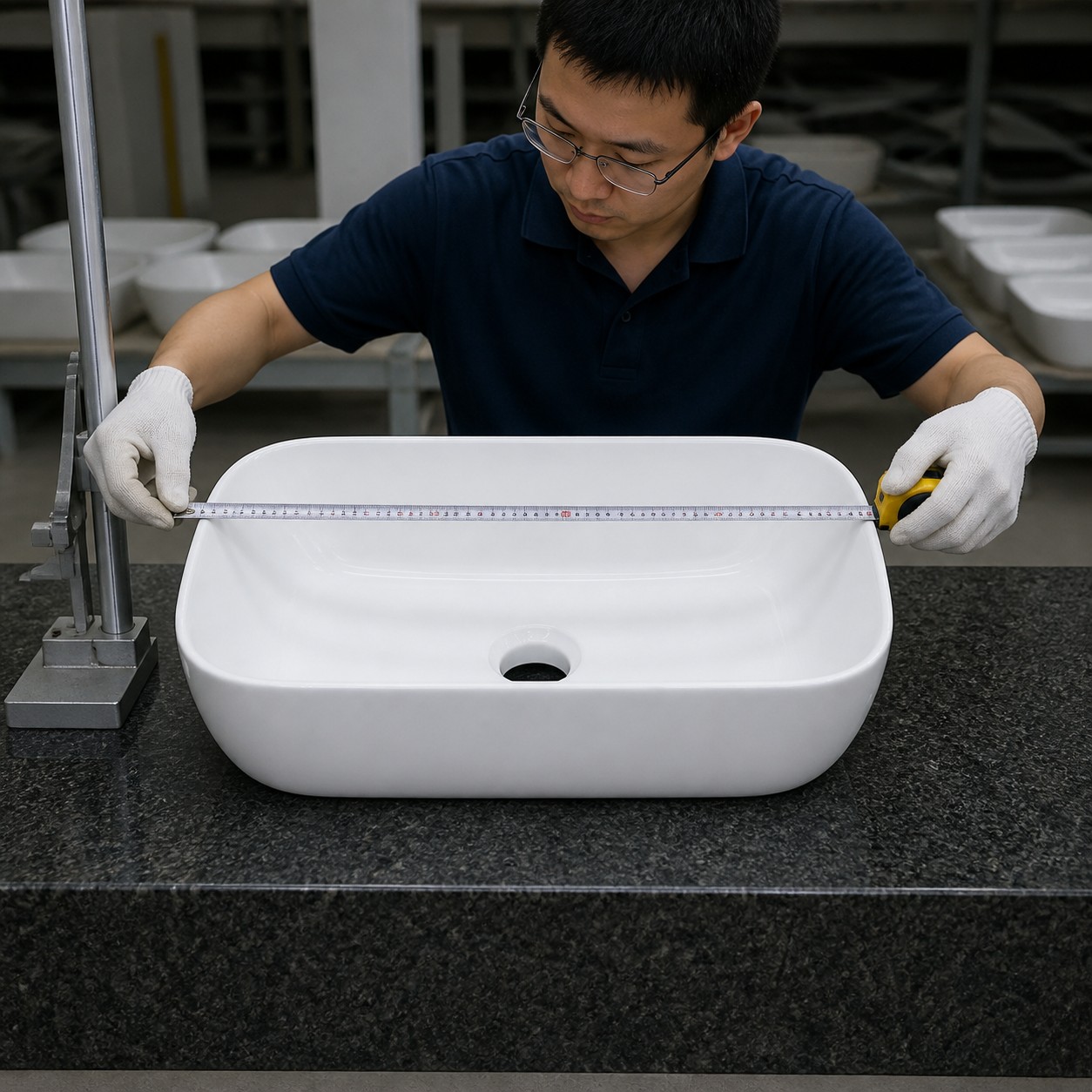
Read the current drawing in plan, front and side views, then verify the sample in the same orientation. Record the maximum ceramic envelope, including any rear faucet deck or asymmetrical projection. Do not rotate length and width merely because the basin looks nearly round or square. On an irregular sculpted basin, specify the reference axes and the points used for measurement so the vanity supplier and factory measure the same object.
Overall height is not internal bowl depth. Chengda A117 is listed at 510 × 340 × 110 mm overall, while A125 is 450 × 300 × 180 mm overall; those heights describe the external products, not a verified comparison of usable water depth. If splash capacity or hand space matters, request the internal section, overflow level where present and a real water test instead of subtracting wall thickness from the outside dimensions.
03 VANITY FIT
How do you match vessel sink dimensions to a vanity?
Place the actual basin outline on the intended countertop. Check front and rear margins, side counter space, backsplash, mirror line, wall-mounted or deck-mounted faucet position, and the path for cleaning around the base. A basin that physically fits a 400 mm-deep top may leave no usable faucet deck or may push the user's hands too close to the front edge. The final choice is a plan-layout decision, not a catalogue-width decision.
Look below the counter as well. Align the ceramic drain opening with the countertop hole, tailpiece, trap and cabinet service zone. Protect drawer runners and shelves from the waste path and allow tools to reach the drain nut. Then calculate finished counter-to-rim height using the method in the countertop basin height and faucet guide. Cabinet width, cabinet depth and cabinet height solve different problems.
04 COMPACT MODELS
What vessel sink sizes work on small vanities?
Compact does not mean one fixed number. Chengda's current range includes A225 at 280 × 280 × 120 mm, A132 at 300 × 300 × 115 mm and A120 at 370 × 240 × 120 mm. The first is round, the second square and the third rectangular. Each uses space differently: a round bowl needs radial clearance, a square bowl brings corners closer to surrounding objects, and a narrow rectangle can preserve front-to-back room.
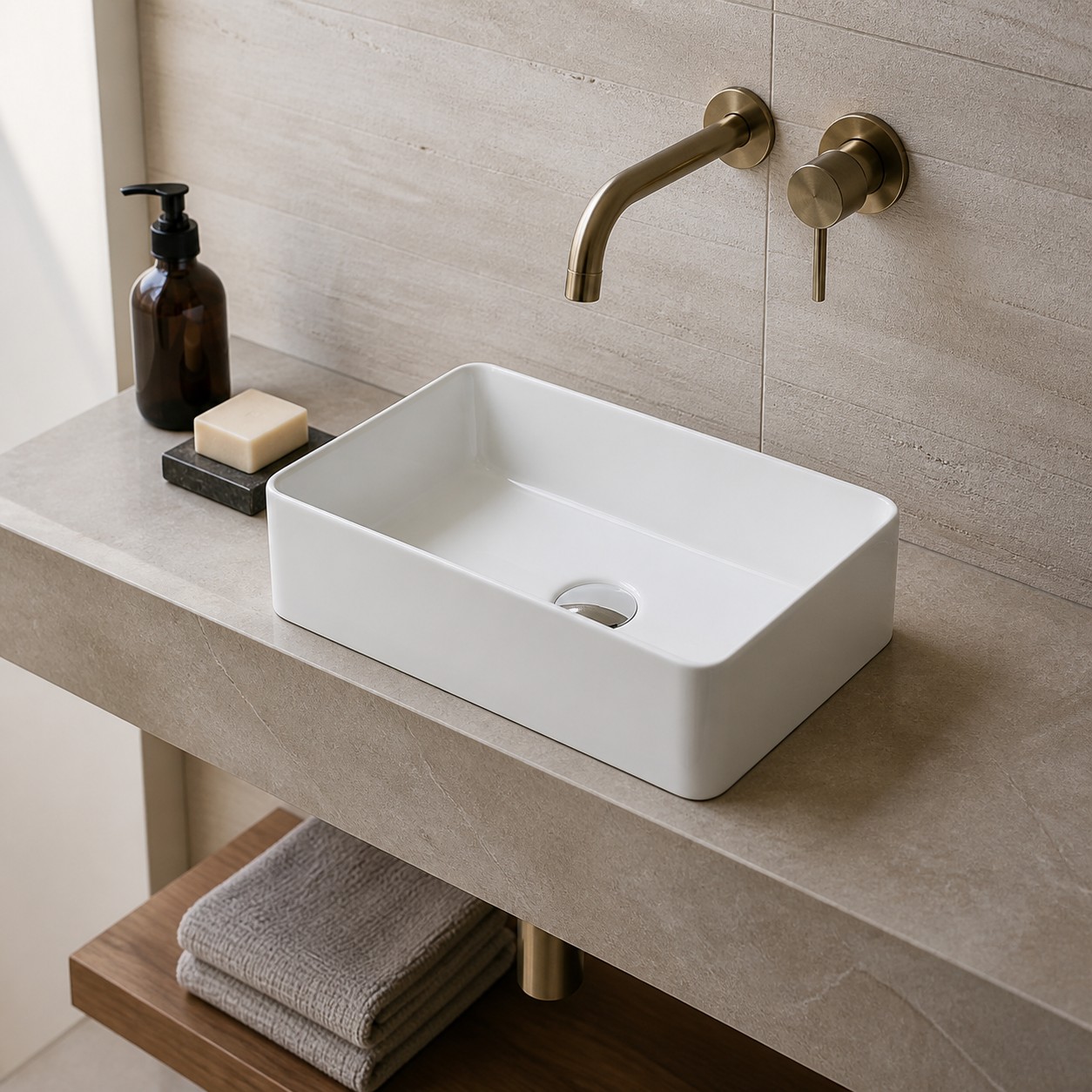
For a powder room or narrow counter, test hand-washing space rather than choosing the smallest outside dimensions automatically. Confirm faucet reach, stream landing, soap position, counter splash protection and the user's ability to approach the rim. Link the selected model to the room plan in the powder room sink guide, then build one full-size mock-up before repeating it across apartments or hotel rooms.
05 RANGE PLANNING
When does a medium or large vessel sink make sense?
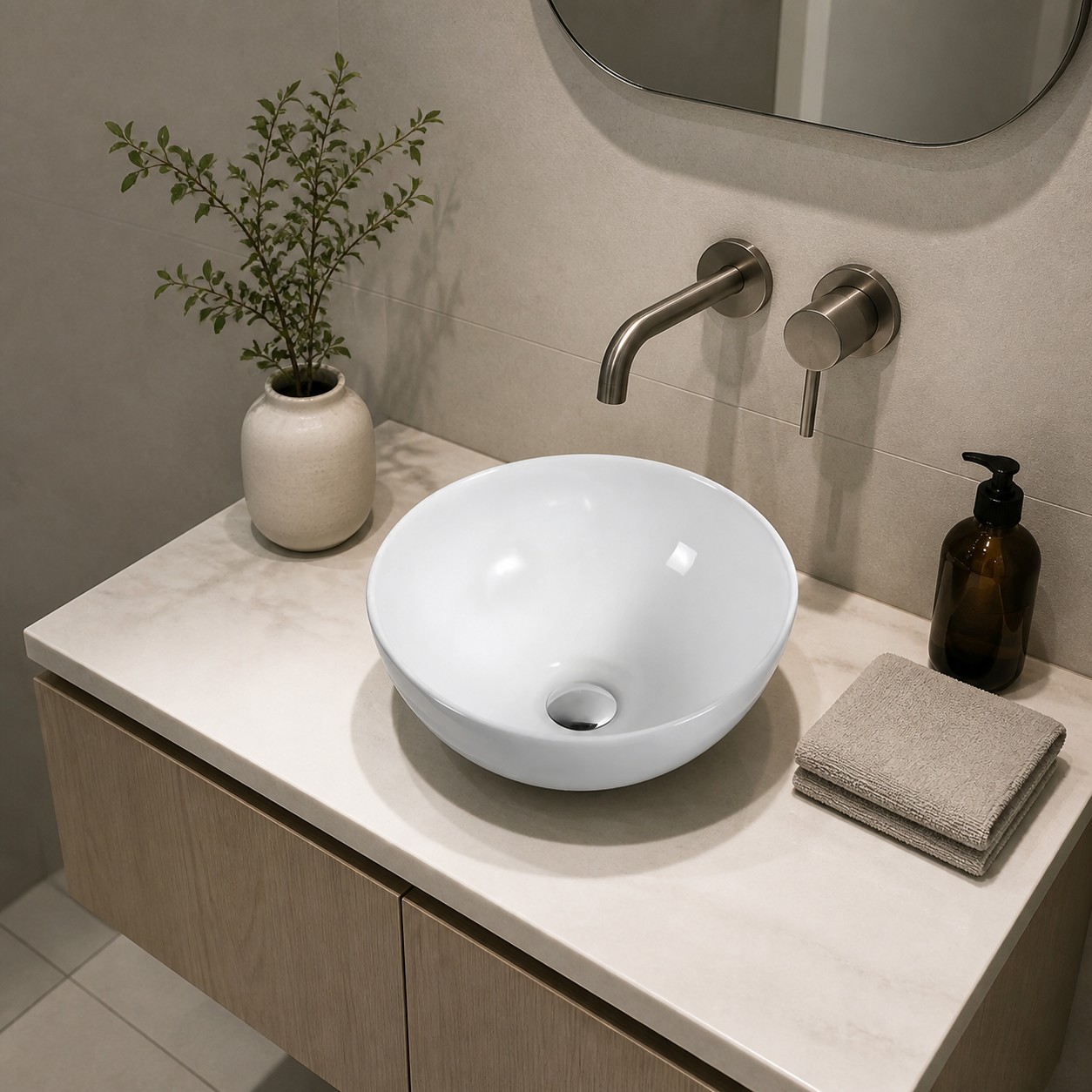
Medium rectangular examples such as A107 at 455 × 320 × 135 mm and A209 at 480 × 345 × 135 mm suit many single-vanity concepts, but the surrounding counter and faucet still control usability. At the larger end, A126 is listed at 700 × 400 × 140 mm and includes a faucet hole, while the oval A228 is 600 × 420 × 140 mm without a faucet hole. Similar width does not mean the same installation package.
A larger basin can give more hand space and stronger visual presence, yet it also consumes countertop area, changes carton size and weight distribution, and may require a deeper or wider vanity. Review handling through doors and lifts, counter support, packaging, pallet pattern and replacement access. For project procurement, compare usable function per room—not simply the most ceramic for the price.
06 SHAPE
How does bowl shape change the size decision?
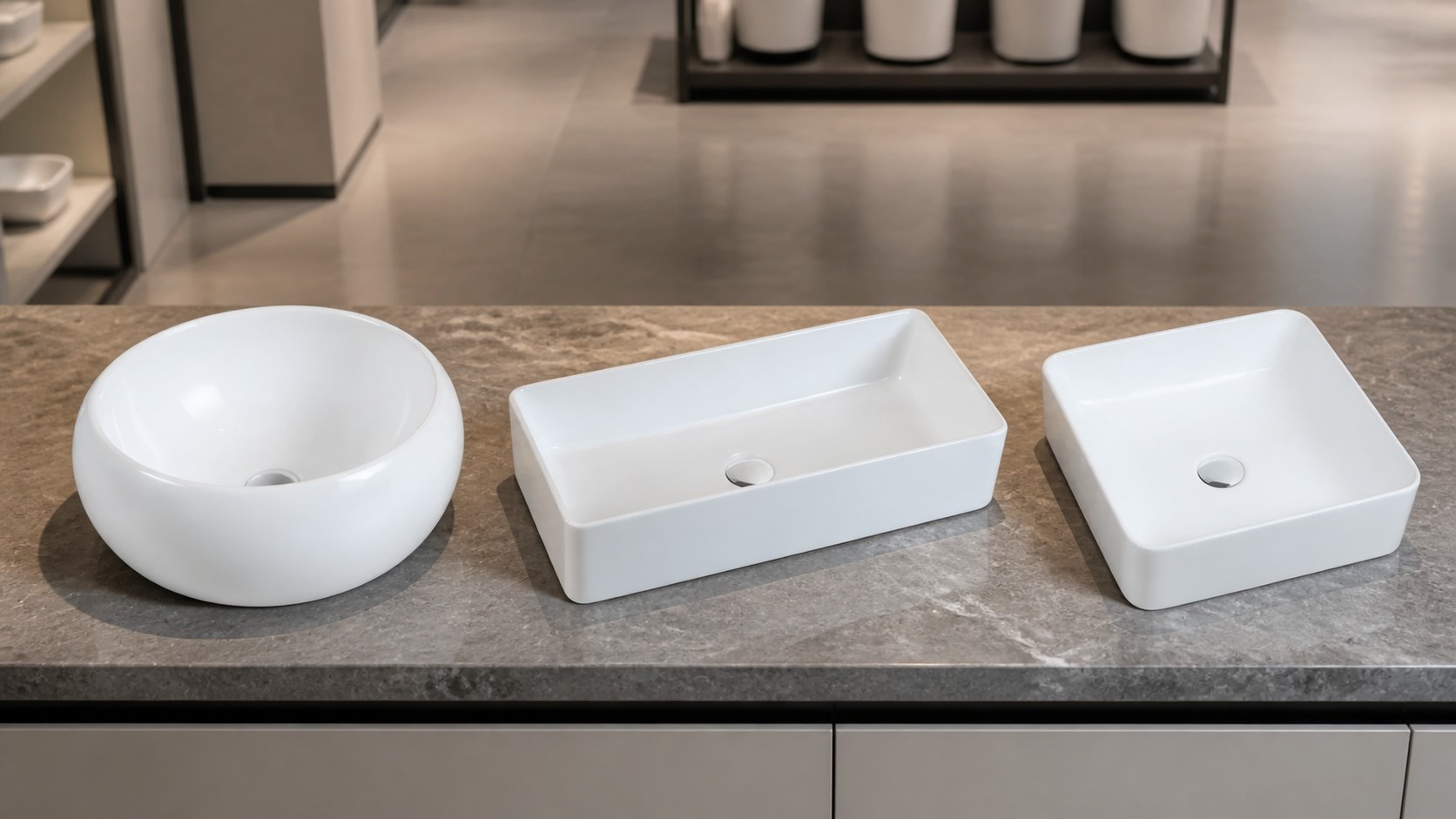
Round, rectangular, oval, square and special-shape vessel sinks use the same nominal footprint differently. Round bowls such as A213 keep corners away from the user but may project further at the centre. Long rectangles such as A115 preserve a narrow 240 mm front-to-back envelope. A134 uses a special sculpted plan, so its maximum 400 × 350 mm envelope alone cannot describe every wall and faucet clearance.
Shape also changes where hands enter, where a faucet stream meets the bowl and how easily the counter-base junction can be wiped. That does not make one shape universally better. Use the round versus square basin comparison as a starting point, then test the exact vessel model with the specified faucet and user task.
07 B2B SELECTION
How should buyers build a vessel sink size range?
A commercial range should cover clear use cases instead of collecting near-duplicate dimensions. One compact powder-room model, one narrow rectangle, one mainstream medium bowl, one larger statement basin and selected faucet-hole or overflow options create a more intelligible assortment. Record the model, revision, overall L × W × H, shape, hole arrangement, current drawing and actual sample in one controlled matrix.
For hotels and apartments, standardisation has value: repeated vanity drilling, faucet position, trap routing and spare stock become easier when many rooms share a controlled interface. Retail importers may need more visual variety, but cartons, display depth and replacement compatibility still matter. Ask the factory which geometry is shared and which is model-specific; never assume similar-looking bowls use the same base footprint.
08 FINAL APPROVAL
What should be approved before ordering a vessel sink size?
Release the order only when the current product drawing, actual ceramic sample, countertop layout, faucet specification, waste assembly and cabinet service zone agree. Confirm which dimensions are nominal, which tolerances the supplier controls, whether a model has a faucet hole or overflow, and which template controls the counter. The bathroom sink specification guide explains why overall size cannot replace cutout or bowl data.
Photograph the signed sample on the intended vanity, record stream landing and drainage, and retain the approved carton and label. Chengda's new 280-700 mm countertop range gives buyers many starting points, but the best vessel sink size is the one proven as a complete installation—not the number most often repeated in a generic size chart.

FAQ COMMON QUESTIONS
Frequently asked questions
What is the standard size of a vessel sink?
There is no single standard. Current products vary widely by shape and use; compare the exact model's overall dimensions, bowl geometry, footprint and template.
How wide should a vanity be for a vessel sink?
Wide enough for the complete basin outline, side margins, faucet or wall clearance, counter use and cabinet structure. Verify with a full-size layout rather than a fixed rule.
Is vessel sink height the same as bowl depth?
No. Overall height is the exterior envelope; internal bowl depth and usable water depth need separate stated endpoints.
What is a good small vessel sink size?
Chengda examples include 280 mm round and 300 mm square models, but faucet reach, user hand space and counter margins must still be mocked up.
Can two vessel sinks with the same width use the same cutout?
Not necessarily. Base footprint, drain location and mounting instructions are model-specific; use the current template or approved drawing.
Should I choose the largest vessel sink that fits?
No. Balance washing space against counter area, faucet position, cabinet services, handling, cleaning and room circulation.