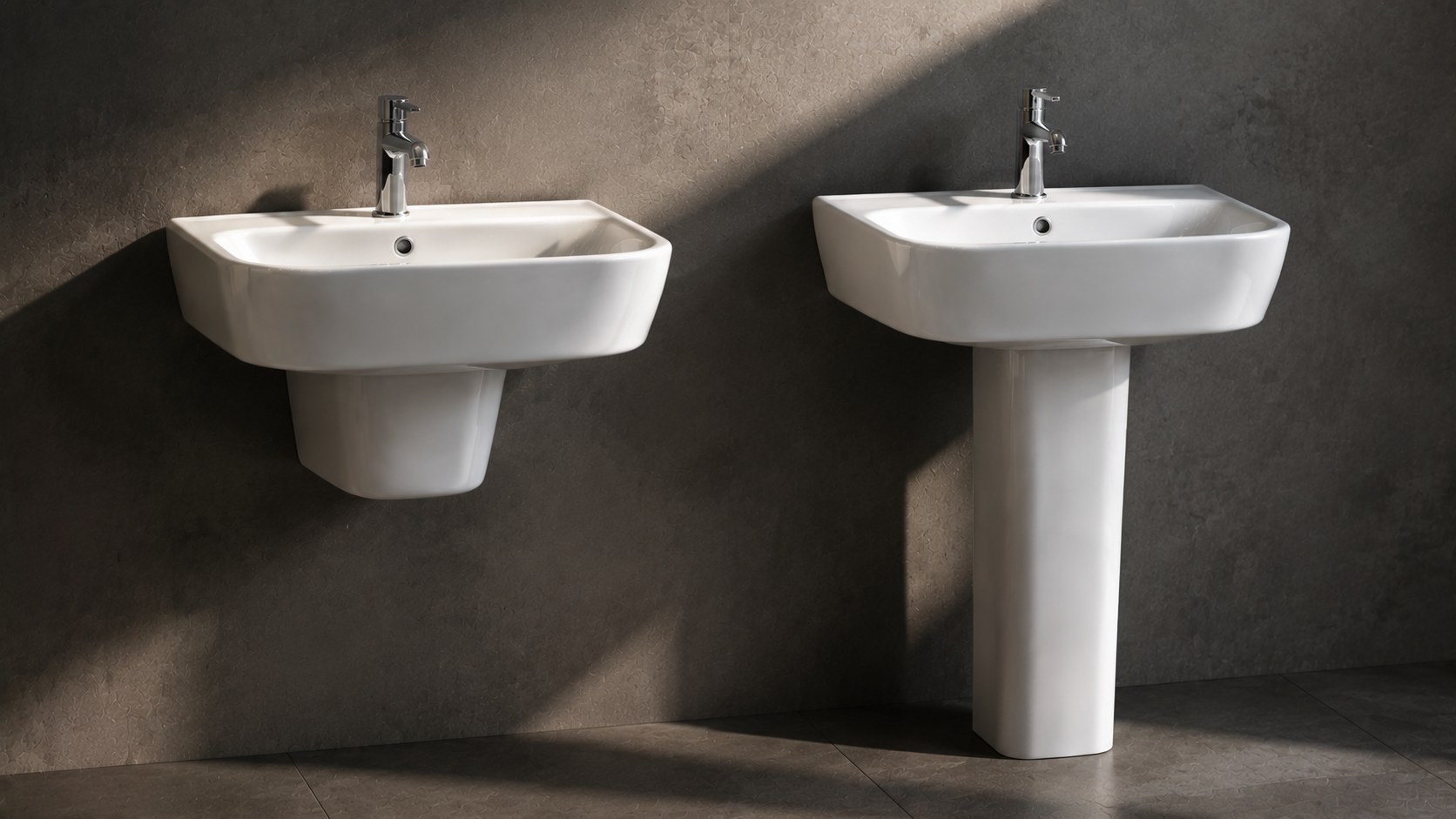
Ask ten buyers to settle the wall hung basin vs pedestal basin question and you will get two camps, both convinced. The truth is less dramatic: neither type is simply "better." A wall hung basin frees the floor and reads modern; a pedestal basin hides its plumbing and installs on almost any wall. Which one wins depends on the wall behind it, the floor space in front of it, and the kind of project you are fitting out.
Key takeaways
- Wall hung wins on space and cleaning — it floats off the floor, so it suits small bathrooms and mopping is easy, and the mounting height can be set to suit the user.
- Pedestal wins on simplicity and cost — the ceramic column hides the trap and shares weight to the floor, so it needs no reinforced wall or in-wall frame.
- The wall decides more than the style — a wall hung basin needs solid masonry or a braced carrier frame; get that wrong and it is the number-one failure point.
01 SIDE BY SIDE
Wall hung basin vs pedestal basin: quick comparison
Here is the practical picture before we get into the detail. Both are the same vitreous-ceramic bowl at heart; what differs is how they mount, where the pipes go, and what the wall and floor have to provide.
Wall hung vs pedestal at a glance
| Factor | Wall hung basin | Pedestal basin |
|---|---|---|
| Mounting | Bolted to wall, floats, no floor contact | Basin on a ceramic column standing on the floor |
| Trap / plumbing | Concealed in wall cavity or behind bowl | Hidden inside the pedestal column |
| Floor space & cleaning | Open floor below — easy to mop, feels larger | Occupies a footprint; base collects dust |
| Wall / support needs | Solid masonry or braced carrier frame required | No special wall — column shares load to floor |
| Height | Set on site to suit the user | Fixed by the column height |
| Style | Modern, minimalist, floating look | Classic, traditional, symmetrical |
| Installed cost | Higher once frame / reinforcement is added | Generally lower, no extra building work |
| Best-fit projects | Small bathrooms, hotels, public washrooms | Homes, mid-range hotels, retrofits |
02 PEDESTAL
What is a pedestal basin?
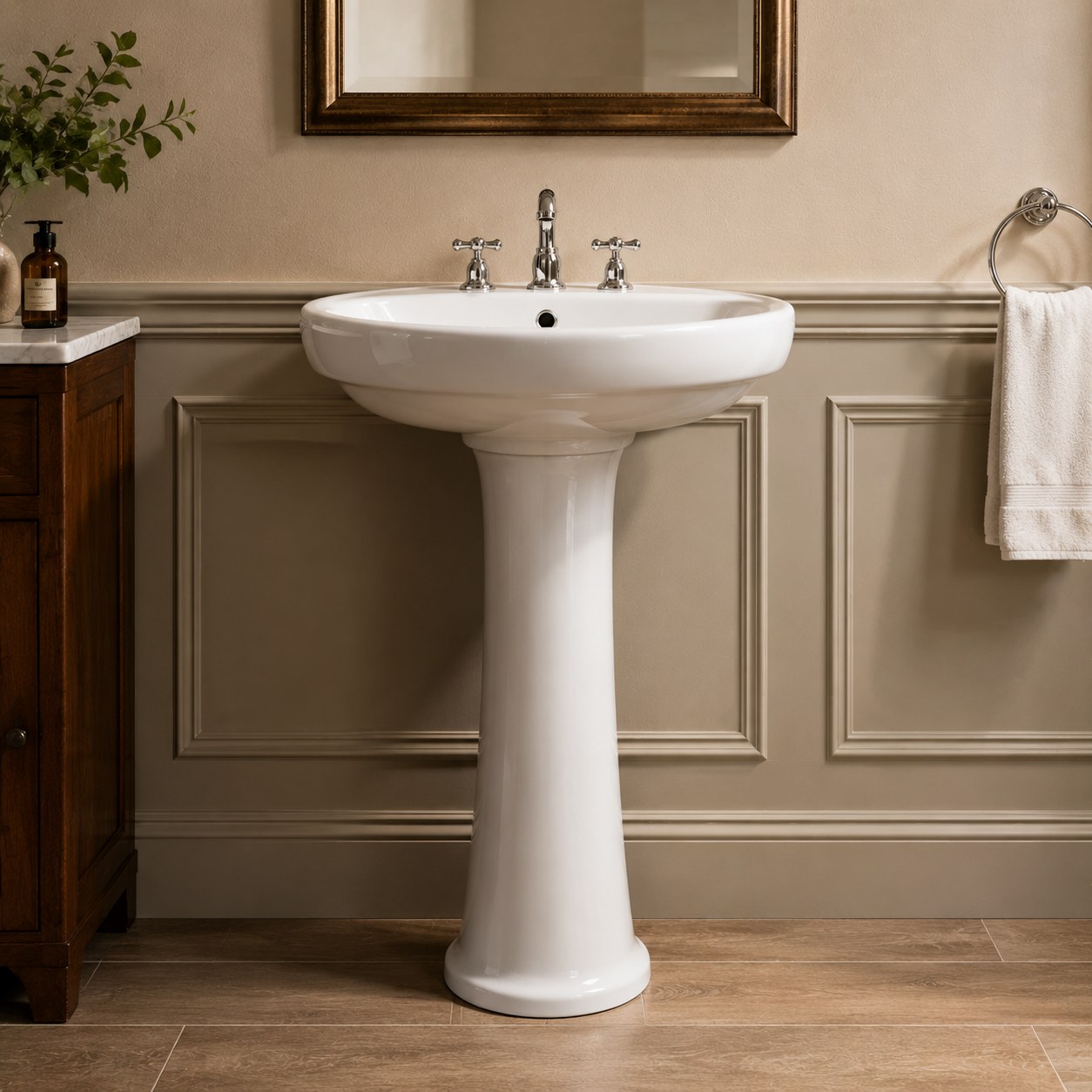
A pedestal basin (or pedestal wash basin) is a two-piece fixture: the basin bowl plus a ceramic column — the pedestal — that stands on the floor beneath it. The bowl is bolted to the wall for stability, while the column locates under it and does two jobs at once. First, it hides the P-trap and the supply and drain pipes running down to the floor, giving a tidy finish with no in-wall plumbing work. Second, it shares the basin's weight down to the floor, easing the load on the wall fixing.
That combination is why pedestal basins remain a default across so many markets. They install on almost any wall, conceal the plumbing at low cost, and carry a familiar, symmetrical look that suits traditional and transitional bathrooms. The trade-off is that the column takes up a floor footprint, the height is fixed by the column, and the base is one more edge to clean around.
03 WALL HUNG
What is a wall hung basin?
A wall hung basin — also called a wall mounted basin or wall hung wash basin — fixes directly to the wall with concealed brackets or threaded bolts anchored into the structure, so the basin appears to float with nothing beneath it. The trap and supply lines are hidden inside the wall cavity (with an in-wall frame) or tucked discreetly behind the bowl. The result is a clean, uninterrupted line and open floor, which is exactly why the look reads modern and high-end.
Because there is no column, everything the pedestal did for you must now come from the wall: it carries the entire load and it houses the plumbing. That means a solid masonry wall or, behind a stud partition, a braced steel carrier frame. The upside is real flexibility — the rim height is chosen on site, so it can be set for comfort, for children, or for accessible/step-free use.
The pedestal leans on the floor; the wall hung basin leans entirely on the wall — so specify the wall first, the basin second.
04 SPACE & HYGIENE
Floor space, small bathrooms and cleaning
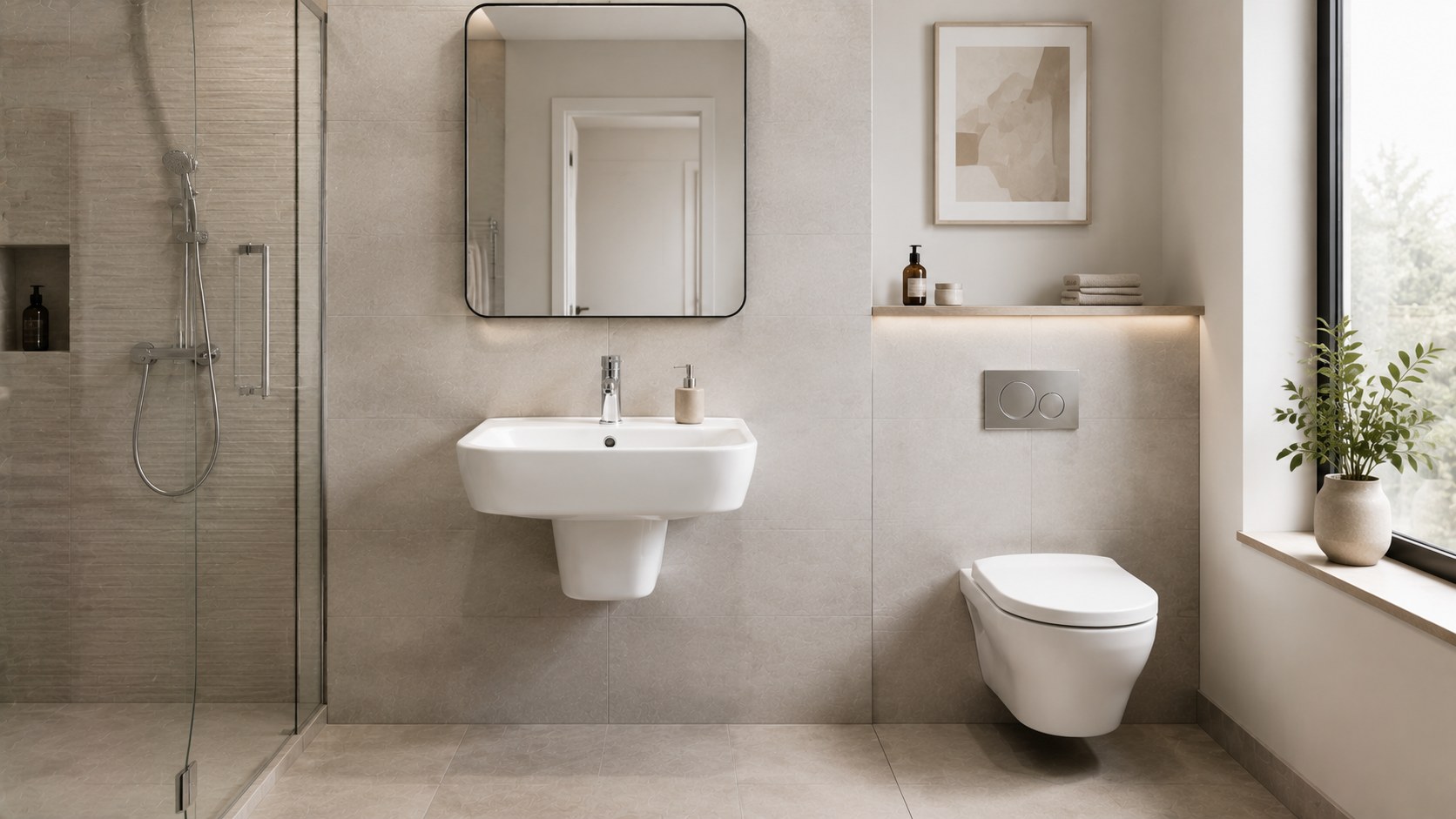
This is the decision driver for most buyers, so lead with it. A wall hung basin clears the floor entirely, which does two things: it makes a small bathroom or powder room feel larger and less boxed-in, and it lets a cleaner run a mop straight underneath with nothing to work around. For compact apartments and en-suites, that open floor is often the whole reason the fixture is specified — it is one of the strongest reasons wall hung is called the best basin for a small bathroom.
A pedestal basin, by contrast, occupies a floor footprint and puts a column base right where dust and mop water collect, so cleaning means working around the base rather than under it. Neither type offers much storage on its own — both are storage-poor compared with a vanity — but the wall hung leaves the space below open for a shelf, a towel rail or a slim cabinet, whereas the pedestal fills it.
05 INSTALLATION
Installation and wall support requirements
This is where the two diverge most, and where wall hung installs go wrong. A pedestal basin is forgiving: the column carries most of the weight to the floor, so the wall fixing is secondary and no reinforcement or frame is needed. Rough the pipes to floor level, bolt the bowl, seat the column, done.
A wall hung basin asks more of the building. With no column, the wall or carrier bears the basin plus water plus a person leaning on it, so it must be a solid masonry wall or a braced steel carrier frame behind a stud partition. Mounting a wall hung basin on an unreinforced drywall or stud wall is the single most common cause of failure — and when a wall hung basin fails, it is almost always the anchoring, not the ceramic. The in-wall plumbing must also be planned before tiling, which adds a step the pedestal skips.
Confirm the wall and the brackets, not just the basin
For wall hung, agree the wall type (masonry vs a carrier frame behind studs), the bracket or bolt spacing, and whether brackets are included — and match them to the buyer's frame if one is used. A typical wash-basin rim sits around 800–850 mm from the floor, but the beauty of wall hung is that you can set it to the project's needs. Get the support spec in writing and the number-one field failure disappears.
06 COST
Cost and long-term value
On the shelf, the two basins can be priced similarly — it is the installed cost that separates them. A pedestal keeps total cost down because the ceramic column replaces framing and hides pipes with no extra building work. A wall hung basin usually costs more once you add wall reinforcement or an in-wall carrier frame and the plumbing planning that goes with it. So the honest answer to "which is cheaper?" is: the pedestal, once installation is counted in.
Over the life of the fixture, both are dense vitreous ceramic and share similar surface durability when fired and glazed correctly. The wall hung basin's long-term reliability rides almost entirely on correct anchoring; a pedestal is less sensitive to fixing quality but its column can chip if knocked. Neither should be judged on unit price alone — for a project, the installed cost and the complaint rate matter far more than the number on the carton.
07 WHICH TO CHOOSE
Which should you choose?
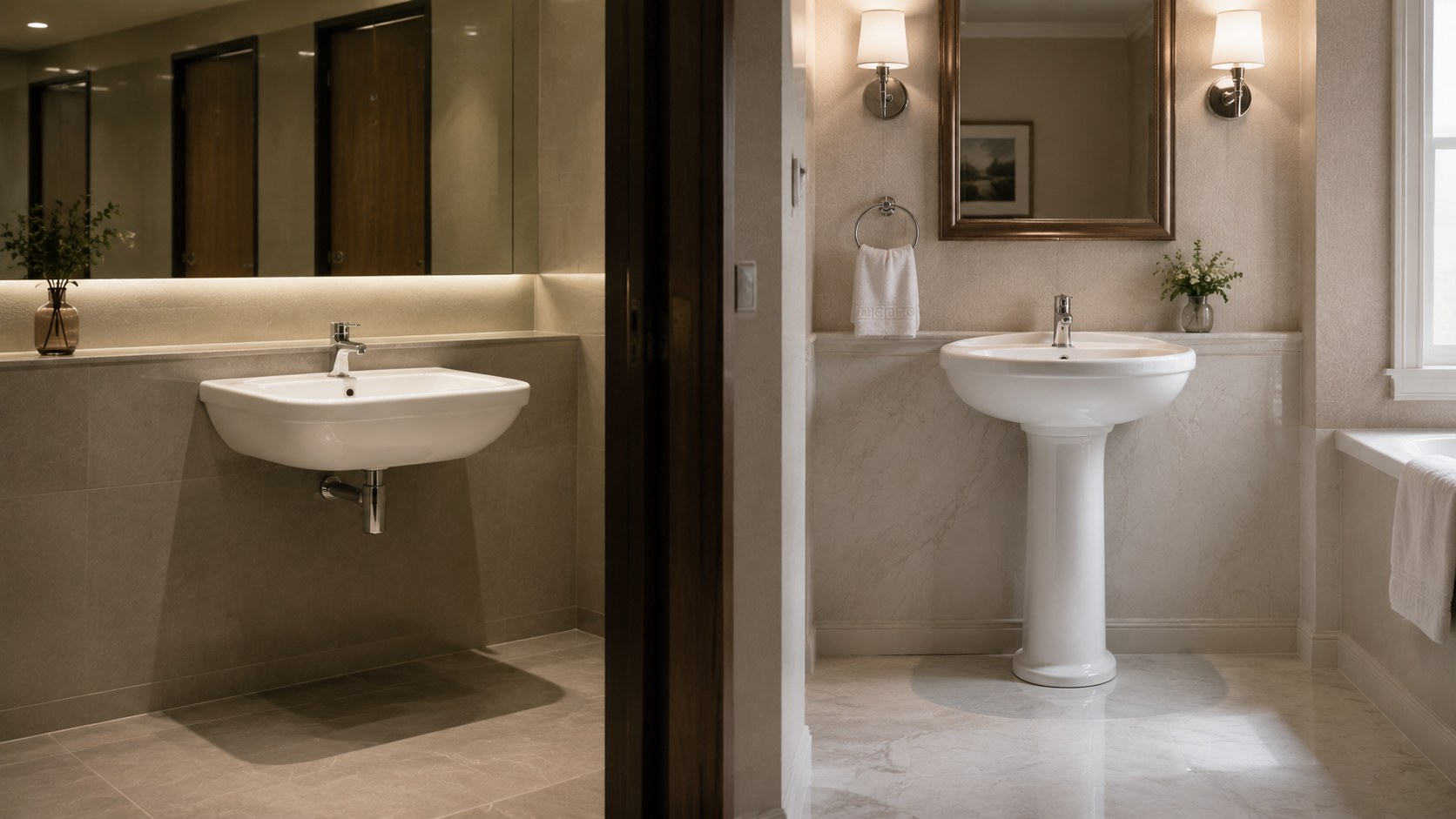
Match the fixture to the room and the wall. Choose a wall hung basin for small bathrooms, modern apartments, hotels and commercial or public washrooms where easy floor cleaning and a clean line matter, and wherever you want to set a comfortable or accessible height — provided the wall is solid masonry or you are fitting a carrier frame. Choose a pedestal basin for homes, mid-range hotels, renovations and retrofits where in-wall work is undesirable, the wall may be weak, and a traditional look is wanted. These are the projects where we most often supply pedestal sets — for the wider hospitality picture, see supplying hotels and apartments.
Are pedestal basins outdated? Not at all — they simply target a different brief. Plenty of current projects mix both: wall hung in the compact en-suites and public restrooms, pedestal in the standard guest bathrooms and value lines. As a ceramic basin manufacturer, we carry both formats precisely because most buyers need the range, not a single winner.
Before you specify, confirm
Wall type and support (masonry or carrier frame for wall hung); mounting height; bracket/bolt spacing and whether brackets are included; basin-and-column pairing and combined height for pedestals; tap-hole option (0 / 1 / 3) and overflow yes/no; basin width (commonly 450–650 mm); export packaging; MOQ and lead time. Pin these down and most field problems never arise.
08 WHAT TO SPECIFY
What to specify when ordering in bulk
For importers and project buyers, the format is only half the order — the spec is the rest. For a wall hung wash basin, confirm bracket or bolt spacing, whether brackets are supplied, and that they suit the buyer's frame or carrier. For a pedestal basin, confirm that basin and column are a matched pair from the same series so the column aligns with the trap, and ship them as sets — mismatched series is a common, avoidable return. Across both, lock down tap-hole count and overflow up front, as these drive the most returns.
As a Guangdong-based manufacturer, we produce both wall hung and pedestal basins in vitreous ceramic, with OEM/ODM support for custom sizes, glaze colours, branding and packaging — send drawings or a sample for tooling. MOQ and lead time vary by model and customization, packaging is palletised for container loading, and certification support may vary by product and market, so buyers can request available test reports before ordering. If you can tell us the project, the wall type and the sizes, we will recommend the right format and quote it — whether that is a wall hung range for compact hotel bathrooms or matched pedestal sets for a residential development.
In the end there is no universal winner — only the format that fits the wall in front of you. Spec the wall and the plumbing first, and the basin choice makes itself.
FAQ COMMON QUESTIONS
Frequently asked questions
Is a wall hung basin better than a pedestal basin?
Neither is universally better — they suit different situations. A wall hung basin saves floor space, is easy to mop under and lets you set the height, so it wins in small or modern bathrooms and public washrooms, but it needs a solid or reinforced wall. A pedestal basin hides its plumbing in the column, installs on almost any wall and costs less to fit, which suits homes, retrofits and traditional-style projects.
Do wall hung basins need special wall support?
Yes. Because there is no column, the wall carries the whole load — the basin plus water plus someone leaning on it. That means a solid masonry wall, or a braced steel carrier frame behind a stud partition. Fixing a wall hung basin to plain drywall or an unreinforced stud wall is the most common cause of failure, so the wall or frame must be confirmed before installation.
Which is cheaper, a pedestal or a wall hung basin?
Once installation is counted, the pedestal is usually cheaper. The two basins can be priced similarly on the shelf, but a wall hung install often adds wall reinforcement or an in-wall carrier frame plus plumbing planning, which raises the total. A pedestal uses its ceramic column to hide pipes and share weight, so it needs no extra building work.
Are pedestal basins outdated?
No — they simply serve a different brief. Pedestal basins remain a strong choice where the wall may be weak, in-wall plumbing work is undesirable, or a classic look is wanted, which covers many homes, retrofits and mid-range hotels. Many current projects specify both formats: wall hung in compact and public spaces, pedestal in standard guest bathrooms.
Which basin is easier to clean, wall hung or pedestal?
The wall hung basin. Because it floats clear of the floor, a mop passes straight underneath with nothing to work around, which is a real advantage in high-traffic and commercial bathrooms. A pedestal basin has a column base that sits where dust and mop water collect, so cleaning means going around the base.
What is the standard height for a wall hung wash basin?
A typical wash-basin rim sits roughly 800–850 mm from the finished floor, but the advantage of a wall hung basin is that the height is set on site. That flexibility lets you lower it for children or raise or adjust it for comfort and accessible, step-free use — something a pedestal, whose height is fixed by the column, cannot offer.