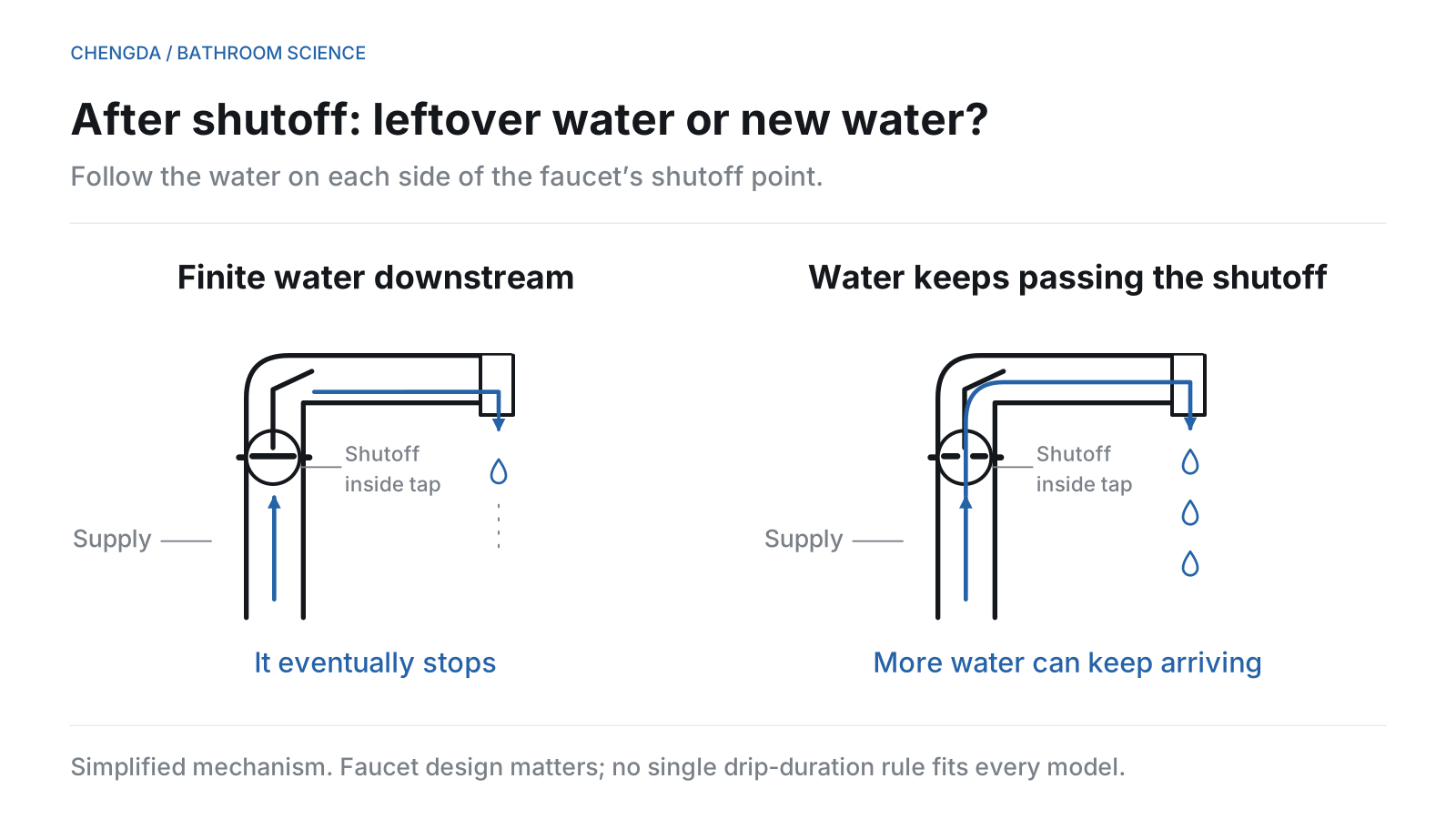
You close the bathroom faucet, hear a drop hit the basin, and wonder whether the valve has failed. That sound alone cannot tell you. Water already downstream of a closed valve may still leave the outlet; continued leakage through the shutoff mechanism is a different process.
The useful questions are whether the dripping stops without further use, where fresh water first appears, and what equipment supplies the tap. These details turn 'the faucet leaks' into a description that separates an outlet symptom from water escaping onto the counter or inside the cabinet.
01 UNDERSTAND YOUR BATHROOM
A closed valve and an empty spout are different conditions
Closing a faucet stops incoming flow at its shutoff mechanism. It does not necessarily remove water already between that point and the outlet. Some of that remaining water can emerge afterwards. hansgrohe's bathroom-tap FAQ recognises brief dripping after use; it does not provide one passing time limit for every faucet.
Think of two possible water supplies to the drop: a finite amount left downstream, or additional water passing a closure that is not sealing properly. The first can empty and stop. The second can keep replenishing the outlet. This distinction explains why a drop immediately after use and recurring drops while the tap remains untouched deserve different attention.
Treat that as a way to frame an observation, not a home certification test. Spout geometry and outlet design differ, and some hot-water systems add another explanation. A pause between drops does not prove a sound valve; a small number of initial drops does not by itself prove a defect.
02 UNDERSTAND YOUR BATHROOM
Record the pattern before naming a failed part
Watch the actual point where fresh water appears. A drop falling from the lowest edge may have travelled along the faucet's exterior. The following observations help describe the problem without claiming to identify a replacement part.
| What you observe | What it suggests checking | What remains uncertain |
|---|---|---|
| Outlet drops after use, then no further water without another use | Residual drainage and the model's stated behaviour | Whether other leak paths are present |
| Repeated outlet dripping while the faucet stays closed | The shutoff mechanism and any relevant heater arrangement | The specific failed component or cause |
| Fresh wetness begins at the handle or base | The external water path and local seals or connections | Whether the final puddle marks the source |
| Water appears beneath the counter | Visible supply, faucet and drain connections | Which assembly leaked before the water travelled |
| Outlet drips coincide with a heater cycle | Whether this exact system is open-vented and how it handles expansion | Whether the behaviour is permitted for that model |
03 UNDERSTAND YOUR BATHROOM
Why a faucet can keep dripping in the off position
A shutoff component must interrupt the water path. Moen's bathroom-spout guidance identifies the cartridge as the flow-control component in its described faucets and a common investigation point for off-position leakage. That is more precise than assuming the visible nozzle is the part that turns the water off.
Wear, deposits or another fault can prevent effective closure, depending on the design. hansgrohe's basin-faucet guidance specifically mentions cartridge faults and limescale in relation to persistent dripping. The outside appearance of a faucet cannot establish which condition is inside it.
A lever that reaches its usual resting position is useful information, but it does not prove that the internal water path seals. Nor should harder pressing or repeated forceful closing become the test. Report any changed handle travel or stiffness alongside the dripping, rather than compensating for it.
04 UNDERSTAND YOUR BATHROOM
The aerator can affect the outlet, but it is not the shutoff valve
An aerator is an outlet component that shapes the delivered stream. Moen's aerator guide explains that attachments differ and that debris or mineral deposits can distort spray or restrict flow. Those are useful clues about the outlet, not proof that a closed valve is leaking.
For that reason, 'clean the aerator' is not a universal answer to off-position dripping. It may be part of a model's troubleshooting procedure, but cleaning the outlet does not establish that an upstream closure is sound. Avoid gripping an unfamiliar concealed insert with pliers or applying a cleaner without checking the finish and part instructions.
Water splashing while the tap runs is another observation again. Our guide to reducing vessel-sink splashing discusses that active-flow problem. Keep it separate from drops produced after closure, even if both have left the same countertop wet.
05 UNDERSTAND YOUR BATHROOM
Water at the base or below the basin follows a different trail
Dry the accessible surface gently and observe where new wetness starts, without loosening anything. Moen's bathroom-base guidance warns that a handle leak can run onto the base plate and resemble a base leak. Water from washing or cleaning can also obscure the initial trail.
Below the counter, record whether a visible droplet begins at a supply connector, a faucet connection or the drain assembly. Delta's widespread lavatory guidance treats under-counter connections separately. A wet cupboard should not automatically trigger a cartridge replacement, and a dry spout does not clear those connections.
Only inspect safely accessible areas. Our basin plumbing rough-in guide explains the separate supply and waste routes; it is useful context when describing a location. A hidden connection remains unverified, rather than presumed dry because the countertop looks normal.
06 UNDERSTAND YOUR BATHROOM
The open-vented water-heater exception needs a model check
Some non-pressurised, open-vented water-heater installations deliberately release expansion water through a compatible tap during heating. hansgrohe's heater FAQ describes this arrangement. It is a specific system behaviour, not a general explanation for every bathroom faucet connected to hot water.
The equipment details matter. The STIEBEL ELTRON SNU 5 manual describes an anti-drip function, and says its tap outlet also serves as a vent: it must not be sealed and requires appropriate outlet components. Thus even two open-vented systems should not be assumed to discharge expansion water identically.
If a heater is present, record its model and whether dripping coincides with heating. Have that checked against the exact heater-and-tap instructions. Do not cap the outlet, add a shutoff attachment, change the heater setting or alter its plumbing to silence a suspected expansion drip.
07 UNDERSTAND YOUR BATHROOM
What to record, and when to arrange service
After ordinary use, close the faucet normally and leave it untouched while observing. Note whether outlet dripping stops and stays stopped, whether fresh moisture appears elsewhere, and whether anyone uses the tap again. A short video showing both the control and outlet is more useful than a count without context.
If dripping persists, behaviour changes, or water escapes onto cabinetry, arrange assessment. Keep the area dry; for an active external leak, stop use and isolate the supply only where the correct accessible controls operate safely. Do not force a stuck valve or handle wet electrical equipment.
Provide the faucet model, heater information, recent installation or repair history, and the wet location. Kohler's service guidance distinguishes valve types, compatible parts and water isolation before internal work. Our basin tap-hole guide helps describe the installation layout, but hole spacing alone cannot identify the internal valve.
Technical references
- hansgrohe — Bathroom taps FAQ
- Moen — Bathroom faucet dripping from the spout
- hansgrohe — Lavatory faucets
- Moen — Faucet aerator cleaning
- Moen — Bathroom faucet leaking around the base
- Delta — Widespread lavatory faucet leaking under the counter
- STIEBEL ELTRON — SNU 5 operation and installation manual
- Kohler — Leaky sink faucet guidance
FAQ COMMON QUESTIONS
Frequently asked questions
How many seconds of dripping are normal?
There is no single limit established here for every basin faucet. Check the model's guidance and describe whether the drops stop without further use. A continuing or changed pattern deserves attention even when each individual drop is small.
If a new faucet drips, does that prove it was supplied defective?
No. Brief residual drainage, installation-related issues and a shutoff fault are different possibilities. Record the location and pattern, then have the specific product assessed rather than diagnosing it from its age.
Will cleaning the aerator always stop an off-position drip?
No. Outlet deposits and water passing a shutoff component are different issues. Follow the model's troubleshooting instructions, and do not assume that an improved running spray proves the closed faucet is leak-free.
Should I close the handle harder?
Use its normal closing action. Extra force does not identify why water is emerging and should not substitute for inspection. Tell the technician if the handle position or resistance has changed.
Can I stop a heater-related drip by blocking the spout?
No. On the specified open-vented arrangements, the outlet is part of the vent path. First confirm the actual equipment and its instructions. A blocked outlet or unsuitable attachment can interfere with that function.
NEXT · RELATED READING