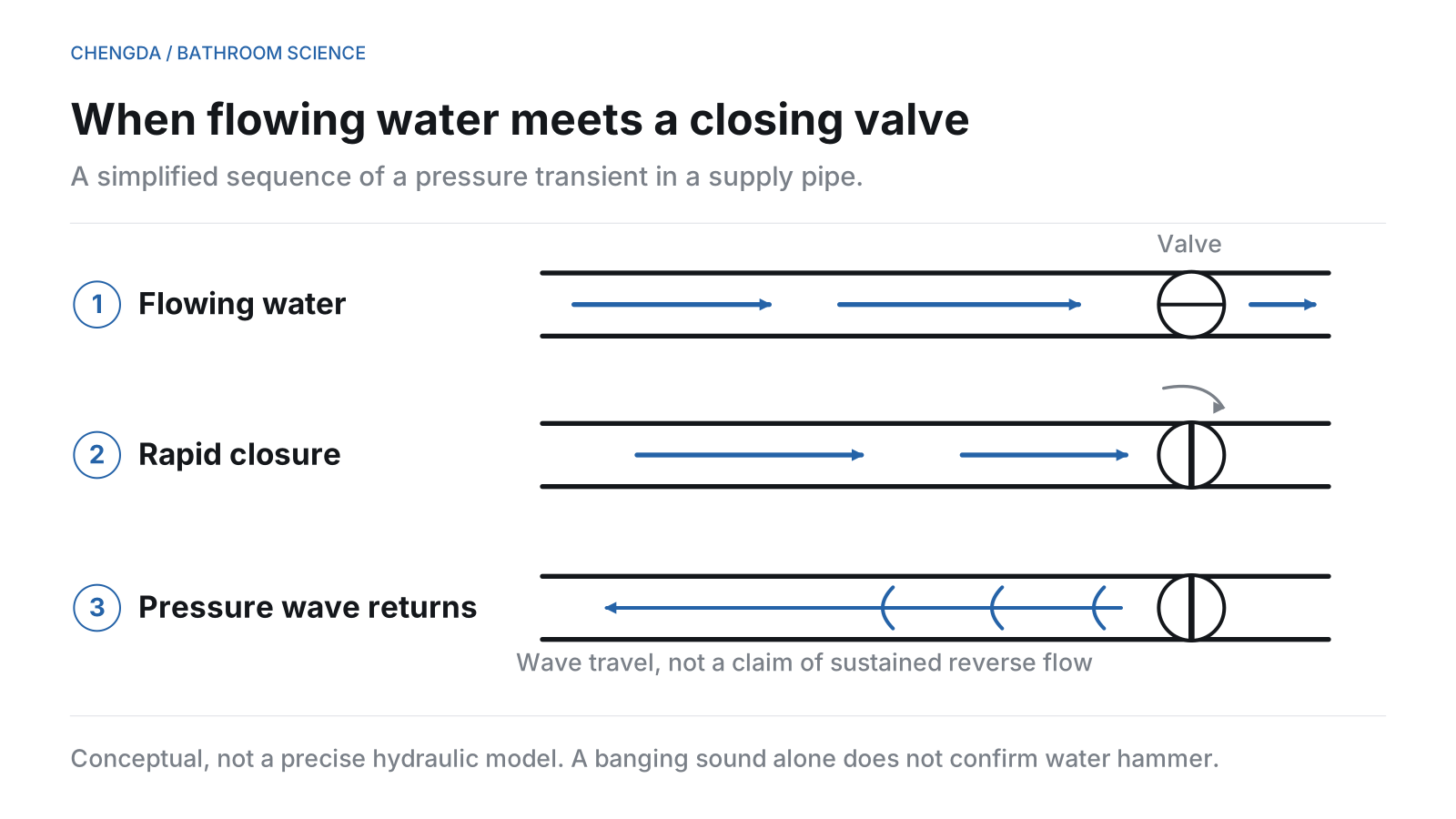
A bathroom pipe that knocks just as water stops may be responding to a sudden change in flow, known as water hammer. A fast-closing valve can trigger it, and loose pipework can make the sound more noticeable. The useful first question is exactly when the knock happens.
This guide explains the mechanism and the observations that help distinguish it from other bathroom noises. It is about understanding the cause and preparing a useful report, not selecting a replacement part from a sound alone.
01 UNDERSTAND YOUR BATHROOM
What happens inside the pipe when a valve closes?
A sharp knock at the moment a tap shuts can be water hammer: flowing water suddenly slows or stops, producing a pressure wave that travels along the supply pipe. The pipework may vibrate and strike nearby surfaces. The name describes a hydraulic event; it does not mean a loose object is travelling inside the pipe. Sioux Chief explains the pressure-wave mechanism.
Picture normal handwashing followed by one knock as the lever reaches its closed position. That timing is useful evidence. It is more informative than saying the bathroom is noisy, but it still cannot identify the exact valve, fitting or support that needs attention. The same sound heard beside a basin could originate elsewhere along a connected supply branch.
02 UNDERSTAND YOUR BATHROOM
Separate a shut-off knock from other sounds
Listen during ordinary use without deliberately snapping valves shut. Write down whether the sound happens while water is flowing, exactly when it stops, or well after use. A phone recording that includes the tap or refill finishing can help a plumber interpret the sequence. This is an observation record, not a home pressure test.
Use the comparison below to describe the complaint. The entries are possible investigation paths, not diagnoses based on sound alone. In particular, a drain gurgle and a supply-pipe knock concern different parts of the bathroom. A change following recent installation is worth recording alongside the old and new fixture model numbers.
| What you notice | Useful detail to record | What it does not prove |
|---|---|---|
| One knock as a tap closes | Which tap; gentle or ordinary closure | That the ceramic basin is defective |
| A knock when toilet filling ends | Whether it follows the end of incoming water | That the flush outlet is blocked |
| Noise while water keeps flowing | Continuous hiss, vibration or repeated rattle | A confirmed shut-off pressure surge |
| A sound near the drain | Whether water is draining at that moment | That a supply arrester will solve it |
03 UNDERSTAND YOUR BATHROOM
Why can the noise happen after a toilet refills?
The fill valve admits water into the tank, then closes at its set level. Some valves stop that flow quickly enough to trigger a supply-side knock. The timing can therefore be later than the main flush sound. Oatey identifies toilet fill valves, single-lever taps and some appliance valves among quick-closing applications. Oatey pipe-support guidance.
A tank that quietly refills by itself between uses presents another question: why has it lost water? This article does not diagnose that loss. Keep the two observations separate when reporting them: “it refills without flushing” and “it knocks when filling stops” describe different events, even when both occur on the same toilet.
04 UNDERSTAND YOUR BATHROOM
The loudest spot may not be the faulty part
A pressure disturbance can make a poorly supported pipe move against a wall, cabinet or another pipe. Oatey notes that a noise seemingly beside a valve may actually involve unsecured pipework inside a wall. Replacing the nearby tap without checking the installation can leave the complaint unresolved. Oatey on locating banging pipes.
Observe only accessible pipework. A short video of a visible line moving during normal use is more useful than opening a wall based on a guess. A plumber can check support type, spacing, contact points and the pipe material together. Tightly wedging random material around a pipe is not a substitute for selecting a suitable support.
05 UNDERSTAND YOUR BATHROOM
Why a pressure regulator and an arrester do different jobs
A pressure-reducing valve controls the downstream supply pressure. A water hammer arrester provides a compressible cushion to absorb a brief surge near the relevant flow interruption. These functions are different, so the presence of one device does not establish that the other issue has been addressed. Watts explains pressure regulation.
Nor does the strength of the stream tell you the size of a transient pressure spike. The assessment may need pressure measurements and a check of valve behaviour and pipe supports. Settings must match the building system and fixture specifications; copying a pressure number from an overseas product article is not a reliable local prescription.
06 UNDERSTAND YOUR BATHROOM
Why there is no single universal arrester fix
Arresters differ in size, connection, mechanism and maintenance requirements. For example, Watts describes its LF150A as a rechargeable diaphragm design, while Oatey describes sealed gas-filled piston products whose internal O-rings are not replaceable. These are examples of different products, not interchangeable repair instructions. Watts LF150A; Oatey arrestor product guidance.
Location and sizing also matter, as does the condition of the surrounding pipework. Oatey explains the role of secure piping. A contractor should match the device to the actual installation and its instructions. An arrester cannot be assumed to correct a loose fixing, a malfunctioning valve or an unrelated drainage noise just because all of them can be heard in the bathroom.
07 UNDERSTAND YOUR BATHROOM
Check the fixture instructions before changing parts
Some fixtures have explicit supply requirements. One Kohler smart-toilet installation manual, for example, specifically calls for a water hammer arrester. That requirement belongs to the models covered by that manual; it should not be converted into a claim that every conventional toilet needs the same accessory. Kohler installation instructions.
Another distinction is heating-related expansion. Water heated in a closed system can raise pressure, which Watts treats separately from a sudden shut-off event. Watts technical questions and answers. If noise is unrelated to an obvious tap or fill-valve closure, provide that information instead of assuming the same remedy. Do not adjust a heater’s safety devices to chase a sound.
08 UNDERSTAND YOUR BATHROOM
What to tell the plumber or property manager
For a recurring complaint, keep a short record rather than repeatedly provoking the bang. Include the room, fixture, exact moment, whether one or several outlets are involved, and any recent work. In a shared building, tell management if the sound also occurs when your own fixtures are idle; investigation may need to extend beyond your unit.
Arrange inspection when the noise grows, pipework visibly moves or moisture appears. South East Water recommends professional assessment for these patterns. South East Water’s water-hammer checks. A clear observation helps the person attending start with the right system, while the final cause still needs to be checked on site.
Technical references
- South East Water — Water hammer
- Sioux Chief — Water hammer arresters
- Oatey — Banging pipes: what the pros should know
- Oatey — Pipe support
- Watts — Water pressure reducing valves
- Watts — LF150A water hammer arrestor
- Oatey — Water hammer arrestors
- Kohler — Smart toilet installation manual 1411744-2
- Watts — 52 questions and answers
- Oatey — How do water hammer arrestors work?
FAQ COMMON QUESTIONS
Frequently asked questions
Does a single bang prove that my water pressure is too high?
No. It identifies a sound and a timing pattern. Valve closure, pipe support and the supply conditions all need consideration. A plumber should measure pressure where appropriate rather than infer a pressure value from loudness or stream strength.
Can I try closing the tap more slowly?
Gentle closure during ordinary use can provide a useful comparison if it is practical for that tap. A quieter result supports investigating the shut-off event, but it is not proof that the underlying installation is correct. Do not repeatedly slam the valve for comparison.
Is this the same as air trapped after a water outage?
Do not assume so. Report whether an outage occurred and whether the tap sputters as well as making a knock. That history is relevant, but a sharp closure-related noise alone does not justify treating every supply system as an old air-chamber installation.
Will changing the ceramic basin stop the banging?
A ceramic basin does not regulate the water inside the incoming supply pipe. Check the tap, valve, support and supply arrangement before treating this as a basin replacement problem. The closest visible product is not necessarily the source of a transmitted noise.
What should I send before asking about a Chengda fixture?
Send the fixture model, a short video showing the timing, and a photograph of the accessible supply connection. Chengda can help check its product information; diagnosis of concealed pipes or shared building supplies belongs with the installer or property maintenance team.
NEXT · RELATED READING