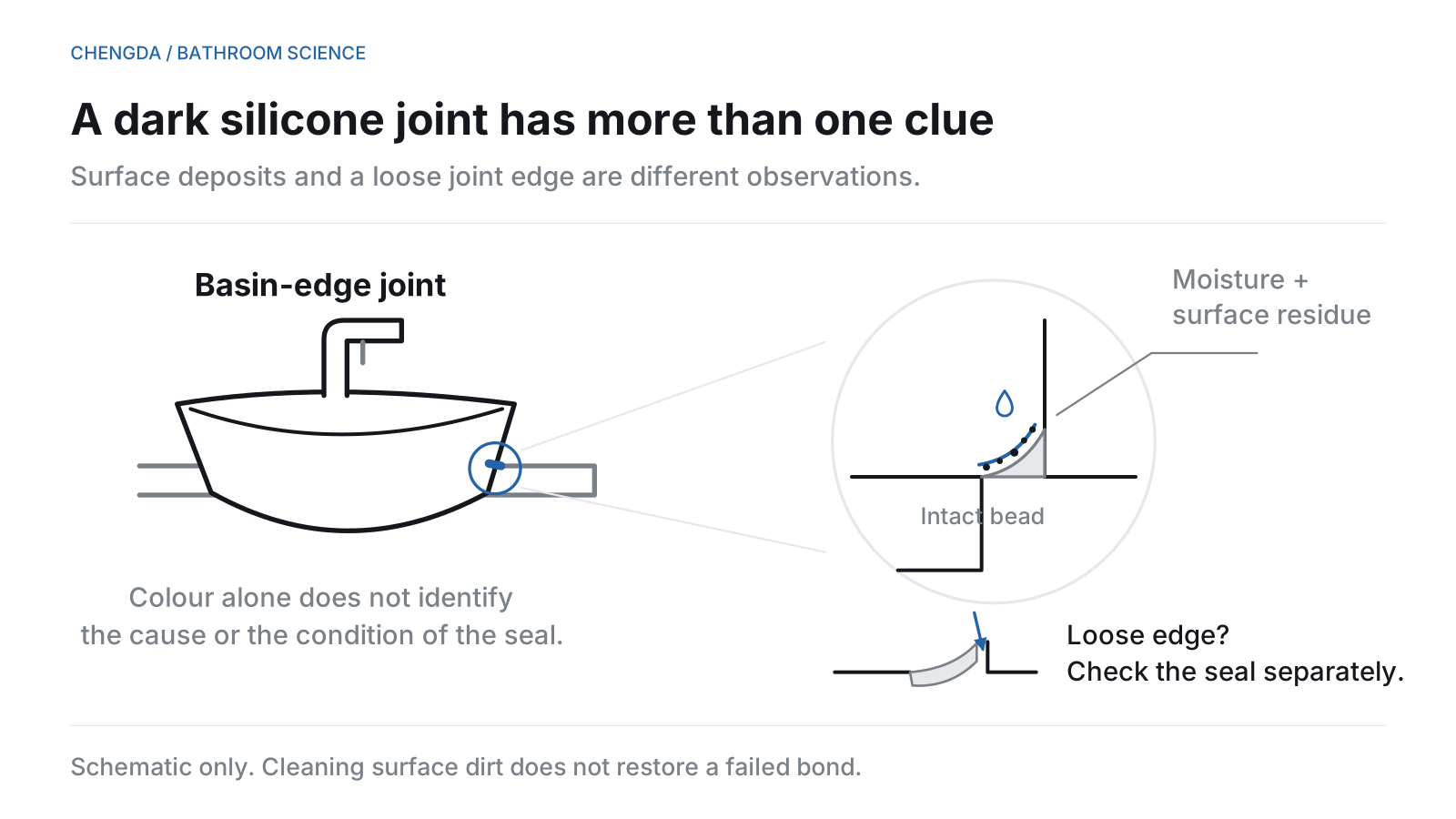
Soap residue and persistent dampness can support recurring mould on a basin joint's surface, including residue sitting on mould-resistant silicone. If an edge has lifted away, there is also a bonding problem that surface cleaning cannot repair. A dark line can involve one of these issues or several together.
Three questions help explain the recurring pattern: what is sitting on the surface, why does the area stay wet, and is the sealant still bonded to both sides? Looking at the joint itself, as well as the surrounding basin and countertop, gives each question a concrete starting point.
01 UNDERSTAND YOUR BATHROOM
Separate the surface, the moisture and the joint itself
A dark mark is a starting observation. CDC NIOSH cautions that mould colour does not establish its danger. A photograph also cannot identify a species or test the supply water. The useful first description is where the mark sits and what condition the surrounding joint is in.
| What you can observe | Which question it raises | What cleaning alone cannot establish |
|---|---|---|
| Film or spots on an otherwise continuous bead | What residue is collecting on the surface? | Whether every remaining mark is active growth |
| The same corner stays wet after use | What keeps supplying or holding water there? | Whether the moisture source has been corrected |
| An edge lifts away or a gap is visible | Has the joint lost its bond or continuity? | Whether the joint can still exclude water |
| Darkness appears behind clear sealant or nearby materials swell | Is there a concealed moisture or joint problem? | The extent of damage beneath the visible surface |
02 UNDERSTAND YOUR BATHROOM
The growth may be on a residue layer above the silicone
A sealant joint can carry soap film and other deposits even when the nearby ceramic has been wiped. Soudal's anti-mould silicone FAQ explains that mould can develop on residue left on the joint's surface. A mould-resistant formulation does not remove that residue for you.
This explains an easily missed difference in cleaning coverage. A cloth may pass over the broad basin while missing the narrow rear junction, the edge behind a dispenser or the transition to the wall. Look at the actual joint after ordinary use.
Our ceramic basin cleaning guide covers the fixture's routine care. The flexible joint beside it deserves its own compatible care instructions; the two surfaces should not automatically receive the same chemical treatment.
03 UNDERSTAND YOUR BATHROOM
Why does the same short section keep coming back?
Soudal's technical discussion identifies persistent moisture, poor air circulation, organic residue and poor water run-off as relevant conditions. That points towards the local wetting pattern, rather than immediately blaming the entire basin or the sealant's age.
Notice where water remains after normal handwashing: beside the tap, beneath a bottle, against the wall or in a low part of the junction. Move ordinary countertop items aside for a clear view, without disturbing the plumbing or bead. A photograph taken after use and another when the area should have dried can make the difference visible.
A backsplash manages part of the splash exposure, but does not make its bottom joint self-drying. Our basin backsplash guide explains that surface-protection role. If moisture appears without basin use, or the cabinet below is wet, extend the investigation to a possible leak rather than repeating surface cleaning.
04 UNDERSTAND YOUR BATHROOM
A dark joint and a detached joint need different assessments
Adhesion is the bond between the cured sealant and the surfaces beside it. A bead can still be present while an edge has separated. Soudal's joint-failure guidance describes peeling away from the substrate as an adhesion problem and highlights preparation and joint design as relevant factors.
Observe any visible gap, lifted edge or split without pulling at the bead to test it. Where the intended seal is discontinuous, making the exposed face look cleaner does not reattach it to the basin or countertop. Equally, a dark mark on a continuous bead does not prove that the bond has failed.
If separation is present, the repair assessment needs to include the mating surfaces and any movement or wetness at the joint. A thin cosmetic layer over the top is not evidence of a restored bond underneath. This is why a cleaning result and a sealing result must be judged separately.
05 UNDERSTAND YOUR BATHROOM
Mould resistance does not answer every material question
Sanitary sealants have different specifications. For example, Sika Hong Kong's SikaSeal Kitchen and Bathroom page lists basin applications but excludes natural stone, some porous materials and copper. This named example shows why wet-area suitability cannot be treated as approval for every adjacent material.
If a joint needs replacement, identify the installed materials and the proposed sealant rather than relying on the colour of the tube. Our countertop-material guide helps explain why the surface surrounding a ceramic basin is not always ceramic too. Three separate checks matter:
- Application: is the product intended for this type of sanitary joint and exposure?
- Compatibility: does its technical sheet allow both surfaces, including their coatings or finishes?
- Conditions: what preparation, curing and subsequent-care requirements apply to that product?
06 UNDERSTAND YOUR BATHROOM
What a cleaning result can tell you
Begin with a method permitted for the sealant and both neighbouring surfaces, using the cleaner as labelled. Avoid scraping into the bead or extending a chemical's contact time just because a stain remains. Surface improvement is useful information, but repeated stronger treatment is not a substitute for checking wetness and adhesion.
For suspected mould cleanup, CDC guidance calls for protective equipment, including gloves, suitable respiratory protection and goggles, and warns against mixing cleaning products. Follow the relevant cleanup guidance as well as the product label. Keep the cleaner's container available so its ingredients, permitted surfaces and instructions can be checked.
The EPA's home mould guide notes that cosmetic staining can remain after cleanup. A mark that will not whiten is therefore not a reason to keep escalating chemicals. If its condition is unclear, arrange assessment; do not declare it harmless staining merely because one cleaning attempt did not remove it.
07 UNDERSTAND YOUR BATHROOM
Check what changed before repeating the same treatment
After appropriate care, keep the junction clear of residue, dry accessible standing water and use the bathroom's ventilation as intended. Then revisit the same places under ordinary use. Record whether wetness lasts, whether spots spread and whether an edge begins to separate. Compare similar conditions rather than a busy morning with an unused day.
Where a joint needs renewal, first resolve the reason for persistent wetting and assess the affected materials. CDC's cleanup advice says covering mould with new caulk does not prevent its growth. Proper renewal is a materials-and-installation task, not simply drawing a whiter line over the old one.
Swelling cabinetry, soft surrounding material, an ongoing leak or suspected hidden growth calls for a broader inspection. Extensive water damage or health concerns also changes who should do the cleanup; the EPA guide provides those boundaries. A small visible joint should not distract from a larger moisture problem behind it.
Technical references
FAQ COMMON QUESTIONS
Frequently asked questions
Does black silicone mean the tap water is contaminated?
The joint's colour does not test the water supply. Record the surface condition and moisture pattern. Any independent water-quality concern needs the appropriate water-supply investigation, rather than a diagnosis from the sealant.
Why can spots return even though I clean the basin often?
The ceramic and the narrow joint may receive different cleaning coverage and dry at different rates. Check the seam itself for residue, repeated wetting and visible separation. Cleaning the large bowl does not necessarily address all three.
If the black marks disappear, is the seal waterproof again?
Removing a surface mark does not restore a lifted edge or close a split. Inspect the condition of the joint separately. If water has reached the cabinet or an edge is detached, the sealing issue still needs assessment.
Can I add fresh silicone over a dark existing joint?
Do not use a fresh layer to conceal suspected mould or an unresolved gap. The moisture problem and affected joint need assessment first, with preparation and replacement following the selected product's instructions.
Does anti-mould silicone mean that cleaning is unnecessary?
No. Residue on the surface still needs appropriate care. Any performance or guarantee claim belongs to the named product and its conditions; it is not a promise that every sanitary joint stays clean indefinitely.
NEXT · RELATED READING