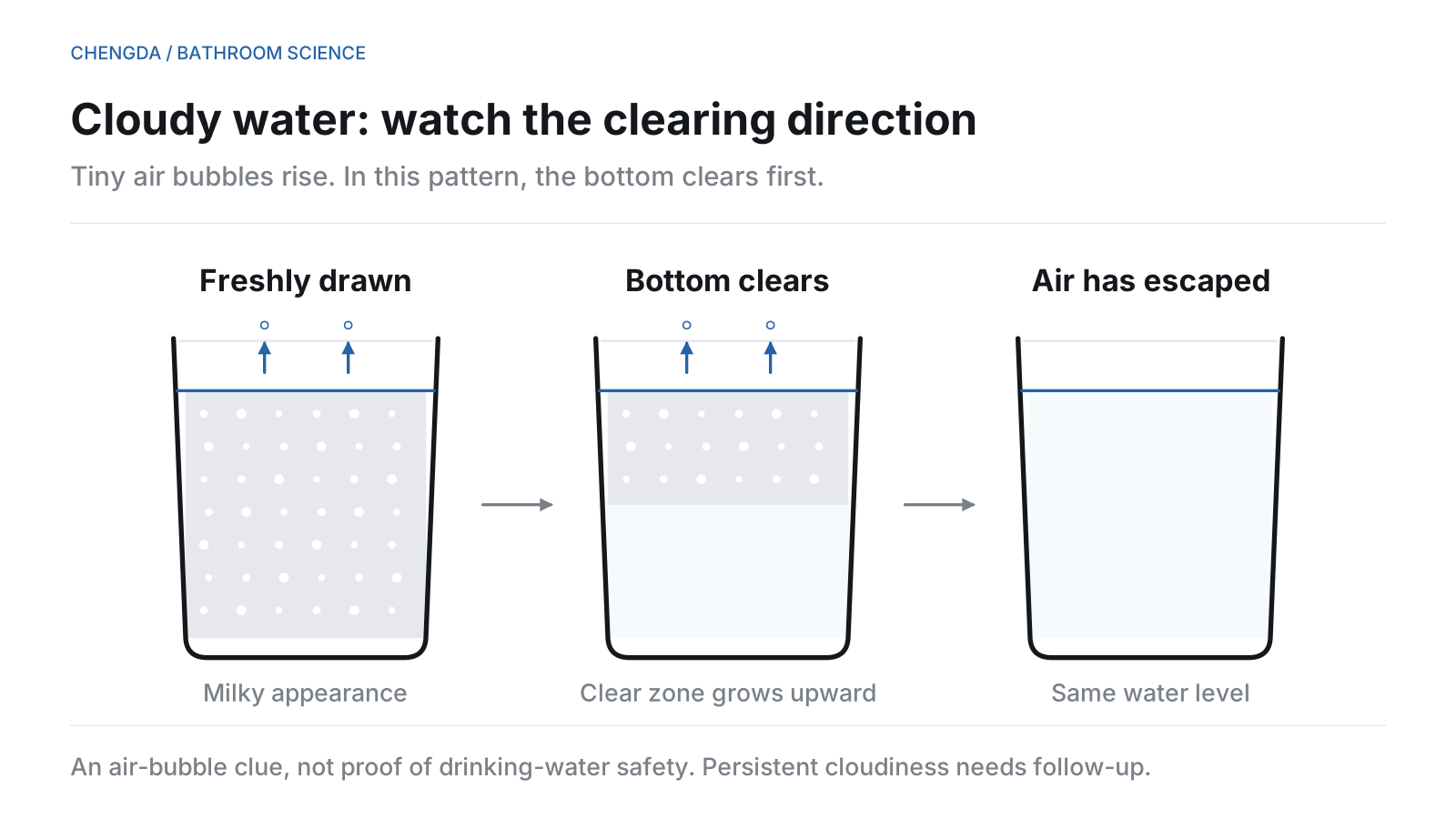
A glass of bathroom tap water can look white at first and become clear while it stands. The Drinking Water Quality Regulator for Scotland describes a common explanation: dissolved air forms tiny bubbles after water leaves the pressurised supply. The resulting cloudiness can clear from the bottom upward.
That direction of change is more useful than a single photograph of a white glass. It is evidence about a visible effect, however, not a complete water-quality test. The aim is to recognise the air-bubble pattern, record anything that does not fit it and know which question to take to the water supplier.
01 UNDERSTAND YOUR BATHROOM
How can air make otherwise transparent water look milky?
The US Geological Survey explains that dissolved gases can leave solution when water moves from pressurised pipes into a glass at atmospheric pressure. Small bubbles rise to the surface and escape. The water is not turning white and then changing its chemical identity back again; the visible bubbles are leaving it.
This is an explanation of appearance, not a way to measure supply pressure. Two photographs of different taps cannot show which has the higher operating pressure or greater flow. Those are separate quantities, explained in our water pressure and flow rate article.
Nor can the whiteness alone show whether the tap is faulty. Before replacing anything, separate the brief appearance at the outlet from what happens after the same water has been collected and left undisturbed.
02 UNDERSTAND YOUR BATHROOM
Watch the clearing direction in a clean, transparent glass
United Utilities recommends collecting water in a clear glass and letting it stand for a few minutes. Clearing that begins near the bottom and progresses upward is the characteristic observation for trapped air. Its guidance also describes fizzing or spluttering after some supply interruptions.
Use a clean, well-rinsed transparent container so residue from washing does not confuse the picture. Set it down where you can see the full water depth against a plain background. Do not shake it, add anything or taste it to investigate. Take a photograph at collection and another as the appearance changes.
Record whether the lower portion becomes transparent first, whether the change travels upward and whether anything remains visible. Use the actual elapsed time rather than declaring that every sample must clear within a fixed number of seconds. If the view is ambiguous, record that uncertainty instead of forcing it into the bubble explanation.
03 UNDERSTAND YOUR BATHROOM
White bubbles, lasting haze and coloured water are different observations
Thames Water’s appearance guidance discusses both fine air bubbles and white particulate material. A white appearance alone therefore does not identify the material in a sample. Visible pieces remaining after the surrounding water changes should be reported separately from a cloud that disappears.
The Drinking Water Inspectorate’s discolouration guidance describes disturbed sediment as another possible source of changed appearance and advises seeking supplier advice before assuming suddenly discoloured water is safe to drink. Do not use the air-bubble explanation to dismiss yellow, brown or other unusual colour.
| What you observe | What to report |
|---|---|
| A white cloud retreats upward from the bottom | The direction of clearing and whether anything remains |
| A haze persists without a clear moving boundary | That the glass observation did not establish the usual bubble pattern |
| Visible particles remain or collect | Their appearance and whether they occur at other outlets |
| An unusual colour or smell accompanies the change | Both symptoms, when they began and any current supply notice |
04 UNDERSTAND YOUR BATHROOM
Timing and the affected outlets help frame the next question
DWI’s white-water page links temporary air-related cloudiness with events such as a burst main or restored supply. It also identifies possible internal influences, including an aerator or cold pipework warmed nearby. Persistent cloudiness or unusual odour warrants contacting the supplier rather than relying on appearance alone.
Write down whether this is new, whether it began after an announced interruption, and whether it appears only on first use or repeatedly. If readily observable without exposing yourself to hot water, distinguish the cold side from the hot side. Do not turn that distinction into a diagnosis of a particular heater component.
One bathroom tap behaving differently is useful context, but it does not isolate the fault by itself. Compare with another known cold-water outlet and state which outlet you used. A mixed tap can blend different supply paths, so a photograph taken at an unspecified handle position leaves an important detail unanswered.
05 UNDERSTAND YOUR BATHROOM
In a shared building, include the management team in the picture
Hong Kong WSD’s water-use guidance separates milky water caused by escaping air from turbid or yellowish water after supply restoration. For persistent turbidity, it points building management toward checking storage tanks. That local distinction is useful in a bathroom supplied through a building system.
WSD’s fresh-water plumbing maintenance guide explains that maintaining internal pipes and tanks is part of protecting water quality at the tap. Where a shared system may be involved, provide management with the affected flat and outlets so they can coordinate the appropriate inspection. This is not a request for a resident to open or drain a communal tank.
Check whether neighbours or management have already reported a similar change. Their observations can help establish the extent of an incident, but a neighbour’s clear glass does not certify your own supply. Outside Hong Kong, use the responsibilities and contact routes given by your local supplier and building operator.
06 UNDERSTAND YOUR BATHROOM
A clear glass cannot cancel a water-use advisory
The CDC distinguishes several kinds of drinking-water advisory, with different instructions for different problems. Follow the notice that applies to your supply. Boiling is not a universal response: it does not make water containing harmful chemicals or toxins safe. Simply waiting for a glass to clear is not an alternative to those instructions.
For example, Scottish Water’s interruption guidance says that when a boil notice applies, customers should continue following it until the supplier issues its all-clear notice after assessing samples. The practical distinction is between an observation at home and a decision made using supply information and testing.
Keep the glass observation in its proper role: it helps describe what changed. It cannot identify every substance or establish microbiological quality. If there is an active advisory, read its directions for the actual bathroom activity as well as drinking; do not assume that every notice has the same restrictions.
07 UNDERSTAND YOUR BATHROOM
Send a short report instead of trying random plumbing changes
Contact the local water supplier when cloudiness persists, the usual clearing pattern is absent, or there is unusual colour or odour. Tell them the address, start time, affected outlets, whether hot or cold water is involved and what the standing glass showed. Include any recent interruption or building-work notice and the photographs you took.
Ask whether there is an incident affecting the supply, whether management or a qualified plumber should investigate the internal system, and what use or sampling instructions apply meanwhile. Follow their specific flushing advice rather than leaving several taps running indefinitely. Do not change a pump, main valve or tap insert to make the sample look better.
Keep separate symptoms separate in the report. A weak stream belongs with our weak bathroom water-flow guide; water hitting the basin and scattering belongs with our vessel sink splashing guide. Neither symptom, by itself, explains the contents of a cloudy glass.
Technical references
- DWQR Scotland — White, Cloudy or Milky Water
- USGS — Why does my drinking water look cloudy sometimes?
- United Utilities — Cloudy or white water
- Thames Water — Water looks different
- DWI — Brown, Black or Orange Water
- DWI — White or Cloudy Water
- Hong Kong WSD — Water Use Tips
- Hong Kong WSD — Fresh Water Plumbing Maintenance Guide
- CDC — Drinking Water Advisories: An Overview
- Scottish Water — Water Supply FAQs
FAQ COMMON QUESTIONS
Frequently asked questions
Does bottom-up clearing prove the water is safe to drink?
It supports the explanation that small bubbles caused the visible cloud. It is not a comprehensive safety test and does not override an advisory or a supplier’s instructions about other symptoms.
Should I taste the water to identify the problem?
No. There is no need to taste it for this observation. Record its appearance and any unusual odour already noticed, then follow the supplier’s advice.
Is white tap water always limescale?
No. White appearance does not identify a substance. Note whether the cloud disappears, whether particles remain and how the appearance changes; those details make a more useful report than naming it from colour alone.
Should I buy a filter as soon as the water looks cloudy?
First establish what is being observed and ask the supplier about persistent or unusual changes. Appearance alone does not define a treatment requirement or identify a suitable filter.
What if the water stays cloudy in the glass?
Do not classify it as the usual disappearing-bubble effect. Contact the supplier and describe the observation, together with affected outlets and any colour or odour. Follow their use and investigation instructions.
NEXT · RELATED READING