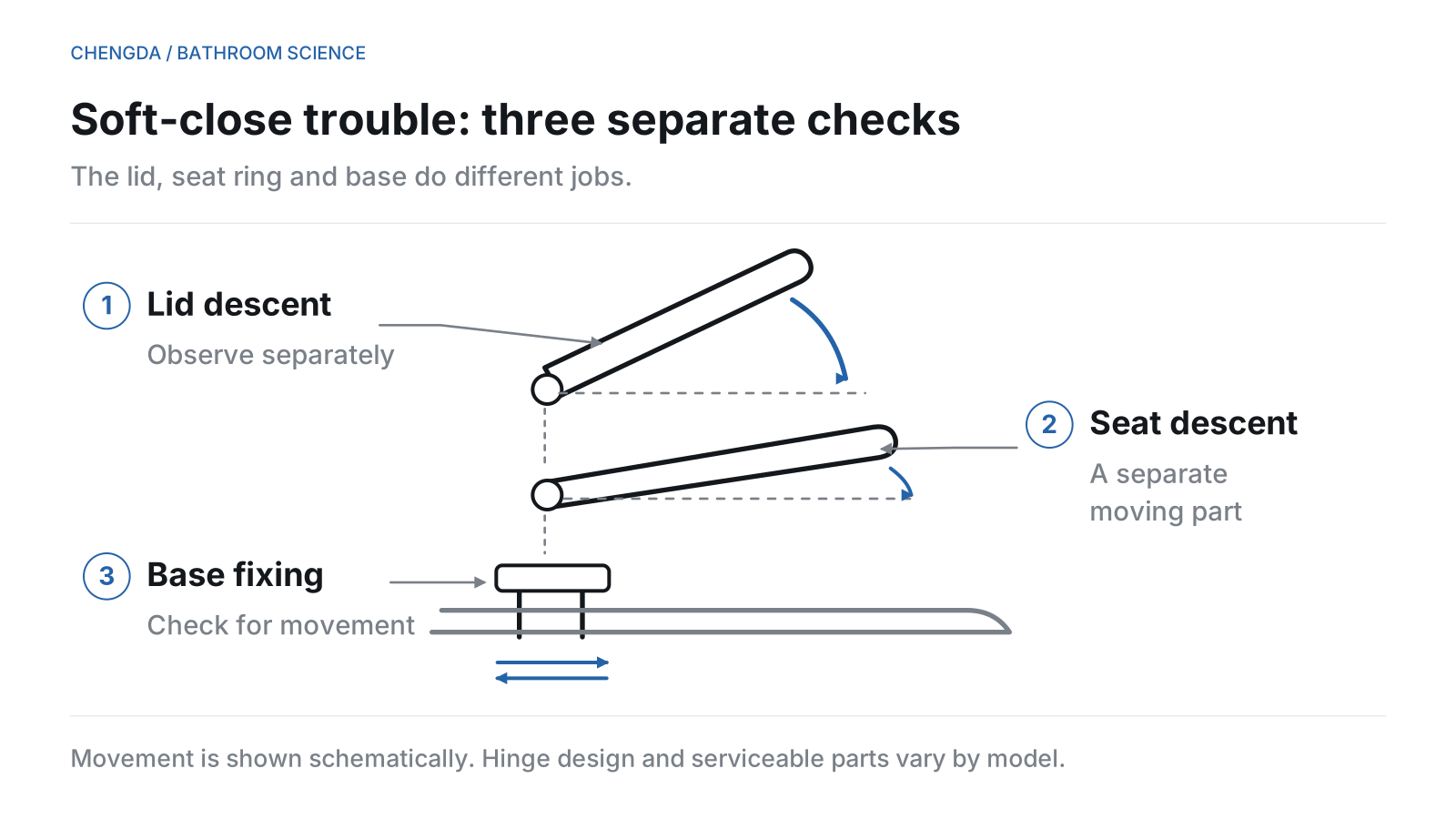
When a soft-close toilet seat starts slamming, first identify what changed: does the lid fall quickly, does the seat ring fall quickly, or does the whole assembly move on the ceramic? Those observations point to different checks. Tightening a mounting bolt is not automatically a repair for lost damping.
This guide helps you describe the fault and choose the correct next step without opening an unidentified hinge. It covers ordinary mechanical soft-close seats; a powered automatic lid needs its own manufacturer’s troubleshooting instructions.
01 UNDERSTAND YOUR BATHROOM
Is the lid falling, the ring falling, or the base moving?
Use three names consistently: the lid is the cover, the ring is the part you sit on, and the mounting base holds the assembly to the bowl. Duravit describes soft closing as a damping function. A quick-release feature serves a different purpose: removing the seat for cleaning.
Record the symptom before choosing a part. The following observations guide the next check; they do not identify an internal cartridge or prove the cause. More than one problem can exist at the same time.
| What you observe | What to check first |
|---|---|
| Lid falls fast; ring still closes slowly | Lid closing function and model-specific hinge guidance |
| Ring falls fast; lid still closes slowly | Ring closing function and model-specific hinge guidance |
| Both close slowly, but the assembly shifts | Mounting security, support and release engagement |
| Movement began after removing the seat | Reattachment and locking procedure for that seat |
| Fast closing and a moving base occur together | Treat closing and retention as separate reported symptoms |
02 UNDERSTAND YOUR BATHROOM
Observe one gentle closing cycle instead of pushing harder
With the assembly secure, observe the lid and ring separately through their normal permitted movement. Keep control of a part that begins to fall, and avoid repeatedly allowing it to strike the ceramic. Note which part accelerates and whether anything catches or rubs. Do not press through resistance or twist the hinge to find a supposed reset point.
The Geberit AquaClean 4000 guide explicitly warns that pressing its seat ring or lid down can damage the dampers. That supports a gentle observation, not a force test. A short side-view video showing the moving part and the fixed base is often more useful to support staff than the description “the hinge is broken.” Stop if the assembly is loose, cracked or cannot be controlled safely.
03 UNDERSTAND YOUR BATHROOM
If the whole seat shifts, check retention rather than closing speed
Watch where movement begins: between the mounting base and ceramic, between the removable seat and its posts, or in the ring as it rests on the bowl. Do not sit on an unstable seat to test it. Photograph the point that moves and any missing or displaced support pad; this helps distinguish the complaint before parts are ordered.
Manufacturers separate these functions. Bemis lists fastening, slow closing, alignment and grip bumpers separately. For an identified seat, follow its installation instructions to check the relevant fixings and support arrangement. Avoid tightening every visible screw: some belong to another function, and the correct tightening method depends on the hardware. If the mounting problem is corrected, observe closing again; a fast-falling lid may still need a separate assessment.
04 UNDERSTAND YOUR BATHROOM
Did the problem start immediately after cleaning?
If the seat was removed for cleaning, check the specified reattachment procedure first. The Kohler Cachet 4639-RL page identifies a positive locking latch for retention alongside its separate Quiet-Close feature. On a seat with this kind of retention system, confirming that it is properly locked is a different task from assessing damping.
Release designs differ: Bemis Push 2 Clean is another named removable-seat mechanism. Find the instructions for the mechanism you actually have. Reattach only as directed, confirm the documented lock or engagement check, and then reassess. Do not assume that hearing a click proves every model is secured. If it will not engage normally, stop; forcing the ring onto misaligned posts is not a reliable repair.
05 UNDERSTAND YOUR BATHROOM
Identify the seat, not just the ceramic toilet
A replacement seat fitted years later may be from a different range or brand than the toilet. Look for the seat’s model label, purchase record or original packaging before searching for spares. Kohler’s identification guidance says most of its plastic seats made from October 2019 carry model and colour information beneath the hinge; that location and date are specific to Kohler.
Remove the seat to read a hidden label only if its removal instructions are clear. Otherwise photograph the top, underside that is safely visible, mounting arrangement and release controls for the supplier. Record whether the lid, ring or base is affected. Include any model suffix and finish information rather than sending only a photo of a generic white seat. Identification comes before deciding which component is replaceable.
06 UNDERSTAND YOUR BATHROOM
Can you replace a damper, or does the complete seat need replacing?
Some seats have an official component-replacement route. Kohler’s hinge-and-damper replacement page specifically limits its guidance to Q3-style seats. This is a useful example of serviceable construction, not evidence that every soft-close hinge can be dismantled or that its parts fit another series. Ask whether the maker supplies a damper, hinge assembly or complete seat for your exact revision.
Model matching matters even within one brand. Roca’s historical seat-hinge table lists different references for named seat ranges and types. Use it to understand why identification matters, not to assume an old part is still sold. Obtain current written confirmation of the required part and fitting instructions. If no approved component route exists, ask the supplier about a compatible complete-seat replacement rather than buying a similar-looking cartridge.
07 UNDERSTAND YOUR BATHROOM
Retest the reported symptom and keep a useful service record
After an approved adjustment or part replacement, compare the same lid and ring movements under the same conditions. Check that the base remains secure, the removable seat is retained, and the original complaint has changed. A seat that closes slowly but still moves has not passed the retention check. Record what was done and retain the part reference for future service.
For routine cleaning, follow the seat’s own care instructions. Duravit advises mild soap and water and warns about cleaner vapours when a toilet seat is closed over cleaner left in the bowl. That is a care precaution, not proof that cleaning caused this failure. Do not add oil or grease to an unidentified hinge or open a damper without an explicit manufacturer procedure.
If a complete replacement is needed, use our seat measurement guide and round versus elongated guide to confirm fit. Our PP versus UF comparison covers materials separately. Changing material alone does not identify the part responsible for this particular fault.
Technical references
- Duravit — Toilet seats with slow-close function
- Bemis — Our Features
- Geberit — AquaClean 4000 quick guide 971.386.00.0(01)
- Kohler — Cachet ReadyLatch Quiet-Close 4639-RL
- Bemis EMEA — Push 2 Clean
- Kohler Assist — I do not know my Toilet Seat Model
- Kohler Assist — Quiet-Close Toilet Seats Hinge and Damper Replacement
- Roca — Discovery 2021, spare parts: seat hinges
- Duravit — FAQs, toilet-seat care
FAQ COMMON QUESTIONS
Frequently asked questions
Why does only the lid slam while the ring still closes slowly?
The symptom concerns the lid’s closing function. Report that distinction to the supplier; do not infer which side cartridge has failed. The internal arrangement and repair parts depend on the seat model.
Will tightening the toilet-seat bolts restore soft close?
It may correct a loose mounting problem when done according to the model instructions. It does not establish that damping has been repaired. Observe mounting security and closing speed separately after any approved adjustment.
Can every soft-close damper be replaced?
No universal replacement method applies. Some manufacturers document component replacement for specific seat families, while other designs or support arrangements require a complete seat. Confirm the exact part and current availability first.
Should I spray lubricant into a noisy or stiff hinge?
Do not use a lubricant simply because the hinge feels stiff or noisy. Find the seat’s care or service instructions and ask the manufacturer when they are unclear. Lubrication is not a general fix for lost damping.
Can I keep using a seat whose soft close has failed?
First distinguish lost damping from loose retention, cracks or damaged supports. Do not use an unstable or damaged seat. For a secure seat with a closing complaint, ask its manufacturer about interim use and the appropriate repair or replacement.
NEXT · RELATED READING