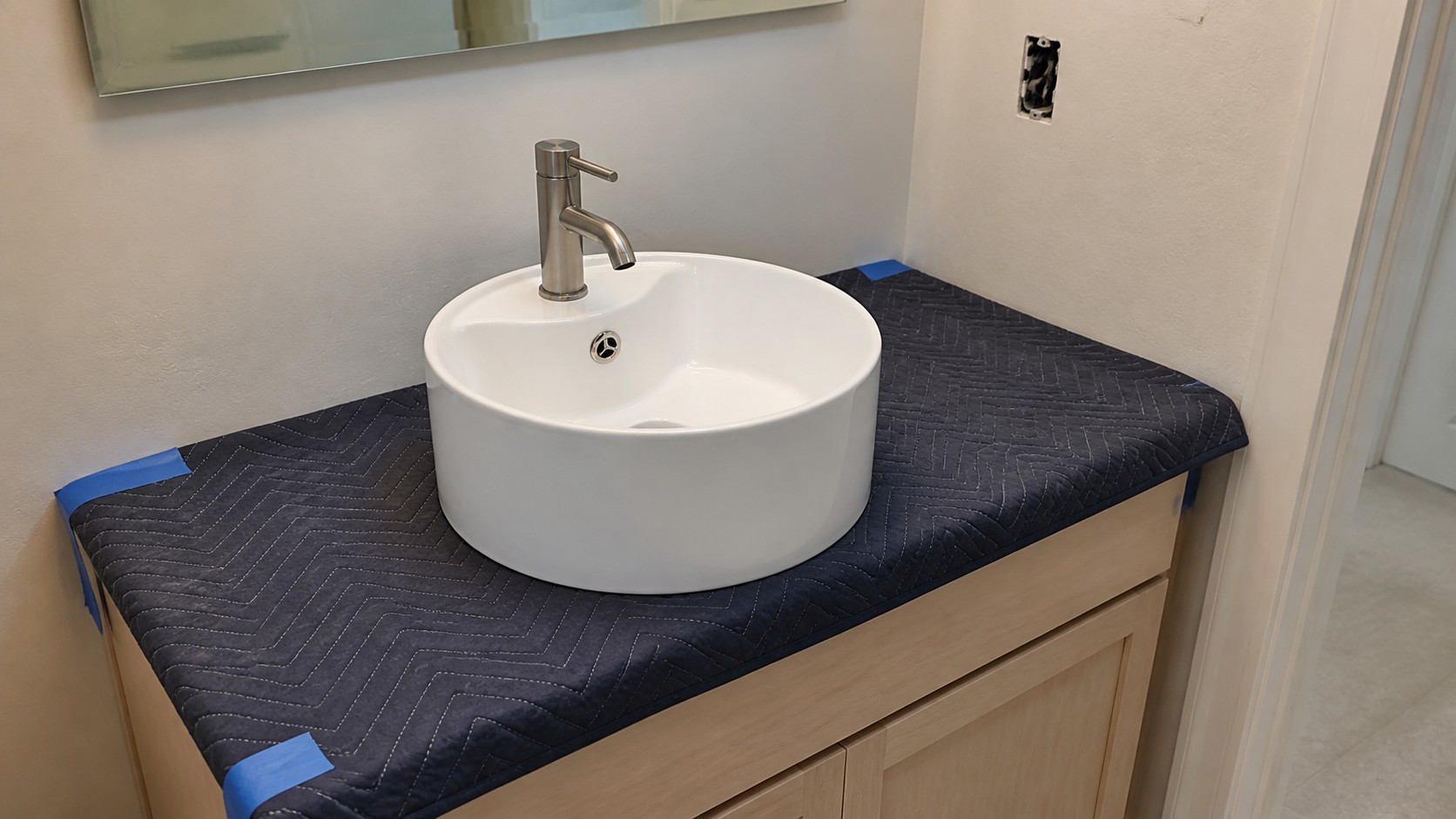
Yes, you can often convert an existing vanity to a vessel sink, but the basin itself is usually the easy part. The real decision is whether the old countertop opening, finished height, faucet holes, cabinet structure and drain route can become one safe, maintainable system. A vessel sink may need only a controlled passage through a new top, while an old drop-in or undermount basin can leave a much larger opening that cannot simply disappear beneath the new bowl.
Treat the conversion as a measured retrofit, not a cosmetic swap. Survey what exists, collect the new basin, faucet and drain documents, and dry-fit the complete assembly before any irreversible cut. Exact product instructions, countertop-fabricator requirements and local plumbing or building rules always take priority over general guidance. If the existing top is damaged or the geometry is wrong, replacing the top can be safer and cleaner than forcing a patch.
Key takeaways
- The old cutout decides feasibility: a large sink opening may require a new countertop or a professionally engineered repair.
- Finished rim height must be recalculated: the existing cabinet, counter and full vessel height stack together.
- Approve one complete system: basin, faucet, waste, counter, cabinet and trap must all fit before work begins.
01 THE SHORT ANSWER
Can an existing vanity accept a vessel sink?
It can when the cabinet is sound, the final working height suits the users, the countertop can receive the correct opening and the plumbing can connect without strain. A flat new top over a suitable vanity is often the simplest route because the fabricator starts with known material and controlled holes. Keeping the existing top is more conditional: its material, thickness, damage, cutout and previous faucet holes all become fixed constraints.
Do not judge feasibility by placing a bowl over the old sink and checking whether it covers the hole from above. The new basin needs continuous, specified support; its drain and mounting parts need room below; the counter must remain structurally sound; and water cannot be allowed into an exposed core or patch. A decorative cover plate is not automatically a structural repair. Obtain written approval from the basin and countertop specialists where the detail is unusual.
02 RECORD WHAT EXISTS
What should you measure before buying?
Document the cabinet width, depth, height and condition; countertop material and thickness; old cutout length, width and corner form; faucet-hole positions; backsplash clearance; wall condition; and distance to nearby doors or mirrors. Below the top, photograph the supply valves, drain, trap, drawers, rails and shelves. Look for swelling, corrosion, loose joints, mould or previous leakage. A cabinet weakened by water should be repaired or replaced before it carries a new fixture.
Then collect controlled information for the proposed vessel basin: overall footprint, actual height above the counter, underside contact area, drain opening, overflow status, faucet-hole arrangement, installation template and weight. Add the proposed faucet's spout height, reach, mounting-hole data and handle movement, plus the complete drain assembly. Our vessel sink size guide explains why nominal width alone cannot approve this fit.
03 THE OLD HOLE
Can the old countertop cutout be reused?
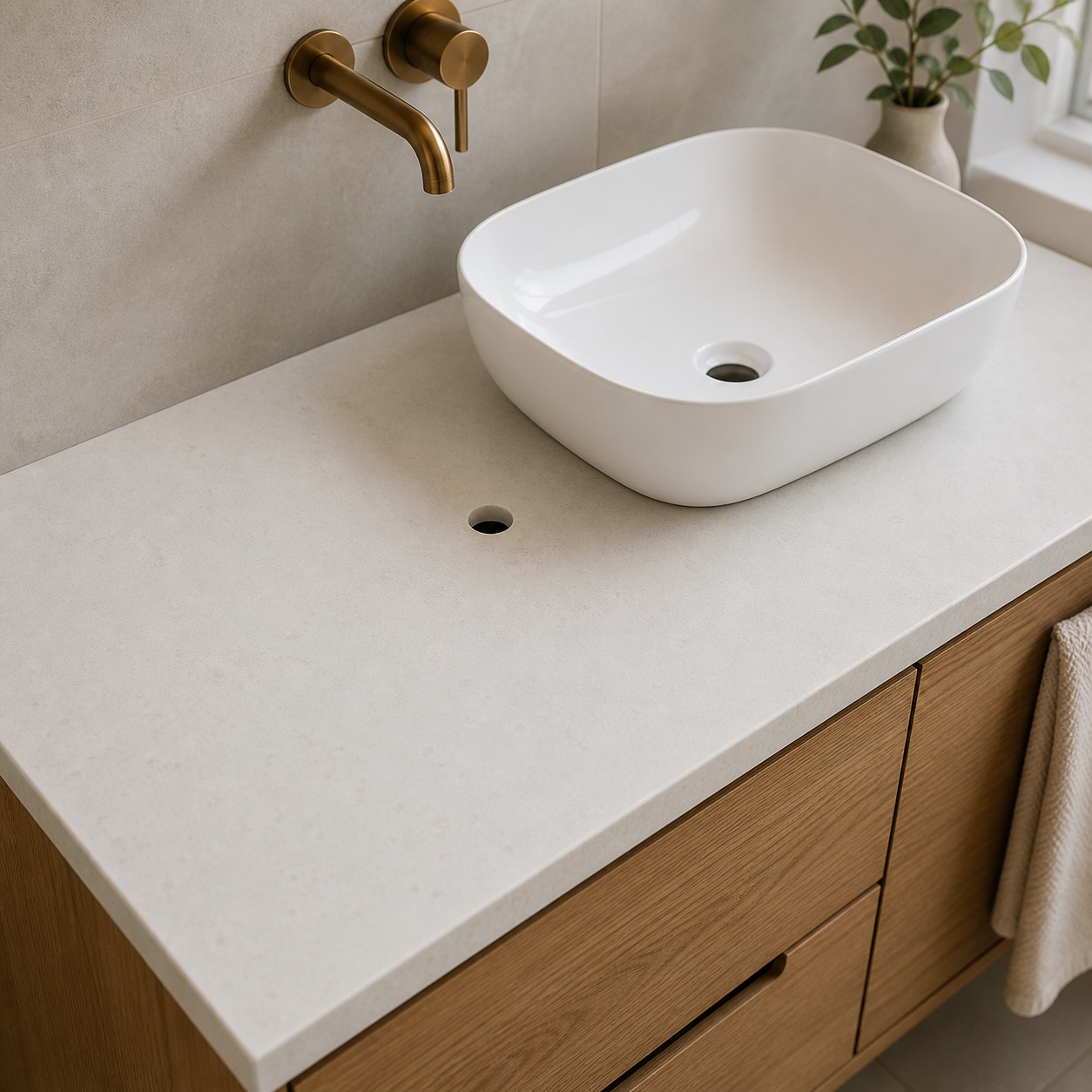
Sometimes, but not by assumption. A previous drop-in or undermount sink commonly leaves an opening shaped for the old bowl, whereas an above-counter vessel may use a smaller model-specific passage for its waste or mounting detail. If the existing opening removes the area where the new basin must sit, the top may no longer provide the required bearing surface. Even when the vessel hides the opening visually, hidden edges can remain unsupported or vulnerable to water.
Options include replacing the countertop, selecting a specifically compatible semi-recessed design, or commissioning a fabricator to assess a documented repair. Stone, engineered quartz, solid surface, laminate and wood require different techniques; an improvised filler is not a universal solution. Use the current basin template and counter manufacturer's instructions. Kohler, for example, treats cutout templates as model-specific positioning and cutting tools, which is why a photograph or guessed diameter is insufficient.
04 WORKING HEIGHT
Will the finished vessel sink be too high?
Calculate from the finished floor to the top of the basin rim: cabinet height plus counter build-up plus the part of the vessel that remains above the counter. An existing vanity selected for a drop-in or undermount sink may already place its top near the intended working level. Adding a full vessel above it can make handwashing uncomfortable, especially for children or shorter users, and can conflict with mirrors, shelves or wall fittings.
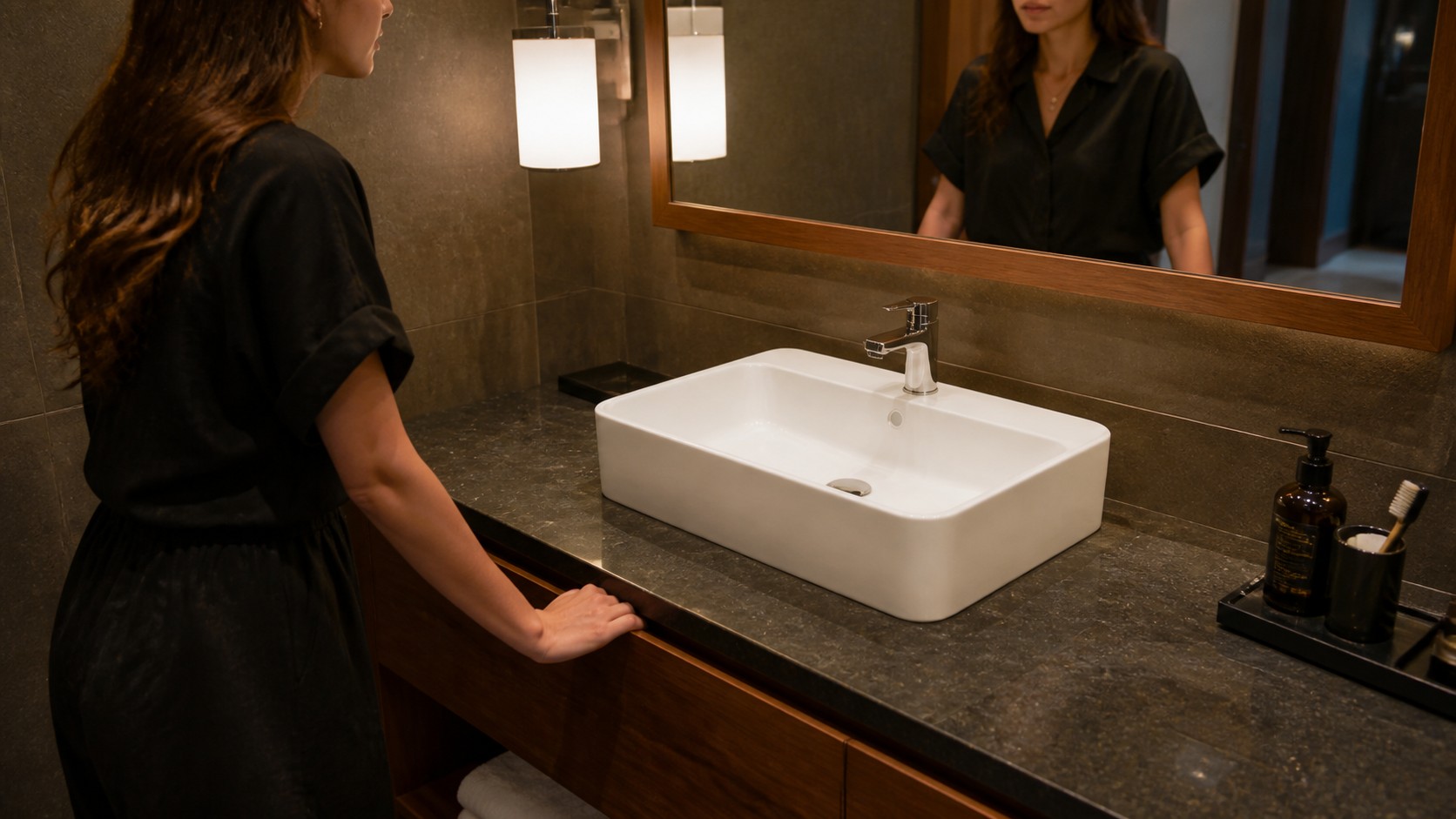
There is no responsible universal cabinet number because user height, basin form, recessed depth, floor build-up, accessibility needs and local requirements vary. Mock up the rim and faucet positions at full scale, then have the intended users test reach and posture. The countertop basin height and faucet guide provides a measurement method. If the result is too high, a lower cabinet, recessed installation or different basin may be better than compromise.

05 WATER DELIVERY
Can the existing faucet be reused?
A standard faucet that worked with a recessed bowl may not clear a vessel rim or reach far enough into the new basin. Check the water outlet, not just overall faucet height. The stream must clear the rim, land in a suitable area of the bowl and leave enough hand space without creating unnecessary drop and splash. Confirm handle movement against the basin and backsplash. Never drill the final faucet hole until the actual components have been dry-positioned.
A tall deck-mounted vessel faucet may need a new counter hole and may leave old holes visible. A wall-mounted faucet can free the counter but normally requires correct in-wall rough-in, service access and wall repair; it is not a shortcut when the wall is finished. Existing supply valves may still serve the new faucet if condition, connection and local rules allow. Match every dimension to the selected faucet instructions rather than to a generic vessel-sink diagram.
06 DRAIN ROUTE
Does the drain plumbing need to move?
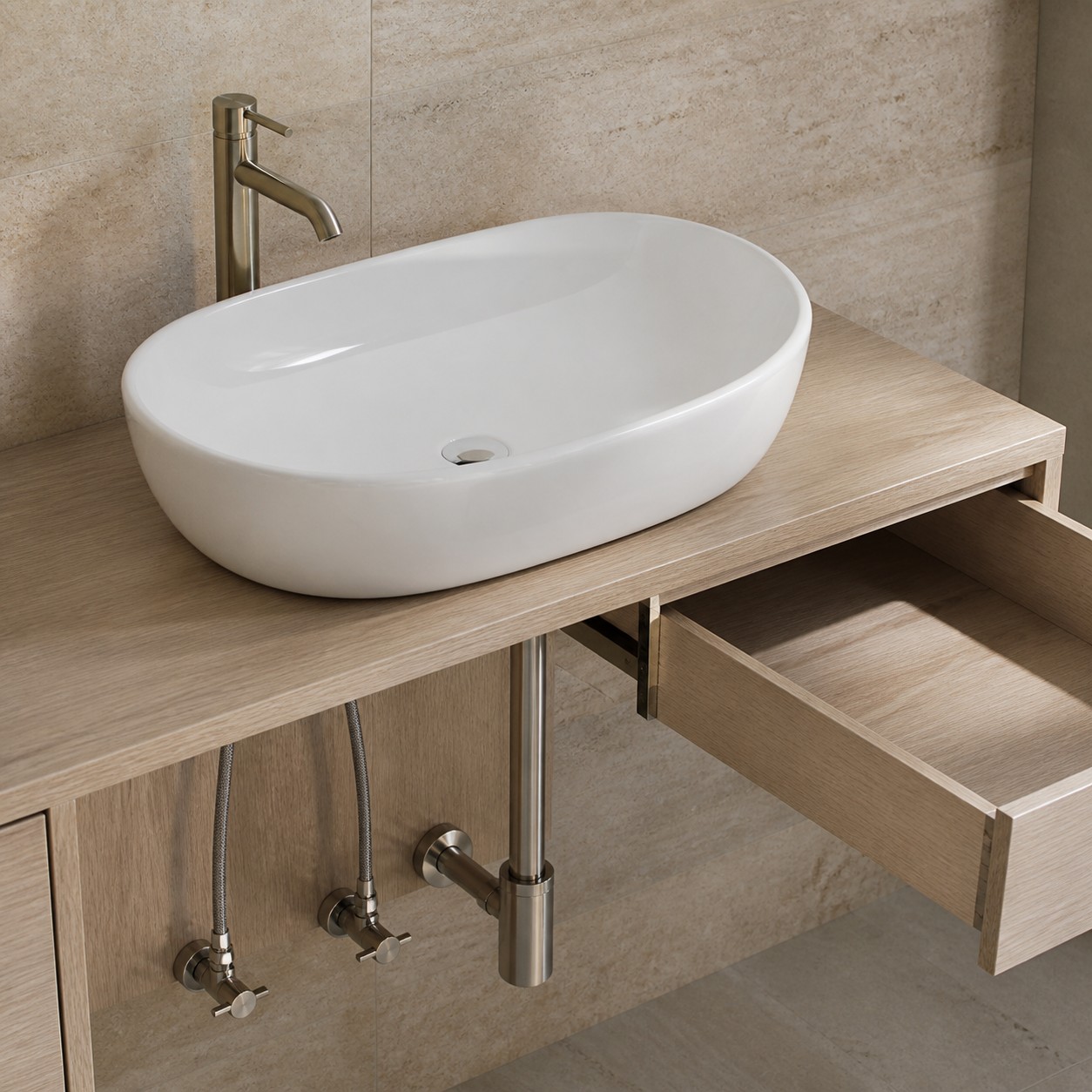
A vessel sink does not automatically require an entirely different building drain, but the visible fixture assembly changes. Match the basin's overflow or no-overflow configuration to an approved waste, confirm the ceramic opening, counter passage, flange, seals, thread engagement and tailpiece, then check how the tailpiece meets the existing trap. Our vessel sink drain guide separates these interfaces so one nominal pipe term is not mistaken for every dimension.
The trap may need adjustment if the new outlet moves horizontally or vertically. Do not use rigid pipework to pull the waste into alignment, and do not cut drawers or structural rails until service access and cabinet strength have been reviewed. Maintain the required trap seal, slope, venting and accessible joints under the applicable local plumbing rules. Replace corroded valves, brittle hoses or damaged waste parts rather than building a new finish around an unreliable connection.
07 PROVE BEFORE CUTTING
How should the conversion be approved?
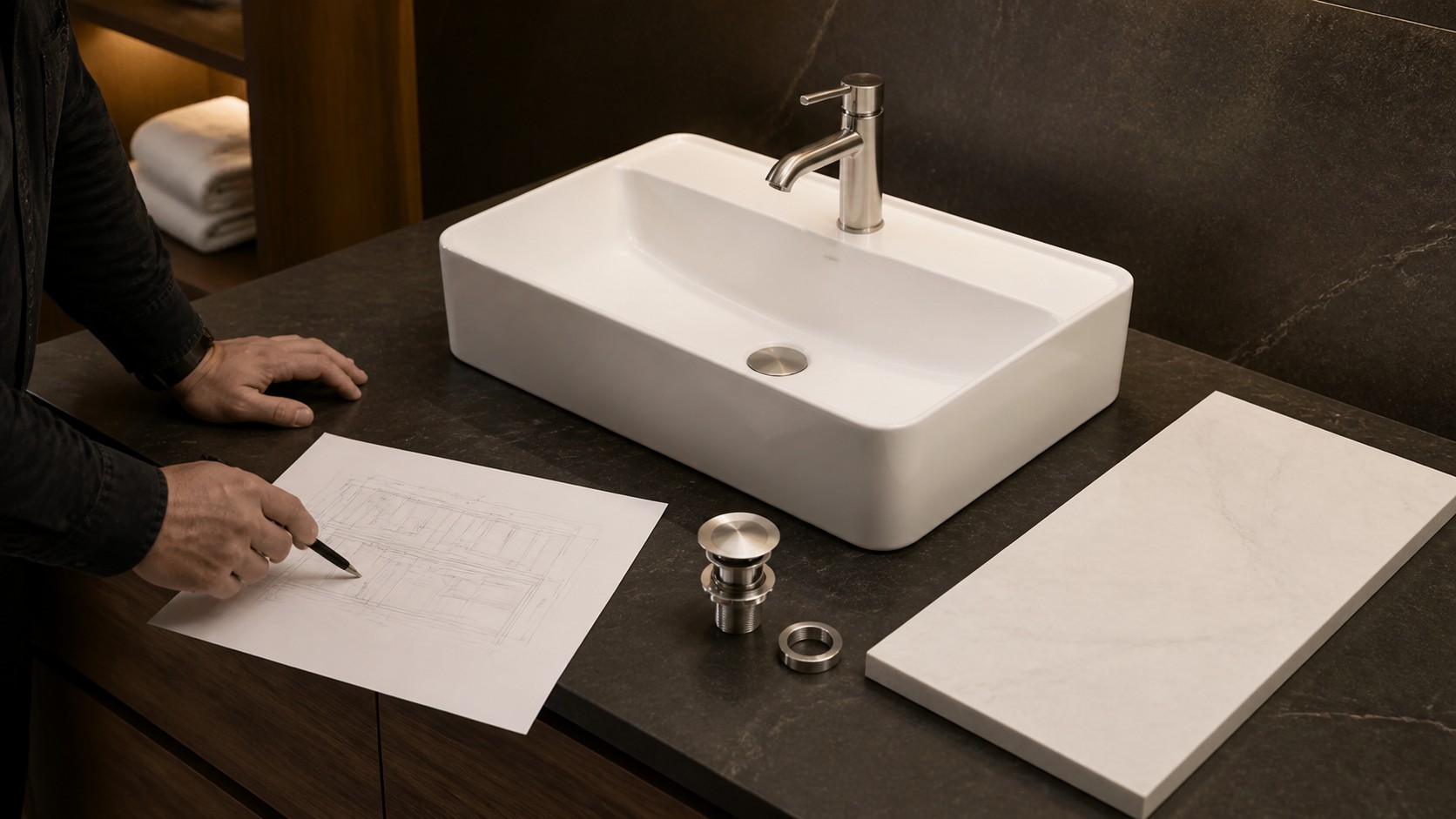
Create a full-size layout showing the basin footprint, drain centre, faucet body, spout path, handles, backsplash and counter edges. Dry-position the actual production-intent basin, faucet, waste and counter sample. Check stability, cleaning access around the base, user reach, splash behaviour, drawer clearance and tool access below. Record the approved centres and orientations so the counter fabricator, plumber and installer are working from one controlled arrangement.
Only then isolate the water and begin removal. Protect reusable surfaces and follow the product instructions for templates, cutting, sealants, curing and tightening. Stone or engineered-surface modification should be assessed by a qualified fabricator; electrical tools, silica-containing dust and fragile slabs add risks beyond ordinary plumbing. The ceramic vessel sink installation guide covers the later installation sequence, but the retrofit survey must be settled first.
08 MAKE THE DECISION
When should you replace the top or vanity?
Replace the countertop when the old opening removes required support, exposed edges cannot be made water-safe, previous holes cannot be finished acceptably, the material is cracked or swollen, or professional modification costs more than a controlled new top. Replace or lower the vanity when it is structurally damaged, cannot clear the plumbing, or makes the final rim unsuitable. Keeping old parts is worthwhile only when they improve the finished system, not simply because they already exist.
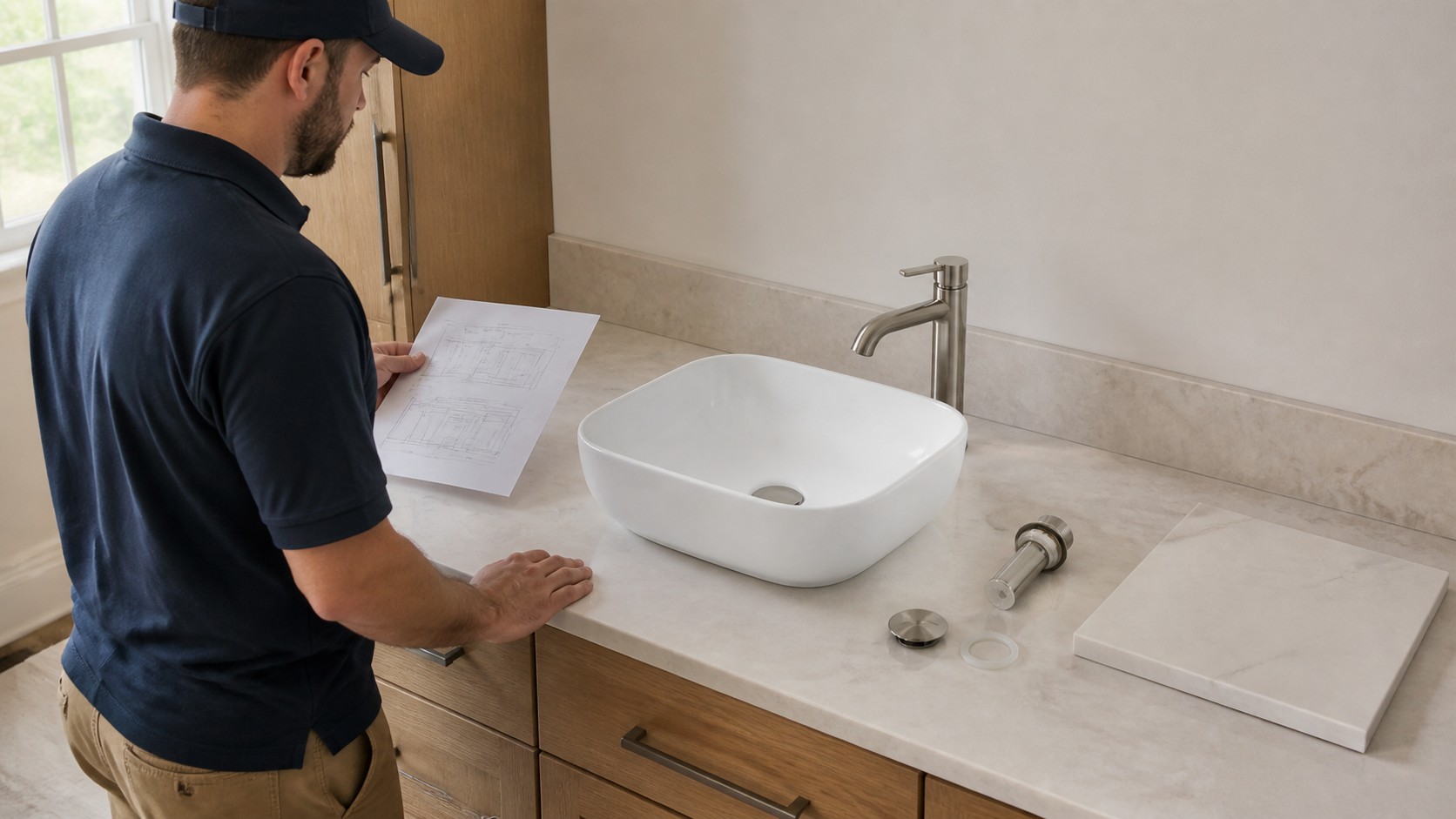
For a multi-room project, complete one signed mock-up before repeating the conversion. Record old-condition limits, approved basin and faucet models, counter details, centres, seals, drain parts and leak-test procedure. Stop the rollout if site conditions differ from the sample room. A successful vessel-sink retrofit looks simple because the difficult questions were answered before fabrication: support, height, water delivery, drainage, maintenance and replacement all agree.
FAQ COMMON QUESTIONS
Frequently asked questions
Can I put a vessel sink on an existing vanity?
Often yes, if the cabinet is sound, the final rim height works, the countertop can support the basin and the faucet and drain can be coordinated. Survey all parts first.
Can a vessel sink cover the old drop-in sink hole?
Visual coverage is not enough. The remaining countertop must provide the support and water protection required by the new basin; a large opening may require a new top.
Can I reuse the existing bathroom faucet?
Only if its outlet clears the vessel rim, reaches the correct area, leaves hand space and fits the available holes. Many standard faucets do not.
Does the vanity need to be lower for a vessel sink?
It may. Calculate cabinet, counter and above-counter basin height together, then test the finished rim with intended users and applicable requirements.
Does a vessel sink need special plumbing?
It needs a compatible basin, waste, tailpiece and trap arrangement. Existing building drainage may be usable, but alignment, overflow configuration and local rules must be checked.
Should I cut the countertop before the sink arrives?
No. Use the current model template and dry-fit the actual basin, faucet and drain before any irreversible fabrication.