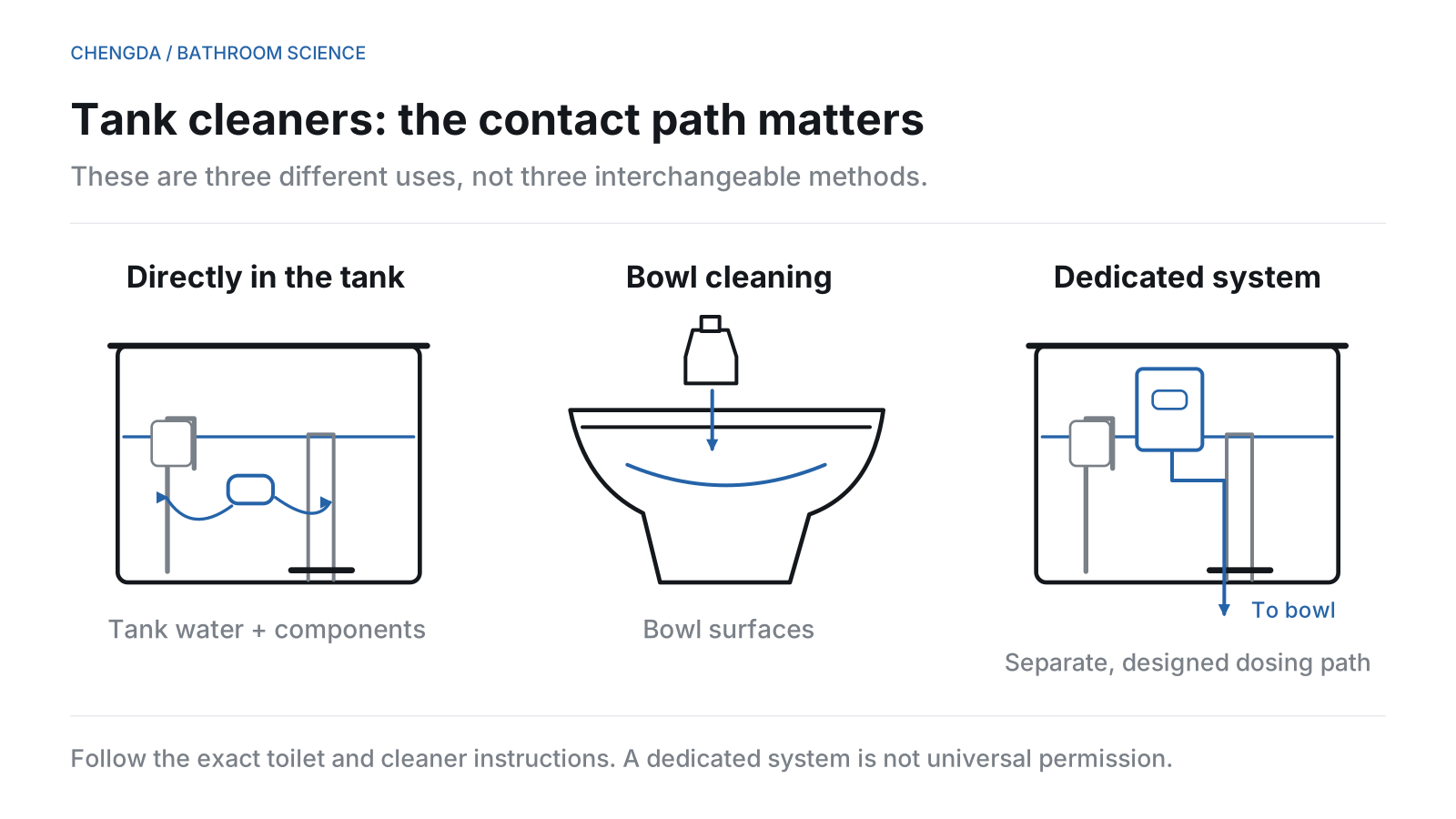
A toilet-cleaning tablet is not automatically suitable for the water tank. The answer depends on the cleaner, the installed toilet and valves, and exactly where the product will sit. A tablet approved for a dedicated dispenser is a different case from one dropped into the stored flushing water.
There is also no sound basis for saying that every tablet damages every toilet. The useful question is whether the instructions for this cleaner and this hardware allow the same method of use. A familiar brand name, pleasant smell or blue bowl water cannot answer that.
01 UNDERSTAND YOUR BATHROOM
First identify where the cleaner is meant to go
The words toilet cleaner describe a purpose, not a universal location. Before opening a package, distinguish the following arrangements. They expose different parts of the toilet to the cleaner.
| Method | Where the product acts | What needs checking |
|---|---|---|
| Bowl cleaner | Applied to the bowl as its label directs | Bowl finish, application method and accidental contact with other surfaces |
| Loose tank tablet | Dissolves directly in stored flushing water | Whether the toilet and fitted valves permit this product and use |
| Dedicated dispensing reservoir | Held in a separate, designed compartment | The exact dispenser's permitted tablet type and loading instructions |
02 UNDERSTAND YOUR BATHROOM
A ceramic shell does not make the whole tank chemically resistant
The visible tank may be ceramic, but the water-control assembly includes other materials. TOTO's care guidance notes plastic and rubber parts inside its tanks and warns that specified cleaners can damage them and interfere with water shutoff. A cleaner's suitability for a ceramic surface therefore does not establish suitability for the assembled tank.
The restrictions are real, but they should remain specific. Gerber's cleaning guidance warns against chlorine- or bleach-containing drop-in tank cleaners. A Kohler toilet installation guide also prohibits in-tank cleaners and identifies possible fitting damage and leakage. These examples support checking instructions; they do not establish a rule for every formula and system.
Replacing the question 'Will it damage porcelain?' with 'Which parts will it contact, and is that use permitted?' avoids a common mismatch. A one-piece body does not answer that question either: the one-piece and two-piece distinction concerns construction, not blanket chemical compatibility.
03 UNDERSTAND YOUR BATHROOM
Why can some toilets have a tablet compartment?
A purpose-built compartment can change the cleaner's route. Kohler's ContinuousClean explanation describes a reservoir that separates cleaning agents from the other tank components and dispenses cleaner to the bowl. Its instructions distinguish placing tablets in that reservoir from dropping them directly into tank water.
That is an example of a designed system, not permission to improvise one. A small basket, spare corner or plastic container inside an ordinary tank does not establish equivalent isolation. Do not assume that two things described as in-tank products use the same water path.
The ContinuousClean setup page specifies solid puck-style tablets rather than liquids or powders for the system it describes. Other equipment must be checked against its own instructions. This example describes Kohler hardware; it makes no claim about a Chengda model having that feature.
04 UNDERSTAND YOUR BATHROOM
Read the hardware instructions alongside the cleaner label
A practical compatibility check needs identifiable products. Keep the toilet model, any replacement valve details and the cleaner's full label together. A photo of the front of a packet may omit the placement restrictions on its back.
Look for an explicit match, rather than an absence of warnings on one document. If the instructions conflict or the relevant model cannot be identified, pause tank dosing and ask the equipment supplier a specific question: is this named cleaner allowed in this location with these fitted components?
- Toilet instructions: do they prohibit tank additives or identify an approved dispensing compartment?
- Cleaner label: does it specify bowl use, direct tank use or a particular dispenser, and what handling limits apply?
- Fitted components: if a valve was changed, are there separate care restrictions for that replacement part?
05 UNDERSTAND YOUR BATHROOM
Keep bowl cleaning separate from soaking the mechanism
If the task is cleaning the bowl, start with the bowl's care instructions. A cleaner intended to be applied, brushed and rinsed from a surface should not be reassigned to a reservoir simply because both belong to the same toilet. Nor should tank dosing be treated as proof that visible deposits no longer need attention.
The rim, seat, buttons and surrounding finishes also deserve separate checks. Our rimless versus rimmed toilet guide explains the bowl-access distinction; neither shape grants permission for tank additives. Likewise, PP and UF toilet seats are not the same material as the ceramic bowl.
For another ceramic fixture, the bathroom sink cleaning guide makes the useful distinction between routine care and identifying deposits. It is not a chemical recipe for toilet valves. Avoid transferring a cleaning method from one fixture to every surface in the room.
06 UNDERSTAND YOUR BATHROOM
If a tablet is already in the tank, what information matters?
Previous use does not prove damage, but an unclear instruction is a reason to stop adding more. Record the cleaner name, placement and any change in toilet behaviour. Follow the product's handling and removal guidance, and obtain advice if access or removal is unclear; do not reach for a partly dissolved tablet with bare hands.
Do not pour in a second chemical to neutralise the first. CDC guidance says not to mix bleach or disinfectants with other cleaners and calls for ventilation during use. A toilet is not a suitable place to experiment with combinations of descaler, bleach and deodoriser.
Repeated refilling or water outside the toilet warrants inspection, not an instant diagnosis of chemical damage. Kohler's running-toilet guidance identifies several possible causes. Tell the person inspecting it about the cleaner. If water is escaping onto the floor, stop using the toilet and isolate its supply if the normal shutoff operates safely; arrange repair rather than another dosing experiment.
07 UNDERSTAND YOUR BATHROOM
Blue water and fragrance do not demonstrate disinfection
Cleaning and disinfecting are different functions. The EPA's explanation distinguishes removing dirt from using a product to kill specified microorganisms. A visible colour change or fresh scent does not tell you whether a disinfectant claim applies or its required conditions were met.
For a disinfectant, the EPA's use guidance emphasises the labelled application site and contact time. That is separate from plumbing compatibility: a supported disinfectant claim does not authorise prolonged exposure of every seal and valve. Check both questions instead of allowing one claim to stand in for the other.
Technical references
- TOTO — Toilet bowl and tank cleaning tools and methods
- Gerber — Cleaning the toilet, seat and bowl rim holes
- Kohler — Toilet installation instructions 1466533-2
- Kohler — ContinuousClean technology FAQs
- Kohler — Toilets with ContinuousClean technology
- CDC — Cleaning and disinfecting with bleach
- US EPA — Cleaning, sanitising and disinfecting compared
- US EPA — Selected EPA-registered disinfectants
- Kohler — Toilet occasionally leaking or running
FAQ COMMON QUESTIONS
Frequently asked questions
Are chlorine-free tank tablets automatically safe?
No. That describes one aspect of the formula, not compatibility with every seal, plastic part or dispenser. Confirm the permitted placement and use in the cleaner's label and the instructions for the installed hardware.
Can ordinary bowl-cleaning liquid be poured into the tank?
Do not transfer a bowl-use instruction to the tank. Only use a product there if the equipment instructions and product label explicitly permit that method. A similar colour or smell is not evidence of equivalent use.
Does having a tablet compartment mean I can drop a tablet anywhere inside?
No. The compartment and its water route may be the reason that use is permitted. Follow its loading instructions and keep the tablet in the specified location. Do not bypass the compartment or substitute a makeshift holder.
If refilling starts after tablet use, does the whole toilet need replacing?
The timing alone establishes neither the cause nor the repair scope. Record the product and symptoms, then have the fitted mechanism assessed. Avoid assuming either that all components are damaged or that removing the tablet has resolved a leak.
How can I check whether my Chengda toilet permits a particular tablet?
Provide the toilet model, details of any replacement valve, the cleaner's complete label and the proposed placement. Ask for confirmation against the documents for the actual supplied model and fitted components. Another brand's example does not establish compatibility for your toilet.
NEXT · RELATED READING