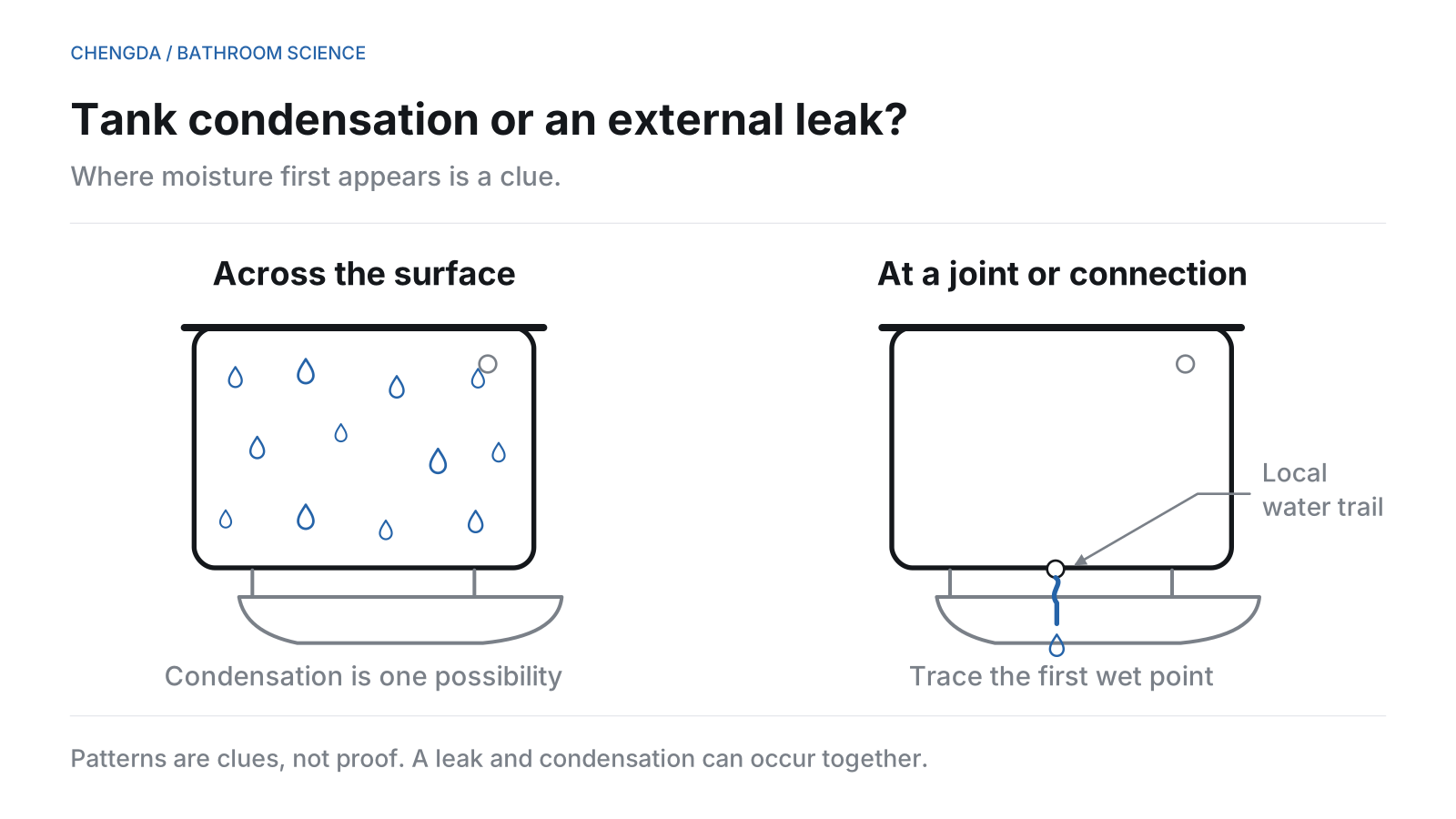
Water on the outside of a toilet tank does not automatically mean that water has escaped through the ceramic. Moisture from the room can condense on a cold tank. Equally, a leaking connection can wet the same surface, and both problems can occur together.
The useful question is where the water first appears, under what conditions, and whether another symptom accompanies it. A photograph of a puddle is rarely enough to answer that. This guide explains what the observations can tell you before anyone starts tightening fittings or replacing parts.
01 UNDERSTAND YOUR BATHROOM
Why can an intact tank develop water droplets?
Condensation is water vapour changing into liquid at a sufficiently cool surface. The relevant threshold is the surrounding air's dew point, not simply whether the bathroom feels warm. The National Weather Service's dew-point explanation uses a chilled container to illustrate this familiar effect.
A cistern holding cold supply water can cool its outer wall. In humid conditions, that surface may collect small droplets even when the tank is watertight. TOTO's seasonal guidance identifies humidity and water-to-room temperature differences as relevant factors. The droplets originate in room air; they are not evidence that sound ceramic has become porous.
A cold surface alone is not a diagnosis, either. Two bathrooms with similar room temperatures can behave differently because their moisture conditions differ. Describing the tank as cold is useful context, but it cannot establish that every drop on it came from condensation.
02 UNDERSTAND YOUR BATHROOM
Why the timing matters as much as the location
Note whether the wetness appears after a shower, during humid weather, after repeated toilet use, or while the room has been quiet. Showering adds moisture to indoor air, as EPA's moisture-control guidance explains. A time pattern can therefore support a condensation explanation without proving it.
For example, beads appearing over several cool surfaces after a shower are different evidence from a narrow wet trail that reappears at one connector. Record the distinction before wiping everything away. Neither observation should become a shortcut such as 'after showering always means condensation' or 'near a fitting always means a failed seal'. Water can move after it forms.
Compare like with like. A dry tank on a day with no shower and little toilet use does not establish that a previous problem has been repaired. Keep the use pattern and room conditions in your notes so the comparison remains meaningful.
03 UNDERSTAND YOUR BATHROOM
Read the moisture pattern without treating it as a verdict
The table is a way to organise observations, not a diagnostic test. Start at the highest visible fresh wet point and look downwards; the final drop or puddle may be some distance from its origin. Check only places you can see safely, without shifting the toilet or loosening joints.
| Observation | What deserves attention | What it cannot prove |
|---|---|---|
| Fine beads over a broad part of the tank | Surface condensation and room moisture | That the inlet connection and other seals are sound |
| A fresh wet trail repeatedly starts at one connector | That connector and the surface above it | That tightening the nut is the correct repair |
| Water appears between a separate tank and bowl | The joint, mounting points and water arriving from above | Which gasket, fastener or other component is responsible |
| A puddle is found at the toilet base | The full route from tank to floor, plus the base area | That the floor seal or flange has failed |
| External droplets occur together with unwanted refilling | Surface moisture and a possible internal water-loss path | That these are mutually exclusive problems |
04 UNDERSTAND YOUR BATHROOM
An internal leak, an external leak and condensation are different paths
An internal leak can send tank water into the bowl without wetting the floor. When enough water is lost, the inlet refills the tank; Kohler describes this intermittent-running pattern. Our article on a toilet refilling by itself explains that mechanism separately.
If repeated refilling keeps bringing in colder water, it may also help maintain a cool tank surface. That is a physical possibility connecting two observations, not proof of the cause in a particular bathroom. Improving ventilation would not repair an internal seal, while repairing the seal would not guarantee suitable room humidity.
External leakage needs its own inspection. A two-piece toilet has tank-to-bowl connections that differ from a one-piece body; see our one-piece and two-piece explanation. Korky's connection guide identifies tank-joint leak locations and warns against overtightening. Water near the base is not enough reason to begin a flange repair.
05 UNDERSTAND YOUR BATHROOM
A short observation record is more useful than a guess
Gently dry accessible exterior surfaces and the surrounding floor, following the product's care instructions. Then record where fresh moisture first returns. Observe during ordinary use rather than repeatedly flushing just to provoke a result. A photo showing the whole tank, supply connection and wet trail gives more context than a close-up of one droplet.
Include whether anyone recently showered, whether the toilet has been refilling without use, and whether water appears when it is left alone. A room humidity reading can add context, but there is no single reading that certifies the toilet leak-free. If the first wet point is hidden, describe it as unknown.
A tank dye test answers a narrower question: is water passing from the tank into the bowl? EPA WaterSense explains that check. It does not identify external condensation or clear a supply joint, and any dye used must be flushed away after testing. Do not interpret a clear bowl as proof that the outside is sound.
06 UNDERSTAND YOUR BATHROOM
What can the room conditions tell you?
Use the bathroom's ventilation as intended and note whether the moisture pattern changes. A fan that makes noise is not necessarily extracting enough air; EPA's bathroom ventilation guidance stresses that exhaust should actually leave the building. Recurring moisture can justify an assessment of the room as well as the fixture.
Wipe droplets rather than letting them accumulate. TOTO's use precautions note that condensation can damage nearby flooring. Calling water 'only condensation' does not make repeated wetting harmless. Keep the area dry while the cause is being established.
Avoid treating a towel wrapped around the tank, a homemade liner or altered supply-water temperature as a proven solution. Such changes can hide the original wetness pattern or require model-specific assessment. This article provides no instruction to add hot water or modify plumbing. Concealed tanks also need their designated access method; our wall-hung toilet guide explains why access is a separate consideration.
07 UNDERSTAND YOUR BATHROOM
When should the investigation move beyond observation?
Arrange inspection if water repeatedly emerges from a fitting, a visible crack is present, the floor remains wet, or the source cannot be traced. An active escape of water calls for prompt action: stop use and isolate the accessible supply only if it operates normally. Do not force a stuck valve or handle wet electrical controls.
Give the installer the model, photographs, timing and any recent work. Explain whether ventilation changed the droplets and whether unwanted refilling continues. That separates what you saw from what you suspect. Differences in tank placement, discussed in our close-coupled and back-to-wall guide, can affect what is visible, so an inaccessible connection should remain an open question.
Technical references
- TOTO — Summer toilet troubleshooting
- National Weather Service — Dry-bulb, wet-bulb and dew-point temperature
- US EPA — Main ways to control moisture in your home
- Korky — Leak between toilet tank and bowl
- Kohler — Toilet occasionally leaking or running
- US EPA WaterSense — Home maintenance
- US EPA — Remodeling your home and indoor air quality
- TOTO — Toilet use precautions
FAQ COMMON QUESTIONS
Frequently asked questions
Does tank sweating mean the ceramic is defective?
No. Surface condensation can form on an intact tank. It also does not rule out a defect or leaking connection. The source needs to be established from the whole pattern and, where necessary, an on-site inspection.
Can condensation leave a puddle on the floor?
Droplets can collect and run down to the floor. A puddle alone does not show whether the source was condensation, a tank connection or another leak. Trace the fresh moisture before assuming a failed floor seal.
If ventilation improves it, is a leak ruled out?
No. Improvement supports a moisture-related explanation, but another water-loss path may still exist. Check whether local wet trails or unwanted refilling remain instead of treating reduced droplets as a complete test.
Why can a supply fitting also look wet?
A cool fitting can collect condensation, but its connection can also leak. Wipe and observe without loosening it. A repeatable wet starting point is useful information for inspection, not a diagnosis by itself.
Should I tighten the tank bolts first?
Not simply because water is nearby. Water may have travelled from above, and excessive tightening can damage ceramic. Establish the source and follow the specific model's service requirements.
NEXT · RELATED READING