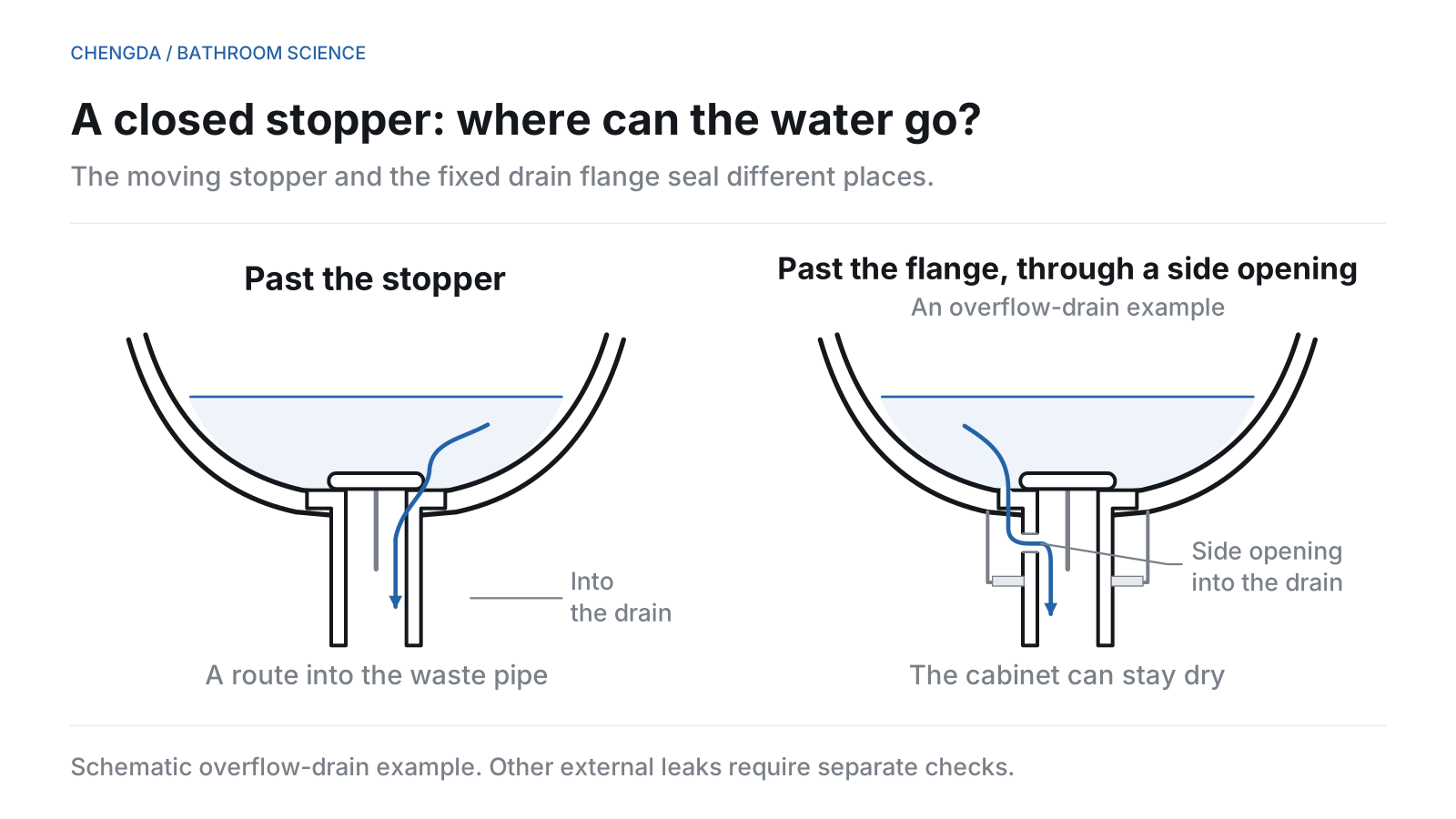
You close the basin stopper, turn off the tap and return to find a lower water level. Calling this a leaking sink does not yet identify the faulty part. First separate the water retained in the bowl from any water appearing underneath it.
The main possibilities are incomplete closing travel, a moving seal that no longer makes contact properly, or—in some overflow-drain assemblies—a bypass beside the fixed flange. These involve different parts. This article separates them so a disappearing bowlful of water becomes a specific observation rather than a guess.
01 UNDERSTAND YOUR BATHROOM
Start with what changed: the water level, the movement or the cabinet
Observe the basin with the tap off and the surrounding surfaces initially dry. Describe what you actually see before naming a seal or buying a part. A wet cabinet needs prompt attention, while a falling bowl level without visible external water is a different report.
The following distinctions organise a first conversation with the installer. They are not a pass/fail test, and more than one condition can exist at once. Stop using the basin if water is reaching furniture or the floor.
| Observation | Useful question |
|---|---|
| The stopper does not visibly change position | Is this a closable drain, and is its operating mechanism moving? |
| The stopper moves, but the bowl level falls | Is the closure reaching and maintaining its intended contact? |
| The cabinet becomes wet | Where does external water first appear, and during which action? |
| The problem began immediately after work | Which parts were removed, adjusted or replaced? |
02 UNDERSTAND YOUR BATHROOM
A moving stopper must complete its closing travel
On the lift-rod arrangement described by Kohler, the control at the tap moves an under-basin linkage connected to a ball rod. Linkage adjustment affects the stopper’s movement. Moving the visible control therefore does not, by itself, prove that the stopper has completed its closing travel.
Watch one normal opening and closing cycle without adding force. Does the cap descend smoothly, remain visibly tilted or return to the same position? A short video can show this more clearly than a photograph of the handle. Record the behaviour; do not treat a familiar-looking linkage as permission to copy another model’s adjustment.
It also helps to distinguish a control that feels different from a basin that merely loses water later. The first description directs attention to motion; the second says very little about motion unless you watched the cycle.
03 UNDERSTAND YOUR BATHROOM
The small seal beneath the cap can matter more than the shiny top
Moen’s explanation of immediate basin water loss identifies the underside O-ring on its illustrated waste plug as the water-retaining component. Deterioration can prevent closure; disconnected or damaged operating parts are separate possibilities. A stopper can therefore look present and still need closer identification.
Care is also model dependent. The Kohler K-7700 owner guide separates removal of exposed dirt from inspection of the seal and clicker. It specifies its own reassembly and warns against pulling the cap to open it. That is a particular drain’s procedure, not a universal twist-and-pull method.
For your report, distinguish visible residue from a split, distortion or missing part. A photograph cannot establish how a concealed seal contacts its seat. If the manual allows routine removal, record the original orientation before handling anything; otherwise leave the assembly intact. General basin care is covered separately in our ceramic sink cleaning guide.
04 UNDERSTAND YOUR BATHROOM
The fixed flange creates a second, less obvious boundary
Delta documents a specific overflow-drain case: an inadequate seal between the flange and basin can let water enter the drain body’s overflow openings, even with the outlet closed. The water may stay inside the drainage route, leaving the cabinet dry. Delta also notes that its stopper cap need not sit flush with the flange.
The component distinction is visible in Moen’s bathroom drain installation sheet: the push-down plug, drain body, upper gasket and cone gasket are separate items. A closure observation cannot assess every installed connection. Nor does the presence of several gaskets tell you that they are interchangeable or belong in the same position.
The practical question is where an inspection should focus, not how much sealant to add. Ask the installer to distinguish closure contact from fixed-joint sealing using the actual assembly instructions. A product diagram is more useful here than pressing harder on the cap.
05 UNDERSTAND YOUR BATHROOM
Identify the mechanism before interpreting the symptom
A push-operated cap introduces a different operating system from a lift rod. Kohler’s lavatory clicker service page specifically addresses loss of clicking or water retention. Its existence supports a model-specific service route; it does not establish that every clicker cartridge can be removed, adjusted or replaced in the same way.
Likewise, Kohler’s bathroom stopper identification guide distinguishes body material, stem form and other details, including versions with restricted model compatibility. Matching the colour or the visible top alone is insufficient evidence that a replacement will work with the existing drain.
Keep the basin model and drain model separate in your notes. The ceramic bowl may have been supplied independently of the tap and waste fitting. A dated invoice or original fitting diagram can identify the assembly more reliably than an online photograph. For the interface questions that follow identification, see our vessel sink drain guide.
06 UNDERSTAND YOUR BATHROOM
Compare observations under the same ordinary conditions
Use a modest water level below the overflow opening, remain nearby and note the starting level and elapsed time. Keep the tap off during the observation. If you repeat it after authorised care or servicing, use the same starting level, water temperature and observation period. This creates a useful before-and-after record without inventing an acceptable leak rate.
Do not fill to the rim to make a result more dramatic. A basin overflow is another route whose relationship with the waste fitting requires its own explanation; our overflow and no-overflow guide covers that arrangement.
Record a result as a result: the level changed visibly, stayed similar during this observation, or could not be compared reliably. A photograph at an oblique angle can make levels look different. Neither a brief hold nor an overnight experiment establishes a universal storage capability.
07 UNDERSTAND YOUR BATHROOM
Give the next person evidence they can use
A concise handover includes the basin and drain identification, when the symptom started, what work preceded it, normal operating movement, your timed level observation and any external wetness. Keep observations separate from proposed causes: “cap drops but water level falls” is more useful than declaring that the whole basin is defective.
Ask which component the inspection will verify and whether a proposed part matches the existing assembly. If resealing or drain removal is required, the installer should follow the fitting and basin instructions together. Our vessel sink installation guide explains those installation interfaces. This focused approach avoids replacing unrelated ceramic simply because water is disappearing.
Technical references
- Kohler — Adjusting Pop-Up Drains
- Moen — Bathroom Faucet Drain: Immediately Leaking Water
- Kohler — K-7700 Pop-up Drain Homeowners Guide
- Delta — Why does my pop-up sink stopper not stop water draining?
- Moen — INS10694A Bathroom Faucet Installation
- Kohler — Bathroom Sink Pop-Up Drains Clicker Mechanism Replacement
- Kohler — Identify the Correct Bathroom Sink Stopper
FAQ COMMON QUESTIONS
Frequently asked questions
Does a dry cabinet prove the drain is correctly sealed?
No. It records the absence of visible external water during your observation. Report it alongside the bowl-level change, then ask the installer which internal and fixed connections need checking.
Should I keep pushing the cap harder until it holds?
No. Observe its normal operating action and consult the drain’s instructions. Extra force makes the observation less useful and is not a substitute for identifying the mechanism and its intended closing position.
Can I fit any stopper with the same top diameter?
Do not assume compatibility from the top alone. Confirm the drain model and approved replacement reference; the part hidden below the surface matters too.
How long should every bathroom sink hold water?
There is no universal retention duration established here. Ask the fitting manufacturer about the intended use and applicable product requirements. A timed observation describes your symptom; it does not certify a leak rate or promise permanent storage.
Is this the same problem as a sink that drains slowly?
No. This question concerns water disappearing when you intend the outlet to be closed. Slow drainage concerns water leaving too slowly when you intend it to be open. Describe both separately if both occur.
NEXT · RELATED READING