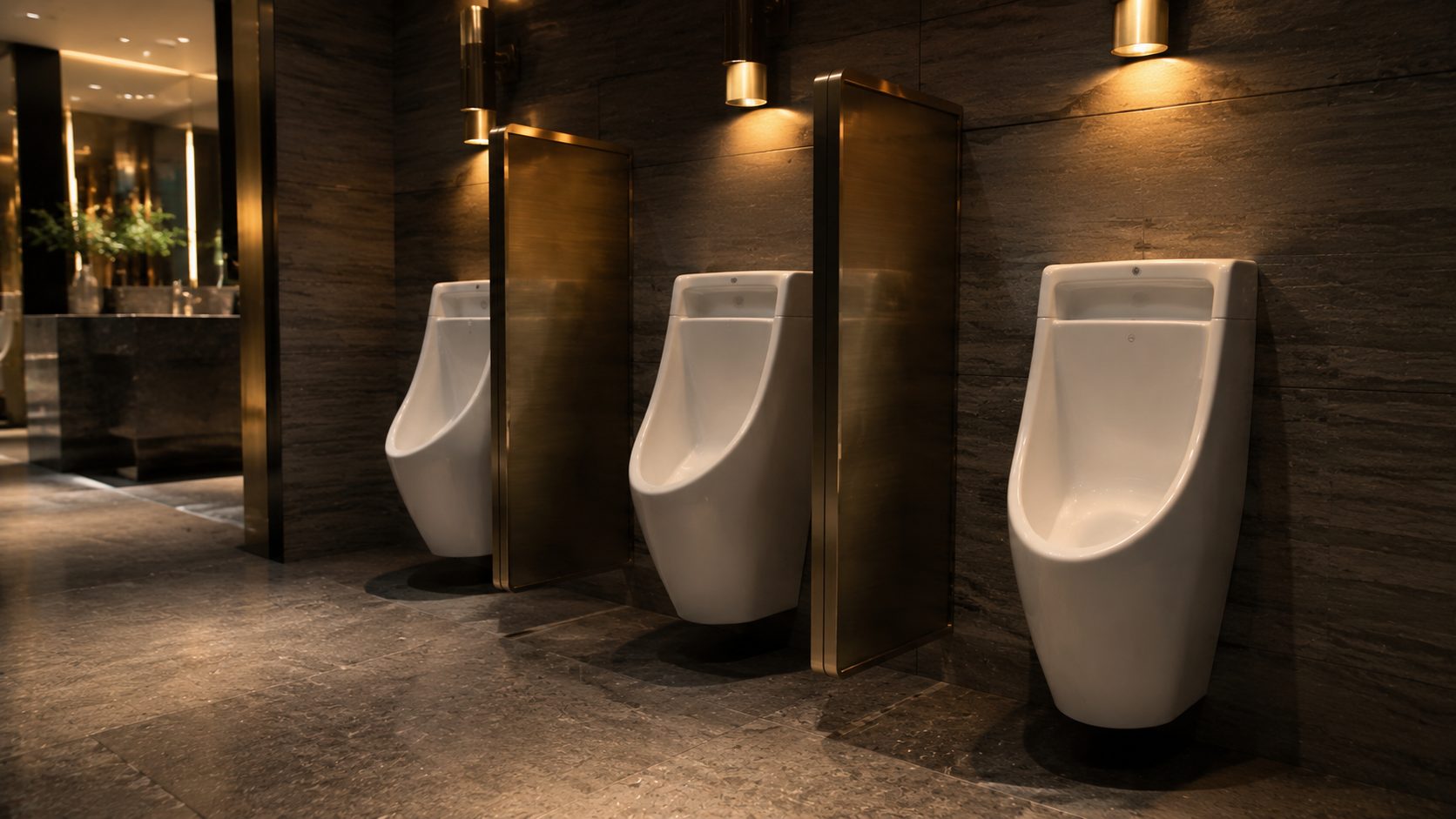
Urinals are the fixture buyers specify last and complain about first. They look simple — a glazed bowl on a wall — so they get ordered on a photo and a price, and then the wrong rough-in height turns up on site, the sensors have no power in the wall, or the washroom smells six months in. Commercial urinals are actually one of the most specification-heavy things we make: four different types, four ways of flushing them, two places the water can come in and two places it can go out, and a set of height and spacing numbers that change with the country. This is the guide we wish more buyers had read before sending the enquiry.
Key takeaways
- Type and flush are two separate decisions. Wall-hung, floor-standing, integrated sensor and waterless answer different problems; manual button, timed self-closing valve, infrared sensor and no-flush-at-all are chosen on traffic, power and who does the cleaning.
- The numbers that break projects are rough-in and height. Top spud or back spud, back outlet or bottom outlet, rim height for adults, children or accessible use, and the clear spacing between partitions — all decided before the wall closes, none of them recoverable afterwards.
- Water limits follow the border, not the factory. A urinal that is legal in most of the United States is illegal in California, and the UK regulates litres per use while Australia regulates the label on the box.
01 THE TYPES
The four commercial urinal types
Strip away the catalogue names and there are only four. A wall-hung urinal bolts to the wall with clear floor underneath. A floor-standing (or stall) unit runs all the way down to the floor. An integrated sensor urinal buries the sensor and the flush valve inside the ceramic so nothing is exposed. A waterless urinal replaces the flush entirely with a cartridge and a sealant liquid that floats on top of the urine and blocks the odour. The choice is rarely about looks. It is about how many people pass through in an hour, who is cleaning it, whether there is power in the wall, and how much abuse the fixture will take.
One structural note before the table, because it catches buyers out. The European functional standard for urinals — EN 13407, current edition BS EN 13407:2015+A1:2018 — covers wall-hung urinals in vitreous china or stainless steel, and gives them a class 1 / class 2 rating. It explicitly does not apply to slab and stall urinals, or to waterless ones. That is not a quality judgement; it simply means a floor-standing or waterless unit is assessed against something else, and an order that assumes “EN 13407” blankets every line item will find a gap in the paperwork.
Four types, four different problems
| Type | How it works | Strengths | Watch out for |
|---|---|---|---|
| Wall-hung | Bowl hangs off the wall on bolts; floor runs clear underneath | Fastest floor cleaning, saves space, widest model range | The wall has to carry the load; one fixed rim height suits adults only |
| Floor-standing / stall | Extends to the floor, so the whole height is a catching surface | Naturally fits every user height, children included; takes heavy abuse | Bigger footprint, heavier to ship, floor junction must be sealed properly |
| Integrated sensor | Sensor window and flush valve built into the ceramic body | Nothing exposed to break or steal; touch-free; clean lines | Power has to be decided early; servicing means getting inside the ceramic |
| Waterless | Cartridge plus a sealant lighter than urine, floating as an odour trap | No flush water, no valve, no power, no flush noise | Cartridges and sealant are a standing cost; it saves water, not labour |
02 FLUSH & POWER
How it flushes — and the power question nobody asks early enough
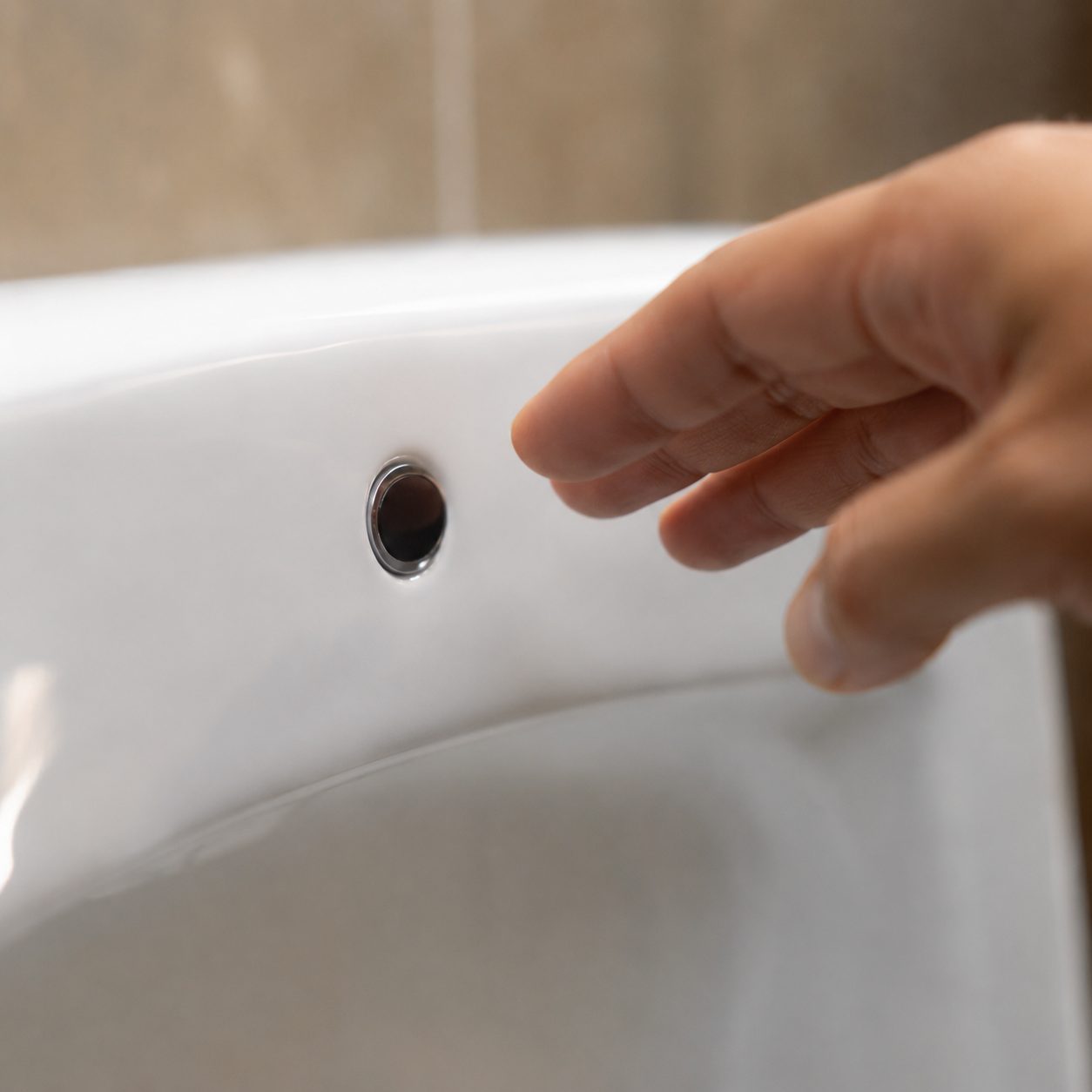
The simplest option is a manual push button or a timed self-closing valve: press it, the valve opens, it closes itself after a set few seconds. No electronics, no battery, very little to go wrong. Its one weakness is human — it only flushes when somebody presses it, which is why unattended washrooms with manual valves are the ones that smell. An infrared sensor removes that variable. The usual logic is a short pre-rinse of around two seconds when a user stands in front, then the main flush roughly six seconds after they step away, so the bowl is wet before use and cleared after it.
Then comes the question that decides more urinal projects than any other, and almost nobody raises it at enquiry stage: where does the sensor get its power? There are three answers. DC — typically 6V from four AA alkaline cells, with suppliers commonly claiming around two years of life at 4,000 flushes a month (a manufacturer’s figure, and heavily dependent on real traffic). AC — a transformer, usually accepting 110–380V in and delivering 6–9V out, which needs a power supply and somewhere to put the transformer. Or AC/DC dual supply, running off mains and falling back to batteries when the power drops.
For a buyer this is not a detail, it is a deadline. If there is no cable in the wall by the time the tiles go on, the whole washroom is battery-powered by default — and on fifty urinals in an airport, changing two hundred AA cells on a maintenance ladder is a real annual cost that nobody budgeted. Decide the power source at the drawing stage, tell us before we quote, and the transformer position goes on the setting-out drawing instead of into a change order.
03 ROUGH-IN
Top spud or back spud, and where the waste goes
“Spud” is simply where the water comes in. On a top spud urinal the flush valve connects at the top of the ceramic and is visible — easy to service, easy to see, and the usual choice for schools, factories and anywhere a maintenance team wants to reach the valve without a chisel. On a back spud urinal the supply arrives behind the ceramic and is hidden in the wall — cleaner to look at, standard for office and hotel work, and completely unforgiving if the wall is built before the model is chosen. An integrated sensor unit is effectively a back-spud arrangement taken to its conclusion: the water leaves through the sensor plate itself and there is no exposed outlet at all.
The North American rough-in conventions are worth knowing as a sanity check, not as gospel. A standard wall-hung urinal is usually set with the rim at 24″ (610mm) above finished floor; a top spud supply centre line sits around 42″ (1067mm) AFF; and the 2″ waste centre line lands roughly 17¼–17½″ (438–445mm) AFF. Every one of those numbers moves from model to model. They are a common convention, not a standard, and the only figure a plumber should build to is the one on the cut sheet for the exact model being supplied.
At the bottom, two more decisions. The outlet is usually a back outlet into a wall-mounted trap, though bottom outlets exist for some floor-standing work. And the trap is either integral — cast into the ceramic, fewer joints, nothing to hide behind the fixture — or an external P-trap, which is serviceable and easier to clear. Seal depth by convention runs 1.5–2″ (about 38–50mm), with UK practice commonly specifying a 50mm seal. A shallower seal dries out faster in a low-use washroom, which is the quiet cause of a lot of odour complaints.
Never build to a generic rough-in table
The 42″ supply and 17½″ waste figures above are what most North American installers expect, and they will be wrong for some models. Before the plumber sets out, get the dimensioned cut sheet for the exact model, in the exact configuration ordered — top or back spud, back or bottom outlet, integral or external trap — and build to that drawing. Ask for it at quotation stage; it costs nothing then and thousands after the tiling.
04 HEIGHT
Mounting height, children and accessible urinals
For a standard adult urinal in a commercial washroom, the working figure is a rim at 24″ (610mm) above finished floor. That single number is where most washrooms stop, and it is also why most washrooms fail somebody. A row of identical urinals at one height serves one kind of body, and the moment children, wheelchair users or a wide range of heights walk in, the fixture stops working long before it breaks.
The United States puts figures on that. Under the 2010 ADA Standards, an accessible urinal is a stall-type or wall-hung unit with the rim no higher than 17″ (430mm) AFF. It must be at least 13½″ deep measured from the outer face of the rim to the back, so a shallow decorative bowl will not qualify however low it is hung. A 30″ × 48″ (760 × 1220mm) clear floor space is required for forward approach, and the flush control has to sit within the 15″–48″ reach range — which quietly rules out a flush button placed high on the wall, and is one more reason sensor flushing gets specified on accessible fixtures.
Children are a separate exercise. The ADA children’s provisions bring the accessible rim down to 15″ (380mm) or lower. European school practice commonly sets urinals around 50cm for ages 7–11 and around 57cm for ages 12–15 — but treat those as common practice rather than law, because the binding figure is whatever the local building code says. This is where floor-standing earns its keep: because the catching surface runs the full height to the floor, one fixture quietly accommodates a child, an adult and a wheelchair user without three different setting-out heights on the drawing.
05 LAYOUT
Partitions, spacing and the splash zone
Buyers order urinals by the piece and install them by the row, and the row is regulated. Under the International Plumbing Code (IPC 405.3.5, echoed by IBC 2903.1.5), each urinal in a public or employee washroom must have walls or partitions giving privacy, and the clear horizontal distance between those walls or partitions must be at least 30″ (762mm). That is the number that decides how many fixtures actually fit a wall — and it is why a quantity worked out from the drawing width alone is usually optimistic.
The partitions themselves are dimensioned too. They must begin no more than 12″ (305mm) above the floor, extend at least 60″ (1524mm) upward, and project at least 18″ (457mm) from the back wall — or at least 6″ (152mm) beyond the front lip of the urinal, whichever is greater. That last clause matters for deep or projecting bowls: a partition sized off a shallow model will be short for a deeper one.
Then there is the splash zone, which is the part everyone forgets and everyone smells. The code requires the wall and floor surfaces within 2ft (610mm) in front of the urinal lip, 4ft (1219mm) high, and 2ft (610mm) to each side to be smooth, non-absorbent and readily cleanable. Porous grout and absorbent flooring inside that box is where odour actually takes hold — not in the bowl. One more layout figure worth having: under IPC 424.2 (formerly 419.2), urinals may substitute for up to 67% of required water closets in assembly and educational occupancies, and up to 50% elsewhere. That single clause is why stadium, school and airport packages carry so many urinals per container.
06 SPLASH & GLAZE
Why the curve inside the bowl is a hard specification
Splashback is treated as a design quirk. It is physics, and it has been measured. A 2025 paper in PNAS Nexus, “Splash-free urinals for global sustainability and accessibility” (Weber State University with the University of Waterloo), identified the governing variable as the impinging angle — the angle at which the stream meets the ceramic. When that angle stays below about 30°, splashing falls by roughly 95% compared with a stream hitting the surface head-on. The researchers’ two study geometries, nicknamed Cornucopia and Nautilus, cut splashing to about 1.4% of a conventional bowl, and the Nautilus form held that performance across a much wider range of user heights. Those are research concept designs, not products on our shelf — but the lesson transfers directly: the curve of the inner bowl is a functional dimension, it is why a bowl that catches the stream at a shallow angle over its full height outperforms a shallow decorative one, and it is why floor-standing units are naturally more forgiving of who is standing in front of them.
Most “smelly urinal” complaints have nothing to do with the flush. They are droplets on a porous floor, uric scale in the waste pipe, and a trap seal that dried out over a long weekend.
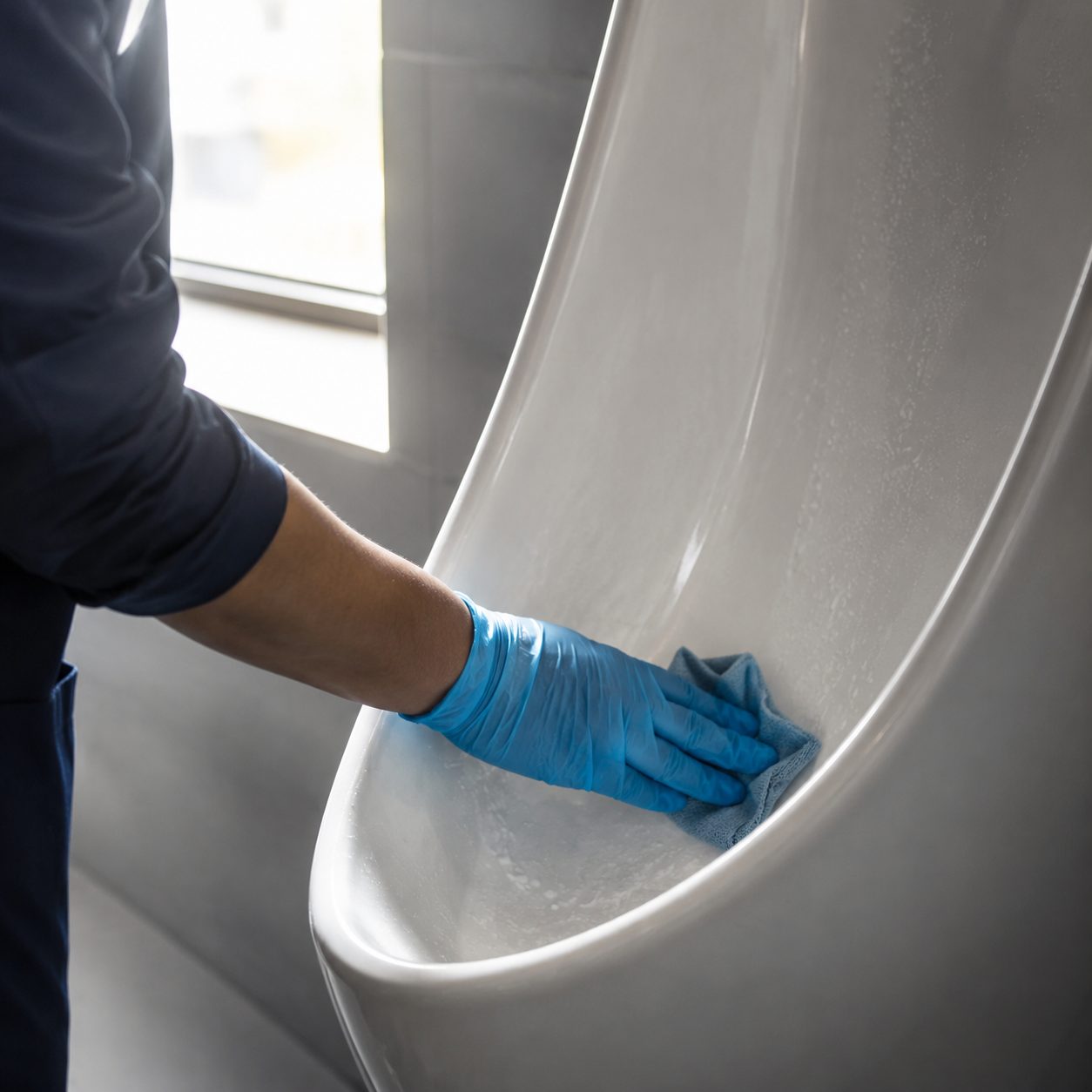
The ceramic does the rest of the work. A proper vitreous china body has a water absorption of no more than 0.5% of dry weight, verified by ISO 10545-3 — and that low absorption, sealed under an even glaze, is the whole reason a urinal resists staining and odour for years rather than months. It is a firing question before it is a cleaning one, which we cover in why we fire at 1250°C and in our look at the raw material behind the glaze. The long-term enemy is uric scale — uric salts crystallising with hard water into a deposit that no amount of extra flushing removes; it needs enzyme or bacterial cleaners, and a bowl geometry that lets a cloth reach every part of the surface.
07 WATER
Water limits change with the border
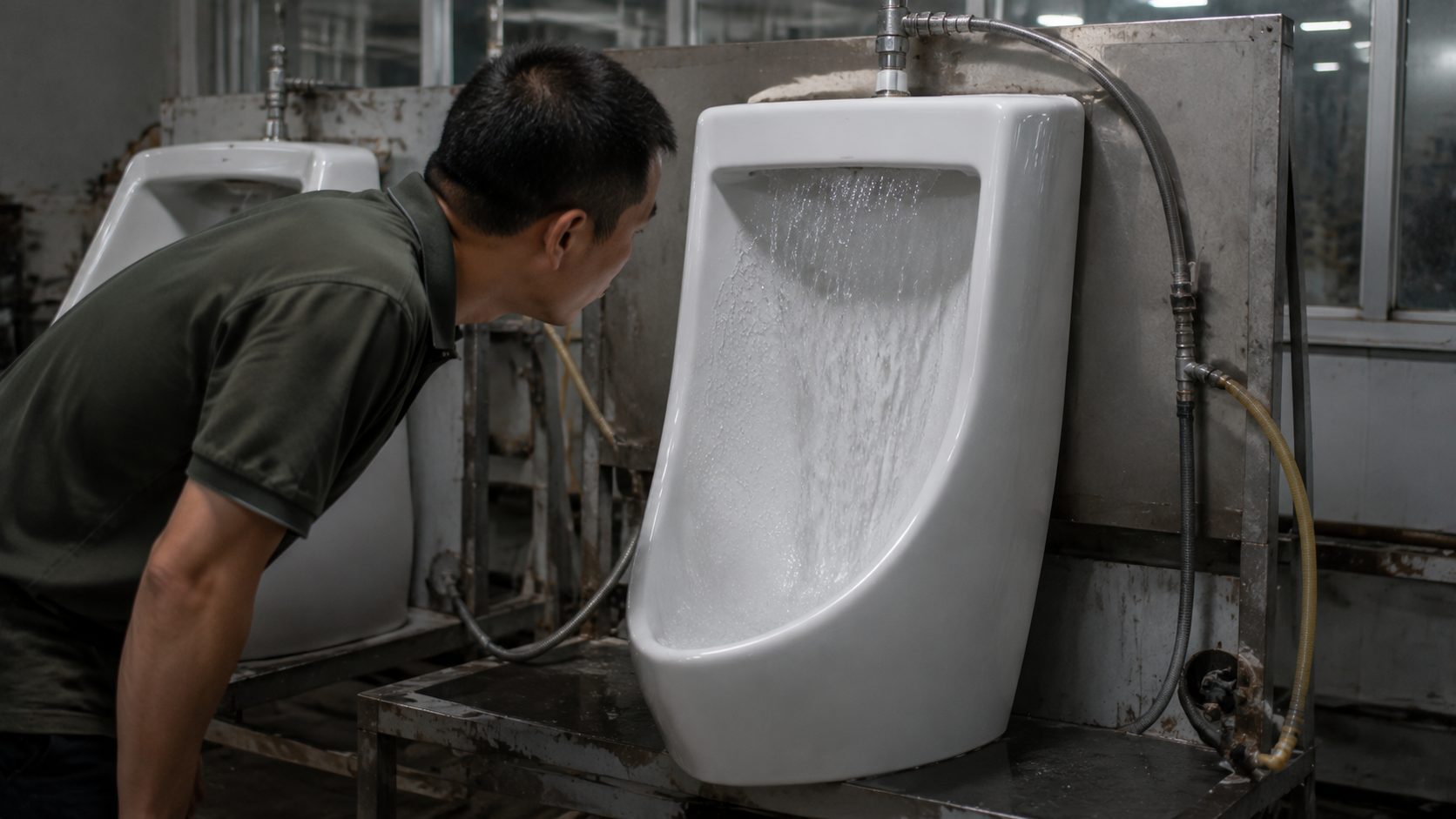
The United States sets a federal floor of 1.0 gpf (3.8 litres) per flush under the Energy Policy Act of 1992, and then the market moves well past it. The EPA’s WaterSense label requires 0.5 gpf (about 1.9 litres) or less — half the federal baseline — and the EPA estimates that replacing one older 1.5 gpf urinal with a WaterSense model saves around 4,600 gallons (roughly 17,400 litres) per urinal per year. California went further: since 2015, wall-hung urinals sold there must flush at 0.125 gpf (0.47 litres), and as of 2024 thirteen states were running standards stricter than the federal one. One honest caveat that trips up marketing copy: the EPA handles waterless urinals under separate guidance, and they sit outside the WaterSense flushing-urinal label. Nobody should be told a waterless urinal “is WaterSense certified”.
Elsewhere the rules are shaped differently. The UK Water Supply (Water Fittings) Regulations 1999 regulate use, not the label: a pressure flushing valve may deliver no more than 1.5 litres per use per position, while an automatic flushing cistern is capped at 10 litres per hour for a single urinal and 7.5 litres per hour each where two or more are served — and an automatic cistern that is neither manually operated nor electronically triggered by actual use must have a time-controlled isolating valve plus a lockable isolating valve, or an equivalent automatic device. That regulation, more than any sales pitch, is why British projects specify sensor flushing so often. Australia works through labelling: urinals must be registered under WELS and star-rated on litres per flush, with WaterMark approval normally a prerequisite. Europe assesses wall-hung units against EN 13407. Which mark applies where is a longer story, covered in our guide to sanitary ware certifications for export.
Urinal water limits by market
| Market | The limit that binds | Notes |
|---|---|---|
| USA (federal) | 1.0 gpf (3.8 L) per flush — EPAct 1992 | A legal floor, not a target; most of the market sits below it |
| USA (WaterSense) | ≤0.5 gpf (about 1.9 L) | Half the federal baseline; waterless urinals sit outside this label |
| California | 0.125 gpf (0.47 L), wall-hung, since 2015 | As of 2024, 13 states ran standards stricter than federal |
| United Kingdom | ≤1.5 L per use per position (pressure flushing valve) | Automatic cisterns: ≤10 L/hour single; ≤7.5 L/hour each for two or more |
| Australia | Registered and star-rated under WELS by litres per flush | WaterMark approval is normally a prerequisite to registration |
| Europe | EN 13407 (BS EN 13407:2015+A1:2018), class 1 / class 2 | Wall-hung vitreous china or stainless only — not slab, stall or waterless |
08 ORDERING
What to specify before you order
Most urinal enquiries arrive as “price for 200 wall-hung urinals”, and most of them then take three weeks of back-and-forth to become an order. The venue usually decides the specification faster than the buyer does, so here is how we normally read it.
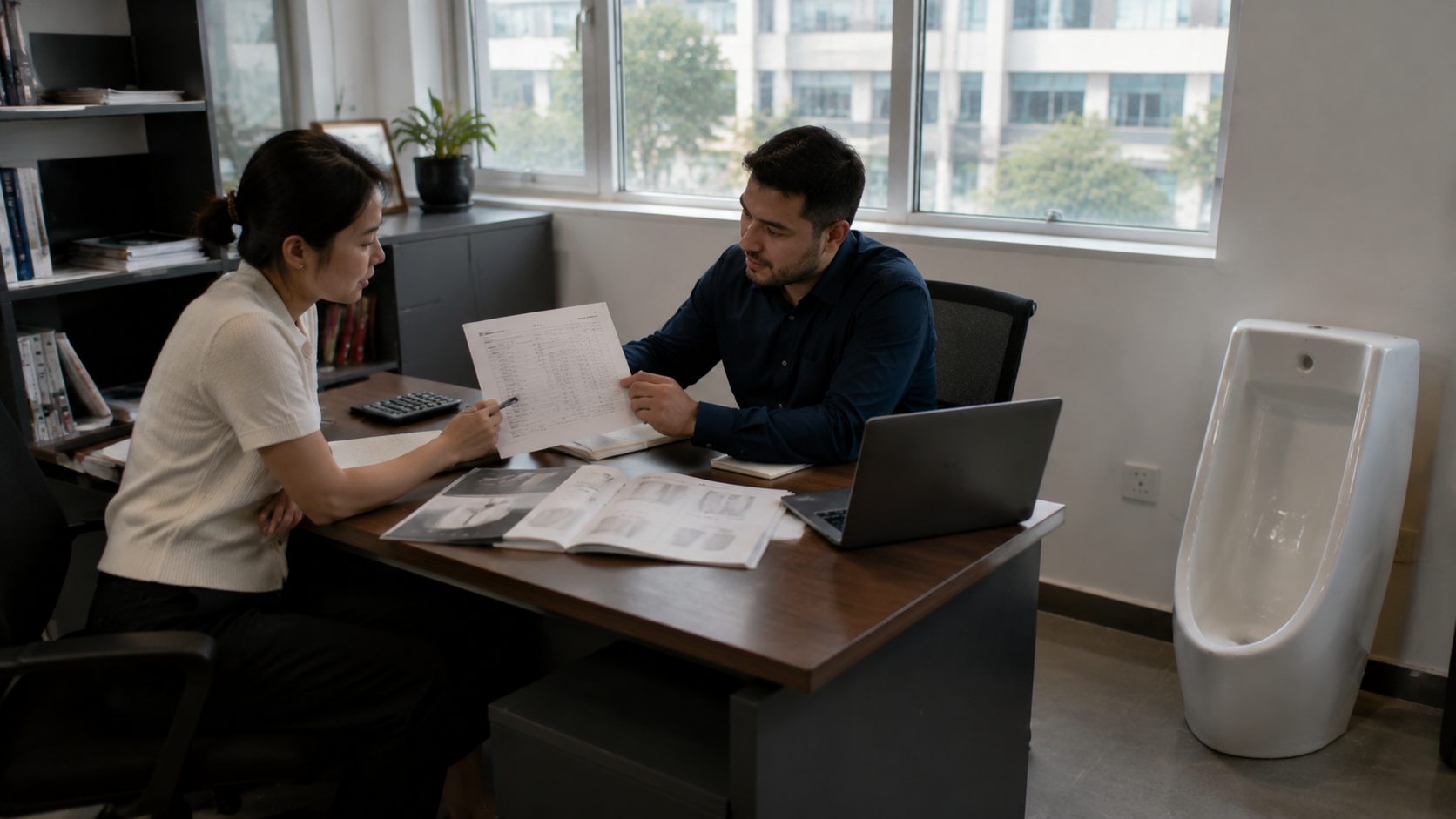
Venue, constraint, and what we usually quote
| Venue | The real constraint | What we usually quote |
|---|---|---|
| Malls & airports | Very high traffic, constant cleaning, vandalism risk | Floor-standing or heavy-duty wall-hung, sensor flush, AC power |
| Office buildings | Steady traffic, appearance is part of the brief | Wall-hung integrated sensor, valve concealed inside the ceramic |
| Schools | Two heights needed, tight budget, thin maintenance cover | Floor-standing or low-set wall-hung, push button or timed valve — no batteries to change |
| Factories & warehouses | Durability first, incoming water quality may be poor | Timed self-closing valve, large open bowl that can be hosed down |
| Hotels | Quiet, easy to clean, guest-facing finish | Wall-hung with sensor, low-noise flush |
Then the parts list, which is where urinal orders leak. Confirm every line: the flush valve and its power source; the transformer if AC; the supply connection and angle valve; the drainage fittings — P-trap, connectors, gaskets; the strainer; the cartridge and sealant if the unit is waterless; and the wall fixings — bolts, anchors and how the load is actually carried. On a high-traffic wall-hung installation that last point is structural, not a hardware detail; the reasoning is the same as for a wall-hung pan, which we set out in our wall-hung toilet installation guide.
On commercial terms, we would rather be useful than impressive. MOQ depends on the model and whether it is OEM — ask us for the specific item rather than trusting a platform listing. Lead time depends on the order structure, and we will give you a date against your actual mix, not a slogan. Our usual load port is Shantou, with Shenzhen and Guangzhou available. And packing deserves a sentence of its own: a urinal is an awkward shape, and the two most fragile places on it are exactly the two that matter — the rim and the corners inside the bowl. We pack with foam corner protection in individual cartons, and we work the loading plan out by volume and pallet method for your specific model rather than quoting a units-per-container number that turns out to be someone else’s. Where this sits inside a wider project package is covered in our guides to supplying hotels and apartments and bathroom products for apartment projects, and a pre-shipment check belongs in the plan too — see inspecting sanitaryware before shipment.
Confirm before the deposit
Type and rim height; flush method, and if sensor, the power source (DC batteries, AC transformer or AC/DC dual) and where the transformer lives; top or back spud; back or bottom outlet; integral trap or external P-trap and seal depth; supply and waste centre lines taken from the model’s own cut sheet; clear spacing and partition dimensions, and therefore the real quantity per washroom; wall build-up and fixing method; cartridge and sealant supply if waterless; carton and pallet spec; the flush volume your destination market legally allows.
As a Chaozhou-based ceramic sanitary ware factory — not a trading company — we produce wall-hung, floor-standing, integrated sensor and waterless urinals alongside basins, toilets, smart toilets and bathroom cabinets, with OEM and ODM adaptation to destination-market requirements. Certification support varies by product and market, and buyers can request available test reports before ordering; how we run private-label work is set out in our OEM and ODM bathroom products guide. Send us the venue, the destination market, the quantity and whether there is power in the wall, and we will come back with the right type, the cut sheet and a quotation. WhatsApp +1 213 216 0960.

A urinal is the cheapest fixture in a commercial washroom and the one most likely to generate complaints for the next fifteen years. Decide the type and the flush on the traffic, fix the power before the wall closes, build to the cut sheet rather than a rough-in table, and check the water limit against the border you are shipping to. Everything after that is just ceramic — and ceramic we can handle.
FAQ COMMON QUESTIONS
Frequently asked questions
What types of commercial urinals are there?
Four. Wall-hung units bolt to the wall and leave the floor clear, which makes cleaning fastest and gives the widest model choice. Floor-standing (stall) units run down to the floor, so the whole height is a catching surface — they suit every user height including children, and take heavy abuse. Integrated sensor units build the sensor and flush valve into the ceramic, so nothing is exposed to break or steal. Waterless urinals replace the flush with a cartridge and a sealant liquid that floats on the urine and blocks odour. Note that EN 13407 covers wall-hung units only — not slab, stall or waterless.
What is the standard urinal mounting height, and what does ADA require?
A standard adult wall-hung urinal is normally set with the rim at 24 inches (610mm) above finished floor. Under the 2010 ADA Standards, an accessible urinal must be stall-type or wall-hung with the rim no higher than 17 inches (430mm) AFF, at least 13½ inches deep from the outer rim to the back, with a 30 × 48 inch (760 × 1220mm) clear floor space for forward approach and the flush control within the 15–48 inch reach range. For children, the accessible rim drops to 15 inches (380mm) or lower. Local codes govern, so confirm against the code that applies to your project.
Top spud or back spud — which should I order?
Top spud means the flush valve connects at the top of the ceramic and is visible: easy to service, and the usual choice for schools, factories and buildings with lean maintenance. Back spud means the supply arrives behind the ceramic and is hidden in the wall: cleaner to look at, standard for offices and hotels, but the wall has to be roughed in for that exact model. Decide before the wall is built, and take the supply and waste centre lines from the model's own cut sheet rather than a generic rough-in table.
Should I choose sensor or manual flushing for a commercial washroom?
It depends on traffic, maintenance and power. A manual push button or timed self-closing valve has no electronics and almost nothing to fail, but it only flushes when somebody presses it — which is why unattended washrooms with manual valves are the ones that smell. Infrared sensors remove that variable, typically with a short pre-rinse of about two seconds and a main flush around six seconds after the user steps away. The real question is power: DC batteries (commonly 4 × AA at 6V), an AC transformer (110–380V in, 6–9V out), or AC/DC dual supply. Decide it before the wall closes, because battery changes across fifty fixtures are a real annual cost.
Are waterless urinals worth it?
Sometimes, and honestly less often than the marketing suggests. They use no flush water, no valve and no power, but the cartridge and sealant are a standing cost — cartridges are typically rated for roughly 1,500 to 7,000 uses or about three to six months depending on traffic, and the sealant must be replaced with the cartridge. When a cartridge is past due, drainage slows and odour returns, and waste pipes that never see a flush can build uric scale. Waterless saves water, not labour, so it fits places with expensive or scarce water and a professional cleaning contract, and fits schools and thin-maintenance buildings poorly. They also sit outside the EPA's WaterSense flushing-urinal label.
How much water should a commercial urinal use?
It depends entirely on the market. The US federal baseline is 1.0 gpf (3.8 litres); the EPA's WaterSense label requires 0.5 gpf (about 1.9 litres) or less, and the EPA estimates replacing an older 1.5 gpf unit with a WaterSense model saves around 4,600 gallons per urinal per year. California requires 0.125 gpf (0.47 litres) for wall-hung urinals, and as of 2024 thirteen states were stricter than federal. The UK regulates use: no more than 1.5 litres per use per position for a pressure flushing valve, and automatic cisterns capped at 10 litres/hour for a single urinal or 7.5 litres/hour each for two or more. Australia registers and star-rates urinals under WELS by litres per flush.