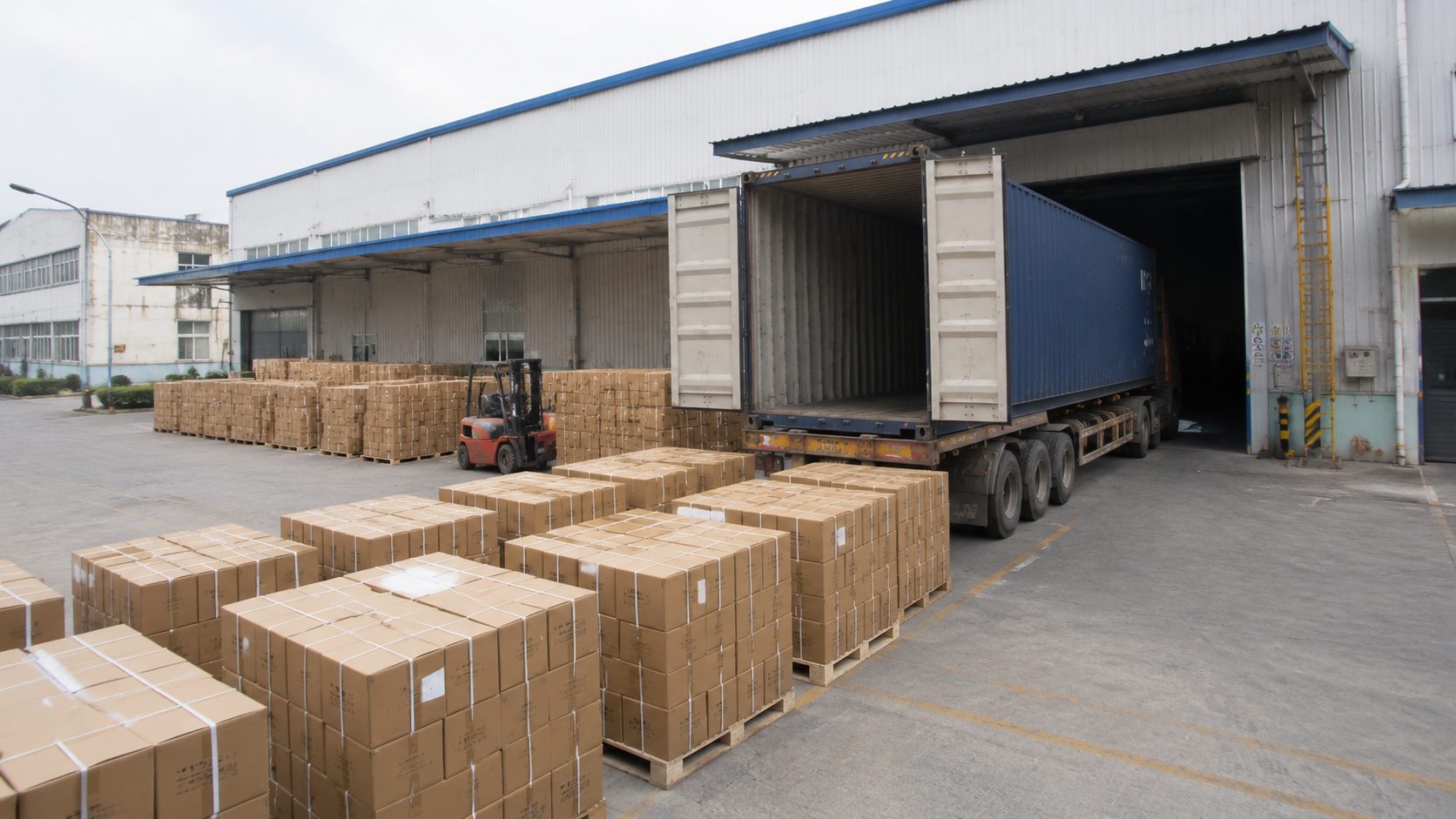
Before we quote freight, almost every new buyer asks the same thing: how many toilets in a 40ft container? The honest answer is a range, not a number — a 40HQ of one-piece toilets runs roughly 180 to 260 pieces, but the real figure swings with the bowl size, the carton, whether the load is floor-stacked or palletised, and what you put in the headroom above the toilet rows. Sanitary ware container loading is a puzzle of two ceilings at once — how much space the box has, and how much weight it may legally carry — and the mistake that costs money is planning against only one of them. This guide walks through both, gives working quantity ranges by product, and shows how to get a real load plan for your exact models instead of trusting a platform’s units-per-container figure.
Key takeaways
- The 40’s advantage over a 20 is volume, not weight. Both cap near 28 tonnes; a 40 simply gives you far more cubic metres, so it only pays off when your load runs out of space before it runs out of weight.
- Boxed sanitary ware usually cubes out on a 40HQ, but weights out on a 20GP or a dense mixed load. Always check both ceilings — space and tonnage — before you fix a quantity.
- Every number here is a range that depends on model and packing. Ask the factory for a load plan against your exact SKUs; never accept a generic “X pcs per container” that is usually someone else’s product.
01 THE BOX
What actually fits inside a 20GP, 40GP and a 40HQ
Start with the box, because every quantity later hangs off it. A standard 20ft (20GP) container gives about 5.90m of length, 2.35m of width and 2.39m of internal height — call it 33 cubic metres on paper. A standard 40ft (40GP) doubles the length to about 12.03m at the same width and height, so roughly 67 CBM. The 40ft high-cube (40HQ or 40HC) shares the 40GP footprint but is about 30cm taller inside — 2.69m — which lifts nominal volume to around 76 CBM. That extra top layer of height is the whole reason a 40HQ is the export standard for bulky boxed goods: it takes a final row of light basins a 40GP simply cannot.
Two cautions before you multiply anything by it. First, nominal is not usable. Once you allow for packing gaps, the taper of a stacked wall, corner loss and tops you cannot stack on, real cargo lands at roughly 85 to 90% of the nominal figure — so a 40HQ that reads 76 CBM should be planned as about 65 to 68 CBM of actual goods. Second, the door opening is smaller than the interior (about 2.34m wide and 2.58m high on a 40HQ), so an oversized crate that fits the inside may still not pass the doors.
Container internal size and real capacity
| Container | Internal L × W × H | Nominal volume | Practical volume (~85–90%) | Max payload |
|---|---|---|---|---|
| 20GP | ~5.90 × 2.35 × 2.39 m | ~33 CBM | ~28–30 CBM | ~25,000–28,000 kg |
| 40GP | ~12.03 × 2.35 × 2.39 m | ~67 CBM | ~58–60 CBM | ~26,000–28,800 kg |
| 40HQ | ~12.03 × 2.35 × 2.69 m | ~76 CBM | ~65–68 CBM | ~26,300–28,800 kg |
Notice the last column. A 40ft container carries only marginally more weight than a 20ft — both cap somewhere around 28 tonnes, often within a few hundred kilos of each other. The 40’s advantage over the 20 is almost entirely volume, not payload. Hold that thought, because it decides the single most important question in sanitary ware loading.

02 WEIGHT OR VOLUME
Does ceramic weight out, or cube out?
“Ceramic is heavy cargo, so weight tops out first” is a rule you will hear repeated, and for tiles it is exactly right. Flat, dense and solid, tiles stack tight — around 22kg per square metre for a 10mm tile means roughly 1,000m² already reaches the ~28-tonne payload while there is still volume for half as much again. Tiles weight out: the container is full by tonnage long before it is full by space.
Boxed sanitary ware behaves differently, and getting this right separates a real load plan from a guess. A toilet or a basin is hollow and bulky, riding inside a large foam-protected carton, so a 40HQ packed only with one-piece toilets weighs only about 11 to 16 tonnes in total — comfortably under the ~26-tonne payload. A pure-WC or pure-basin 40HQ therefore usually cubes out: it runs out of space long before it runs out of weight allowance.
So the factory rule is: check both ceilings, every time. On a 40HQ of standard boxed toilets and basins, volume is the binding limit. But weight becomes the limit the moment you (a) load a 20GP, where the small volume fills to near the tonnage cap easily; (b) skew the mix to dense, solid pieces — squat pans, thick pedestals, heavy floor-mount bases; or (c) consolidate sanitary ware with tiles, stone or mosaic in the same box. Sanitary ware is heavy cargo, and although a 40HQ of it usually fills by volume first, never load to volume without checking the tonnage — because on a 20GP or a dense mixed load, weight tops out first.
03 THE NUMBERS
How many pieces per 40HQ, product by product
Here are the working ranges we plan from. Read every one as an estimate that depends on the exact model and how it is packed — not a standard, and not a promise. The binding limit for all of these in a 40HQ is space, not weight, which is why the light, small pieces run into the high hundreds or thousands while a bulky cabinet is counted in low hundreds.
Typical loading quantity per 40HQ (ranges; depend on model and packing)
| Product | Typical per 40HQ | Packed weight each | Binding limit |
|---|---|---|---|
| One-piece toilet | ~180–260 pcs | ~38–55 kg | Cubes out |
| Two-piece toilet | ~220–340 sets | ~30–45 kg | Cubes out |
| Smart toilet | ~120–200 pcs | ~40–60 kg | Cubes out (bulky box) |
| Pedestal basin (set) | ~400–700 sets | ~22–38 kg | Cubes out |
| Countertop / art basin | ~600–1,200 pcs | ~12–25 kg | Cubes out |
| Wall-hung basin | ~500–900 pcs | ~15–28 kg | Cubes out |
| Vanity cabinet | ~100–250 units | ~25–60 kg | Cubes out hard |
Two things those numbers hide. A two-piece toilet packs more efficiently than a one-piece because the tank and bowl are flatter cartons that stack cleanly — the packed-weight and stacking difference is set out in our guide to one-piece vs two-piece toilets. And a smart toilet, despite similar weight, cubes out early because its box carries foam and electronics — see the smart toilet buying guide for importers. For a 20GP, halve these expectations: because bulky boxed goods cube out, a 20GP holds only roughly 45 to 50% of the 40HQ piece count, and for dense pieces it fills by weight, so the per-container economics are worse still.
A useful side effect: for most of these products a single full container equals or exceeds a typical minimum order, so “a full 40HQ” and “the MOQ” are often the same conversation — we keep the minimums and timelines in our MOQ and lead times guide and the quantities here.
04 THE VARIABLES
Six things that move the number
If two suppliers quote different piece counts for the same toilet, the gap is almost always in these variables rather than in the container itself. Carton method comes first: individual export cartons with foam corners (our standard — a 5-ply carton plus a poly bag, with colours getting six-sided foam) take more room per piece than bare or master-carton packing, but they are what protects the fragile rim and inner-bowl corners in transit. Floor-loaded versus palletised is the next big lever, worth its own section below. Model geometry matters more than buyers expect — nesting basins swallow far less space than boxy toilets, and whether a two-piece tank and bowl travel in one carton or two changes the maths.
Top-space fill is where a good loader earns the freight: light, small basins loaded on top of the heavy toilet rows use the 40HQ’s extra 30cm of headroom that would otherwise ship as air. The payload ceiling is the quiet override on all of it — the tonnage check that stops a dense load before the space runs out. And wooden crates or frames for fragile art pieces add both volume and weight, cutting the piece count in exchange for protection. Change any one of these and the number moves; change three and two “identical” quotes can differ by 20%.
Ask for carton dimensions and gross weight per model
The only inputs that turn a guess into a plan are the carton’s outer dimensions and its gross packed weight, per model. With those two numbers the factory can calculate total CBM and total tonnage for your exact quantity, pick the right container, and confirm it clears both the payload and the door opening. Ask for them at quotation stage — they cost nothing then and settle every argument later.
05 BULK OR PALLET
Floor-loaded or palletised — the real tradeoff
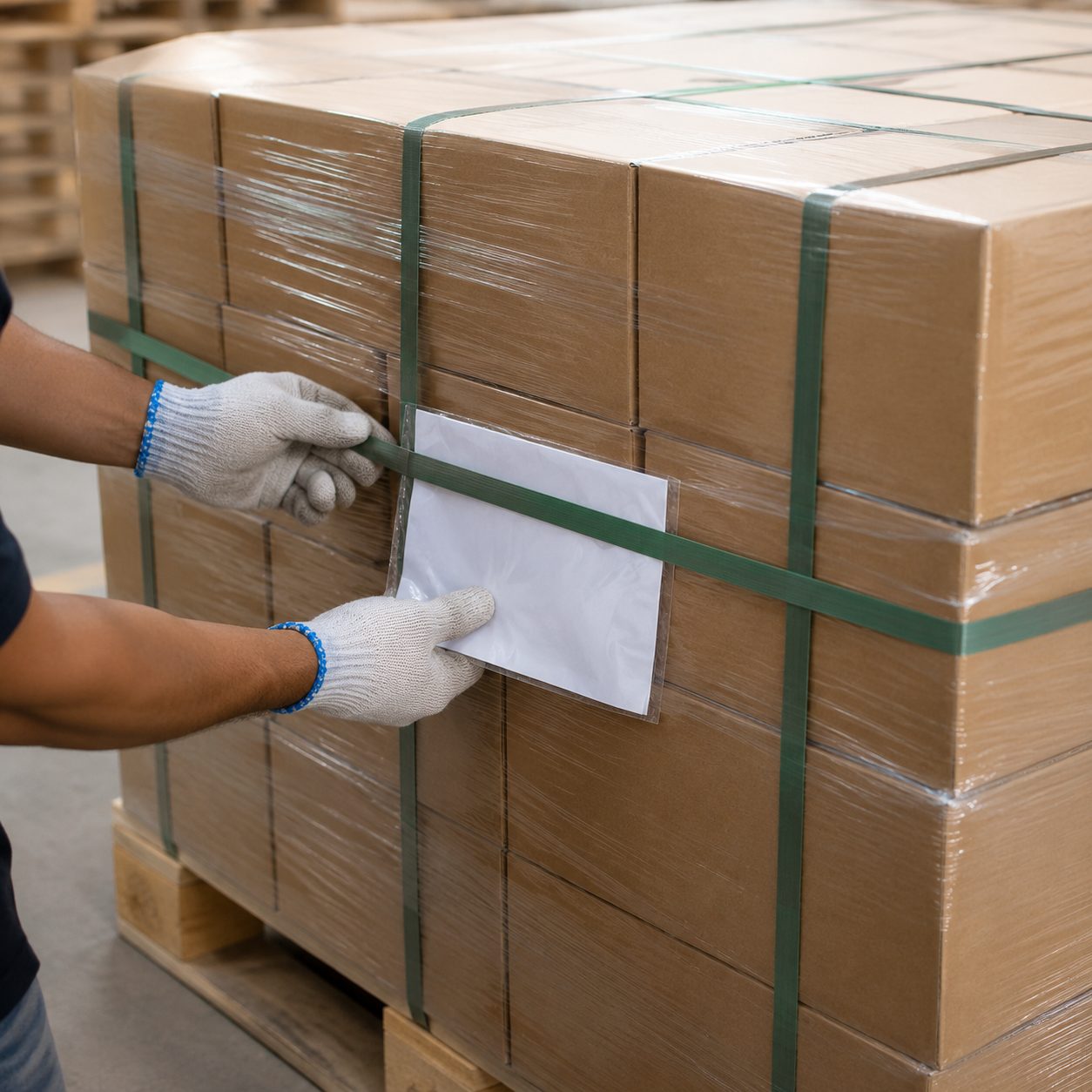
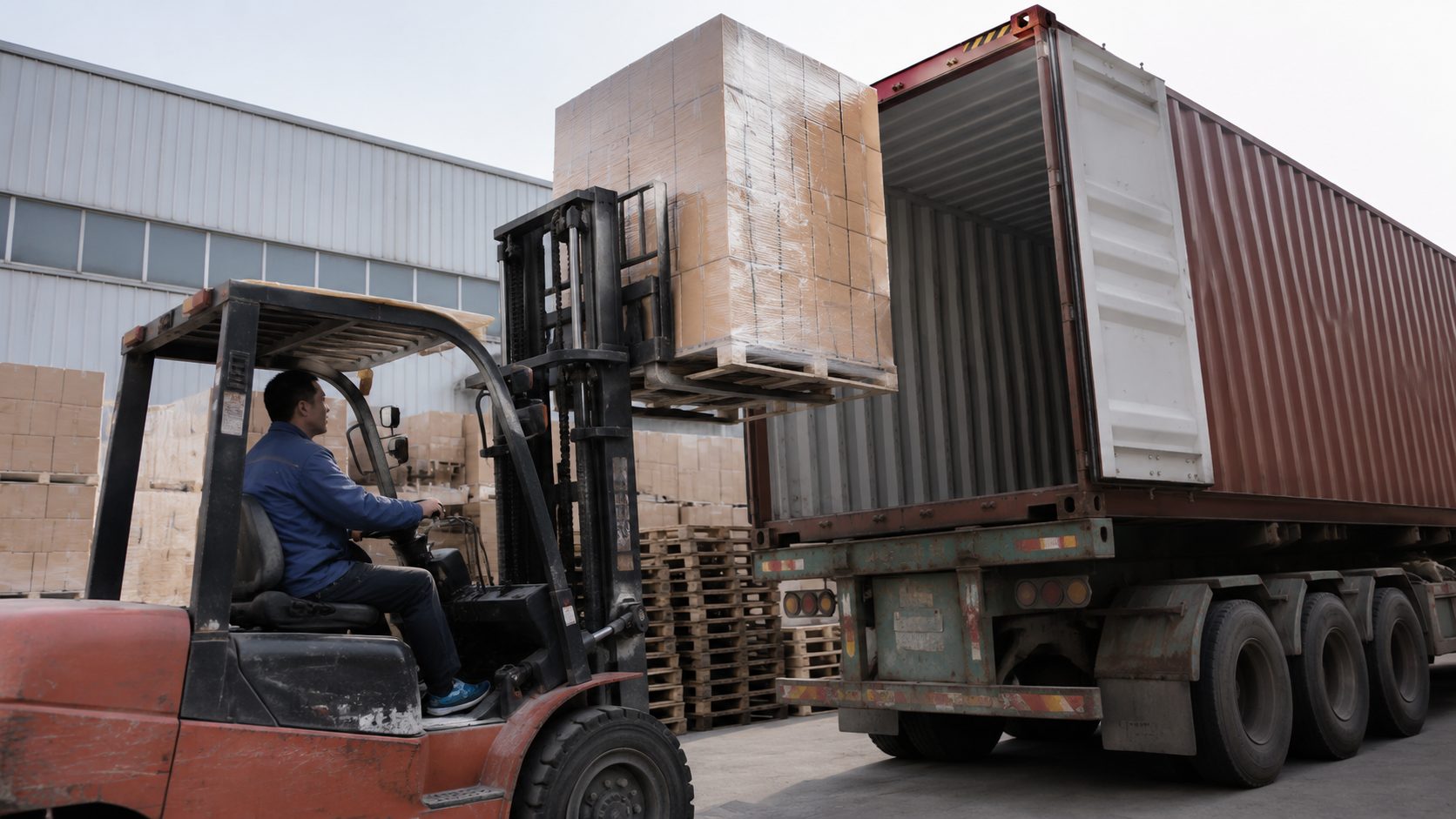
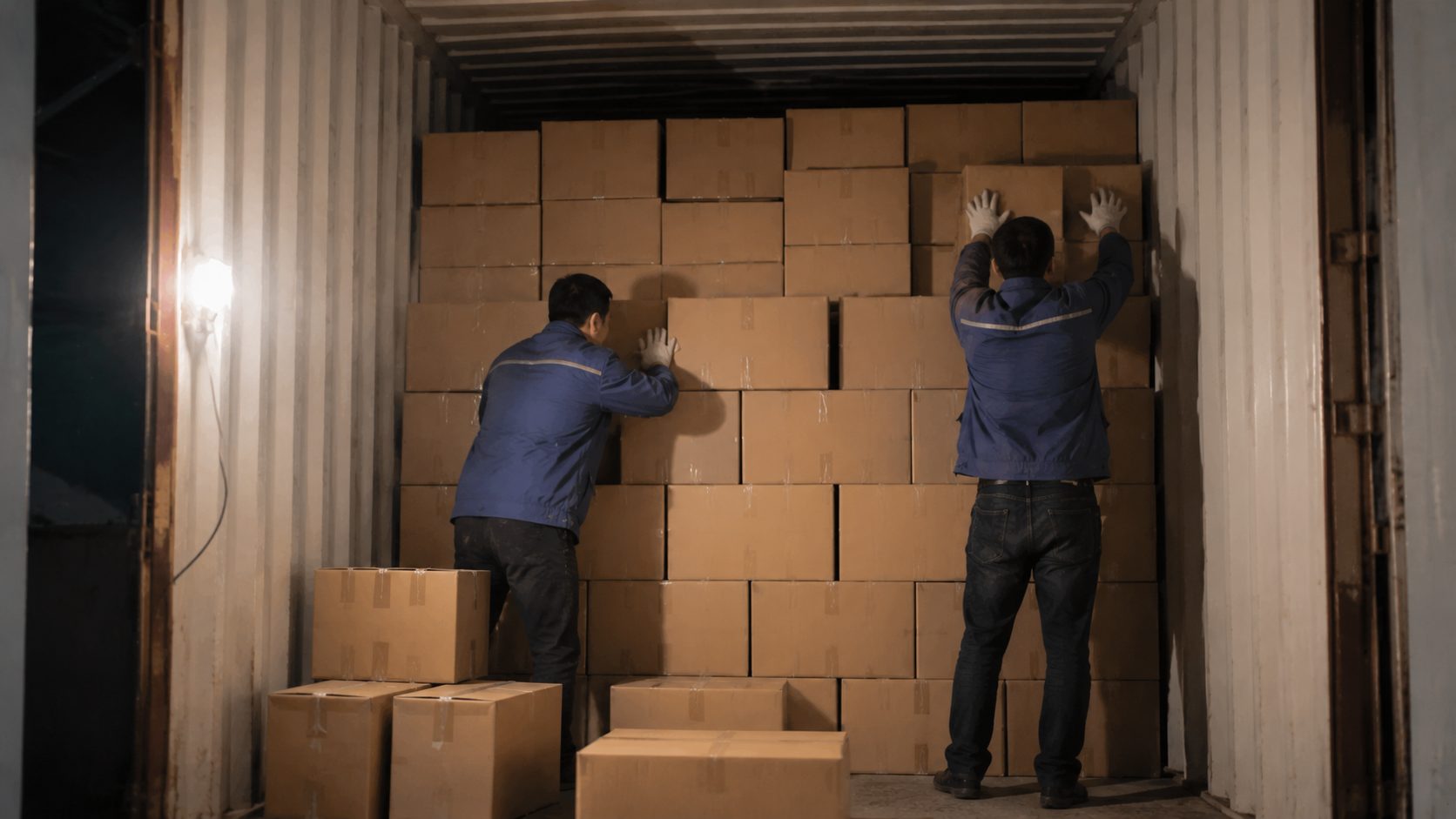
Floor-loaded (hand-stacked, bulk) packing uses the space best. Cartons are built into a tight interlocking wall with no pallet voids, which puts the most pieces in the box and the lowest freight cost on each one. The price is time and labour to load, a higher handling-damage risk on fragile ceramic, and a slower hand-unload at the far end. Palletised packing reverses every one of those: forklift-friendly, fast to load and unload, more secure against in-transit shifting — but pallets waste space (the load is sized to the pallet, with gaps between them and the pallet’s own height), so you fit fewer pieces, and you pay for the pallets in both weight and cost.
Our default for ceramic is floor-loaded with foam corner protection, for a specific reason: the fragile points on a basin or a toilet — the rim, the inner-bowl corners, the basin edge — are protected by the carton and its foam, not by the pallet. Floor-loading lets that protected carton fill the container tightly and safely. We palletise when the buyer’s warehouse is forklift-only with no hand-unload labour, or for very high-value art pieces where a crate on a pallet is the safer bet. It is a piece-count versus handling-safety decision, and the right answer depends on your destination warehouse, not on a rule.
06 MIXED LOADS
Mixing toilets, basins and cabinets in one container
Few real wholesale orders are a single SKU, and mixing is usually the smart move. A consolidated container lets you balance the two ceilings on purpose: heavy toilets go on the bottom and the floor, light basins and cabinets fill the headroom, and cartons of different sizes interlock to kill the voids a single-product load leaves behind. Cabinets in particular cube out hard and pair well with dense ceramic — more on those in bathroom vanity cabinets from China.
A mixed container is how a buyer reaches full-container economics without ordering a full container of one item — heavy on the floor, light in the roof, and nothing shipped as air.
Mixing also ties to your order size: consolidating several products is how a buyer hits FCL pricing without meeting the MOQ on any single line. Two housekeeping points, though — the weight has to sit evenly across the floor for the container’s rating and for road limits at the destination, and the heavier the ceramic, the more the tonnage check matters even in a mixed box. If you are furnishing whole projects, the same logic scales up in our guides to supplying hotels and apartments and bathroom products for apartment projects.
07 FCL OR LCL
FCL or LCL — and 20GP versus 40HQ
For a trial or a first order of a few cubic metres, LCL — sharing a container — is usually cheaper than paying for a whole box. The rough break-even is around 15 CBM: below roughly 12 to 15 CBM LCL tends to win, above about 15 CBM a full 20ft container almost always does, and the 12–20 CBM band is a genuine grey zone where you should get both quotes and let the route and season decide. One honest warning for ceramic specifically: LCL is priced on revenue tons — per CBM or per tonne, whichever is greater — so a small, heavy sanitary ware shipment can be charged on its weight, not its volume, which quietly erodes the saving. Always compare door-to-door, because LCL also carries higher destination handling fees per CBM.
When you do fill a container, the 20GP-versus-40HQ choice comes back to one question: does this mix weight out or cube out? For bulky boxed sanitary ware that cubes out, the 40HQ gives the best freight per piece — you actually use the volume, and the high-cube’s extra height buys a top layer of light basins. But for a load skewed to dense, solid goods that weights out, a 20GP can be the smarter box: you hit the tonnage cap in half the space, and a 20GP carries nearly the same weight as a 40 at lower freight, so a 40 would sail half-empty by weight. Ask the factory to run your list both ways before you book.
08 THE LOAD PLAN
How to get an accurate container quantity — before you order
Never accept a bare “X pieces per container” — it is almost always someone else’s product, someone else’s carton and someone else’s packing method. To get a number you can plan freight and cash around, send the factory three things: your exact model list with quantities (or a target), the destination port, and any pallet or warehouse constraint. In return you should get carton dimensions and gross weight per model, total CBM and total weight, a recommended container (20GP, 40GP or 40HQ), a floor-load-versus-pallet recommendation, a stow plan, and written confirmation that the load clears the payload and the door dimensions.
One more step belongs in the plan: loading supervision. Having someone watch the actual stuffing — checking the count, the packing and the stow as the container fills — sits naturally alongside your pre-shipment quality check, which we cover in how to inspect sanitaryware before shipment.
Send the factory this, get a real load plan back
Your exact model list and quantities (or target); destination port; any pallet or forklift-only warehouse constraint; whether you want floor-loaded or palletised. Ask back for: carton outer dimensions and gross weight per model; total CBM and total tonnage; recommended container size; a stow plan; confirmation it clears payload and door opening; and, for mixed loads, how the weight is distributed across the floor.
As a Chaozhou-based ceramic sanitary ware factory — not a trading company — we load toilets, smart toilets, basins, art basins, pedestals, urinals and vanity cabinets for export every week, floor-loaded with foam corner protection as standard and palletised on request. Tell us your model list, your quantities and your destination port, and we will come back with the CBM, the tonnage, the right container and a stow plan for your exact goods — plus a wholesale quotation. Because the price per piece falls once a load is efficient, our ceramic wash basin price guide is a useful companion. WhatsApp +1 213 216 0960.

How many toilets fit in a 40ft container is never one number — it is a range that moves with the model, the carton and the packing, bounded by two ceilings at once. Plan against both space and weight, fill the headroom, decide floor-load versus pallet on your warehouse, and get a stow plan for your exact models before you book. Do that, and the container leaves full, legal and freight-efficient — which is the whole point.
FAQ COMMON QUESTIONS
Frequently asked questions
How many toilets fit in a 40ft container?
It is a range, not a fixed number. A 40HQ holds roughly 180 to 260 one-piece toilets, about 220 to 340 two-piece sets, or around 120 to 200 smart toilets — all depending on bowl size, carton dimensions, whether the load is floor-loaded or palletised, and how the headroom is filled. Boxed sanitary ware usually cubes out (runs out of space) rather than weighting out, so volume is the binding limit. Always ask the factory for a load plan against your exact models rather than trusting a platform's units-per-container figure.
Does a 40HQ hold more than a 40GP?
Yes, but it only helps if you cube out. A 40HQ shares the 40GP footprint but is about 30cm taller inside (2.69m vs 2.39m), giving roughly 13% more nominal volume (about 76 vs 67 CBM). Their weight limits are almost identical (both near 28 tonnes). So for bulky sanitary ware that fills by volume, the high-cube's extra layer of height takes a top row of light basins and is well worth it; but if your load weights out, the extra volume does nothing for you.
Is sanitary ware weight-limited or volume-limited when shipping?
It depends, and you should check both. A 40HQ of standard boxed toilets and basins usually cubes out — it runs out of space long before it reaches the tonnage cap. But on a 20GP, or on a load skewed to dense solid pieces (squat pans, thick pedestals) or consolidated with tiles or stone, it weights out instead. The working rule: ceramic is heavy cargo, a 40HQ of it generally fills by volume first, but never load to volume without checking the tonnage.
Floor-loaded or palletised — which is better for ceramic?
Floor-loaded fits more: cartons build into a tight interlocking wall with no pallet voids, giving the most pieces and the lowest freight per piece — at the cost of slower loading and unloading and a higher handling-damage risk on fragile ceramic. Palletised loads and unloads faster and resists in-transit shifting, but pallets waste space and add weight and cost, so you fit fewer pieces. Most Chinese sanitary ware ships floor-loaded with foam corner protection, because the rim and inner-bowl corners are protected by the carton, not the pallet. Palletise when your warehouse is forklift-only or for very high-value pieces.
When is LCL cheaper than a full container?
The rough break-even is around 15 CBM. Below roughly 12 to 15 CBM, LCL (sharing a container) is usually cheaper; above about 15 CBM a full 20ft container almost always wins; and 12 to 20 CBM is a grey zone where you should get both quotes and let route and season decide. Watch one thing with ceramic: LCL is priced on revenue tons (per CBM or per tonne, whichever is greater), so a small heavy sanitary ware shipment can be charged on its weight, eroding the saving. Always compare door-to-door, since LCL also carries higher destination fees.
How do I get an accurate container quantity for my order?
Send the factory three things: your exact model list with quantities (or a target), the destination port, and any pallet or warehouse constraint. You should get back carton dimensions and gross weight per model, total CBM and total weight, a recommended container size, a floor-load-versus-pallet recommendation, a stow plan, and written confirmation the load clears the payload and the door opening. Pairing loading supervision with your pre-shipment inspection keeps the whole step honest.